
Acts of War: Aftershock – Dramatis Personae Part I

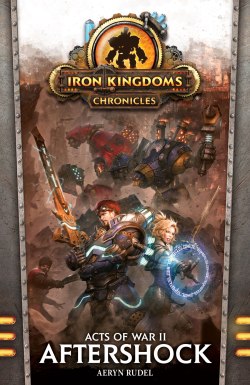
Here we are in week twenty-three, and Acts of War: Aftershock is in editing and will soon be heading off to the printer. At this point, beyond a bit of promotion, my work on the book is done. So, like I said last week, these updates will change quite a bit and will essentially be sneak peeks, including excerpts, art, and other goodies. This week, I’m going to kick off a three-part series and talk about the characters in Aftershock, broken down into main POV characters, secondary POV characters, and supporting characters.
So let’s get to it.
Main POV Characters
We’ll kick off this series with the characters through which the story is (mostly) told. These are the heroes and protagonists of Aftershock, and they get the lion’s share of POV time. For those of you familiar with the Iron Kingdoms, these names will be well known to you, for those unfamiliar, well, let me introduce you.
Lord General Coleman Stryker
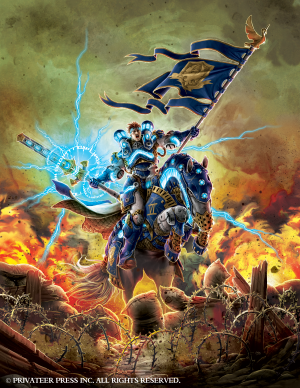
Stryker is essentially the main character of Aftershock, though he shares the stage a bit more in this book than he did in Flashpoint. The commanding officer of the Storm Division and the highest ranking warcaster in Cygnar, Coleman Stryker embodies the strength and fighting spirit of his nation. At thirty-six years old he is relatively young for such a high-ranking position, but he has been at the forefront of the near ceaseless conflict that has consumed the Iron Kingdoms over the last seven years and has battled Cygnar’s enemies across western Immoren since he began service at eighteen.
Stryker currently leads the invasion force sent to drive Khador from the nation of Llael, and this is familiar ground for the veteran warcaster. He was at the forefront of Cygnar’s efforts to defend its longtime ally when Khador first invaded Llael in 605 AR. Cygnar was eventually forced to abandon Llael to defend their own borders, leaving that kingdom mired in occupation. Stryker understood the need to protect Cygnar first and foremost but saw it as a grave mistake to leave Llael unsupported for so long, a decision which only strengthened Khador. Stryker was himself soon swept up with the grueling Caspia-Sul War against Cygnar’s formidable eastern enemy, The Protectorate of Menoth, a conflict which tested Stryker’s convictions.
Stryker was a trusted advisor and friend to the former king of Cygnar, Leto Raelthorne, having helped this man secure his throne. Fifteen years later, when the king abdicated the throne to his nephew Julius to end a devastating civil war, Stryker found himself an outsider in the new king’s council. Julius sees Stryker as a remnant of his uncle’s rule, a worthy general and weapon in the army’s arsenal but not the king’s champion. Julius put his trust in Asheth Magnus instead, a formerly exiled warcaster who had once supported Leto’s brother, the tyrant Vinter Raelthorne IV, before helping Julius secure his throne. Stryker and Magnus have a long and troubled history and the restoration of a man Stryker still views as a criminal further strains his relationship with the new king.
In battle, Stryker is a fearsomely gifted warcaster and one of Cygnar’s most respected warriors. His soldiers follow him unquestioningly into battle, secure in the knowledge their lord general will be fighting alongside them. With his massive battle blade Quicksilver, he can hew through enemy troops or the armored hulls of warjacks with ease. Stryker commands a host of lightning-based spells and abilities, unique and iconic to the Storm Division he leads. His personal warjack, an aging Ironclad named Ol’ Rowdy, is one of the most formidable warjacks in the Cygnaran Army, and the pair can often be seen leading from the front, bringing destruction to Cygnar’s enemies with blasts of lightning and the shuddering impacts of mechanikal blade and quake hammer.
Major Asheth Magnus
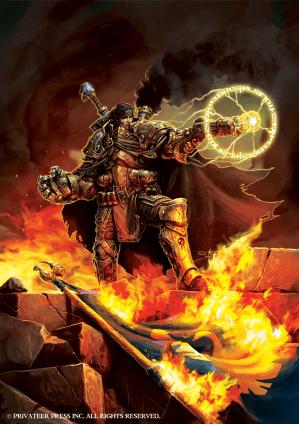
Exiled with King Vinter Raelthorne years ago, Asheth Magnus was one of the most prominent warcasters and battle leaders under Vinter’s despotic rule. He escaped justice during Vinter’s defeat, an event known as the Lion’s Coup, though not without consequences. Prior to that conflict Magnus had taken under his wing a young emerging warcaster named Coleman Stryker, then a member of the Royal Guard. Despite his efforts to guide him, Stryker betrayed Magnus during the Lion’s Coup, joining the cause of the king’s younger brother, Leto. In this fight Stryker severely injured Magnus, crushing his right arm and leg beneath a toppled warjack. At the end of the coup Magnus was offered a pardon but refused, going into exile to lead an armed resistance against Leto, for which he was branded a criminal and traitor.
Meanwhile, Vinter escaped imprisonment and fled into the eastern wastes, promising one day to return. Magnus spent more than a decade plotting against King Leto and working against him whenever possible. Exploiting his military knowledge Magnus became a mercenary warlord. He used his considerable warcaster talents and genius for mechanikal improvisation to muster an army of warjacks and sell-swords, earning coin and gaining allies against Cygnar. His loyalty to Vinter was shaken and then shattered when his former liege returned to the west alongside foreign allies and had the warcaster tortured after Magnus questioned the wisdom of his plans.
The love Magnus once held for Vinter became bitter hatred, ultimately leading to Vinter’s downfall. Magnus had a secret he had concealed: he had found and soon secured Vinter’s bastard son, Julius, and began training the boy to take the throne of Cygnar. When Vinter made his move against Leto, rallying his former supporters, Magnus and Julius led a third army, comprised of the warlord’s mercenaries, which tipped the balance and played a key role in the final battle in this civil war. Fighting alongside Stryker for the first time in many years, Magnus struck the killing blow against Vinter Raelthorne. To avoid further bloodshed, King Leto abdicated the throne and installed his nephew Julius as the new king of Cygnar.
Magnus had no official role in Julius’ court until an heir to the Llaelese throne was found, brought to Cygnar, and betrothed to Julius Raelthorne. Eager to make his mark and seeing a chance to restore Llael and see it eventually joined to Cygnar for his own heirs, the young king order an invasion of Llael to drive out the Khadoran invaders and put his new queen on the throne. He chose Lord General Coleman Stryker to lead this “liberating” army but also brought Asheth Magnus back to the capital and made him a Cygnaran officer once again. Magnus would accompany Stryker into Llael and serve as the king’s eyes and ears.
Magnus is coldly pragmatic warrior, and was infamous for sacrificing troops in battle if he saw a tactical advantage in doing so, and also being utterly ruthless to his enemies. He is cunning, ferocious, and gifted with a military mind second to none. His relationship with Stryker is complicated. While the lord general has nothing but disdain for a man he considers a traitor and worse, Magnus still holds some hope his former pupil might realize the hard truths Magnus tried to teach him when he first recognized Stryker’s gift decades ago.
Marshal Ashlynn d’Elyse

The only daughter of Llaelese noble and renowned master duelist Benoir d’Elyse, Ashlynn d’Elyse was destined to be a great warrior and swordsman like her father. When her arcane abilities manifested, she earned a place at the Royal Arcane Academy, and became one of Llael’s few warcasters.
Her full potential as a warcaster was realized on the front lines when Khador invaded Llael, and she quickly became known among her enemies and allies as a fearsome warrior and battle leader. The execution of her father and many other nobles after the fall of the capitol city of Merywyn only made her more determined and ruthless.
When Cygnar withdrew its aid and Llael fell, Ashlynn fought on, offering her services as a mercenary to fund a growing rebellion. The Resistance has long been a thorn in the side of the Khadoran occupiers, and Ashlynn d’Elyse and her warcaster abilities are behind much of the damage caused by the Llaelese freedom fighters.
When Cygnar invaded Llael to drive out Khador under their new king Julius Raelthorne, the Resistance was not a large part of their plans. Much of this was because of the Resistance’s relationship with the Protectorate of Menoth, a nation of zealots whose interests often put them at odds with Cygnar. Ashlynn resents Cygnar’s invasion of her lands and sees them as little better than the Khadoran occupiers they are attempting to remove, and she largely rejects Lord General Stryker’s aim to be a liberator rather than the leader of an invasion force. She has been here before and has seen the Cygnaran Army abandon her nation to defend its own interests when Khador first invaded Llael in 605 AR. She believes Llael cannot rely on Cygnar if they are to cast off the yoke of Khadoran oppression, so she and the Resistance fight on, against Khador and any who would stand in the way of a free Llael.
Ashlynn is one of the most feared swordsmen in western Immoren, a skill further enhanced by her warcaster abilities and her deadly mechanikal blade Nemesis. She has mastered traditional Llaelese dueling styles and there are few other warcasters who could hope to defeat her in a one-on-one confrontation. Ashlynn is also a gifted military leader with vast knowledge of tactics and stratagems that has allowed her to defeat larger and better-equipped enemies time and again. Ashlynn’s skill, bravery, and devotion to her nation have endeared her to the Llaelese people and especially the desperate freedom fighters of the Llaelese Resistance.
If you have a question or comment about the book or my writing process, ask away in the comments section below. And if you’ve missed the updates for the previous weeks, you can find them right here:
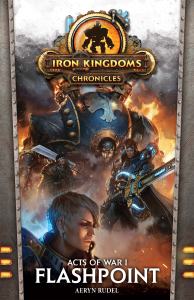
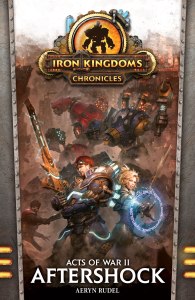
Acts of War: Aftershock is available for preorder in print and digital from Amazon, and you can buy and read the first book in the series, Acts of War: Flashpoint, right now.
“On a Black Tide” Excerpt & Free eBook!

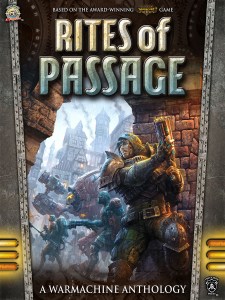
A few years ago, I wrote a novelette called “On a Black Tide” for Privateer Press, which was included in an anthology of novelettes called Rites of Passage. Privateer Press has given me permission to post an excerpt from “On a Black Tide” and to tell you that you can download the entire novelette from Amazon for free for the next five days. In addition, Rites of Passage is now available from Amazon in print. The anthology is a fantastic introduction to the steam-powered fantasy world of the Iron Kingdoms and features stories by some great authors, including Douglas Seacat, Darla Kennerud, Matthew D. Wilson, Oren Ashkenazi, William Shick, and some dude who runs a blog about rejection. 🙂
Here’s the cover and back cover text for “On a Black Tide.”
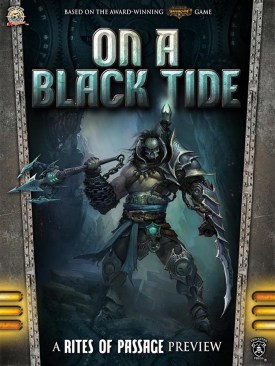
They say the waters of Cryx run black with ancient evil . . .
In the port city of Blackwater, deep in the heart of the Nightmare Empire, life is short and brutal. Murderous gangs rule the streets and surviving to adulthood means being more vicious and uncompromising than those around you. The only hope of escaping the gang-infested streets is to join one of the many pirate vessels that launch raids from Cryx against the mainland.
For Aiakos, a strong yet undisciplined street thug, the opportunity to join the pirate ship Scythe in a trial by combat is the chance of a lifetime. But as he soon discovers, fighting his way onto a Cryxian pirate vessel is only the beginning of the bloodshed.
When the Scythe is drawn into the schemes of the powerful Satyxis Admiral Axiara Wraithbane, Aiakos once again has a chance to improve his station . . . or die trying.
The novelette “On a Black Tide” is a preview of Rites of Passage, a novel-length collection featuring five additional tales about the grueling trials of novice warcasters in the Iron Kingdoms.
Blackwater, Late Summer, 605 AR
Aiakos watched the Scythe limp into port like a great, wounded beast. The thick ironwood planks of its hull were shot through in many places, and the ship sat low—too low—in the water. Its main mast was gone; only a cracked six-foot stub remained where the massive beam had once stood proud and straight. Rigging and torn sails lay in a tangled snarl on the decks. The ropes had soaked up blood leaking from dozens of broken bodies, turning them pink so they looked like great heaps of intestines. The paddle wheel and the steam engines that powered it were intact; otherwise, Aiakos surmised, the Scythe would be at the bottom of the Meredius.
“That’s Bloodbrine’s ship,” Dasko said, pointing his dirk at the lumbering pirate galleon. “Shot to hell and gone, looks like.”
Aiakos nodded. “Just like Baros said. He’s headed for our pier.” He took a few steps down the pier as the Scythe came to a stop and the few men on her deck cast hawsers to waiting sailors on the pier. Once the ship was moored, its surviving crew shuffked down the gangplank. Every one of them bore some injury, mostly deep cuts and bullet wounds, the mark of pistol and cutlass.
“That he is,” Dasko said. “Baros had good information. That’ll earn him a few more coins.”
Aiakos glanced back at the gang leader, who was now worrying a bit of meat from his teeth with the point of his knife. Behind Dasko twenty of their best lads waited, clubs and knives in hand. He and Dasko had run the Quay Slayers for the last five years. They’d both joined the gang as a means of survival. Aiakos had been forced onto the brutal streets of Blackwater at eleven, Dasko at twelve. This was the way of things in Cryx. Once a child was deemed old enough, he was forced to fend for himself. The only real way to avoid death was to join one of the countless street gangs and learn to be as vicious and cruel as everything else in Blackwater.
What remained of the Scythe’s crew had now disembarked, and the captain himself, Grivus Bloodbrine, was making his way down the gangplank. Captain Bloodbrine was tall, gaunt, and hollow-cheeked. His clothes, although of fine make, were spattered with blood and scorched, and he cradled one arm against his chest, bloody bandages shrouding the limb completely.
Aiakos made his way down the pier, pushing through the line of injured sailors leaving the Scythe. Bloodbrine saw him coming and put his good hand on the heavy pistol shoved into his belt. This was how most people greeted Aiakos—with suspicion and an expectation of violence. Aiakos was large and strong, and he’d earned a reputation as a formidable fighter: relentless, uncompromising, and brutally skilled. He approached the captain slowly, his own weapons—a whaler’s harpoon balanced over one shoulder and a long flensing knife at his hip—at the ready but not overtly so.
“And who might you be?” Captain Bloodbrine called out.
“I am Aiakos, second in the Quay Slayers. You’re moored on our pier, Captain.”
Bloodbrine smiled. “Is that so?”
“It is,” Aiakos said. “But your ship is in bad shape, so we’re willing to let you remain here and offer our protection.”
“What would I need protecting from?” Bloodbrine asked, tapping the butt of his pistol with one finger. Behind the captain another member of his crew had come down the gangplank. She wore closefitting leathers and carried a brace of pistols across her chest. She held a gaff pole in both hands, its blade hooked and gleaming. Unlike the other members of the Scythe’s crew, this woman bore only superficial signs of combat—torn clothing and a few scrapes. The fact that she was uninjured meant either she’d avoided the fighting or she was very good at it. By the way she carried herself, Aiakos assumed the latter.
“Aiakos here says we’re on his pier, Nyra,” Bloodbrine said as the woman came up beside him. “What do you think of that?”
Nyra stared at Aiakos with cold, appraising eyes, her face unreadable. “Pay him what he wants. Someone has to watch the ship while repairs are made,” she said, then pushed past Aiakos.
“My first mate says pay you,” Bloodbrine said. His smile soured. “But what if I’ve got twenty fighters waiting in the hold to protect what’s mine?”
Aiakos glanced up at the decks of the Scythe and quickly counted thirty bodies; there were likely more in the hold. Bloodbrine was in a bad position and vulnerable. The pirate captains were certainly a notch up on the food chain over the street gangs, but any wounded beast was likely to attract scavengers. Aiakos took the risk, weighing his words carefully to imply the threat. “You don’t, or some of them would be with you now. We’ll make sure the shipwrights do their work without interruption while you fill out your crew.”
Bloodbrine grimaced and then spat. He knew his vulnerability was obvious, and in Blackwater that meant he was prey. “How much?”
“Twenty gold crowns a day,” Aiakos replied. “I’ll take today’s payment now.” He held out his hand.
Bloodbrine shook his head and dug into one of the pouches hanging from his belt. He pulled out a handful of gold coins and shoved them at Aiakos, who dropped them into his own pouch.
“Good,” Aiakos said. “Have someone here with the next payment tomorrow at the same time.”
“Do you think you could keep them off the ship?” Bloodbrine nodded at something over Aiakos’ right shoulder. He turned and saw a trio of awful figures moving down the pier. The necrotechs were bulbous, fleshy things upon a tangle of metal spider-like legs. They moved toward the Scythe, a small mob of shambling thralls in their wake. The undead masters of necromechanika were always on the lookout for fresh supplies. Word had obviously reached them that the Scythe was, for the moment, a floating abattoir.
Aiakos suppressed a shudder as the necrotechs approached. The undead were part of everyday life in Blackwater, but most of the living stayed out of their way lest they, too, be considered raw materials for the flesh foundries. Some in Blackwater saw undeath as a way to accumulate power and rise in station; certainly the armies and navies of Cryx contained powerful undead, not to mention the almost god-like power of the lich lords who controlled everything. To Aiakos, though, the thought of surrendering breath and blood for the cold eternity of undeath was abhorrent. Worse yet was that many were thrust upon that path unwillingly, robbed of their free will to serve as mindless and disposable cannon fodder.
“No,” Aiakos said and stepped out the way of the necrotechs and their thrall servitors. The rotten stink of their passing made his eyes water and his gorge rise. “They always take what they want.”
Bloodbrine watched the necrotechs clamber aboard his ship, their spidery legs making a dull metallic clacking noise as they scuttled across the main deck. “The shipwrights will be here tomorrow, after they’ve”—he jerked his head toward his ship—“taken what they want.”
Thralls had already begun to drag the dead from the Scythe, leaving bloody smears across the pier. Many of the corpses were in various states of dismemberment, as the necrotechs cut away the burnt and mangled pieces, leaving the choicest bits intact.
Aiakos nodded, then turned and walked back to Dasko. Bloodbrine remained, watching the necrotechs with a scowl. Aiakos felt a twinge of sympathy for the captain, a well-known and powerful pirate now forced to stand by and watch the real power in Blackwater take what it wanted from him.
“What did he say?” Dasko said as Aiakos approached.
“He agreed. Twenty per day,” Aiakos replied.
Dasko smiled and rubbed his hands together. “The lads were hoping for a bit of sport, but I’d just as soon have the money without a fuss. Hand it over.”
Aiakos dug the coins from his pouch, counted out his cut, and passed the rest to Dasko without a word.
“We talked to a few of Bloodbrine’s men as they passed,” Dasko said. “He’ll be looking for replacements. They’re gathering at the Black Hold. Should be quite a spectacle.”
Pirate captains looking to replace men lost in battle often announced their intentions and gathered potential recruits into one of the many fighting pits around Blackwater. There, the poor and desperate would fight one another, sometimes to the death, for a chance at a life at sea. Crewing a pirate vessel was not exactly easy work, but the chance to get off Blackwater and at least have the opportunity to amass wealth and prestige was often considered enough to die for.
Aiakos was no stranger to the fighting pits. He fought regularly, both to earn extra coin and to keep his battle skills honed. His many victories only enhanced his reputation among the Quay Slayers and the rival gangs they often battled. “I’ll meet you there,” Aiakos said and walked past Dasko. He turned and looked at the Scythe. The ship was swarming with activity as more thralls arrived to cart away the dead. Beyond the ship was the Meredius, its waters stretching to the horizon in a flat, grey expanse. To Aiakos the sea looked like a blank slate, pure and filled with untold possibilities. He turned back to Blackwater, grimaced, and pressed on.
If you’d like to read the rest of the story, you can download “On a Black Tide” from Amazon absolutely free for the next five days. And if you dig my little tale of piracy, undead, and general mayhem, you should absolutely check out the other five stories in Rites of Passage, also available in eBook and print formats from Amazon.

Alien: Covenant – A Review
Let me start this review by stating that Alien is perhaps my favorite film of all time, and Ridley Scott is my favorite director, so there was a decent chance I would come out my viewing of Alien: Covenant happy with what I’d seen. As a horror writer, I’ve drawn a lot of inspiration from Alien, and I hoped Alien: Covenant would be similarly inspiring.
With that out of the way, here’s the spoiler free part of this review. In my opinion, Alien: Covenant is a good film, not a great film, but a solidly entertaining one that doesn’t shame (much) the truly great movies in the franchise. It has some issues, which I’ll get into in more detail below, but as sci-fi horror goes you’d be hard-pressed to find a better film in the last ten years (one of you will almost certainly remind me of a better one I’ve forgotten). If I had to give it a letter grade, I’d give it a solid B. On a star scale, 3.5 stars out of 5.
Okay, now on to the review proper. I’m going to assume that everyone knows the plot of the film by this point. I mean, there were only like, what? Thirty separate previews of this movie? If you do need a summation of the film’s plot, just head on over to Wikipedia, where you’ll find a good one.
Oh, lots and lots of spoilers ahead. Obviously.
Things I Liked:
- Visually stunning. Ridley Scott has a knack for making films that are beautiful to look at, and Alien: Covenant does not disappoint in this department. From the sweeping natural vistas of the Engineers’ planet to the gloom-shrouded necropolis where David exterminated them, there is a haunting majesty to the whole thing.
- Music. I’m pretty sure a lot of the music is lifted straight from Alien, and at first I thought that might bother me, but, in the end, it’s just a good score, and I didn’t mind hearing it again. Certainly, there are new pieces, but the old music invoked a pleasant sense of nostalgia and was as effective at conveying urgency and terror as it was in Alien.
- David: The android David is an effective villain, and he’s played to perfection by Michael Fassbender. He’s a cross between HAL 9000 and Hannibal Lecter, and his ghoulish laboratory in the dead Engineer city is one of the most horrifying part of the film. One of the best things about Covenant, is that it looks like David is going to be a prominent villain going into the next movie(s). I’m all for that.
- The Neomorph. Good god, these things were gnarly. These proto-aliens, which are sort of precursor to the Xenomorph we all know and love, are created when spores from fungus-like pods in the corrupted biosphere of the Engineers’ planet enter a human host. They gestate quickly and burst out of their host pretty much anywhere that’s convenient. In the film we see one tear it’s way out out of a man’s back and another come out of a victim’s mouth. The birthing sequence is far worse than the traditional chest-burster, as the neomorph is born in a pink amniotic sack that looks a lot like a massive length of intestine. It’s gross in the best possible way. The adult Neomorph is even better, with its sickly white skin, weird clicking and chirping noises, and a bulbous head that seems to lack a mouth until the thing decides to literally chew someone’s head off. The Neomorphs are scary in the way the original Xenomorph was. They’re weird, completely alien, and just kind of awful to look at (in a good way).
- Some of the crew: Certain members of the crew were great. For starters, Danny McBride’s Tennessee was a very pleasant surprise. McBride showed a range with his acting that, frankly, I didn’t think he possessed. I would very much like to see him do more dramatic roles. Katherine Waterson’s Daniels is also very good. At first blush, you might think she’s simply a Ripley clone, but she isn’t. There’s a depth to her character that Ripley lacked in Alien (though she gained it in Aliens). Her motivation is different from Ripley’s as well, and it goes beyond simple survival. Finally, Michael Fassbender in his dual role as the android Walter and David, the older version of the same android, is probably the best performance in the film. Fassbender’s ability to play them in a way that makes them feel like completely different individuals, down to their unique accents and physical affectations, is superb.
- Disturbing. I wouldn’t say Alien: Covenant captures the horror of the original Alien, but it is definitely disturbing in a way that’ll make you squirm in your seat. A lot of this hinges on David’s ghoulish experimentation on the fauna of the engineer’s planet and, horrifically, Dr. Elizabeth Shaw. His laboratory in the dead engineer city, festooned with his ghoulish anatomical drawings of his many experiments with the black goo, is downright nightmarish. As far as monsters, the Neomorphs were the stars of the film, and they definitely upped the creepy factor in a major way.
- Brutal: The gore in this one is pretty intense, but it’s not cheesy or over-the-top in my opinion. It’s used primarily to demonstrate just how fucking crazy dangerous the Neomorphs and Xenomorphs are. In past films, a lot of the Xenomorph kills happen off-screen, but here you get to see what one motivated parasitic monstrosity can do to a human body, and it ain’t pretty . . . but it is kind of cool.
Things I Didn’t Like:
- The Xenomorph. Yep, I’m sad to say that the classic Xenomorph is old news, and when it finally shows up in this film, I was pretty underwhelmed. The CGI is superb, as I’ve said, but I had a real problem seeing the old Xeno walking around in broad daylight. It worked so well in Alien because you didn’t see it. It was the shadowy monster in the dark that you glimpsed but never saw completely. Despite the excellent CGI that allowed the Xeno to move in ways that were strange and unnatural (like going from bipedal to quadrupedal smoothly), not to mention doing justice to its bizarre anatomy, it, honestly, wasn’t scary. The Neomorphs, which are frighteningly original, simply outclassed the Xeno in this one. That’s not a good thing for a movie with “Alien” in the title.
- Sped-up Xenomorph lifecycle. Yep, they went ahead and monkeyed with the classic Xeno’s lifecycle, speeding it up and removing the worm-like embryo stage. Now it takes, like thirty seconds for the little monster to gestate and it emerges fully-formed but in miniature. Oh, and the Xeno grows to full-size in something like five minutes. Come on, Ridley, this is the kind of shit I expect from Alien vs. Predator not from you, the guy who directed the original Alien.
- The rest of the crew. All the actors did a fine job in the limited time they were on screen, but most of them had little purpose other than to be ripped to shreds by alien nasties. It was especially disappointing with Billy Crudup’s Oram and Demián Bichir’s Lope, both of which showed us tantalizing hints at interesting characters but whose talents were largely wasted. Oh, and if there was a reason James Franco is in this film for the ten seconds we seem burn alive in his hypersleep pod, it’s completely lost on me.
- Stupid, stupid decisions. Like in Prometheus, the “professional” folks (and, yes, all of them are pros in one field or another) in this film made some really head-scratchingly dumb decisions. Some of this is because the entire flight crew was composed of married couples, so a lot of the bad decisions were based on a character’s emotional attachments to his or her spouse. It’s exactly why no one in their right mind would ever compose a crew like that. You know bad decisions are going because people will not be able to think clearly and pragmatically when their loved ones are about to be torn apart by aliens. Also, some characters seem to be making bad decisions just to further the plot. For example, when David leads Captain Oram into the Xenomoprh egg chamber, Oram, who is armed at the time, by the way, blithely stares into the churning pink innards of an open egg for what seems like minutes at David’s urging. This is especially irritating because at this point in the movie Oram has figured out that David is one unhinged motherfucker, yet he still follows David’s instructions, which are basically, “Hey, stare at this egg for a long time and hold still.”
- Dr. Elizabeth Shaw. Man, did she get the shit-end of the stick. When it’s revealed that David has killed Shaw, and we see her mangled corpse, on which David has performed some kind of unspeakable vivisection/experiment, it’s initially awful and disturbing. But, I felt like I did when I first saw Alien 3 and learned Hicks and Newt had been killed off-screen. I would have very much liked to have seen Shaw, surviving, Newt-like, after David destroys the Engineers. Then, she could have met up with the crew of the Covenant and relayed what had happened to the Engineers, which would have been a much more realistic way to get that information than the series of strange flashbacks that are supposed to be David’s memories. Sure, you can still kill her off at the end of the film if you must, but I think her presence would have strengthened the film.
- A little too much like Alien. The set-up is practically a carbon copy of Alien. Crew awakes from hypersleep, gets a mysterious transmission from an alien planet, go to investigate, discover derelict ship and horrible aliens, etcetera, etcetera. I know the filmmakers were trying to give folks what they want (another Alien), I just wished they could have been a little more original with how it all came together.
- Kind of unnecessary. I’ve stated this elsewhere, but the basic premise of Alien: Covenant (and Prometheus to a lesser extent) rankles me a bit, and after seeing it, I feel even more strongly that it’s a film no one really needs. Basically, I DO NOT CARE WHERE THE ALIENS COME FROM. In fact, this film, as good as it is, hurts the legacy of the first two films in the franchise in my opinion. What made Alien so effective was the unsettling unknowable, the dread mystery of the derelict spaceship and the horrific monsters in its hold. The more you pull back the curtain on something like that, the less effective it is. Like I said before, the Xenomorph in Covenant is, honestly, a little boring. I know too much about it now to really be scared of it. I’m all for more Alien films, but I would have preferred Ridley make sequels that furthered the stories of his characters rather than, well, potentially ruining the legacy of what may be his greatest film.
So, in summation, Alien: Covenant is a good movie with some effectively disturbing scenes and one terrifyingly original monster that, unfortunately, we’ll probably never see again. In the pantheon of Alien films it ranks third for me, after Alien and Aliens. Admittedly, some of my critiques of the film are based on what I want out of an Alien movie, and I know there are folks who absolutely want to know more about the Engineers and the origins of one of Hollywood’s most famous beasties. So, as with any review, this is one man’s opinion and should all be taken with a grain of salt.
What’s your take on Alien: Covenant? Tell me about it in the comments.
Acts of War: Aftershock – Week 22 & First Excerpt

Hey, folks, the book is in editing, so I don’t have the usual update for you. My work on Aftershock is pretty much done save for any questions the editors might have for me as they go through the manuscript. What I do have for you, though, is the first full excerpt from the novel. Yep, no 200-word mini-excerpt this time. I’ve got 2,700 words of Ashlynn d’Elyse action for you.
So, without further ado, let’s head to the city of Rynyr and check in on our favorite Llaelese warcaster.
Rynyr, Occupied Llael
How do people live here? Ashlynn d’Elyse thought as she approached the outer walls of Rynyr and the smothering heat and smoke that poured from the city. Calling them walls was not really accurate, though; Rynyr’s foundation was a deep volcanic chasm, crisscrossed with catwalks and gantries that connected clusters of buildings, constructed on jutting rocky outcroppings or directly into the side of the chasm. The lowest point in the city was still an arduous climb up the side of a mountain where she knew a garrison of Khadoran soldiers awaited her.
The way up was steep and narrow, and though it was wide enough for the battalion of soldiers she’d brought with her to walk three abreast, her warjacks—especially the heavy Mules and Nomads—seemed in constant danger of plummeting from the mountainside. She kept in nearly constant contact with the ’jacks, guiding their steps when necessary.
The Khadorans wouldn’t expect an attack from this direction. The pass was too narrow for a sizable army to assault, but it presented one advantage. Just before the plateau, an enemy would have an unrestricted field of fire if they could lob their artillery high enough. In addition, the canyon walls would prevent the Khadorans on the plateau from returning fire effectively. The angle was wrong, as the plateau hung over the pass, and targeting those on it would mean firing straight down, something multi-ton warjacks and artillery emplacements were not designed to do.
“We’ll be fish in a barrel when we make the plateau, Marshal,” said a tall man in an officer’s uniform standing next to Ashlynn. Major Heward Cocteau had been part of the Llaelese Army before the occupation, and he carried the same rank now that he was part of the Llaelese Resistance.
“We’ll lose some men,” Ashlynn agreed. “But if the reports are accurate, most of the Khadoran troops were pulled to Laedry when they evacuated Rynyr. We should encounter only a small force. And we can hurt them before they can shoot back.”
Major Cocteau pulled aside the thick and water-soaked black cloth he’d wound around his mouth. The fumes that permeated Rynyr were nearly unbreathable. He grimaced but nodded. He was not only a veteran soldier, he’d also been part of the Resistance for a long time. When in the army he’d been a friend of her father’s; Benoir d’Elyse had inspired many to throw off the yoke of Khadoran oppression, and Ashlynn had been following in his footsteps for over a decade. Cocteau was similarly committed to her leadership.
The squat garrison buildings were now visible, their slate grey tops peering over the horizon. Behind them, Rynyr loomed, miasmatic clouds of dust and ash hanging like globs of phlegm in the sulfur-yellow sky above the city. The late summer heat was tolerable, even to soldiers in armor, but it would be like fighting inside an oven once the battle began in the city.
She called a halt and glanced back at the force she was leading: five-hundred infantrymen armed with rifles and short swords, two hundred halberdiers, and two hundred heavy horse armed with blunderbuss and long axe. The horsemen and halberdiers were drawn entirely from the ranks of the Steelhead chapter in Merin. While the Steelheads were good soldiers, she was hesitant to use men not completely loyal to the cause. Yet she and the other leaders of the Resistance had had little choice. Her greatest asset was two squads of Thorn gun mages drawn from the old Loyal Order of the Amethyst Rose. Each was the equivalent of five ordinary soldiers and utterly dedicated to Llael. Lastly, she had her warjacks: two Mules, a Nomad, and a pair of Vanguards. They were old warjacks—in fact, the Mules and Nomad were positively ancient, each more than a century old. Despite their age, all were in good fighting condition.
“Let’s get the Mules up here,” she said to Cocteau. “The Khadorans have to know we’re here, and I want to start shelling those barracks so our infantry can advance under their fire.”
“A sound plan, Marshal d’Elyse,” Cocteau said. “Shall I have the horsemen charge up first to make a hole for the infantry?”
She nodded. “Go pass the order along.”
It sometimes felt strange to give orders to men who had served with her father. She remembered them as larger-than-life figures who had helped begin the rebellion, the military of which she now led. Her warcaster ability and her many victories spoke for themselves, so the men who once followed Benoir d’Elyse now gladly followed her. Major Cocteau was no different.
Cocteau left to dispense her orders, and she reached out to the pair of Mules towering over the column of soldiers behind her. Their minds were old and slow; it was like pushing through a layer of mud to reach their cortexes. They were reliable machines, but the technology on which they were built was nearly two hundred years old, and they lacked the speed and precision of newer warjacks. Still, these two had served her well for many years. She called them Soldier and Crash—the former for a strange habit of seeking her permission to enter combat and the latter because it liked to use its body more than its mace to smash enemy warjacks and the occasional building to pieces.
The two Mules made their way up through the ranks with no small amount of her direct guidance. They were careful, and she could feel a faint trepidation through her connection with them; they wanted to avoid hurting their brothers in arms. The soldiers in their way did their best to move aside, flattening themselves against the canyon wall or ducking between the warjacks’ legs to avoid their passage.
When Soldier and Crash reached her, Soldier brought its mace up to its head in something like a salute. That was a new quirk, though it fit the old warjack’s regimented personality. Crash vented steam in an irritated rumble. She could feel its aggression like an old attack dog kept in its pen too long. It wanted to break something.
Each of the Mules was armed with a primitive cannon that used pressurized steam to launch an explosive projectile. Usually, the range was very short, certainly not enough to reach the Khadoran barracks above them. Given time, though, the steam could be allowed to build and a shell launched farther, but the steam cannon’s primary benefit was that it could lob artillery at a very high angle. She mentally ordered the two Mules to aim their cannons. The steady hiss of building pressure was audible, and Crash’s frustration that it wouldn’t see the carnage it was about to inflict on the enemy was like a hive of bees in her mind.
“Don’t worry, old man,” she said out loud. “Plenty of opportunity for close work ahead.”
The cannons had reached the correct pressure, and she saw a line of horsemen behind the warjacks, ready to advance, all of them veteran mercenaries. They would fight hard, but she’d need to get her infantry up to the plateau as soon as possible to bolster them. Mercenaries would not fight a losing battle.
Fire.
The steam cannons weren’t as loud as traditional cannons blasting powder munitions, but they still made a deep choonk! sound as they released their cannonballs.
She had guided the Mule’s aim with her magic, and the two projectiles sailed high and at the arc she wanted. They were loaded with two pounds of blasting powder each, and when they hit, the resulting double explosions sent shockwaves through the ground.
Screams and shouts from above followed, and now the horsemen moved past the two Mules—there was just enough space to let them through—and up toward the enemy. She pushed Soldier and Crash to fire their cannons again, and two more explosives sailed up and over. She estimated she could get three volleys launched before the horsemen reached the plateau.
She was right.
After the third round of explosions, she heard the telltale clash of steel on steel. The horsemen had made contact.
She drew her mechanikal sword, Nemesis, and held it aloft. “For the Resistance! For Llael!”
She charged up the steep pass, Soldier and Crash pounding along behind her. As she did, she made contact with the rest of her warjacks, the sword-wielding Nomad and a pair of Vanguards armed with guisarme and shield cannons. They were a bit farther back with hundreds of infantry between them. She’d planned it that way: to hit the Khadorans in waves.
Soldier and Crash were excited, as excited as two ancient warjacks were likely to get. They were about to do what they had been built to do, and the likelihood of battle filled them with something akin to joy. They vented steam in long angry blasts as they thundered along.
She made the plateau and saw something she did not expect. There were Khadorans here. Ranks of Winter Guard poured out of the barracks, six squat buildings pressed against the wall of the canyon. Another steep pass rose behind them, this one leading to the city proper.
There weren’t enough enemy troops to hold their position, and they seemed to possess only a single warjack, a Juggernaut that looked to have seen better days, judging by the condition of its hull, which was cracked and warped in many places.
She realized her force outnumbered the Khadorans by two-to-one at least. She’d expected a roughly even fight and had hoped her surprise attack would give her the advantage. But it had done more than that: it had put her in a position to annihilate the enemy.
Ashlynn didn’t stop to wonder at her good fortune. There was still a battle to fight. Ahead of her was roughly a hundred yards of open ground, and the Steelhead horsemen roaring across it turned it into a dustbowl.
The Winter Guard fired their rifles, and she saw horsemen tumble from the saddle. The Juggernaut was controlled by an officer, a man with a black fur hat and a saber. He was no warcaster but a ′jack marshal, directing his machine’s actions with shouted commands and hand signals. The Juggernaut waded into a knot of horsemen, its ice axe glowing bright blue as it simultaneously cut and froze. Limbs snapped off or shattered, as if the warjack were dismembering lifelike ice statues.
That was where she needed to be.
She summoned her magic, the spell runes forming in swirling gold around her sword blade. She directed the spell at Crash, quickening the old Mule’s movement and reaction time with sorcerous augmentation.
“Get him, old man,” she said, directing Crash to do what it wanted to do: to slam into the enemy warjack as an eight-ton battering ram.
She directed Soldier to fire its cannon at the Khadoran buildings. If more enemy were inside, she could delay them from coming out, perhaps even kill or trap them in the barracks.
Soldier’s cannon fired, and the explosive whistled into its target, blasting apart the roof of one of the barracks.
She ran behind Crash, and the Juggernaut’s ’jack marshal saw her coming and began screaming orders. The Juggernaut turned just in time to catch Crash’s armored shoulder in its chest. Sparks and scraps of metal flew in all directions. Crash’s joy reached almost human levels of ecstasy as the Juggernaut slammed backward, trampling a Khadoran soldier beneath it. The enemy warjack did not go down, however, and in a straight-up fight, a Mule was at a disadvantage against a Juggernaut. Not that Crash knew or cared about this.
Ashlynn forced Crash to use its mace, and it reluctantly stepped forward to engage the Juggernaut. Behind her, the infantry had arrived—she could hear Major Cocteau shouting orders and then the staccato rattle of rifle fire.
The Juggernaut’s ice axe smashed into Crash’s hull, nearly severing its left arm and the steam cannon attached to it. She guided the return stroke and crumpled the Juggernaut’s hull above its cortex, knocking it back again.
She needed to remove the Juggernaut’s ’jack marshal before Crash took more damage, but half a dozen Winter Guard stood in her way. That worried her little. She advanced slowly with measured steps, keeping her sword in long point, hilt at shoulder level, blade projecting toward the enemy. She called forth her magic again, and runes formed once more around Nemesis. This time she used the spell on herself, so when she reached the Winter Guard, she was a blur of silvery death. She took one soldier through the throat, pulled her blade free, and slashed open the chest of the man next to him. The Khadorans tried to bring their axes to bear, but they moved as if trapped in thick mud, unable to intercept or ward off her flickering sword. She knocked an axe aside with the strong of her blade, raised her hands high over her foe’s guard, and rammed Nemesis through his chest. She then lunged forward and skewered the man behind the one she’d just killed. The final two Winter Guard gave ground, allowing her to finally reach the ′jack marshal.
The Khadoran had drawn his short heavy saber and was waiting for her. He’s a brave one, she thought. Yet he was at a severe disadvantage; his weapon was shorter and slower, to say nothing of her years of training and her warcaster ability.
Ashlynn drove forward with a thrust at the ′jack marshal’s throat. He knocked it aside with a short crisp parry, binding Nemesis with his heavier blade. It was good form but not good enough. She allowed her blade to be pushed away before snapping Nemesis out of the bind. The Khadoran had been using too much pressure, and his blade dropped for a split second without her weapon to resist it. The opening was small, but she was quick, and Nemesis removed the top half of the Khadoran’s skull in a fountain of blood.
She leaped back, blade up in a defensive guard. Even mortally wounded men could strike one more blow before death claimed them. But she needn’t have worried. The ′jack marshal’s eyes rolled up in his head, and he toppled over.
The battle had ebbed around her. With the infantry and the rest of her warjacks behind them, the remaining Khadoran troops were being slaughtered. There was still that Juggernaut to deal with, however.
She turned her attention to Crash, quickly checking the Mule’s condition through her link with it. It was suffering. Its hull was torn in many places, and it was leaking fluid from multiple ruptures in its hydraulic system.
Soldier had reduced most of the barracks to rubble, and Ashlynn pulled it away to help Crash. Her Vanguards began to pepper the remaining structures with their smaller shield cannons while her Nomad brought its battle blade to bear against the remaining Winter Guard.
Something like concern flowed back through her connection with Soldier, concern for its fellow Mule, which was in real danger. She pushed Soldier into a charge, and the big warjack came hurtling across the battlefield, its mace whistling down with earth-shattering force. The Juggernaut had raised its axe to deliver a finishing blow to Crash, but without a ′jack marshal, it was operating purely on instinct and didn’t see the peril it was in.
Soldier’s mace smashed into the Juggernaut’s head, tearing it off and sending it sailing away. The loss of its head was not fatal to the warjack, though it was now blind and deaf. The Juggernaut stumbled, swinging its axe wildly, cutting in half a Winter Guard soldier not quick enough to get out of the way.
Ashlynn urged Soldier forward and aimed the next blow with its mace at the Khadoran warjack’s chest. The weapon hammered down, crushing the hull and the cortex beneath it. The Juggernaut collapsed to the ground, nine tons of smoking wreckage.
“Good work, Soldier,” Ashlynn said and moved up next to the warjack, taking cover behind its huge frame as she surveyed the battle. It was over; it had been a complete rout.
The remaining Khadorans threw down their weapons and surrendered. Now that the adrenaline rush of battle had faded, she could analyze the situation.
Why was this pass so poorly defended? It was a question that demanded answering before she committed her troops to anything else in Rynyr.
***
If you have a question or comment about the book or my writing process, ask away in the comments section below. And if you’ve missed the updates for the previous weeks, you can find them right here:
Acts of War: Aftershock is available for preorder in print and digital from Amazon, and you can buy and read the first book in the series, Acts of War: Flashpoint, right now.
Submission Rotation – May 2017

Right now, until I put the finishing touches on a few works in progress, I have five short stories in my submission rotation. Most of these stories have been around the block a few times with varying levels of success. Of course, none of them have been published yet, but the responses they have received are an interesting study on what you might expect when you begin submitting your work.
Here are the stories and the responses they’ve received to date.
| Title | Length | Genre | Form Rejections | Higher Tier Form Rejections | Personal Rejections | Short List |
| After Birth | Short | Horror | 4 | 2 | 2 | 2 |
| Akuma | Short | Horror | 3 | 2 | 1 | |
| Fair Play | Short | Urban Fantasy | 2 | |||
| Red Season | Flash | Horror | 5 | 1 | 1 | |
| Set in Stone | Short | Urban Fantasy | 8 | 1 | 4 | 2 |
Here’s a quick summation of each story in the rotation and their performance so far.
After Birth: This is one of my few “extreme” horror stories, though I think it makes that definition by the skin of its teeth, mostly because of the premise more than the content. The responses I’ve received for this one have been good, and it is currently on the short list for one market and awaiting a final decision. Unlike many of my stories, I feel pretty confident about this one, and I think it’ll find a home soon.
Akuma: Fairly good responses so far for this one. The personal rejection included some very good feedback, and I’ll be revising the story soon. It might also get a title change in that revision.
Fair Play: This one is very new, and I’ve only submitted it twice. It’s gotten a couple of form rejection, but that’s a very small sample size, so it’ll be going out again.
Red Season: An older flash story that has received fairly good responses, making a short list and missing publication by an eyelash. It’s one of those stories that requires a pretty specific market, so I don’t submit it as often as I normally would.
Set in Stone: Ah, my lovable loser, and a story that is vying for the title of most-rejected. This story has gotten a lot of feedback, mostly praise, and has made two short lists. It feels a lot like the current rejection record-holder “Paper Cut,” which received sixteen rejections before it was published. Like I said, this story has received a lot of feedback, but most of it has been positive and nothing I could hang my hat on and say, “Ah, here’s what I need to revise.” Like “Paper Cut,” I think this story might be suffering from a rampaging case of right story, wrong market/editor. So, I’m gonna let it continue its historic run, and see if it can hit twenty rejections before all is said an done. After that, maybe I’ll overhaul it or self-publish.
To sum up, I think these stories illustrate the many different responses a story can receive and that rejections don’t always mean there’s something wrong with the story. If my story is making short lists and getting positive personal rejections in the vein of “good story but not right for us,” that’s an indication I need to keep sending it out. Perseverance is key to getting published, and you shouldn’t let three or four, or, hell, even sixteen rejections stop you from sending a story out until it finds a home. This is not to say that some stories don’t need to be revised along the way or even canned altogether, but I think it’s important to get a sizeable sample from multiple markets before you make that decision. In other words, you probably don’t need t go back to the drawing board after a couple of form rejections. What’s right for one publisher may be dead wrong for another.
How many stories are in your submission rotation? Tell me about it in the comments.
Acts of War: Aftershock – Week 21 Update
Twenty-one weeks into the production of Acts of War: Aftershock, and we have completed a very important step.
Progress: The first and certainly the most extensive round of revisions on the novel is done. After adding a lot of new material and rewriting a number of scenes, the novel has grown a bit. It currently stands at 102,000 words. It’ll likely shrink some in editing, but it should be an easy 350+ pages in its final form.
Revision Roundup: Let’s talk about story, the third major focus for the revisions in this round. Much of what I did revolves around the pacing of the story, especially in the third act. Notes from the editors highlighted a potential issue that could slow the story down and lessen the impact of the tension I’d built in the previous two acts. I did a lot of work to address this issue, but I’ll likely continue to fine tune when I get the manuscript back for another, shorter, round of revisions.
Of course, I couldn’t help but do some general clean-up on the manuscript before I handed it back to the editors. As I was reading through the novel again, I noticed a bunch of my personal authorial bugaboos throughout the manuscript. This was primarily stuff like passive voice and overuse of certain adverbs or descriptive words. So, I spent a full day just fixing those issues. By no means did I catch them all, and I’ll go hunting for them again in the next round. Additionally, Mike Ryan, who is quite familiar with my work, will be on the lookout for these problems when the book finally goes to edit.
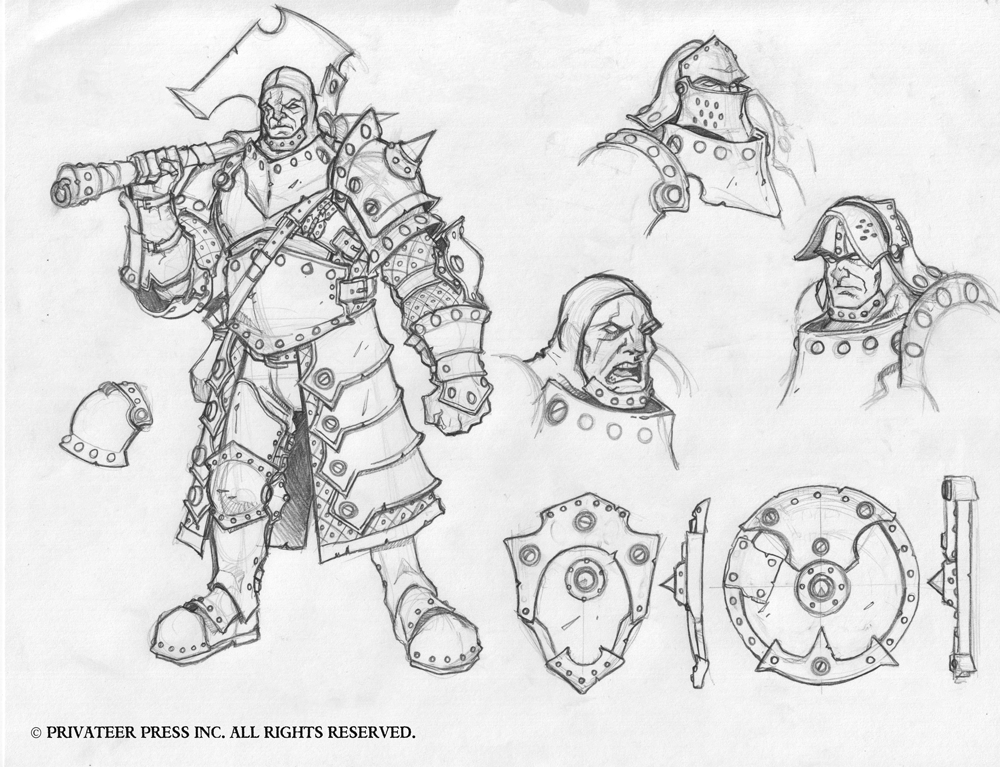
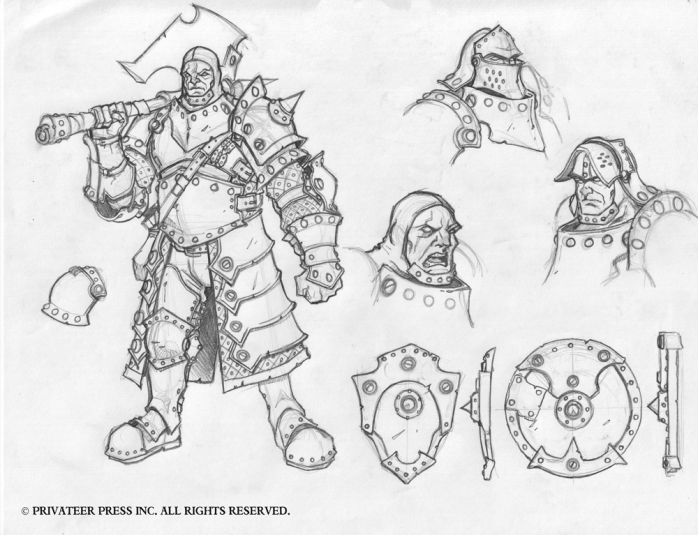
Mini Excerpt: Everybody loves a mercenary, right? Well, maybe not, but the Iron Kingdoms is home to many well-established mercenary companies that operate like armies for hire. The Steelheads may be the most well known example, and they can offer their clients real battlefield versatility with their halberdiers, heavy cavalry, and rifle corps. In Aftershock, Ashlynn d’Elyse uses a large number of Steelhead troops commanded by Captain Reece Keller. Today’s mini-excerpt features Asheth Magnus’ first encounter with the mercenary officer.
“Okay, that’s far enough,” the voice said. “Stay put, and don’t do anything fast or stupid.”
Magnus held his hands up in what he hoped was a peaceful gesture. “You have my word.”
“I hear that’s not worth much,” the voice replied, and the man it belonged too appeared out of the ruins along with six riflemen. He was armored in heavy plate fitted with articulated faulds, the kind of armor you might wear when mounted. He carried a long axe over one shoulder, a cavalry weapon, and he wore a blunderbuss on his right hip. His breastplate was emblazoned with the stylized helmet of the Steelheads.
Magnus smiled. A mercenary. This was the kind of man he could deal with.
“I’m Captain Reece Keller, Steelheads, Merin Chapter,” the man said and walked to within a few paces of Magnus.
“You don’t sound Ordic, Captain,” Magnus said.
“I was born in Ceryl, but, as I’m sure you know, Ord’s a bit friendlier to mercs, ” Keller said. “Now what are you doing here, Magnus?”
One quick revision note. Some of you might remember this particular Steelhead captain from an earlier update. At that time he was named Artis Keller. It’s been changed to Reece to avoid confusing him with an existing Iron Kingdoms character. Remember when I said don’t get attached to anything in these mini-excerpts? 🙂
If you have a question or comment about the book or my writing process, ask away in the comments section below. And if you’ve missed the updates for the previous weeks, you can find them right here:
- Week 1 Update
- Week 2 Update
- Week 3 Update
- Week 4 Update
- Week 5 Update
- Week 6 Update
- Week 7 Update
- Week 8 Update
- Week 9 Update
- Week 10 Update
- Week 11 Update
- Week 12 Update
- Week 13 Update
- Week 14 Update
- Week 15 Update
- Week 16 Update
- Week 17 Update
- Week 18 Update
- Week 19 Update
- Week 20 Update
Acts of War: Aftershock is available for preorder in print and digital from Amazon, and you can buy and read the first book in the series, Acts of War: Flashpoint, right now.
Acts of War: Aftershock – Week 20 Update
Twenty weeks into Acts of War: Aftershock and revisions continue. Here’s how the week went.
Progress: I’ve done quite a bit of work on the book in the last week to ten days. I started by going through the manuscript and addressing all the editors’ comments and suggested changes. Most of that consisted of straightforward and even simple changes, but there were a few scenes I needed to rewrite extensively. Next, I wrote three additional chapters designed to increase the presence of certain characters and solidify their role in the plot. This week, I’m going back through the manuscript again, word for word, chapter by chapter, cleaning up the changes I made and making sure they’re consistent throughout the manuscript. I have one major scene to rework in the third act, and then the first round of revisions will be done.
Revision Roundup: Today, I’m going to talk about another of the three major areas of focus for the revisions: character. As I go through the manuscript, many of the notes from the editors address a character’s dialogue or actions that aren’t quite in line with how they’ve been presented both in Flashpoint and elsewhere in Iron Kingdoms fiction. These types of adjustments are somewhat unique to writing media tie-in, where characters, like Lord General Coleman Stryker, Asheth Magnus, and Ashlynn d’Elyse, have been shared by multiple authors. So, even though I might come at a character differently than another author, he or she still needs to be recognizable to those familiar with the setting.
I’ve also been working on adding new chapters that give some characters more time in the spotlight. For example, I added a chapter about Ashlynn d’Elyse that reveals more about her motivations and how she interacts with the Llaelese Resistance. The antagonists can get this treatment too, and the entire purpose of Irusk’s new chapter, for example, is to give the reader a glimpse into why he made certain decisions that, viewed from afar, could be seen as quite villainous.
Mini Excerpt: One of the cool things about Ashlynn’s new chapter is it lets me spend a little more time with some of the awesome and unique troops that fight for the Resistance. The following mini-excerpt focuses on one of those Resistance powerhouses: the Thorn Gun Mages.
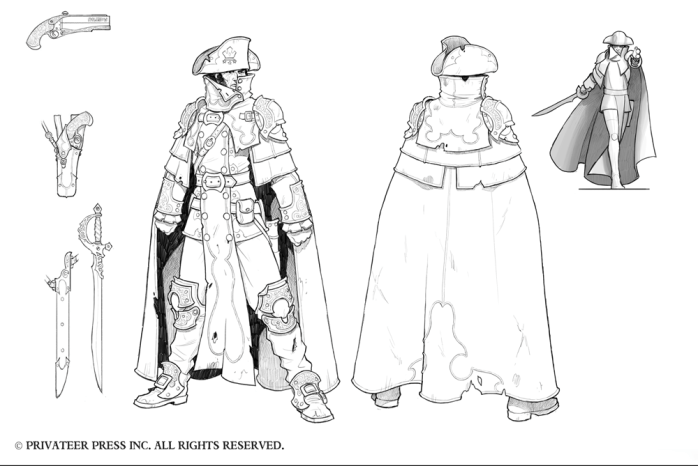
The face of one of the buildings ahead exploded outward in a plume of dust and smoke, disgorging a massive crimson warjack. The towering machine lumbered through the remains of the structure that had been hiding it, bringing its arms together in front of its body with a reverberating clang. The jack’s limbs were covered in slabs of heavy plate steel, like shields, and when locked together they made an impenetrable armored shell. Ashlynn knew the Khadoran design well. In her experience, it often lived up to its designation. Devastator.
Lieutenant Waevyr and her gun mages reacted to the appearance of this new threat as they’d been ordered, and their magelock pistols unleashed ensorcelled ammunition in a thundering volley. The Devastator was huge and slow moving, and the gun mages could not miss at such close range. Magelock rounds hit the target in a strobing flashes of blue and red. Some of the gun mages had fired thunderbolt ammunition, but the Devastator was simply too large and heavy to push back, even with the powerful enchantment. The rest had fired incendiary, and flames engulfed the warjack. The fire would have little effect on the Devastator with its armored shell engaged, but Ashlynn knew if she could force it into close combat, it would emerge from its steel cocoon, and the sorcerous flames would take their toll.
You know, I’ve never used that particular warjack in any fiction. I won’t say it’s the only reason I put a Devastator in that scene, but it didn’t hurt. 😉
If you have a question or comment about the book or my writing process, ask away in the comments section below. And if you’ve missed the updates for the previous weeks, you can find them right here:
- Week 1 Update
- Week 2 Update
- Week 3 Update
- Week 4 Update
- Week 5 Update
- Week 6 Update
- Week 7 Update
- Week 8 Update
- Week 9 Update
- Week 10 Update
- Week 11 Update
- Week 12 Update
- Week 13 Update
- Week 14 Update
- Week 15 Update
- Week 16 Update
- Week 17 Update
- Week 18 Update
- Week 19 Update
Acts of War: Aftershock is available for preorder in print and digital from Amazon, and you can buy and read the first book in the series, Acts of War: Flashpoint, right now.
Acts of War: Aftershock – Week 19 Update
Week nineteen, and I am neck-deep in revisions for Acts of War: Aftershock.
Progress: I’m very pleased with the progress I’ve made so far. I’ve revised over a third of the novel at this point, and that includes rewrites of two major scenes. I’m on pace to put this round of revisions to bed in a total of two weeks or so.
Revision Roundup: Today, I’d like to talk about one of three major areas of revision I mentioned in last week’s post: setting continuity. These are often little tweaks and adjustments that ground the story more firmly in the Iron Kingdoms, or, sometimes, fix outright errors. I’ve been working in the IK for seven years now, so I’m very familiar with how things work in the land of steam and steel, but I do make mistakes, and luckily Doug Seacat and Matt Goetz are there to catch them.
Here’s an example a fairly minor continuity issue that I’ve already addressed:
Original text: The Chargers’ cannons went off first, and he aimed the explosive shells at the towers atop the gate, guiding them with his will.
I had been using these cannon blasts to kill multiple foes, and Doug Seacat had this comment on the text: Chargers don’t have explosive shells. Sentinel guns would work better for clearing groups of infantry, whereas Charger cannons are better to hit individual targets harder. If you want light warjacks with explosive shells, have him take Grenadiers instead of Chargers.
Revised text: The Grenadiers’ grenade launchers went off first, and he aimed the explosive shells at the towers atop the gate, guiding them with his will.
The solution: An easy one. I changed the Chargers to Grenadiers in this scene, changed the words “cannons” to “grenade launchers,” and problem solved. This is one of the small details even someone well-versed in the setting can overlook. You see the word cannon, and you think explosion, but as Doug said, that’s not really what Charger cannons do. Grenadiers, on the other hand, are a great fit for this scene.
I needed to do some additional adjustments in the scene to replace the Chargers (and let the Sentinels mow down some infantry), but it was all pretty easy stuff. I would say about twenty five percent of the changes I’ll be making in the manuscript are similar to this example. Next week, we’ll get into some of the more complicated revisions.
Mini Excerpt: Hey, let’s take those new Grenadiers for a test drive!
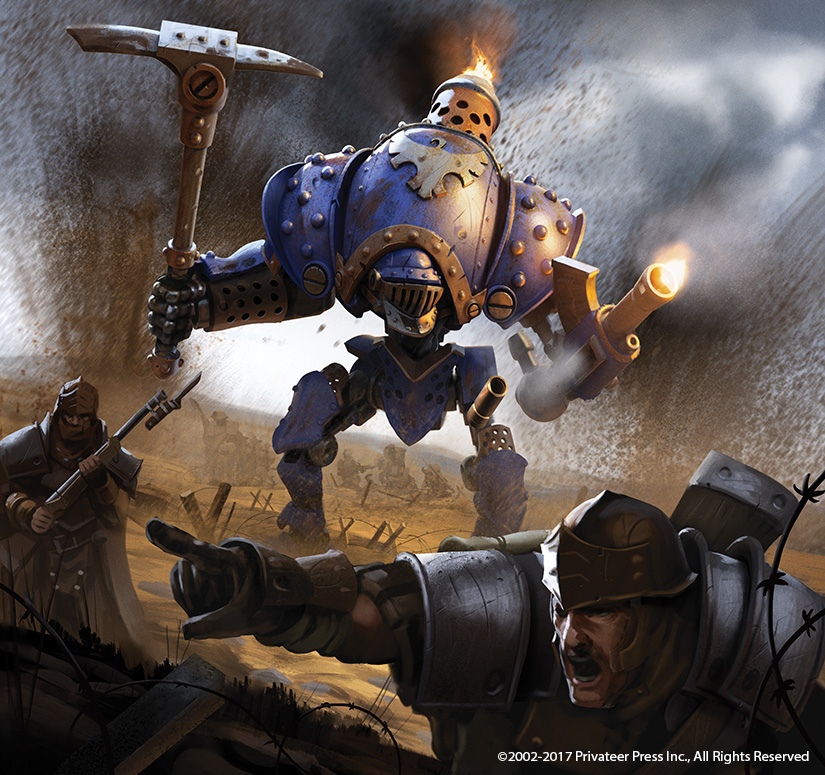
The Grenadier swung its mattock at a Winter Guard officer locked in a saber duel with a Resistance soldier. The pick blade of the oversized weapon struck the Khadoran in the back, passed completely through his body, and burst from his chest in a spray of blood. A slight pulse of irritation flowing back through the warjack’s connection with Magnus as the Grenadier hoisted the dead soldier from the ground, now pinned to its weapon, and shook the corpse free like a man trying to dislodge a bit of trash from the bottom of his shoe.
Often when you revise a scene, you end up liking the revision way more than the original. Of course, this makes Grenadiers seem like jerks, which, hey, maybe they are. 🙂
If you have a question or comment about the book or my writing process, ask away in the comments section below. And if you’ve missed the updates for the previous weeks, you can find them right here:
- Week 1 Update
- Week 2 Update
- Week 3 Update
- Week 4 Update
- Week 5 Update
- Week 6 Update
- Week 7 Update
- Week 8 Update
- Week 9 Update
- Week 10 Update
- Week 11 Update
- Week 12 Update
- Week 13 Update
- Week 14 Update
- Week 15 Update
- Week 16 Update
- Week 17 Update
- Week 18 Update
Acts of War: Aftershock is available for preorder in print and digital from Amazon, and you can buy and read the first book in the series, Acts of War: Flashpoint, right now.
On Writing Godless
Hey, folks, my writer pal Orrin Grey wrote a book called Godless set in the Iron Kingdoms, the same steam-powered setting as my upcoming novel Aftershock. Orrin is one hell of a writer, and this is one hell of a book. In Orrin’s own words, “This is a fantasy story about war and faith, about knights, robots, monsters, and epistemological uncertainty.” I mean, seriously, what more can you ask for out of a novel?
Orrin talks a bit about the writing process for Godless on his blog, and it’s an interesting glimpse behind the scenes for anyone curious about the writing process for media tie-in.
Godless is available right now in e-book and print formats. Check it out.

 Well, it kind of crept up on me, but today is actually the release day of my very first novel, so if you always wanted to read a novel by me, you’re into Warmachine, or you just like the idea of devout religious types with big robots burning heretics and fighting monsters, you might want to pick up a copy of Godless, the first book in the Fire & Faith series from Privateer Press! (It’s available in print or digital via Amazon, or you can check the Skull Island eXpeditions website.)
If you had asked me several years ago how and when I would write my first novel, I would not have guessed that it would be a licensed Protectorate of Menoth novel for Privateer Press. Even when I had already started doing various freelance work for them, and wrote what was, heretofore, my longest published piece…
View original post 457 more words
Acts of War: Aftershock – Week 18 Update

Here we are at week eighteen into the production of Acts of War: Aftershock. These updates are going to change a bit as I start working on revisions. More on that below.
Progress: I’m starting revisions on the novel this week–today, actually—so my progress reports will reflect where I’m at with rewrites, scene additions, scene subtractions, and all the myriad little tweaks and adjustments that will turn the book into the final product you’ll be reading on July 12th.
Revision Roundup: The editors at Privateer Press have given me extensive notes on what they’d like to see changed or adjusted in the next draft. I’ve worked with all of these folks many times on long and short fiction, and the level of notes and requested changes are what I expected. There’s work to do, but it’s not overwhelming, and much of it entails adding material, which, in my opinion, is the easiest type of revising.
There are three primary, broad-strokes areas I’ll be working on in this round of revisions: story, character, and setting continuity. All three involve changes big and small, and I’ll detail some of those changes in the coming weeks as I work through them, but here’s a little taste. After reading through the draft, the editors at Privateer Press all came to the same conclusion: more Ashlynn d’Elyse. That suits me just fine. She’s a great character, and I’ll be adding a scene or two with the Llaese Resistance leader in this next draft. In fact, that’s gonna be the very first thing I do!
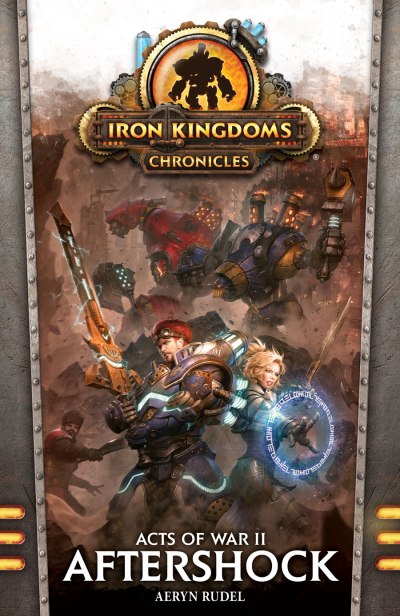
Mini Excerpt: Since the editors want more Ashlynn in the next draft, here’s more Ashlynn in this week’s mini-excerpt AND on the awesome cover of Aftershock (courtesy of the extremely talented Néstor Ossandón).
Another volley from the two Destroyers came shrieking down from the wall. The shells detonated in front of Ashlynn, pelting her power field with debris. Her Vanguards absorbed most of the blast, though one of them suffered for it. Damage reports flowed back through her connection with the warjack; its right leg had been severely damaged. She ordered it to fall back and protect the troops behind her.
She was close enough now that Crash and Soldier could reach the top of the wall with their steam cannons. She urged them to fire, and the explosive shells arced high and exploded against the hull of one of the Destroyers. Khadoran warjack armor was thick, but the twin blasts sent the great red machine stumbling backward, and then it disappeared. Ashlynn smiled at the thought of the ten-ton warjack plummeting forty feet to the ground below. Hopefully, there would be Assault Kommandos to soften its landing.
I like to think some proud son of the Motherland, a kovnik maybe, had a bunch of Winter Guard at the bottom of that wall waiting to soften the fall of such valuable equipment. 🙂
If you have a question or comment about the book or my writing process, ask away in the comments section below. And if you’ve missed the updates for the previous weeks, you can find them right here:
- Week 1 Update
- Week 2 Update
- Week 3 Update
- Week 4 Update
- Week 5 Update
- Week 6 Update
- Week 7 Update
- Week 8 Update
- Week 9 Update
- Week 10 Update
- Week 11 Update
- Week 12 Update
- Week 13 Update
- Week 14 Update
- Week 15 Update
- Week 16 Update
- Week 17 Update
This week marks a special occasion. Acts of War: Aftershock is available for preorder in print and digital from Amazon! Choose your preferred format and click the link below.
Effectively Wild – A Baseball Horror Story
Night Walk & Other Dark Paths
Acts of War: Flashpoint

Acts of War: Aftershock

Acts of War: Stormbreak

 Aeryn Rudel's Rejectomancy