
Acts of War: Aftershock – Crucible Guard in Acts of War

Last weekend Privateer Press held its annual convention Lock & Load in Bellevue, Washington, and announced a whole bunch of exciting things for the Iron Kingdoms, the setting for the tabletop miniatures games WARMACHINE and HORDES. I was at the convention signing copies of my new novel Acts of War: Aftershock, and perhaps not too surprisingly, the novel serves as a bit of a preview to one of those exciting announcements.
If you watched the keynote from Lock & Load, then you saw Privateer Press announce next summer’s new faction, the Crucible Guard. For those of you familiar with the Iron Kingdoms, you’ve no doubt realized the Crucible Guard are connected to the guild of alchemists called the Order of the Golden Crucible.
So, if you’re excited about the Crucible Guard (I sure as hell am), and you’d like a preview of what some of them can do, check out Acts of War: Aftershock, which features two upcoming models from the new faction, including one of their warcasters, Aurum Legate Lukas di Morray.
Here’s a little taste of Aurum Legate Lukas di Morray from Aftershock.
Lukas moved to a stand near the back of the armory where a suit of armor hung. Outwardly, it looked like a simple breastplate of yellow enameled steel with pauldrons, vambraces, and greaves. As Magnus got closer, he noticed the network of thin tubing that ran from the breastplate to the other pieces.
Magnus lifted the breastplate from the stand and set it on Lukas’ shoulders. He then noticed the strange contraption that occupied the same space as an arcane turbine on a traditional suit of warcaster armor. It consisted of half a dozen empty tubes, each about six inches long that jutted from the back plate in two rows of three.
Alyce stepped forward to help her husband with the rest of his armor. “There, on that table, you’ll find a case with twelve vials,” she said to Magnus, pointing at a low wooden table covered in ammunition crates.
Magnus found the case she’d indicated. Inside were a dozen vials of clear liquid with attached syringes. They looked like they would fit in the tubes across the back of Lukas’ armor. More of his serum.
Magnus watched as Alyce placed the syringes into the armor, pushing each one in firmly. Lukas grimaced as the needles punctured his flesh.
“They’re in,” she said.
Lukas took a deep breath and turned his right arm over, exposing the underside of the vambrace. A row of three studs or buttons rose from the steel plate, and he pushed the first one. A soft hiss arose from the back of his armor. He sighed like a man who finally had the one thing he most desired. The flesh on his face grew firmer beneath his beard, as if the weeks and months of his captivity had simply not happened. His back straightened, and his chest seemed to gain breadth and power. Aurum Legate Lukas di Morray was beginning to look like the war leader they had risked so much to free.
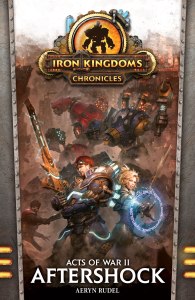
If you’d like to learn more about Aurum Legate Lukas di Morray and his wife Aurum Omnus Alyce di Morray, check out Acts of War: Aftershock, available below:
The Rejection Scorecard

As some of you may know, my professional career with the written word (such as it is) started in the tabletop gaming industry, where I worked as an editor, a game designer, and a writer. With over a decade working in that environment, it should be no surprise that I derive great satisfaction from creating needlessly complex rule systems for just about everything. So, let’s take some of that game design philosophy and apply it to submissions and rejections!
Before I get into this, a quick disclaimer. What follows is for fun, an entertaining (and overly complex) way to take your rejections in stride and illustrate one simple idea: a story that gets rejected (even multiple times) is not necessarily a bad story.
Got it? Cool. Now on to the Rejection Scorecard!
Here’s the main premise of my “system.” Every story you write and submit accumulates rejection points based on the type of feedback it receives in the form of rejection letters. The total number of rejection points is a story’s rejection score. When the rejection score exceeds 10, called the rejection threshold, it is an indicator the story might need revision before it goes out again.
So, how does a story score rejection points? By getting rejected, of course. That said, not all rejections are created equal, and you get different points based on the type of rejection you receive, as follows. If you need a definition on a type of letter, just click the link; I’ve covered all these on my blog.
- Form Rejection: 2 points
- Higher-Tier Form Rejection: 1 point
- Personal Rejection: 0 points
- Further Consideration Letter: -1 points
- Short List: -2 points
As you can probably guess, this is like golf, and the lower the rejection score the better. In the case of the further consideration letter and short list letter, the negative point values apply to the follow up rejection for a total score. So, for example, if I get a further consideration letter and then the story is rejected with a form letter, I add 1 point (2 + -1) to the rejection score for the story.
I separated further consideration letters and short list letters because they aren’t always the same thing, and in my reckoning, making a short list is closer to publication than getting, uh, further considered. Of course, opinions might vary there, so assign whatever points you feel appropriate.
Something to consider with personal rejections. If you get one that gives you excellent feedback about a possible revision AND you agree with that feedback, then, you know, don’t worry about how many points the story has collected (remember, this is for fun). Revise that sucker.
Now let’s look at some rejection score examples from my own stories.
Example 1: “After Birth”
| Rejections | Points | |
| Form | 4 | 8 |
| HT | 3 | 3 |
| Personal | 3 | 0 |
| FC | 0 | 0 |
| SL | 2 | -4 |
| Total | 7 |
So, as you can see by the table above, “After Birth” has accumulated 4 form rejections, 3 higher-tier form rejections, 3 personal rejections, and it has made the short-list twice. Both short lists resulted in personal rejections. All of this activity gives “After Birth” a rejection score of 7, which is below the rejection threshold of 10. In other words, after 10 submissions and 10 rejections, the story has received fairly good feedback, and a couple of the higher-tier rejections came from top-tier markets. It’s come close to publication twice, and the personal rejections were basically “we liked this story, but in the end didn’t feel it was a perfect fit.”
Example 2: “Set in Stone”
| Rejections | Points | |
| Form | 9 | 18 |
| HT | 1 | 1 |
| Personal | 4 | 0 |
| FC | 0 | 0 |
| SL | 2 | -4 |
| Total | 15 |
Man, has this one been round the block. It’s come within a whisker of getting published twice, and one of those short-lists didn’t come to fruition not because of a follow-up rejection but because the publication closed down. That said, despite some good feedback, this story has received enough no-thank-yous it’s time to make some changes. I still believe there’s a publishable story here, and I think I know what to do to give it a better shot.
Okay, a few more examples, and this time we’ll look at the three stories I’ve actually published, and their rejections scores before the acceptance.
| Form | Higher-Tier | Personal | Further Consideration | Short List | Total Rejections | Rejection Points | |
| “Caroline” | 3 | 4 | 1 | 1 | 1 | 9 | 7 |
| “Night Games” | 3 | 3 | 6 | 6 | |||
| “Paper Cut” | 9 | 3 | 3 | 1 | 16 | 19 |
So, the first two stories were well under the rejection threshold of 10 before they were published, and the feedback they received was universally positive. I included the last story, “Paper Cut,” simply to illustrate that this whole system shouldn’t be taken too seriously, and if you have a gut feeling about a story, like I did with “Paper Cut,” stick with it.
Option Rule #1: Pro Markets
Remember when I said “needlessly complex” in the opening paragraph? Well, I’ve restrained myself for the most part . . . until now! Yep, here’s one more thing to consider if, like me, you just ache for more modifiers and statistical pedantry.
Some of you might be thinking, “Hey, a rejection, especially a ‘good’ rejection, from a magazine like Clarkesworld or Apex is a little more significant than the points suggest.” I think there’s some truth to that, so, if you like, use the following point values for pro-paying markets:
- Form Rejection: 2 points
- Higher-Tier Form Rejection: 0.5 point
- Personal Rejection: -0.5 point
- Further Consideration Letter: -2 points
- Short List: -3 points
Keep in mind I’m talking about genre markets here, where payment tier and prestige often go hand-in-hand. I know that’s not always the case with the literary market, so if you’re a lit-fic writer, this optional system may not be as useful to you.
Option Rule #2: Other Modifiers
Of course, a system like this can’t account for every thing that could happen to a story out there, but here are a few other scenarios and some optional modifiers you could use if you like.
- Honorable Mention: If you enter writing contests, then it’s possible the editors might formally recognize your story as one with merit without actually publishing it or really rejecting it. An honorable mention is kind of like a short list, but I think it’s slightly more significant. Go ahead and deduct 3 points from a stories rejections score if you get one of these.
- Referral Rejection: Sometimes a market will send you a personal rejection that suggests you submit your story to another, usually related market because they think the story would be a better fit there. If you get one of these, deduct 1 point from the story’s rejection score.
- Revision Request: Occasionally a market will request revisions to a story, usually with the often unspoken promise that if you make the revisions, they’ll accept the story. Sometimes, however, they’ll reject the story anyway (for a wide variety of reasons). If that happens, go ahead and deduct 2 points from the story’s rejections score (remember to add in the modifier for the rejection too).
Did I miss any rejection scenarios that should be on my list of modifiers? If so, please tell me in the comments. If I like your idea, I’ll update the post. Also, I’d love to see the rejections scores your stories have accumulated–published, not published, whatever.
Acts of War: Aftershock Now Available
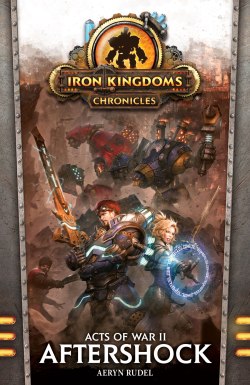
If you’ve been following this blog over that last 30 weeks or so, you’ve seen me document the process of writing, revising, and editing my novel Acts of War: Aftershock. Well, today, all that work comes to fruition. Acts of War: Aftershock is now available in eBook and print formats from all the usual suspects.
War Has Come Again to Llael
On the heels of inflicting defeat upon the Khadorans at Riversmet, Lord General Coleman Stryker marches deeper into enemy territory to prepare a major assault. But he is unprepared for the avalanche of a massive Khadoran counterstrike. Empress Ayn Vanar and Supreme Kommandant Irusk send their nation’s most fearsome warcasters to retaliate against the invaders and secure her conquered territories at any cost. Hope comes in the form of Ashlynn d’Elyse, warcaster and leader of the Llaelese Resistance, a woman with no love for Cygnar but who could make for a powerful ally if convinced to help. Along with Asheth Magnus, Stryker’s enemy-turned-ally, this unlikely team must fight to persevere despite being outnumbered, outmaneuvered, and cornered with only their wits and a few warjacks to save their cause from utter annihilation…
Get an eBook – $7.99:
Get it in Print $15.99:
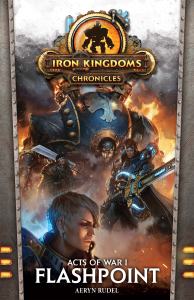
And, of course, if you haven’t read the first book in the series, Acts of War: Flashpoint, you can get that right here.
Acts of War: Aftershock – Excerpt #3
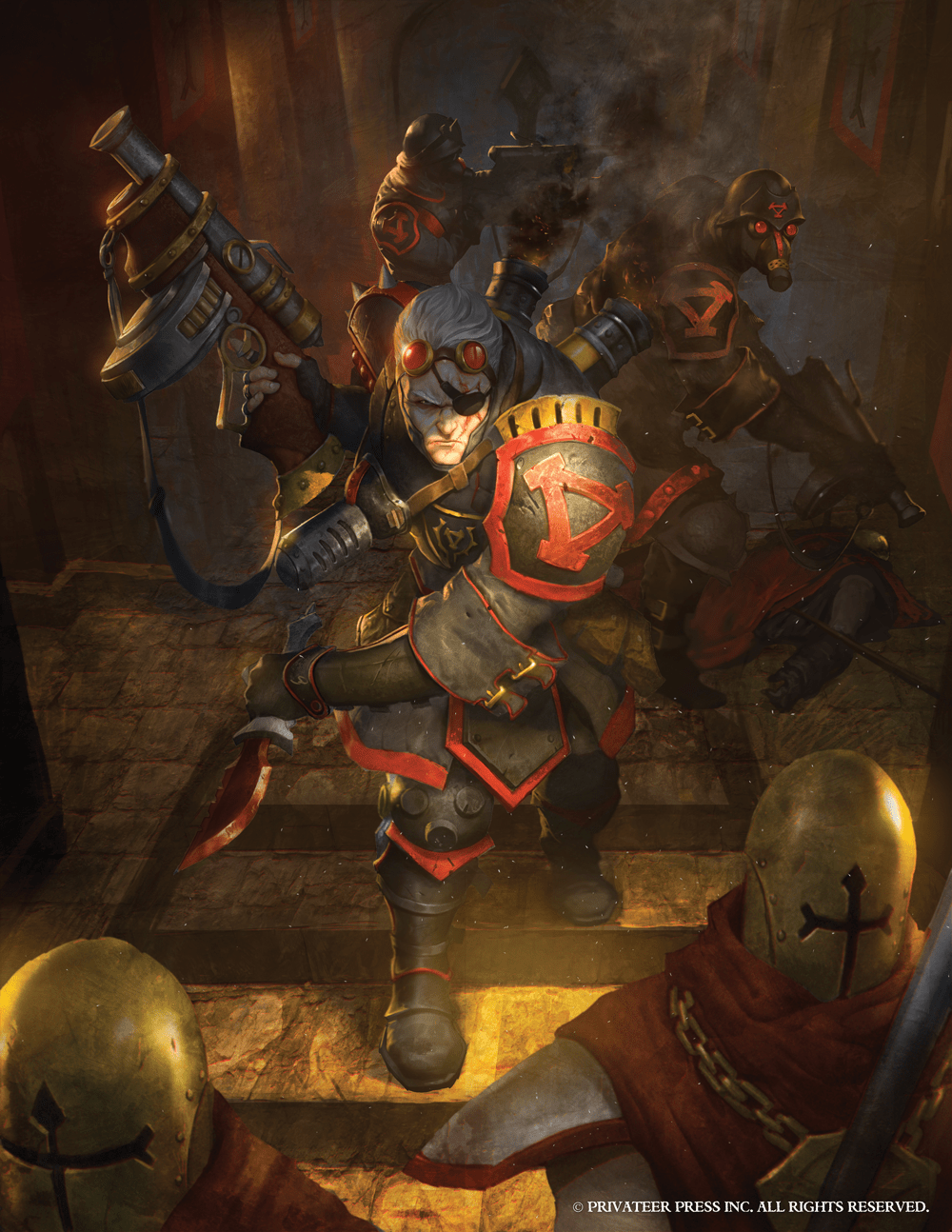
The release date for Acts of War: Aftershock is right around the corner, and here’s one more excerpt to whet your appetite before the book drops on July 12th. This time, we’re going to focus on one of the primary antagonists for the novel, Assault Kommander Oleg Strakhov, and a mysterious new character who has a big role to play in this book and the next.
Rynyr, Khadoran-Occupied Llael
Lukas di Morray had never known such pain. At least that’s what his mind told him; it insisted his suffering was worse than any he had ever endured. His muscles were stone, drawn tight against his bones, and they sent ragged shards of agony through his body with even the slightest exertion. His skin itched and burned, and though he had torn away all his clothing save for a bare strip around his loins, he sweated rivers, and the warm stones of his cell offered no respite.
But it was his mind that pained him most, his mind that conjured specters of friends and family now lost, dead or captured by the enemy. It dredged these memories from his subconscious to torture him, to remind him of his failings, of his dereliction of duty. Most of all, his mind howled with incessant need, the all-encompassing want of the serum to which he’d become addicted. He’d been without it for weeks, ever since his capture, and each day that passed, he grew weaker, withering without the alchemical concoction that granted him strength, vitality, and some semblance of sanity.
The serum was like no mundane drug. There would be no torturous period of withdrawal and then improvement, possibly even freedom from the addiction. No, the strength his serum granted him damaged his body each time he used it, pushed him one step closer to death, and he was much more likely to die if denied it.
He rolled over onto his back, staring up at the ceiling. The heat from the volcano permeated the stone, turning his cell into an oven that slowly baked the moisture from his body. They would bring water soon, and it would offer some fleeting respite, but then the questions would begin, and he still clung to enough of his self to resist them.
He heard footsteps, heavy and purposeful, coming down the hall toward his cell. It would be Strakhov again, coming at the appointed hour to question him. Perhaps he could endure another beating and resist. Or perhaps not.
The barred door of his cell opened with a metallic squeal, and a shadow fell across him. He could smell the smoke from the Khadoran’s warcaster armor trickling into his cell, making the heavy stale air all the harder to breathe.
“Would you like a drink before we begin, Legate di Morray?” Strakhov’s voice was deep, and his Llaelese was practiced and precise with no trace of an accent.
Lukas let out a shaking breath and closed his eyes, fighting tears at the mere mention of water. He could hear it sloshing in the bucket carried by the guard accompanying Strakhov, and though it was undoubtedly warm and would taste of sulfur, it would be a single moment of relief he desperately wanted.
“Today, you can drink as much as you like,” Strakhov said. “Come now, sit up, drink.”
Lukas sat upright, his muscles screaming in protest, and bit down on his lip to keep from crying out. Strakhov and his guard came around to the other side of the cell. The guard, a man in black armor wearing the gas mask of an Assault Kommando, carried a metal bucket from which the handle of a ladle projected. The sloshing inside that bucket was the music of heaven, and Lukas knew he was staring at it like a starving man stares at a crust of bread.
Strakhov was a large man, made even larger by the bulky warcaster armor he wore. His face was square, handsome, though severe in a way that made him less attractive and more threatening. A long jagged scar ran down the right side of his face, crossing his lips and ending above his chin, and he wore an eye-patch over his left eye, a starburst pattern of scars blooming out at its edges. He oozed threat and power, both of which he had in ready supply.
The guard set down a sturdy stool in front of Lukas, and Strakhov sat down on it. He leaned forward, smiling, showing his straight white teeth like a shark just before it bites. “Now, come and have your drink.”
Strakhov held out his hand, and the kommando gave him the bucket. He set it on the ground between him and Lukas. Strakhov dipped the ladle in and pulled it out, dripping water, and lifted it to his own lips. He took a deep drink and smiled.
“It is good,” he said. “We found a water purification system, so this is clean and pure.”
Lukas watched Strakhov drink. He would have drooled uncontrollably if he’d had enough moisture in his system to do so. “Please,” he croaked.
“Of course, Legate, come forward,” Strakhov urged. The distance between them was only a few feet, but it seemed a world away to Lukas.
He crawled toward Strakhov, his body shuddering with the pain. When he reached the bucket, he sat up again. Strakhov offered him the ladle. “Drink.”
Lukas took the ladle, the muscles in his arm spasming at the weight of it, and dipped it in the bucket. He pulled out a full dip, his shaking hand spattering with water as he brought the ladle to his cracked lips. He gulped the water down, the liquid burning the sores that had formed inside his mouth, but he didn’t care. It was exquisite, and Strakhov was right: the water tasted pure and clean.
He plunged the ladle back into the bucket for another drink, but Strakhov shot out a hand and caught his wrist. There was no denying the iron strength in that grip, and Lukas whimpered with fear and pain. Strakhov clicked his tongue.
“You can have another drink when you answer a question. One drink for one question. This is a fair exchange, no?”
Lukas nodded. His lips trembled, and total mental collapse was not far off, but what choice did he have? “Ask.”
“Good,” Strakhov said. “Very good. First, I want to know the primary ingredient of your serum.”
They had been down this road before. Strakhov had seen the effects of what the serum could do, but he didn’t understand it, didn’t understand how dangerous it was, didn’t know how many men had died horribly testing it, and didn’t grasp that Lukas and his wife were the only successful experiments—and that success was a debatable term in either case.
“I told you before,” Lukas said, “the serum is a failure. It can’t help you.”
“A failure?” Strakhov said. “I find that hard to believe. When we took you in Laedry, you killed eight men and destroyed a warjack by yourself. You are no warcaster, yet this serum made you the equal of one.”
“Yes, it made me strong before, but look at me now. I am withering away without it.”
“Improvements could be made, certainly,” Strakhov said. “But if the serum is truly a failure, what harm is there in telling me its main ingredient?”
“You asked about the inner working of this citadel before, how the lava is controlled and dispersed throughout the city. I helped design the system. I can tell you how that works instead.”
Strakhov smiled. “We will get to that soon enough, Legate, but today, I have different questions, and certainly you want that drink.”
The serum was a failure. Lukas knew it, and if he gave it to Strakhov, the warcaster would take it back to the Greylords Covenant, and they would attempt to unlock its secrets. Maybe they would improve on it, and such a thought was terrifying. If Khador could create warcasters at whim, even those with a third of the power Lukas commanded, they would gain an overwhelming advantage in battle.
“It doesn’t matter,” Lukas said. “The serum doesn’t work.”
Strakhov put the ladle back into the bucket and motioned for the guard to take it away. “We are reasonable men, you and I. Yet you would force me to use methods I find…distasteful to get what I require.”
Lukas braced himself for another beating. Strakhov was expert at delivering painful blows that did not leave lasting damage to the head and body. Lukas would soil himself and wail in pain, but he would survive, and the serum would stay a secret.
Strakhov got up and went to the cell door. “Bring them in,” he called down the hall.
The sound of footsteps, many footsteps, echoed off the stone. These were not the strong deliberate treads of soldiers; it was slow, dragging, the sound of men and women walking to their deaths. Four men and three women entered the cell, two Assault Kommandos behind them, carbines at the ready. The prisoners wore tattered rags, and they had likely been taken from the citizenry of Rynyr before the city was cleared out. Lukas looked at each of them, not recognizing anyone, until he got to the last woman in the group. There, his heart caught in his throat. Both fear and joy seized him.
Alyce. No.
Got a question about the book? Fire away in the comments section below. And if you’ve missed any of the Aftershock articles and updates for the previous weeks, you can find them right here:
Acts of War: Aftershock is available for preorder in print and digital from Amazon, and you can buy and read the first book in the series, Acts of War: Flashpoint, right now.
Submission Statement: June 2017

My acceptance slump continued in June, though I did have one publication. I have two new stories I started sending out last month, so they’ve been piling up the rejections with all the usual suspects. Let’s have a look.
June 2017 Report Card
- Submissions Sent: 5
- Rejections: 4
- Acceptances: 0
- Publications: 1
- Other: 0
Roughly one submission per week in June. Not bad, but I’d like to double that in July.
Rejections
Four rejections this month, all of the form variety.
Rejection 1: Submitted 5/22/17; Rejected 6/19/2017
Thank you for submitting “XXX” to XXX. We appreciate the chance to read it. Unfortunately, we don’t feel it is a good fit for us and we’re going to have to pass on it at this time.
Thanks again. Best of luck with this.
A form rejection from a top-tier magazine, one I’ve been trying to crack for a long time. I don’t find it particularly disheartening to receive a form rejection from this market (and others like it). The competition here is absolutely fierce, and they publish some of the best speculative fiction in the industry. In other words, I have to keep working to improve my craft and send them my very best. It’s a real challenge, and I dig that.
Rejection 2: Submitted 5/24/17; Rejected 6/19/2017
Thank you for submitting your story, “XXX”, to XXX. Unfortunately, we have decided not to publish it. To date, we have reviewed many strong stories that we did not take. Either the fit was wrong or we’d just taken tales with a similar theme or any of a half dozen other reasons.
Another standard form rejection from a top-tier market. I have had no luck with this particular market after seven submissions, and some of that may be because they primarily publish sci-fi, and what I tend to send them is sci-fi-ish. There are, of course, other reasons for the rejections, as they state in their letter.
Rejection 3: Submitted 6/19/17; Rejected 6/19/2017
Thank you so much for thinking of XXX. Unfortunately “XXX” is not quite what we’re looking for at the moment. Best of luck placing it elsewhere.
You may have noticed that the receipt date for the last three rejections are all 6/19/17. Yep, three rejections in one day. It happens, and I’ve become sufficiently inured to rejections now that it doesn’t bother me overmuch. You might also notice this is a same-day rejection. I sent the story at 9:46 a.m. and it was rejected at 3:43 p.m. That’s just under six hours. That’s not too uncommon either, and it doesn’t even come close to my record of 45 minutes for same-day rejections.
Rejection 4: Submitted 6/19/17; Rejected 6/21/2017
Many thanks for sending “XXX”, but I’m sorry to say that it isn’t right for XXX. I wish you luck placing it elsewhere, and hope that you’ll send me something new soon.
Another form rejection from one of my go-to markets. Like the market in the first rejection, I submit just about every new story I write to this market (if it’s of the appropriate genre, of course). No luck yet, but I’ll keep trying.
Publications
One publication for this month, and it’s a fun one. My short story “Scare Tactics” was published by Dunesteef in an audio format. They really nail all the voices, and I was very pleased with how it turned out. You can listen to the story by clicking the link or photo below.
Episode 194: Scare Tactics by Aeryn Rudel

And that’s my June. Tell me about yours in the comments.
Dunesteef Does “Scare Tactics”
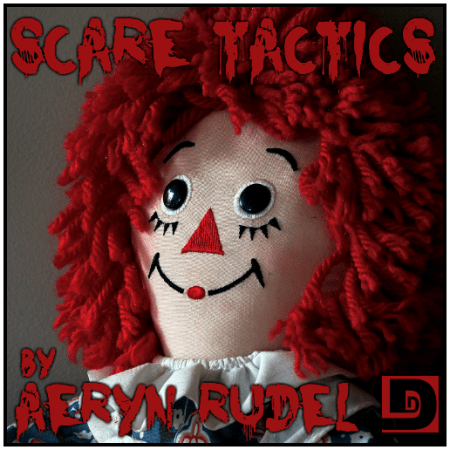
The audio fiction magazine Dunesteef has published an audio production of my horror story “Scare Tactics.” They really nailed the voices, and I’m very pleased with how it turned out. It’s free to listen, so click the link and check it out.
Episode 194: Scare Tactics by Aeryn Rudel
Lindsey is a paranormal investigator, but she has an advantage on most, because she has the demon Adramelech captured in a Raggedy Ann doll, and it does her bidding, which makes casting out the demon really simple. Today, however, things are different. The house they’ve come to investigate has an actual presence that’s already there, and it has bad intentions.
Acts of War: Aftershock – Interview

We are rapidly closing in on the release date for Acts of War: Aftershock, and this week, Mike Ryan, publications director for Privateer Press, interviewed me about writing the book. So, here’s Mike’s interview questions and my answers.
MR: How do you feel the relationship between Stryker and Magnus changes in Aftershock compared to where they were in Flashpoint?
AR: The book begins with the two of them reluctantly accepting they must be in each other’s lives (and way). Magnus has accepted his demotion to major and Stryker has done what he can to get Magnus out of his hair while still trying to get some use out of him. Stryker doesn’t trust Magnus at all, and Magnus believes Stryker is an idealist, which, in his opinion, makes for a poor leader. Not exactly a great place to build trust and cooperation, you know?
As events in the book unfold, an understanding develops between the two. They must face facts: sometimes the other guy’s approach is the correct one. This is a bitter pill to swallow, but it does create a foundation where they can work together for the good of Cygnar.
MR: The introduction of Ashlynn d’Elyse to the novel adds a new element to the series, yet she is not exactly eager to work with our heroes. How did you approach getting into her character?
AR: Ashlynn blames Cygnar, at least in part, for the fall of Llael during Khador’s initial invasion. Though Cygnar had good reason to withdraw its forces—their own territories had become vulnerable—they left what remained of the Llaelese military in a bad way, all but assuring a Khadoran victory.
Now, Cygnar has marched back into Llael to “liberate” the country and place the long lost heir of King Rynnard di la Martyn on the throne, an, heir, mind you, that is currently betrothed to the new king of Cygnar. To Ashlynn, this simply looks like a power play, like a young king trying to expand his territory through a combination of political marriage and military strength. When the book begins, it’s difficult for her to see Stryker’s force as little more than another invading army, and, hey, who could blame her?
That’s where I started with Ashlynn. She’s angry, bitter even, that her country has become an arm-wrestling match between Khador and Cygnar. She’s been fighting tooth and nail to keep the Resistance going and kindle what hope remains to the Llaelese people. She’s seen friends and family die, had to make alliances that could prove disastrous in the future, and she’s running out of men and resources. Of all the characters in the book, she has the most to lose and few reasons to trust those claiming to be her allies. That anger drives her in a lot of ways, pushes her to keep fighting even when it seems hopeless, and our heroes have a lot to prove if they want to win her as an ally.
MR: Readers who are fans of Khador are going to be pleased to see their faction well represented in Aftershock. What are the challenges of shifting to the Khadoran point of view in a book that is focused on Cygnarans as the heroes?
AR: The main challenge is to present them as antagonists but not necessarily villains. Khadoran leaders like Supreme Kommandant Gurvaldt Irusk and Assault Kommander Oleg Strakhov are not evil men; they’re not the monstrous inhuman horrors that run the show for Cryx or Legion. It was important to make sure they came across as soldiers first, men whose loyalty to their country is just as fierce as our Cygnaran heroes. Of course, from the Cygnaran point of view, the Khadorans take actions that are villainous or even cruel, but when we jump into the Khadoran POV, you see a different perspective, one that makes these action justified and even necessary from a Khadoran viewpoint.
MR: You clearly enjoy writing battle scenes–they are among the very best scenes in the book. How do you choreograph a big battle compared to an individual one-on-one fight?
AR: I do like writing battle scenes, especially in the Iron Kingdoms. I mean, you got multi-ton warjacks duking it out, warcaster flinging spells and steel, not to mention armies clashing in battles of truly epic scope. In other words, there’s a lot to work with.
The one-on-one duels are like chess matches, where each fighter matches wits and skill against the other, looking for the tiniest opening to exploit, or, in the case of Ashlynn d’Elyse, just straight-up owning anyone dumb enough to cross swords with her. These battles are almost always from a single POV, and the characters’ personalities, backgrounds, and, of course training dictate a how they fight. Here, I tend to get more detailed with specific techniques, weapons and armor, and how these things affect the outcome of the duel.
In a big battle, there is always an element of chaos. It might be controlled chaos, and the generals and leaders of clashing armies are certainly looking for tactical advantages to exploit, but with so many men and machines on the field, no one can see or know everything that is happening. When I write big battle scenes, I like to jump from POV to POV, both to get a varied sense of how the battle is going, and to use those quick cuts to highlight that element of chaos and the vast scope of the conflict.
MR: What was the writing process like for you in working on Aftershock? Did you find yourself re-reading Flashpoint to get back into the groove?
The first draft for this one went quicker than the first draft for Flashpoint, and I think a lot of that had to do with how much I needed to establish in the first book. Here, I hit the ground running and got right into the action, right into the meat of the overarching plot for the trilogy.
I reread Flashpoint in its entirety before I started writing Aftershock, just to get into the right headspace, and I always had a copy open while I was working on the new book. I referred to Flashpoint constantly, both as a refresher on the events that led up to Aftershock and to make sure the continuity between both books was correct.
MR: Do you have a favorite scene, a favorite moment, in Aftershock that you are particularly pleased with?
As much as I enjoyed writing the battle scenes, it’s the quieter, character-driven moments that stand out for me. There’s a number of them that come to mind, but I don’t want to give away too many spoilers, so, first, I’ll point to one that’s already spoiled. The return of Sebastian Harrow, where he slithers into the ranks of the Resistance as a spy for Irusk, is one of my favorite moments, and you can read it right here on this blog. There’s no action in this scene, but the gravity of what’s happening, and, of course, the foreshadowing is huge.
Another scene I like quite a bit is the initial meeting between Asheth Magnus, as a representative of the Cygnaran army, and Ashlynn d’Elyse. These two have actually never met in the fiction before and know each other only by reputation, so it was a lot of fun to write that historic scene. This is largely a conversation, but with two legendary warcasters and a fairly tense situation, it’s more than a little dangerous, especially for Magnus, who finds himself at a rare disadvantage.
If you have any additional questions about the book, fire away in the comments section below. I’ll answer as best I can.
If you’ve missed any of the Aftershock articles and updates for the previous weeks, you can find them right here:
Acts of War: Aftershock is available for preorder in print and digital from Amazon, and you can buy and read the first book in the series, Acts of War: Flashpoint, right now.
Acts of War: Aftershock – Excerpt #2
We’re moving ever closer to the July 12th release of Acts of War: Aftershock, and this week I have another excerpt to share with you (if you missed the first one, you can find it here). This time we’re focusing on a character introduced in Acts of War: Flashpoint, a villainous mercenary named Sebastian Harrow. Formerly one of Magnus’ go-to cutthroats, Harrow betrayed Magnus and nearly crippled the Cygnaran effort to liberate the city of Riversmet. Well, like the proverbial bad penny, Harrow has turned up again, and this time he’s got a very powerful backer.
Free Llael, Rhydden
SEBASTIAN HARROW LEANED BACK IN HIS CHAIR and sipped the watery ale in his mug. He’d chosen a table at the very back of the Crooked Billet’s taproom so he could clearly see the door. There was another exit in the kitchens, but the woman he’d come to meet wouldn’t come from that direction.
The Crooked Billet was the kind of pub that didn’t mind if a man wore his weapons openly, and Harrow’s left hand rested lightly on the grip of the heavy repeater holstered at his hip. He could draw the gun and fire two shots accurately enough to hit anyone in the room faster than most people could draw a breath.
He had reason to be cautious. Although Rhydden was the greatest bastion of the Llaelese Resistance, it had also recently become home to a large contingent of Cygnaran soldiers, an army he had been a part of until a better opportunity had presented itself. He grimaced at the circumstances that had brought him here, that had forced to him take risks with less upside than he would like. He had served Asheth Magnus during the warcaster’s time in exile, had helped the man put his puppet king on the throne, and for this, there’d been promises of wealth and power. Those promises had evaporated the moment Magnus accepted a position in the Cygnaran Army. Harrow hadn’t signed up to be an honest soldier, to bow and scrape and take orders from the likes of Lord General Coleman Stryker, so when a captured kayazy merchant had offered him the chance to explore opportunities from the Khadoran side of the conflict, he’d taken the chance.
Harrow swallowed more ale, shivering at the awful taste of the stuff. The Crooked Billet, like all the pubs in Rhydden—a city overcrowded with Llaelese refugees and far too many soldiers for a man in Harrow’s situation—was short of resources of every kind, including those required to brew something better than the bilge water currently filling his cup.
The taproom was filled with Rynnish and Umbrean citizens, mostly working-class men and women. There were a few men in uniform, both Cygnaran and Llaelese, but their demeanor and their very presence here said they were just grunts, nothing to be worried about and no one who might recognize him from his short time in the Cygnaran military.
The woman he was waiting for, however, was someone to be worried about. By all accounts, Captain Tegyn d’Lowys was formidable; she was responsible for some of the more important espionage work done on behalf of the Llaelese Resistance. He’d gotten her name from his new employer, Supreme Kommandant Gurvaldt Irusk, and his instructions were simple: meet her, convince her he was valuable, and then become part of her organization.
Meeting the Khadoran warcaster and military leader had been a sobering experience. Pytor Aleshko had promised to introduce Harrow to powerful members of the Khadoran military once they reached Merywyn, the largest seat of Khadoran power in Llael. He assumed such men and women would be interested in the information he possessed about the Cygnaran Army and the crate of devil’s gasp he had taken from Riversmet. He hadn’t expected to meet the highest-ranking warcaster in the Khadoran Army, nor had he expected he and his men to be clapped in irons the moment they set foot in the city. It seemed Pytor Aleshko had not forgotten or forgiven the interrogation he had endured at Harrow’s hands, despite Aleshko’s escape from Cygnaran capture.
Harrow had expected to be ruthlessly interrogated and, once he had given all the information he had, to receive the mercy of a bullet. But Irusk had other ideas. He was more interested in what Harrow knew about the Llaelese Resistance than what he knew about the Cygnaran Army, and the Khadoran had made Harrow an offer. He was in need of informants within the Llaelese Resistance, and if Harrow would serve as one, the rewards would be significant. Harrow had agreed, mostly because Irusk had made other, more hostile promises, like there was nowhere Harrow could go where he would not be found, brought back to the darkest hole the supreme kommandant could find, and made to endure suffering he could scarcely imagine. While Harrow had spent much of his life around dangerous men—Asheth Magnus topped the list—there was a calm sincerity in Irusk’s threats that had chilled him deeply. He would take another gamble, serve the kommandant, and try to keep the number of great nations looking to kill him to one.
The door to the Crooked Billet opened, drawing Harrow back from his memories. He’d been given a description of Captain d’Lowys—tall, robust, with short-cropped black hair, and, oddly, a jovial demeanor—and the woman who walked into the crowded taproom fit it perfectly. She wore a slight smile, and the relative squalor of the taproom did not seem to bother her. Her uniform was standard for an officer in the Llaelese Army: breastplate over a padded grey jacket with purple trim, trousers, and high black boots. She was armed with a hand cannon on her left hip and a long, thin-bladed dueling sword on her right.
Captain d’Lowys moved through the crowd easily, offering a polite word to those in her path. She was making a beeline for Harrow’s table—she’d obviously been given his description through one of Irusk’s double agents.
Harrow sat up and removed his hand from his weapon. Captain d’Lowys stopped at his table and stared down at him. Her smile had disappeared.
“Nathaniel di la Torys?” she said, using the name he’d been told to adopt. Her voice was high and appealing, though it still carried the authority of an experienced officer.
He nodded and gestured to the chair opposite him. “I am he, Captain d’Lowys.”
The Llaelese officer moved the chair so it faced the front door, as Harrow’s did, and sat down. “Your name was given to me by a man I trust, a man who says you may be able to help the Resistance.”
“I hope I can,” he said, slipping into the prepared lie. “I wasn’t born here, but this is my mother’s country, and after what I’ve seen in Rynyr…”
She nodded. “Rynyr has suffered under the occupation, as we all have. What did you do there?”
“Mercenary,” he said. Often the best lie contained at least some truth. “Baron Palyn di Mir was hiring mercs, guard duty mostly, but he paid well.”
A slight frown crossed her lips. Whether at the mention of the so-called “Powder Baron” of Rynyr, an enthusiastic Khadoran collaborator, or because many soldiers had no love for mercenaries, he couldn’t say.
“Is that what you’re looking for now?” she asked. “A job?”
“No, ma’am… Well, yes, I suppose, but it’s more than that.” He needed to look naïve here, like he was unsure of what he was doing and what he was offering. He’d done merc-turned-soldier for real, so it wasn’t too hard. “Like I said, I just couldn’t stomach what was happening in Rynyr. I saw some terrible things.”
“And you grew a conscience, Mister di la Torys?” she said. “Just like that?”
She was smart and experienced, and she might have sniffed the lie he was spinning. He looked down at his drink, as if he were avoiding her gaze. “Look, I understand your position. I’m not ashamed of the work I’ve done, and I’ve fought for some right bastards in my time, but, this…this is different.”
“Why? It can’t have been the first time you’ve seen people mistreated by tyrants.” Her blue eyes bored into his.
“It’s not,” he said and looked away. “My surname is di la Torys, and my mother used to tell me that at one time it was di la Martyn.”
Captain d’Lowys threw her head back and laughed. “So you’re royalty, are you? The long-lost heir? You’re too late, you know—some snip of a girl in Cygnar beat you to it.”
“No, I’m not claiming to be related to old King Rynnard. It’s just…” He paused and took another drink, something a man might do if he’s having trouble talking about something personal.
“It’s what?” she said, and he detected a slight hint of interest.
“It was a story she would tell me when I was little, that I was something more than the son of a barber in Ceryl. I stopped believing it when I got old enough to know better, but just the
same, she made me feel like Llael was where we belonged. I never felt at home in Cygnar, and when she died, I left it. I thought the job in Rynyr was bringing me home, and maybe it has.”
“How did your mother die?” Captain d’Lowys asked.
This part he had to get perfect. It was the capstone on his tale, the part that lent credence to his change of heart, his desire to see usurpers and tyrants overthrown. “My father was a brutal man, and he pissed away any money we had on drinking or gambling. When he didn’t have coin to spend on his other pursuits, he’d entertain himself by beating his wife and son. One night, he hit her harder than he intended—or, hell, maybe he did intend it.”
Captain d’Lowys was watching him intently now, listening to his story rather than simply looking for the holes in it. Just a bit more, he thought.
“I was sixteen,” he continued, “and while he was kneeling over, sobbing and trying to wake her up, like he was sorry for what he’d done, I went to his room, took his pistol, and shot the son of a bitch in the back of the head.”
There was a short space of silence between them, and then she said, “Your surname. It’s your mother’s?”
He nodded. She was putting it together, filling in the pieces for him. Almost there.
“What was your father’s?”
“Mrovka,” he said quietly.
She breathed in deeply through her nose and sat back in her chair. “A sad tale, Mister di la Torys. And an interesting one. A half-Khadoran, half-Llaelese mercenary seeking to avenge his mother and forget his father. Is that about right?”
“Something like that,” he said.
“But to hear a sad tale is not why I agreed to meet you. You said you have information that could help us. Perhaps you should get to that now.”
He fought down a smile. She believed enough of his first lie that she might believe his second. He did have information, though it had come directly from Irusk. “I spent most of my time guarding the citadel. That’s where they do whatever they do to keep the volcano from blowing sky-high.”
Captain d’Lowys’ eyebrows’ arched slightly. She hadn’t expected this. “Go on.”
“Well, that citadel had another purpose,” he said. “It’s also a prison.”
The Resistance captain held up her hand and glanced around the taproom, her eyes scanning the business slowly and methodically. When she was satisfied, she leaned in closer. “Continue.”
“The Khadorans are holding someone there, someone important,” he said.
“Who?”
He held up his own hand. “Now, I could tell you, Captain, but you need to offer me something first.”
She shook her head in disgust. “The mercenary again.”
He slammed his hand down on the table, sloshing ale from his mug. “No.” His voice was low. “Did you hear nothing I said?”
The anger was feigned, but it had the desired effect.
“My apologies,” she backpedaled. “What is it you want?”
“I want to fight Khador for the Resistance. I want to make a bloody difference if I can.” He leaned in. “I want you to give me that chance, and I’ll give you the information I have. I’ll tell you who it is they’re keeping in Rynyr.”
The name Irusk had given him meant nothing to him. It was a Llaelese name; that was as much as he understood. But Irusk had said the name would be very important to the Resistance and all but assure Harrow was accepted and placed where Irusk wanted him.
Captain d’Lowys picked up his half-empty mug and took a pull. She grimaced and set it down again. “Let’s go somewhere we can get a proper drink, and then you will tell me what you know.”
“And then?” he asked.
“And then… How do you feel about returning to Rynyr, Mister di la Torys?”
If you have a question or comment about the book or my writing process, ask away in the comments section below. And if you’ve missed the updates for the previous weeks, you can find them right here:
Acts of War: Aftershock is available for preorder in print and digital from Amazon, and you can buy and read the first book in the series, Acts of War: Flashpoint, right now.
Acts of War: Aftershock – Dramatis Personae Part III

We’re twenty-five weeks into the production of Acts of War: Aftershock, and here’s part three of the who’s who and what’s what in the novel. For this final entry, I’ll be introducing some (not all) of the secondary characters in the book. These are not POV characters, but they do play important roles in the novel. The real difference between these characters and our main protagonists and antagonists is they are (mostly) of my own creation.
So, let’s get to it.
Captain Lissa Archer
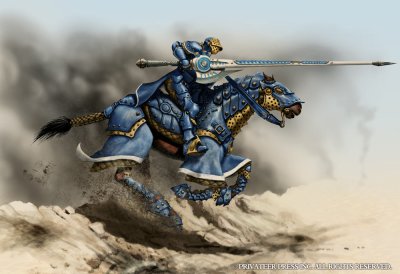
Captain Archer is a young but extremely capable Storm Lance captain who serves as Lord General Stryker’s adjutant. She’s often in the thick of things, leading the Storm Lances into battle and fighting alongside her lord general. Like many in the Storm Division, she admires Stryker, but her job is also to make sure her CO doesn’t take unnecessary risks, something for which he is, uh, kind of infamous for. She’s blunt, to-the-point, and isn’t afraid to tell Stryker when he’s being an idiot, as respectfully as possible, of course.
Captain Reece Keller
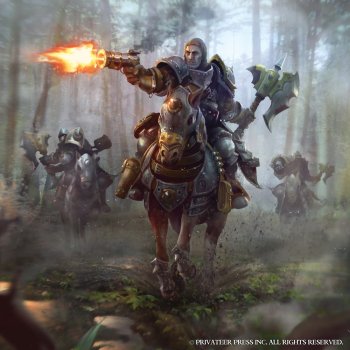
I love mercenaries, and I especially love Steelheads, so with Ashlynn d’Elyse taking a prominent role in this novel, I jumped at the chance to include some of the rough-and-tumble swords for hire. Captain Reece Keller is the head of a Steelhead chapter in Ord, though he’s of Cygnaran descent. He leads nearly a thousand halberdiers and heavy cavalry in the employ of Marshal d’Elyse, and in many ways serves her as an unofficial military advisor (something her actual military advisors aren’t too keen on). He’s a veteran merc with a personality that might be described as charming or grating, depending on who you talk to.
Swift Sergeant Isaac Dane
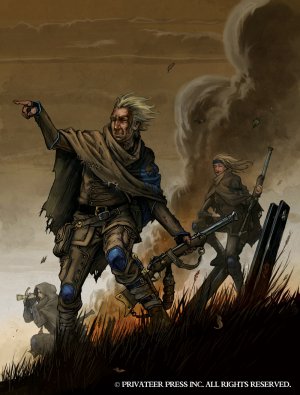
One of the senior-most field agents for the CRS (Cygnaran Reconnaissance Service), Swift Sergeant Dane is a ranger who has refused promotion to stay active in the field. There are few in the CRS with his degree of field craft, and he excels at reconnaissance missions or hit-and-run style guerilla combat. He is assigned to Major Asheth Magnus primarily to keep an eye on the veteran warcaster and to report to Lord General Stryker if Magnus strays too far from mission parameters. He is a stoic and professional soldier who takes his duty to king and country very seriously. As you might imagine, Magnus is not exactly thrilled to have Swift Sergeant Dane on his staff.
Lieutenant Shamus Brigland

A former pirate who served on the infamous Calamitas under the even more infamous warcaster and privateer Captain Bartolo Montador, Lieutenant Brigand took up with Asheth Magnus when the exiled warcaster worked as a mercenary. When Magnus was pardoned and rejoined the Cygnaran military, Brigland followed and received the rank of lieutenant in the Trencher Corps. He is devoted to Magnus but has eagerly taken to his new life as a soldier, seeing it as a fresh start and a way to remake himself as a legitimate warrior after a less-than-legitimate history. As one might expect of a former pirate, Brigland is crass, uncultured, and he’s not exactly a “rule follower,” all traits Magnus finds useful.
Specialist William Harcourt

A field mechanik in the Cygnaran Army, Specialist William Harcourt has only recently joined the Storm Division and has very little combat experience. He is a gifted mechanik, however, and displays an affinity with warjacks that borders on the supernatural. He comes to Lord General Stryker’s attention by demonstrating that affinity with Ol’ Rowdy, Stryker’s infamously cantankerous Ironclad. Harcourt becomes Rowdy’s dedicated mechanik and is thrust into battle alongside the warjack so that he can perform repairs in the field. Harcourt is unsure of himself, but Stryker sees his worth and attempts to bolster the young man’s courage and confidence by testing his mettle in the crucible of battle. If you’ve been following these updates, you know Specialist Harcourt is, uh, even more special than his rank suggests. 😉
Crash & Soldier
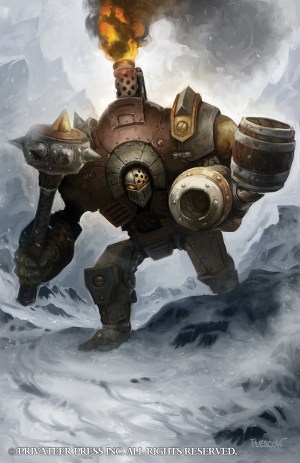
Crash and Soldier are a pair of ancient warjacks that have fought alongside Marshal Ashlynn d’Elyse for many years. The two Mules have logged nearly a century of combat time, and as old warjacks are prone to do, have picked up a number of personality quirks. Crash is so named for its habit of charging into combat, eschewing its battle mace in favor of using its own multi-ton body as a battering ram. Soldier has adopted many of the traits of the professional fighting men and women it has served alongside for decades. It generally requests permission from Ashlynn before engaging in any military task, often performing a crisp salute with its mace before charging off to destroy the enemy. Like Stryker and many other warcasters, Ashlynn has developed a close bond with Crash and Soldier and treats them more like the human men and women under her command than expendable machines.
Corporal Horgrum Stonebrow & Sergeant Victor Sharp
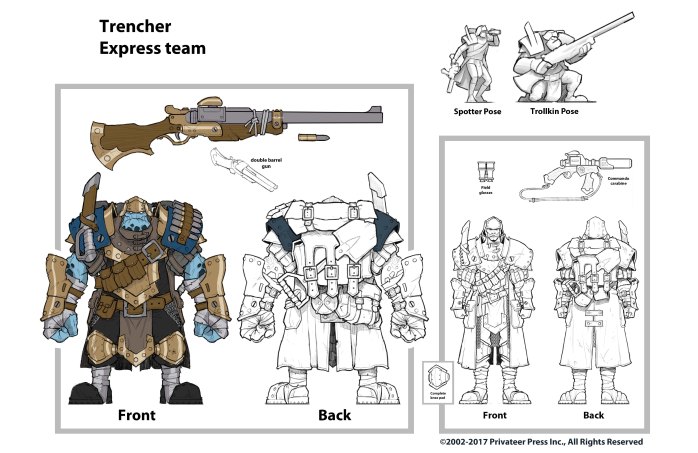
One of the first Trencher Express Teams, the duo of trollkin sniper Horgrum Oakheart and his spotter and CO Sergeant Victor Sharp provided ample proof that the new units could be incredibly effective in the field. Horgrum and Sharp were assigned to the Storm Division shortly before Cygnar’s invasion of Llael to bolster Stryker’s reconnaissance efforts. In the past, the pair have worked at counter-sniper operations, though they are excellent scouts as well. Horgrum has been a part of the Cygnaran military for nearly two years and is still unused to the culture and customs of his human brothers in arms. Much to Sergeant Sharp’s chagrin, Horgrum often speaks when he shouldn’t and rarely acknowledges proper military protocol. Despite all this, the trollkin’s fearsome skill with his weapon more than makes up for his lack of decorum.
If you have a question or comment about the book or my writing process, ask away in the comments section below. And if you’ve missed the updates for the previous weeks, you can find them right here:
Acts of War: Aftershock is available for preorder in print and digital from Amazon, and you can buy and read the first book in the series, Acts of War: Flashpoint, right now.
Submission Statement: March – May 2017

Well, as you can tell by the title of this one, we’re playing a little catch-up. I haven’t been nearly as active with my short story submissions in the past three months, largely because my focus has been on Acts of War: Aftershock, my impending novel from Privateer Press. I haven’t been completely inactive, but these three months are well below my usual submission rate. Anyway, here’s what we’re dealing with.
March, April & May 2017 Report Card
- Submissions Sent: 8
- Rejections: 6
- Acceptances: 0
- Publications: 0
- Other: 1
Yep, my submission slump continues and is not helped by the fact that I haven’t sent out many stories over the past three months.
Rejections
Six rejections for the period, only one of which can be categorized as a “good” rejection.
Rejection 1: Submitted 2/25/17; Rejected 3/19/2017
Thank you for submitting “XXX” to XXX. We appreciate the chance to read it. Unfortunately, we don’t feel it is a good fit for us and we’re going to have to pass on it at this time.
Garden-variety form rejection from one of the pro markets in my standard submission rotation. Not much to see here.
Rejection 2: Submitted 3/13/17; Rejected 3/28/2017
Thank you for submitting “XXX” to XXX, but we’ve decided not to accept it for publication.
We appreciate your interest in our magazine.
Another standard form rejection from a pro market. This is the first time I’ve submitted to this magazine, largely because they primarily publish fantasy and sci-fi, and I primarily write horror. I recently finished an urban fantasy story that fit the bill, though, so I took the plunge on a new market.
Rejection 3: Submitted 3/29/17; Rejected 4/9/2017
Thank you for submitting “XXX” to XXX, but we’re going to take a pass on this one.
Yet another standard form rejection, this time from a pro audio market. This is the same story from rejection two, by the way.
Rejection 4: Submitted 3/19/17; Rejected 4/16/2017
Thank you for your interest in XXX. Although we enjoyed reading your story it is not the right fit for our magazine. We hope that you can place it elsewhere. Please feel free to submit to us again when we reopen our submissions.
This is a form rejection from a fledgling market, so I don’t have enough experience with them to tell if this is standard or higher-tier. It has some of the trappings of a higher-tier rejection–enjoyed reading, feel free to submit–but you never know if those statements are sincere or simple niceties until you have more rejections to compare. At this point, I’m going with standard form rejection.
Rejection 5: Submitted 3/20/17; Rejected 4/26/2017
Thank you for submitting “XXX” to XXX. Unfortunately, it doesn’t quite meet the needs of our podcast.
This is a form rejection from another pro audio market. The story is a reprint submission of one of my more well received horror stories, and I was champing at the bit waiting for the rights to return to me so I could submit it to this particular market. I really thought it would be right up their alley, but, as you can see, that wasn’t the case. Please don’t take this is a complaint or a criticism of this market’s selection process or their editors’ tastes; it isn’t that. There’s nothing even approaching a guarantee in publishing, and sometimes your instincts on where to submit a story can be a little off or just flat wrong.
Rejection 6: Submitted 5/19/16; Rejected 5/22/2017
We have read your submission and unfortunately your story isn’t quite what we’re looking for right now. While we regretfully cannot provide detailed feedback due to the volume of submissions, we thank you for your interest in our magazine and hope you continue to consider us in the future.
Finally, a tiny ray of sunlight into the black void of submission purgatory. This is a higher-tier rejection from a pro horror market for a brand new story, one that I think has real legs. Getting this higher-tier rejection from one of the toughest markets in the biz is a good sign, and I’ve since fired it off to another pro market. Those of you who have followed my blog for a bit or who submit horror stories on a regular basis will no doubt recognize this rejection and the market from whence it came.
Other
One “other” for this period, a further consideration letter.
Further Consideration 1: Submitted 2/25/17; Rejected 3/19/2017
Thank you again for your submission. We really like this story and would like to add it to our short list, if that is okay with you. We will have the final decisions by July 1 at the latest. Let us know!
This is a new semi-pro magazine that publishes “extreme” horror. I sent them the only story I have that really fits that bill, a story that’s been on the cusp of publication before. This is good news, and unlike rejection five, where my submission instincts were a little off, it looks like I might have paired the right story with the right market/editor here. We’ll see. I certainly have a barrel full of rejections that arrived after a nice letter like this. 🙂
Okay, we’re all caught up. I’ll start doing these monthly again in July. Now, tell me about your recent submission triumphs and woes in the comments.
Effectively Wild – A Baseball Horror Story
Night Walk & Other Dark Paths
Acts of War: Flashpoint

Acts of War: Aftershock

Acts of War: Stormbreak


