
Acts of War: Aftershock – Week 19 Update
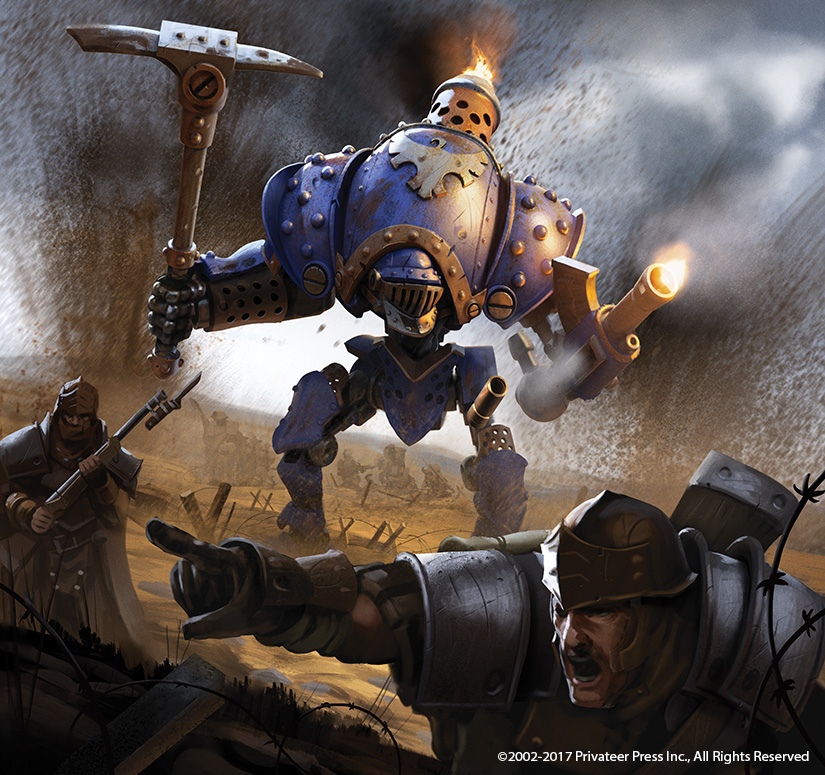
Week nineteen, and I am neck-deep in revisions for Acts of War: Aftershock.
Progress: I’m very pleased with the progress I’ve made so far. I’ve revised over a third of the novel at this point, and that includes rewrites of two major scenes. I’m on pace to put this round of revisions to bed in a total of two weeks or so.
Revision Roundup: Today, I’d like to talk about one of three major areas of revision I mentioned in last week’s post: setting continuity. These are often little tweaks and adjustments that ground the story more firmly in the Iron Kingdoms, or, sometimes, fix outright errors. I’ve been working in the IK for seven years now, so I’m very familiar with how things work in the land of steam and steel, but I do make mistakes, and luckily Doug Seacat and Matt Goetz are there to catch them.
Here’s an example a fairly minor continuity issue that I’ve already addressed:
Original text: The Chargers’ cannons went off first, and he aimed the explosive shells at the towers atop the gate, guiding them with his will.
I had been using these cannon blasts to kill multiple foes, and Doug Seacat had this comment on the text: Chargers don’t have explosive shells. Sentinel guns would work better for clearing groups of infantry, whereas Charger cannons are better to hit individual targets harder. If you want light warjacks with explosive shells, have him take Grenadiers instead of Chargers.
Revised text: The Grenadiers’ grenade launchers went off first, and he aimed the explosive shells at the towers atop the gate, guiding them with his will.
The solution: An easy one. I changed the Chargers to Grenadiers in this scene, changed the words “cannons” to “grenade launchers,” and problem solved. This is one of the small details even someone well-versed in the setting can overlook. You see the word cannon, and you think explosion, but as Doug said, that’s not really what Charger cannons do. Grenadiers, on the other hand, are a great fit for this scene.
I needed to do some additional adjustments in the scene to replace the Chargers (and let the Sentinels mow down some infantry), but it was all pretty easy stuff. I would say about twenty five percent of the changes I’ll be making in the manuscript are similar to this example. Next week, we’ll get into some of the more complicated revisions.
Mini Excerpt: Hey, let’s take those new Grenadiers for a test drive!
The Grenadier swung its mattock at a Winter Guard officer locked in a saber duel with a Resistance soldier. The pick blade of the oversized weapon struck the Khadoran in the back, passed completely through his body, and burst from his chest in a spray of blood. A slight pulse of irritation flowing back through the warjack’s connection with Magnus as the Grenadier hoisted the dead soldier from the ground, now pinned to its weapon, and shook the corpse free like a man trying to dislodge a bit of trash from the bottom of his shoe.
Often when you revise a scene, you end up liking the revision way more than the original. Of course, this makes Grenadiers seem like jerks, which, hey, maybe they are. 🙂
If you have a question or comment about the book or my writing process, ask away in the comments section below. And if you’ve missed the updates for the previous weeks, you can find them right here:
- Week 1 Update
- Week 2 Update
- Week 3 Update
- Week 4 Update
- Week 5 Update
- Week 6 Update
- Week 7 Update
- Week 8 Update
- Week 9 Update
- Week 10 Update
- Week 11 Update
- Week 12 Update
- Week 13 Update
- Week 14 Update
- Week 15 Update
- Week 16 Update
- Week 17 Update
- Week 18 Update
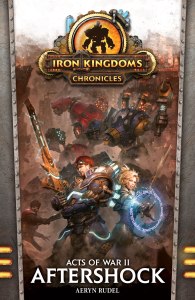
Acts of War: Aftershock is available for preorder in print and digital from Amazon, and you can buy and read the first book in the series, Acts of War: Flashpoint, right now.
On Writing Godless
Hey, folks, my writer pal Orrin Grey wrote a book called Godless set in the Iron Kingdoms, the same steam-powered setting as my upcoming novel Aftershock. Orrin is one hell of a writer, and this is one hell of a book. In Orrin’s own words, “This is a fantasy story about war and faith, about knights, robots, monsters, and epistemological uncertainty.” I mean, seriously, what more can you ask for out of a novel?
Orrin talks a bit about the writing process for Godless on his blog, and it’s an interesting glimpse behind the scenes for anyone curious about the writing process for media tie-in.
Godless is available right now in e-book and print formats. Check it out.

 Well, it kind of crept up on me, but today is actually the release day of my very first novel, so if you always wanted to read a novel by me, you’re into Warmachine, or you just like the idea of devout religious types with big robots burning heretics and fighting monsters, you might want to pick up a copy of Godless, the first book in the Fire & Faith series from Privateer Press! (It’s available in print or digital via Amazon, or you can check the Skull Island eXpeditions website.)
If you had asked me several years ago how and when I would write my first novel, I would not have guessed that it would be a licensed Protectorate of Menoth novel for Privateer Press. Even when I had already started doing various freelance work for them, and wrote what was, heretofore, my longest published piece…
View original post 457 more words
Acts of War: Aftershock – Week 18 Update

Here we are at week eighteen into the production of Acts of War: Aftershock. These updates are going to change a bit as I start working on revisions. More on that below.
Progress: I’m starting revisions on the novel this week–today, actually—so my progress reports will reflect where I’m at with rewrites, scene additions, scene subtractions, and all the myriad little tweaks and adjustments that will turn the book into the final product you’ll be reading on July 12th.
Revision Roundup: The editors at Privateer Press have given me extensive notes on what they’d like to see changed or adjusted in the next draft. I’ve worked with all of these folks many times on long and short fiction, and the level of notes and requested changes are what I expected. There’s work to do, but it’s not overwhelming, and much of it entails adding material, which, in my opinion, is the easiest type of revising.
There are three primary, broad-strokes areas I’ll be working on in this round of revisions: story, character, and setting continuity. All three involve changes big and small, and I’ll detail some of those changes in the coming weeks as I work through them, but here’s a little taste. After reading through the draft, the editors at Privateer Press all came to the same conclusion: more Ashlynn d’Elyse. That suits me just fine. She’s a great character, and I’ll be adding a scene or two with the Llaese Resistance leader in this next draft. In fact, that’s gonna be the very first thing I do!
Mini Excerpt: Since the editors want more Ashlynn in the next draft, here’s more Ashlynn in this week’s mini-excerpt AND on the awesome cover of Aftershock (courtesy of the extremely talented Néstor Ossandón).
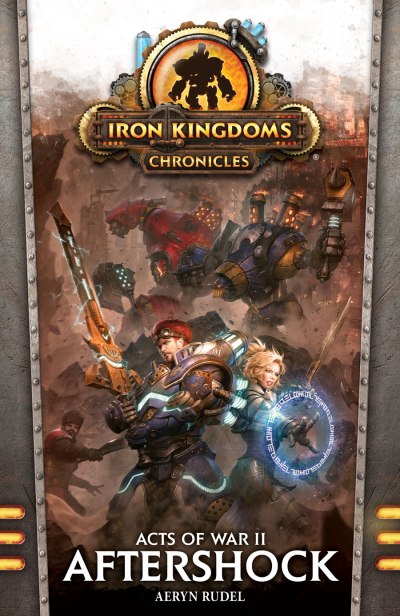
Another volley from the two Destroyers came shrieking down from the wall. The shells detonated in front of Ashlynn, pelting her power field with debris. Her Vanguards absorbed most of the blast, though one of them suffered for it. Damage reports flowed back through her connection with the warjack; its right leg had been severely damaged. She ordered it to fall back and protect the troops behind her.
She was close enough now that Crash and Soldier could reach the top of the wall with their steam cannons. She urged them to fire, and the explosive shells arced high and exploded against the hull of one of the Destroyers. Khadoran warjack armor was thick, but the twin blasts sent the great red machine stumbling backward, and then it disappeared. Ashlynn smiled at the thought of the ten-ton warjack plummeting forty feet to the ground below. Hopefully, there would be Assault Kommandos to soften its landing.
I like to think some proud son of the Motherland, a kovnik maybe, had a bunch of Winter Guard at the bottom of that wall waiting to soften the fall of such valuable equipment. 🙂
If you have a question or comment about the book or my writing process, ask away in the comments section below. And if you’ve missed the updates for the previous weeks, you can find them right here:
- Week 1 Update
- Week 2 Update
- Week 3 Update
- Week 4 Update
- Week 5 Update
- Week 6 Update
- Week 7 Update
- Week 8 Update
- Week 9 Update
- Week 10 Update
- Week 11 Update
- Week 12 Update
- Week 13 Update
- Week 14 Update
- Week 15 Update
- Week 16 Update
- Week 17 Update
This week marks a special occasion. Acts of War: Aftershock is available for preorder in print and digital from Amazon! Choose your preferred format and click the link below.
Acts of War: Aftershock – Week 17 Update

Seventeen weeks into the production of Acts of War: Aftershock, and the revision process is about to kick into high gear.
Progress: Tomorrow, I’m heading into the Privateer Press offices to discuss revision notes on Aftershock with publications director Mike Ryan and the continuity team, which includes Doug Seacat and Matt Goetz. One of the handy things about living in the same city as your publisher is you can have a face-to-face meetings to make sure we’re all on the same page with any big changes. After the meeting, I’ll start revisions in earnest with a goal of completing them by the end of the month.
The Best Part: Help is on the way. One of the great things about writing for Privateer Press is that I have access to a fantastic team of editors and continuity editors. I can get questions answered on just about anything Iron Kingdoms-related from arguably the best source on the planet: Doug Seacat, the sage of the IK himself. The man is a literal encyclopedia of Iron Kingdoms lore. Mike Ryan and Matt Goetz also help out with continuity, and, even better, all three of them are accomplished writers with a great sense of story and characterization. So, in other words, I’m in good hands, and the changes I’ll be making will only improve the final product.
The Hard Part: No, mine! With revisions on a novel this size, you’re going to have minor disagreements from time to time. I’m not talking about the cut-and-dry continuity stuff that’s either right or it isn’t; I’m talking about more nuanced things like characterization and narrative pace and structure. Occasionally, they’ll want me to change something I’d like to keep. It could be a small detail, like the description of character, to something a bit bigger, like that character’s motivation. Invariably, the editors are open to discussion, and if I can make a good case for leaving things the way I had them, they’ll remain unchanged. On the other hand, the editors often make such a compelling argument, even on a point I’m fairly passionate about, that I’ll come around to their line of thinking or at least find a workable compromise.
Mini Excerpt: As many of you know, Asheth Magnus, one of the heroes (?) of Acts of War: Aftershock, is not a “whole” man. His right arm has been replaced with a mechanikal prosthetic, which, as we see in the excerpt below, he has been known to use creatively.

“I know who you are,” Kovnik Narova broke in. “A murderer, a traitor, and a liar.”
Magnus chuckled. “Well, I can’t deny all of that,” he said. “But I’m glad we’re well acquainted.”
He squatted down in front of the Khadoran, ignoring the pain it wrung from his braced leg. He reached out with his right hand, a mechanikal prosthetic, bulky and crude but effective, and laid it on the kovnik’s shoulder. The man did not flinch or pull away, but he would feel the weight and strength of that hand. “I have some questions for you,” he said and squeezed, not enough to hurt yet. He could feel Dane’s eyes on his back, watching, evaluating.
“I will tell you nothing,” Kovnik Narova said.
“I understand,” Magnus said with a sympathetic nod. “You are a good soldier, and you must say that.” He tightened his grip, and the Kovnik winced. Bruising pressure now. “Here is the first question.”
I recently broke my collarbone, a painful experience, and one that I drew upon quite a bit in this excerpt . . . and what comes after. 🙂
If you have a question or comment about the book or my writing process, ask away in the comments section below. And if you’ve missed the updates for the previous weeks, you can find them right here:
Swings & Misses: The Submission Slump

If you were to look at my acceptance ratio at Duotrope a few months ago, you’d have seen a number of around 20%, meaning, very roughly, that for every ten submission I sent, two would be accepted. In baseball terms, that’s a batting average of .200, which, admittedly, ain’t great for the MLB (the infamous Mendoza line), but from what I understand, it’s not a terrible number for writers.
Well, just like a baseball player, a writer can see his or her average plummet from too many swings and misses in a row, and that’s what’s happened to me of late. I’ve watched my acceptance ratio plummet to 11.3% (I’m hitting like a pitcher now) over the last couple of months. This is due to an extended string of rejections without the respite of an occasional acceptance. I’ve gone 0 for 17 since my last hit . . . uh, I mean acceptance. So, to amuse myself (mostly) and hopefully a few of you, I’m going to liken some of the rejections I’ve received in my slump to the various hitting woes a baseball player might experience over the course of the season.
Here we go.
1) The Routine Play Rejection – The player hits a medium-depth fly ball or a nice Sunday-hop grounder that even a little leaguer could field cleanly. It’s so common, it’s, yep, routine.
This is the vanilla form rejection that arrives by the publisher’s expected response time. No surprises here, just routine rejection.
2) The At ‘Em Ball Rejection – In baseball, the “at ‘em” ball is a ball hit straight at an infielder that results in a quick out. The player sometimes doesn’t even make it halfway down the line before the out is recorded.
In rejection terms, this is the fast, sometimes same-day form rejection you can get from some top-tier markets. You hit send and you don’t even have time to fantasize about selling a story to that one market you’ve been trying to crack for five years before the rejection arrives in your inbox.
3) The Can of Corn Rejection – The can of corn in baseball parlance is a high, lazy fly ball that gives the outfield plenty of time to settle under it and make an easy catch. It’s one of the more ho-hum outs you can make.
The rejection version of this particular baseball play is the form rejection that comes after months and months of waiting (6 months in this case). The editor has had all the time they need to make a decision, and that decision was “nope.”
4) The Circus Catch or Highway Robbery Rejection – The batter has done everything right. He’s made good contact and hit the ball hard, but the fielder makes a spectacular play, even leaping high over the wall to take away what should have been a homerun.
In rejection terms, this is that story the editor professes his or her love for but decides not to publish after a few months of deliberation because they have another story just like it, one they like a bit better, or a dozen other perfectly viable reasons beyond your control. You wrote a good story, sent it to a market that liked it, but despite all that, you still get a rejection.
5) The Swinging Bunt Rejection – Sometimes a baseball player will take a mighty hack at the ball, barely touch it, and hit a little dribbler out in from of home plate. Often, he won’t even realize he’s hit the ball fair until the catcher picks up the ball and throws him out at first while he stands there staring at the umpire like an idiot.
The rejection version of this particularly embarrassing situation is when you send out a story and realize, to your everlasting horror, you’ve sent an older, error-riddled version instead of the polished, properly formatted, and, you know, SPELL CHECKED, version you slaved over for hours. The rejection doesn’t say, “Hey, dumbass, you sent us something that looks your 7th-grade book report,” but in your heart of hearts, you know the truth.
Well, that’s a hopefully amusing look at my current submission slump. Maybe I’ll break out of it in April and hit for the cycle, which would be placing a story with a free market, a token market, a semi-pro market, and a pro-market in the same month. Hell, at this point I’d take a seeing-eye single through the infield because the second baseman got his spikes caught on the turf and fell flat on his face. Not sure what the literary equivalent of that would be, though.
I’d love to hear about your own submission streaks or slumps in the comments.
Acts of War: Aftershock – Week 16 Update
Sixteen weeks into the production of Acts of War: Aftershock, and here’s the lay of the land.
Progress: The first draft is still under review with the editors at Privateer Press, but as I hinted at last week, I have not be sitting here twiddling my thumbs. This week I put the final revisions on a prequel story called “Confirmed Kill” about the trollkin sniper Corporal Horgrum and his human spotter and CO Sergeant Sharp. Both appeared in Acts of War: Flashpoint and return in Acts of War: Aftershock in a larger role. The story will appear in the next issue of No Quarter magazine (#72) along with some other goodies you won’t want to miss.
The Best Part: Don’t forget the little guys. When you’re writing an epic war novel like Aftershock, your action focuses on the main characters, the heroes and villains of the story, but they’re commanding entire armies of soldiers, often faceless combatants that are doing the bulk of the fighting. Now, the Iron Kingdoms makes filling out the ranks a lot more interesting because there are so many interesting and flavorful choices. I mean, I’ve got gun mages (both Cygnaran and Llaelese), Trenchers of every flavor, Storm Lances, Storm Knights, Iron Fang Pikemen and Uhlans, Winter Guard, Assault Kommandos, Man-O-War Shocktroopers and Demolition Corps, and the list goes on and on. The names of those troop types alone conjure all kinds of images, so it just makes a writer’s job that much easier having all that cool on tap.
The Hard Part: The little guys have to count, you know, a little. When your action is focused on the near god-like power of warcasters, it can be tough to present a credible threat without the use of other heavy hitters. Stryker and Magnus can mow down large groups of common soldiers, but it’s important to point out that with enough numbers or with the right support, those common soldiers can really ruin a warcaster’s day. It’s nice to have Khador as my primary antagonist in these novels, because the Reds don’t do anything small-scale. They field troops that can be a serious thorn in a warcaster’s side without having to throw an entire regiment at him. This week’s mini-excerpt and art features just one of these elite Khadoran killers.
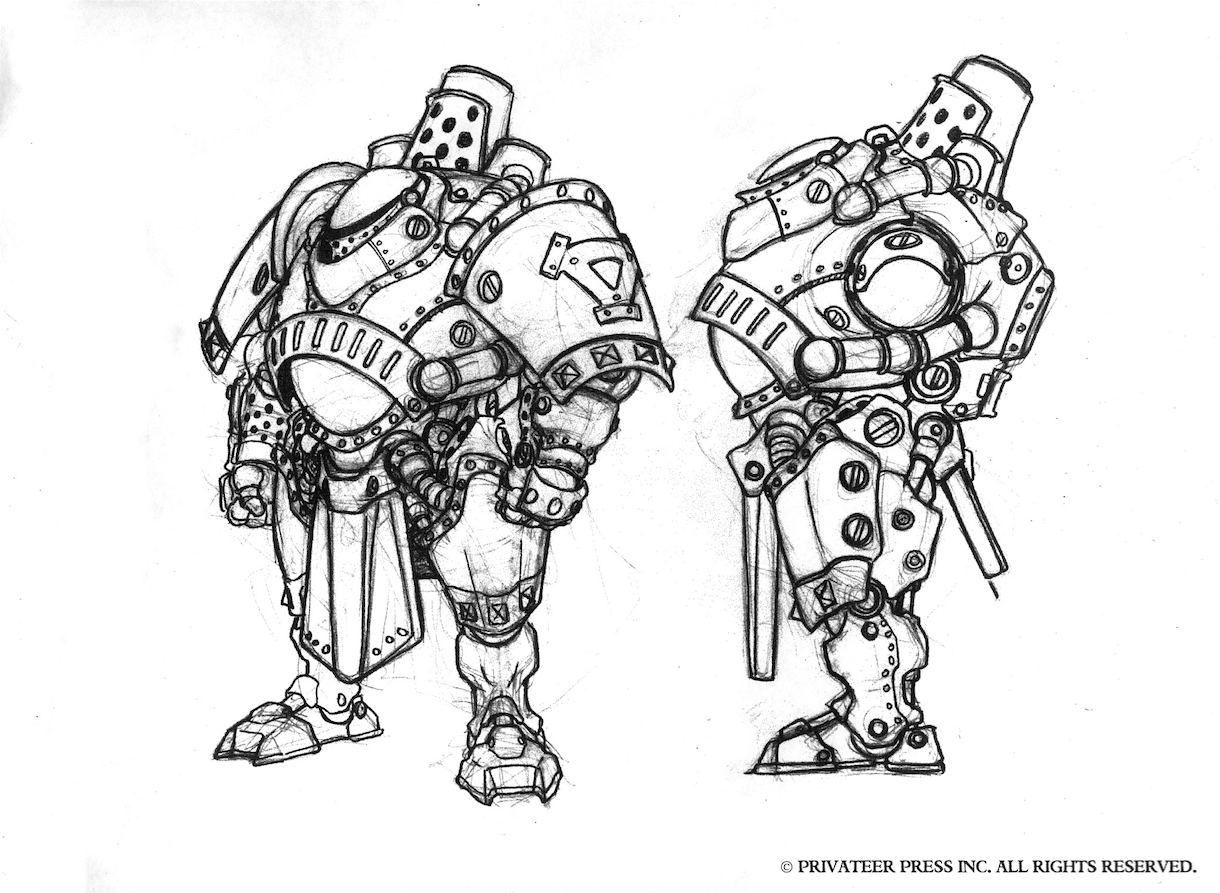
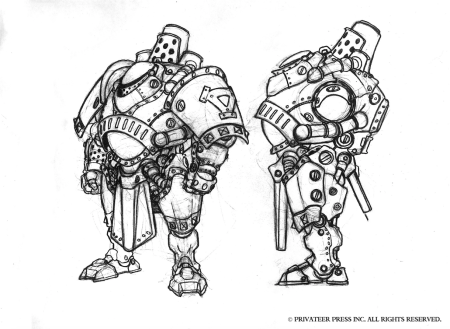
Mini Excerpt: The Man-O-War, brave Khadoran soldiers encased in massive suits of steam-powered armor, have been my go-to in a number of scenes where I need to present a credible threat to warcasters without resorting to, uh, other warcasters. These guys and gals are kind of Khador’s answer to light warjacks, and their armor, plus the truly fearsome weapons they wield, make them a match for just about anything on the battlefield, especially when you get a whole bunch of them together.
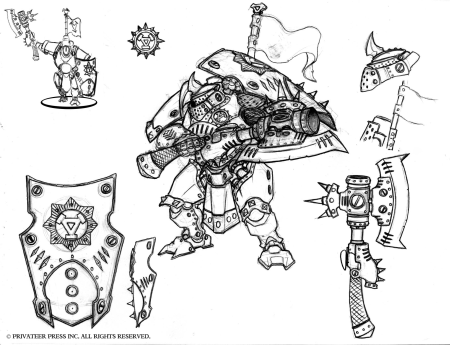
Stryker batted an Annihilator Axe away with Quicksilver, then slipped back to let two more narrowly miss. He had a momentary opening and made a lunging overhand cut at the Man-O-War directly in front of him. The strike lacked the power to penetrate the man’s armor, but it sent him stumbling back a step, disrupting the shield wall, and allowing Stryker to make a more powerful attack at the next Khadoran in the line. He delivered this blow with enough force to split armor and flesh, and one Man-O-War was down.
He leapt back to keep the enemy from surrounding him, but a single Man-O-War broke formation and charged, whipping his Annihilator Axe up to deliver a mammoth strike. The enemy’s weapon was longer than Quicksilver, and Stryker could do little but throw up a desperate parry to ward off the Khadoran attack. The Man-O-War smashed his blade aside, and the axe struck him between gorget and pauldron. He grimaced as the plate steel buckled but held. Harcourt’s spell saved him. Without it, the blow would have broken his collarbone at a minimum or just split him open from neck to sternum.
Always keep those journeyman warcasters handy, right, folks? Never know when you might really need an Arcane Shield spell. 🙂
If you have a question or comment about the book or my writing process, ask away in the comments section below. And if you’ve missed the updates for the previous weeks, you can find them right here:
Acts of War: Aftershock – Week 15 Update

Week fifteen! Here’s the update on Acts of War: Aftershock.
Progress: I haven’t been idle while waiting for Privateer Press to review the first draft of Acts of War: Aftershock. In fact, I managed to write another 3,000 words in the form of a short story, a prequel of sorts, focusing on one of the secondary character in the novel. More on that soon.
The Best Part: Looking ahead. As I read through the Aftershock manuscript again, I’m getting ideas for the third book in the trilogy, and I’ve begun to jot them down for the eventual discussion with Privateer Press chief creative officer Matthew D. Wilson, publications director Mike Ryan, and the other folks who make all the Skull Island eXpeditions books happen. The third act is always the BIG one, and even though I won’t start writing book three for many months, I can’t help but get excited about the future of the series.
The Hard Part: Uh, looking ahead. Another two-for this week. As I inch closer to the spectacularly gigantic conclusion to the trilogy, my fragile writer brain reels in horror. I mean, it’s got to be cool, it’s got be epic, and it’s got be, you know, good. That’s a lot of pressure, but like every major writing project, you have to approach it in pieces, one day and one word at a time. Taking it in small bite-sized chunks prevents me from seeing the towering monstrosity of the whole project and allows me to keep my sanity, such as it is. I’ve done that with each novel I’ve written, and I don’t expect book three to be different in that regard.
Mini Excerpt: Today’s excerpt focuses on Asheth Magnus and a confrontation with one of the most feared Khadoran warjacks: the Juggernaut.
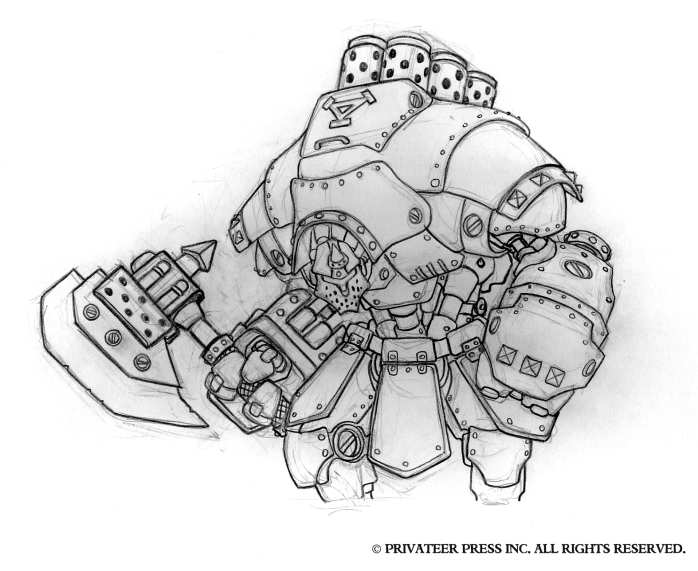
Magnus threw himself flat, dragging Legate di Morray down with him. The shell exploded behind them, and intense heat rolled over Magnus’ back. As he scrambled to his feet, he saw why. The Man-O-War shield cannon had blown a hole in the tower, giving him a clear view of the hellscape below. He pulled di Morray up and pressed him flat against the wall with his mechanikal arm. “Are you injured?” he asked. The legate shook his head, but he looked like he might collapse any minute.
The angle of the doorway ahead offered some cover from the enemy, but it obscured their view of what was inside. To make matters worse, smoke poured from the open door and filled the hall with a black haze. Magnus was more than a little concerned about what that meant. “Did you see what’s in the next room?” he shouted to Horgrum.
The trollkin appeared uninjured, and he stood against the wall a few feet ahead of Legate di Morray. “Three Man-O-War and a warjack with an axe made of ice.”
“Juggernaut,” Magnus said. “Fantastic.”
Come on, Magnus. It’s not all bad news, right? Ice axe, sure, but I’m pretty sure Horgrum would have mentioned the paint job if it was Beast 09. 🙂
If you have a question or comment about the book or my writing process, ask away in the comments section below. And if you’ve missed the updates for the previous weeks, you can find them right here:
- Week 1 Update
- Week 2 Update
- Week 3 Update
- Week 4 Update
- Week 5 Update
- Week 6 Update
- Week 7 Update
- Week 8 Update
- Week 9 Update
- Week 10 Update
- Week 11 Update
- Week 12 Update
- Week 13 Update
- Week 14 Update
***
Check out the first book in this series, Acts of War: Flashpoint, if you haven’t already. You can still get the e-book at 25% off from the Skull Island eXpeditions website by entering the code ACTSOFWAR1 at checkout.
Acts of War: Aftershock – Week 14 Update

Week fourteen has come and gone, and here’s your weekly update on Acts of War: Aftershock.
Progress: The first draft is still under review with Privateer Press, but this is not unusual for a couple or reasons. First, it’s a big book that a bunch of folks need to read, and that just takes time. Second, its July release date means there are books in the queue coming out well before it, like Orrin Grey’s Godless, which need editorial attention first. Truth be told, I finished the first draft of Aftershock well before the deadline, which is good for me, but it doesn’t necessarily speed up the editorial process. I still have to wait in line. 🙂
The Best Part: Sword nerdery. Writing this kind of fiction gives me plenty of opportunities to indulge my love of historical warfare. One of the things I like most is figuring out how different Iron Kingdoms weapons might be used in combat. Take Stryker’s mechanikal greatsword Quicksilver, for example. It’s meant to be used by a warcaster to crack open warjacks and other heavily armored targets. Though it can be wielded like a sword, to my mind, its use would often resemble certain types of polearms. On the other hand, Ashlynn d’Eleyse’s weapon Nemesis is a completely different story. She’s a renowned swordsman with a sword designed for dueling, and I can turn to various real-world techniques (from longsword to saber) to describe her fighting style.
The Hard Part: A little goes a long way. The last thing I want to do is turn the book into a treatise on sword-fighting. When I write a fight scene, I go back and read it, specifically looking to see if I’ve gone too far down the rabbit hole with my descriptions. I want to keep the action moving, and I don’t want to drop a paragraph of exposition on archaic fighting techniques into my battle. So, I work to show the techniques rather than just tell you about them. (I get to do the telling in a series of No Quarter articles.)
Mini Excerpt: Today’s excerpt focuses on Lord General Coleman Stryker, who has gotten himself in a bit of a pickle. He’s found himself without his trusty warcaster armor or Quicksilver and must rely on the skills he learned in the Cygnaran Royal Guard years ago.
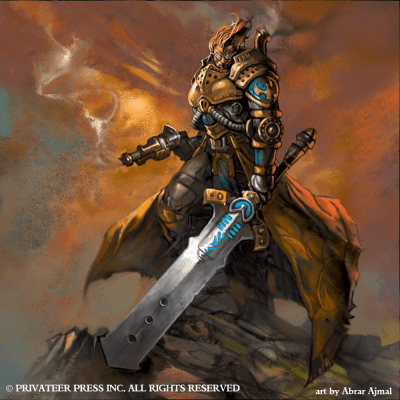
It had been many years since Stryker had used a sword like the one he’d taken from the slain gun mage, but the weapon was similar to the straight double-edged blades of the Royal Guard where he’d received his initial martial training.
The principal guards came back to him in a rush.
Prong.
He held the sword high, point toward his enemy, and caught an axe blow on the strong of the blade. The heavier axe slid away from his sword, and with a quick twist of wrist and shoulder he opened the Winter Guard’s skull with a powerful overhand cut.
The next Khadoran came at him with a rifle bayonet, thrusting at his stomach.
Nail.
Stryker turned his sword, point-down, in front of his body and knocked the bayonet away with a sharp parry. He lunged forward, bringing the point of his weapon back up, and used his momentum to ram the blade through the Winter Guard’s throat.
Split a skull, stab a throat—it’s just like riding a bike, eh, Lord General? 🙂
If you have a question or comment about the book or my writing process, ask away in the comments section below. And if you’ve missed the updates for the previous weeks, you can find them right here:
Acts of War: Aftershock – Week 13 Update

Here we are at week thirteen, and despite a mile case of triskaidekaphobia, we’re one week closer to the July release of Acts of War: Aftershock.
Progress: The first draft is still under review with Privateer Press, a process that can take some time since there a number of people who need to look at the manuscript. In the meantime, have a look at the next exciting release from Skull Island eXpeditions, Godless, the first novel in the Fire & Faith series by the very talented Orrin Grey.
The Best Part: My own little world. While the Iron Kingdoms is an established setting with established characters, but one of the little bonuses about writing a series of novels there is I get to create my own little cast of supporting characters. For example, I introduced many of the men and women that make up Lord General Stryker’s group of senior officers in Flashpoint, and now I get to continue their stories in Aftershock. Some of them have been promoted, shuffled around, given new duties, and so on, largely because of the events in the first book, something I hope to continue in the third. Today’s mini-excerpt focuses on one of these characters.
The Hard Part: Too many choices. Writing a book that’s based on a tabletop miniature game like WARMACHINE has a lot of upsides. I mean, there are so many cool warjacks, troops, and characters I want to put in there. The trouble is deciding which ones. There are essentially three armies in Aftershock: Cygnar, Khador, and the Llaelese Resistance. That’s a whole lot of men and machines to choose from. I have to narrow it down to what makes the most sense for the events in the book, but then, every once in a while, I do indulge myself by including something because it’s too damn cool to pass up. 🙂
Mini Excerpt: Today’s mini-excerpt focuses on one of Lord General Stryker’s officers, a woman who commands some of his most effective troops, the powerful galvanic cavalry known as Storm Lances. This brave storm knight was present during the siege of Riversmet in Flashpoint and continues to serve Cygnar directly under the command Lord General Stryker as the army moves on to its next target.
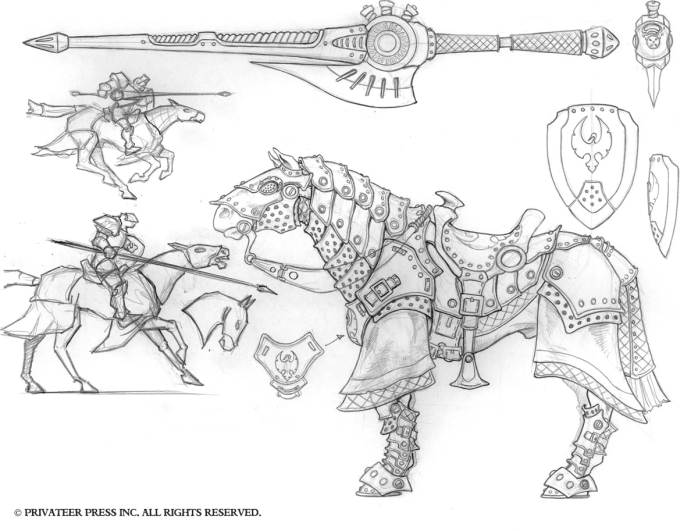
“There aren’t more than fifty Khadorans guarding that pass, sir,” Captain Archer said. “My Storm Lances can handle them.”
“Of that I have no doubt, Captain,” he said, took Quicksilver from its stand, and balanced the huge mechanikal blade over his right shoulder. “You are more than capable of defeating fifty Khadorans, but there may be more, and you’ll want a warcaster for that eventuality.”
Lissa Archer was a young and talented officer. She’d been knighted at the age of twenty and had spent the last six years serving in the Storm Lances, mostly in combat. She’d been promoted to captain after Riversmet and showed every sign of climbing well beyond her current rank. She was less than satisfied with his answer. “Permission to speak freely, sir?”
He chuckled and shook his head. “You know, there’s a major back in Riversmet who asks me that question a lot.”
Warcasters are often devastatingly effective frontline fighters, which is exciting, if a little nerve-wracking for the officers who try and keep them alive long enough to do all that leading from the front.
If you have a question or comment about the book or my writing process, ask away in the comments section below. And if you’ve missed the updates for the previous weeks, you can find them right here:
Excerpt: “Caroline” from Red Sun Magazine #3

My story “Caroline” was just published in Red Sun Magazine #3, and it’s the cover story. The you can check out that cover below by the incredibly talented Mitchell Malloy. The piece perfectly captures a scene from “Caroline,” not to mention the overall tone of the story. Also in this issue, Red Sun horror editor Phillip Englund interviews me in a vain attempt to discover what exactly is wrong with my brain that makes me write such bleak and horrific tales. 🙂
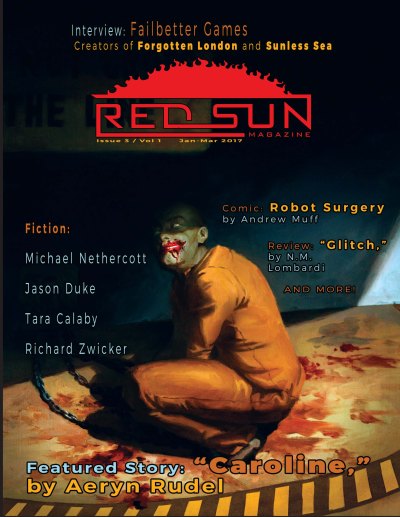
The good folks at Red Sun have also given me permission to publish the first 500 words of “Caroline” right here on my blog to whet your appetite for the rest of the story, not to mention the other great stories that are offered up in issue #3.
An Excerpt from “Caroline” from Red Sun Magazine #3
“Can I go to the basement to see Daddy?” Caroline said.
Barbara set the shotgun on the kitchen counter, made sure the safety was on, and knelt down to her daughter. “No, honey. Daddy isn’t ready for visitors yet.”
“When he finishes his lessons?” Caroline asked, hopeful. She and David had been very close, and Barbara knew she felt the loss more deeply than her twelve-year-old brother. Mark wanted nothing to do with his father.
“Maybe, but that might be a long time from now.” She pulled her daughter close, and Caroline melted into the embrace. After a few moments, Barbara gently pushed Caroline away. It took real effort to let her go. “Now go outside with your brother and Uncle Robert. I’ll call for you when I come back upstairs.” It was just too dangerous to have the kids in the house during rehab.
“I could help you with the lessons,” Caroline said. “I could help Daddy too.”
Barbara smiled. “I know you could, but remember what the people from the Rehabilitation Agency said. Just one of us right now, until he gets a little better.” Caroline was so smart, and she was fascinated by the rehab process, questioning Barbara on every detail. Barbara didn’t tell her daughter much–most of it wasn’t fit for an eight-year-old to hear, and the rest . . . She wouldn’t dash Caroline’s hopes like that.
“Please, Mom. I miss him so much.” Tears stood in her pale green eyes. Green like her father’s used to be.
“Go on, honey. Now,” Barbara said. It was a knife in her heart to see Caroline like this.
Caroline shuffled to the sliding glass door, opened it, and stepped out into the backyard. Her brother and her uncle were waiting for her. Robert looked a lot like David; he was three years younger, though his hair had started to gray at the temples. Stress, probably. She watched him scoop up Caroline, saw her come alive in his arms, smiling and laughing as he spun her around. Mark walked up behind them. He was smiling, too. They all looked happy. Despite the terrible thing that had happened, her family looked happy.
She watched Robert and her children for a few moments, trying to soak in as much of their joy as possible. Robert didn’t like staying outside while she was downstairs. He wanted to be with her if things got bad, but she wouldn’t allow it. She needed him to stay with Mark and Caroline. She didn’t want to worry about them while she worked with David. There was another reason, too, one she couldn’t tell him. Robert had become the bedrock upon which they were rebuilding their lives. She couldn’t risk him getting hurt, or worse. She remained devoted to her husband, but if David couldn’t come all the way back . . . She pushed the thought from her mind, guilty for even considering it. It was too soon to be thinking like that.
If you like what you’ve read, head on over to the Red Sun Magazine website and purchase issue #3 for the rest of the story, plus a whole bunch of other goodies.
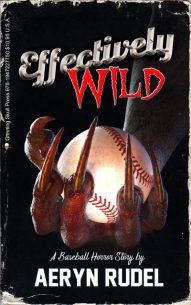
Effectively Wild – A Baseball Horror Story
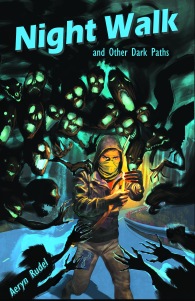
Night Walk & Other Dark Paths
Acts of War: Flashpoint

Acts of War: Aftershock

Acts of War: Stormbreak

 Aeryn Rudel's Rejectomancy