
A Week of Writing: 10/29/18 to 11/4/18

Another Tuesday update. Here’s the writing week that was.
Words to Write By
This week’s quote comes from heralded science fiction author Larry Niven.
You learn by writing short stories. Keep writing short stories. The money’s in novels, but writing short stories keeps your writing lean and pointed.
– Larry Niven
I wrote a lot of short stories before I attempted a novel, and I agree with Larry Niven’s quote. Short stories do keep your writing lean. For me, a lot of that comes from the word count limits you’re have to deal with when submitting short fiction. Generally, that means anything longer than 5,000 words is a tough sell. I also write a lot of flash fiction, limiting myself to just 1,000 words. I think the most important skill I’ve learned in writing short stories is to get to the point as quickly as possible. That’s a handy skill when it comes to writing novels, and, I find, helps me keep my story moving. Of course, with flash especially, you also learn to remove everything that is not essential from a story, which is a skill that translates very well to novels.
The Novel
I’m still working through the third revision, and I’ve fixed a couple of big problems. The best thing about this current revisions is that it’s revealed to me how to fix two or three of the major issues with the book, and that’ll be my focus for the next go-around. The tough part of this whole process, for me, is that clawing urgency to get the book finished, get it out there, get it done. But that won’t serve me in the long run, and sending out a half-finished manuscript is certainly not a path to anything resembling success.
Short Stories
I got back on track with submissions last week, and I’m making good progress this week too.
- Submissions Sent: 3
- Rejections: 4
- Acceptances: 0
- Publications: 0
- Shortlist: 0
The three submissions last week put me at a grand total of 108 for the year (I’m up to 111 as of today). All the rejections last week came from the same market at the same time, which I was more or less expecting.
The Blog
Two blog posts last week.
10/22/18: A Week of Writing: 10/22/18 to 10/28/18
The usual weekly writing report.
10/26/18: Submission Statement: October 2018
My monthly report card for all things submissions.
Goals
The usual. Keep plugging away at the current revision and send more short stories out.
Submission Spotlight
This week I’d like to draw your attention to a horror market that has just reopened their doors for submissions. After a long hiatus, Shock Totem is back in action. I have very fond memories of this market because I cut my flash fiction teeth on their bi-weekly one-hour flash fiction challenge, participating over fifty times. Many of the stories I threw together in an hour have gone on to publication, and I’m thrilled to see Shock Totem reborn and accepting submissions again. Shock Totem is a pro market that accepts works up to 5,000 words (they also take reprints). Full submission guidelines in the link below.
Shock Totem Submission Guidelines
That was my week. How was yours?
Submission Statement: October 2018

October has come and gone, and here are my submission endeavors for the month.
October 2018 Report Card
- Submissions Sent: 10
- Rejections: 11
- Acceptances: 0
- Publications: 3
Ten submissions is solid, and it puts me at 106 for the year. Lots of rejections this month, and for the first time in a while, no acceptances.
Rejections
Eleven rejections for October.
- Standard Form Rejections: 8
- Upper-Tier Form Rejections: 2
- Personal Rejections: 1
As usual, lots of standard form rejections with a smattering of upper-tier and personal.
Spotlight Rejection
The spotlight rejection for October comes from a big market I really hope to crack some day.
Dear Aeryn,
Thank you for sending us [story title] for consideration.
We appreciate the opportunity to read your work, but unfortunately this one isn’t for us.
Please note we received more than 1,750 submissions for approximately 20 slots, which means a lot of very, very good stories are not making the cut. (There are even some great stories that just aren’t right for our market.)
Please keep on writing, revising, and submitting to the very best markets you can find. It can be an arduous journey, but a fulfilling and rewarding one as well. And with each new story you write, you’re honing your craft. No effort at your writing desk is ever wasted.
We wish you the very best of luck with your work.
Some of you won’t have much difficulty figuring out which market this rejection comes from, but I shared it because of the submission numbers the editor included. This is a good example of the kind of odds you’re sometimes up against with pro markets. Here we’re looking at 20 slots for a whopping 1,750 submissions. That’s around a one-percent acceptance rate. As the editor points out, this means very good and even great stories are going to be rejected. It’s good to keep that in mind when you’re submitting to big markets so those form rejections don’t bum you out too much.
Publications
Three publications in October, the first of which is free to read online.
“When the Lights Go On”
Published by The Arcanist (free to read)

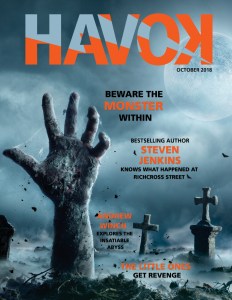
“Burning Man”
Published by Havok Magazine
“Time Waits for One Man”
Published by Factor Four Magazine

And that was my October. Tell me about yours.
A Week of Writing: 10/22/18 to 10/28/18

Getting a late start, but here’s how my writing week that was went.
Words to Write By
This week’s quote comes from Michael Crichton
“Books aren’t written, they’re rewritten. Including your own. It is one of the hardest things to accept, especially after the seventh rewrite hasn’t quite done it …”
—Michael Crichton
This quote pretty much nails how I’m feeling at the moment as I stare down the barrel of another revision. It’s a tough to accept your novel isn’t quite where it needs to be. You want to get it out there, you want people to read it (and publish it), but if you ignore that inescapable feeling that the book isn’t ready and send it out anyway, I think you’re setting yourself up for failure. So, as I finish this revision knowing I’ll need to do at least one more, I’m trying to keep my eye on the goal. That goal is not to write and revise a book as quickly as possible, it’s to write and revise a book that represents my best work.
The Novel
I’m nearing the end of revision three on my novel Late Risers. I’ve fixed many problems, and the book has indeed gotten better, but there’s no escaping the fact I’ll need at least one more revision before it’s ready to shop. It’s a bitter pill because I’m so eager to get the book out in the world, but I wouldn’t be doing myself any favors pushing it out the door before it’s ready. So, it’s head down, keep working, keep refining, keep revising.
Short Stories
Well, last week was a rarity. I was so busy with novel revisions, I didn’t write or submit any short stories. In addition, I didn’t receive any rejections or acceptances, and I didn’t have anything new published. That should change this week, but for the moment, here’s a whole bunch of zeroes.
- Submissions Sent: 0
- Rejections: 0
- Acceptances: 0
- Publications: 0
- Shortlist: 0
I’m still at 105 submissions for the year, and I have sent 9 submission in October. So I don’t feel last week’s goose egg is a major setback.
The Blog
Two blog posts last week.
10/22/18: A Week of Writing: 10/15/18 to 10/21/18
The usual weekly writing report.
10/26/18: How Many Rejections Add up to an Acceptance?
In this post, I looked at all my acceptances for the year and how many rejections each received before the big yes.
Goals
Finish this revision and get ready for the next, and hopefully last, one. I’d also like to get at least one more submission out in October for an even ten.
Story Spotlight
This week’s story spotlight is “Burning Man,” recently published in the very last issue of Havok magazine (in it’s current incarnation). This is a story I’ve been kicking around for awhile, and I’m glad it’s finally found a home. This one isn’t free to read, but the magazine is definitely worth the couple of bucks they’re asking over at Amazon. I would also urge you to head on out to the relaunched Havok Publishing and check out their submission guidelines.
That was my week. How was yours?
How Many Rejections Add up to an Acceptance?

I was perusing my Twitter feed recently, and I happened upon a tweet asking about the maximum number of rejections authors have received before they sold a story. My personal record is sixteen, and while I think that’s a bit of a fluke, I rarely have one-and-done submissions either. I find this subject fascinating because, for me, it’s one of the core principles in my submission philosophy. What I mean is, yes, you have to write a good story, but you also have to send that story to the right market at the right time.
To illustrate my point–and because I love charts and data and stuff–let’s take a look at my acceptances this year and see how many rejection each story racked up before it was accepted.
| Story | Rejections |
| Luck Be a Bullet | 2 |
| New Arrivals | 2 |
| The Food Bank | 3 |
| Scare Tactics | 6 |
| Simulacra | 1 |
| Two Legs | 5 |
| Burning Man | 7 |
| The Inside People | 2 |
| Do Me a Favor | 0 |
| Scar | 6 |
| What Kind of Hero | 8 |
| Far Shores and Ancient Graves | 2 |
| Bear Necessity | 0 |
| Old as the Trees | 2 |
| Time Waits for One Man | 0 |
| When the Lights Go On | 9 |
That’s an average of about three and a half rejections per story. Not too bad. One of the stories “Scare Tactics” is interesting because it’s a reprint, and I’ve now sold it twice after it’s initial six rejections. Another interesting one is “Far Shores and Ancient Graves” because it’s my first acceptance from a market that has rejected me ten times prior. (I could write a whole blog post about not giving up on a market just because they’ve rejected you before, but I’ll save that for another time.) But let’s look at two stories at the extreme ends of my chart, “When the Lights Go On” and “Time Waits for One Man.” They were both ultimately accepted, but “Time Waits for One Man” sold on its first submission while it took ten submissions to find a home for “When the Lights Go On.” Why is that?
Could it be simple quality that determined the fates of these two stories? Though I’m hardly unbiased, I think these two stories represent some of the best flash pieces I’ve written, and “When the Lights Go On” was short listed three times by pro markets and received very positive feedback. Was it submission targeting that made the difference? That’s always a bit of a gamble, but I sent “When the Lights Go On” to markets with which I’m very familiar. Which leads me to genre. Could that be a factor? Maybe. “When the Lights Go On” is sci-fi with a strong horror element and “Time Waits for One Man” is firmly urban fantasy. Admittedly, horror can be a tough sell for some markets, even if the story is within the primary genres they publish, so that could have played a role.
Taking all the above into account, why was “Time Waits for One Man” accepted on its first submission while nine publishers passed on “When the Lights Go On?” Well, with the possible exception of the horror element, I’d chalk it up to two things. Editorial taste and dumb luck. Though a number of publishers liked “When the Lights Go On” and said as much, it wasn’t quite what they were looking for. Whereas “Time Waits for One Man” happened to be more or less exactly what one market (and editor) wanted. I just lucked out and sent the story to them first. I think that easily might have happened with “When the Lights Go On.”
To sum up, remember, good stories get rejected all the time, and nearly every story on my list was rejected by a market that ultimately accepted another story on my list. So don’t get discouraged because your story receives a couple of rejections (or nine). It might mean you just haven’t sent to the right market yet.
What’s your record for number of rejections before you sold a story? Tell me about it in the comments.
A Week of Writing: 10/15/18 to 10/21/18
Happy Monday, all. Here’s anther week of writing that was.
Words to Write By
This week’s quote comes from fantasy author Scott Lynch.
“I think it’s fairly common for writers to be afflicted with two simultaneous yet contradictory delusions; the burning certainty that we’re unique geniuses and the constant fear that we are witless frauds speeding towards epic failure.”
—Scott Lynch
It’s rare a quote sums up my state of mind the way this one does, especially lately. As I power through revisions on the novel, I go back and forth between thinking “I’ve really got something here” and “I’ve really written a terrible, unpublishable mess.” Like Scott Lynch says, both of these statements are delusional, which leads me to believe the truth is somewhere in the middle. That truth might look something like this” “I might have something here if I can rescue this novel from its current state as an unpublishable mess.” I think that’s pretty close to where I’m at and what I’m working toward. We’ll see in a couple of weeks. 🙂
The Novel
I’m exactly one-third of the way through the current revisions of Late Risers. Here are the big issues I addressed last week.
- Added new chapters to the beginning of the book that clarify the stakes in the first act and add some depth to certain character relationships.
- I had a few characters that were pretty samey and doing basically the same jobs, so on the advice of my critique partners I’ve ditched one and combined two others into a single character. This helps the pacing in the first act, as I lose some unneeded scenes around the excised characters.
- Fixed a slew of small continuity issues caught by my critique partners. These were easy to fix, but they’re the kind of thing that can pull a reader right out of the story.
This week I’ll continue through the manuscript working off the notes provided by my critique partners. The big goal is to cut or streamline more scenes from the first act that are slowing the pacing. These scenes are largely redundant and exist because I didn’t trust the reader to “get it.” I’ll also continue to fix the small continuity and voice issues throughout the manuscript. I still think I can make my deadline of the end of the month, but if I don’t, that’s okay too. I want to do this right, not just do it quickly.
Short Stories
I finished one new short story, a flash piece I’ll likely start sending out this week. I also have a couple of longer stories I started last week that I might work on when I need a break from novel revisions. As for submissions, here’s how I did.
- Submissions Sent: 3
- Rejections: 3
- Acceptances: 0
- Publications: 1
- Shortlist: 0
The three submission last week put me at 105 for the year. Two of the rejections were fairly run-of-the-mill, but the third was from Cemetery Dance, and they had held it long enough I allowed myself to hope, just a little. Oh, well, that’s how it goes, and I’ll definitely send them something else when they open for submissions again. As for the publication, more about that in a bit.
The Blog
Two blog posts last week.
10/15/18: A Week of Writing: 10/8/18 to 10/14/18
The usual weekly writing report.
10/19/18: Replying to a Rejection: Dos and (mostly) Don’ts
Returning to a popular subject among writers, I break down the reasons you might (but mostly shouldn’t) reply to a rejection letter.
Goals
Oh, you know, the usual broken record. Keep revising the novel, keep submitting and working on short stories.
Story Spotlight
This week’s story spotlight is my story “When the Lights Go On” which recently took second place in The Arcanist’s ghost story contest. I don’t say this often, but I’m a little proud of this one. It’s one of the rare times when the idea and the story came together easily and completely. Anyway, you can check it out by clicking the title or the photo below.
“When the Lights Go On”
That was my week. How was yours?
Replying to a Rejection: Dos and (mostly) Don’ts

A topic I see a fair amount among authors is whether or not you should reply to a rejection letter. Ninety-nine percent of the time, I’d say the answer is no, but my views on this blog are kind of an evolving thing. Something I said you should never do a couple of years ago, I might now say don’t do very often or don’t do it unless it’s under these very specific circumstances. So let’s revisit replying to a rejection letter and talk about some specific reasons you might think about typing out a reply and whether or not it’s a good idea.
1) To argue with the editor for rejecting your story. Do. Not. Do. This. It’s real bad form, and it’s probably (definitely) going to hurt your chances at future publications with that market. Look, rejections aren’t fun, but they’re part of the gig, and, most importantly, they are not personal. Editors reject stories for lots of reasons that often have nothing to do with the quality of the work, and what doesn’t work for one market may very well be exactly what another market wants. So, suck it up, move on, and submit that story somewhere else.
2) Because you didn’t like or agree with the feedback. If the editor took the time to actually give you constructive feedback, that’s probably because they saw some merit in the work. That’s a good thing. You should submit another story to that market. If you don’t agree with the feedback you received, that’s okay too. There’s no point in attempting to argue with the editor over something like that. It’s an opinion, and, again, it’s not personal. Absorb the feedback (or don’t) and move on.
3) Because the editor was rude. But were they? Really? I conceded that it’s certainly possible an editor might be rude in a rejection, and I’m sure it’s happened, but after receiving hundreds of them, I can’t remember a single one where the editor was anything but professional. Sometimes form rejection letters are short and to the point, and if you’re feeling salty about the no, you might be tempted to read terseness or rudeness into that (I’ve actually seen this happen). Don’t. See reason number one. It’s not personal.
4) They made a mistake. I mean an actual mistake. See reason number one for the “mistake” of not accepting your story. I once received a rejection for someone else’s story. Our pieces had very similar titles, and the editor made a very understandable error. I replied with a polite note explaining the situation, and the editor responded with an apology and then read and replied to my submission within the next couple of days. In a sense, my response to that error worked a lot like a submission status query, and my story was read well ahead of the publisher’s usual schedule.
So, yes, this is the ONE time you should absolutely respond to a rejection letter. I can’t imagine an editor being anything but appreciative, just like the editor in my example was.
5) To thank an editor for providing feedback. The last time I talked about replying to rejection letters, I said you shouldn’t do this. Mostly, because it’s not necessary or expected. That said, my thoughts have evolved slightly on this specific example. Let me explain.
A market I hugely respect published one of my stories a few years ago, and I send them a lot of my work. I generally get personal rejections, and, as is my standard operating procedure, I don’t respond to them. In this one case, though, the editor gave me some thorough and very insightful feedback that vastly improved the story. I was so grateful I wanted to let them know. I sent a quick, “I never do this, but thank you so much for that incredibly useful feedback.” They sent me a nice email about how they rarely take offense at responses to rejections (you know, unless they’re for those first two reasons), and they don’t mind hearing their feedback was helpful.
Despite my example, I don’t think you should do this often (I’ve done it exactly once), but if the market has published you before and you’re somewhat familiar with the editor and they’ve provided you with something really helpful, then, a quick, polite thank you after a rejection is probably not an issue.
Please note, however, some publishers straight-up tell you in their guidelines not to respond to rejections, even if it’s something like I outlined above. In that case, follow the guidelines and do NOT respond to a rejection from that publisher (with the possible, very rare exception of reason #3).
So, to sum up, replying to a rejection letter is almost always a bad idea or simply not necessary, but there are a couple of corner cases where you might consider it.
Can you think of a reason I left off? If so, tell me about it in the comments.
A Week of Writing: 10/8/18 to 10/14/18
Fell of the weekly writing update wagon there for a bit, but I’m back at it. Happy Monday.
Words to Write By
This week it’s another one of my favorite quotes from Stephen King.
“The scariest moment is always just before you start.”
—Stephen King
Show me a writer that doesn’t procrastinate, and, well, I just won’t believe you. 🙂 I think we all do it, and why do we do it? Mr. King hits that particular nail on the head with his quote. Before I actually start writing, all I can think about is what might go wrong, how I won’t be able to write that scene convincingly, make that character believable, revise this chapter into something coherent, even compelling. Of course, when I get over myself, and start, you know, writing, it’s never as bad or as hard as I feared. When I finish for the day, I almost always look back and think, “Now, why did it take me so long to get started?”
The Novel
I’ve been working on and off on the revisions of the novel for the last couple of weeks. Primarily, I’ve been writing new material to fix some of the plot holes and character motivation problems. This week, I’ll paste that new material in to the manuscript and then begin the process of revising the book as a whole. I’m still shooting to finish this round of revisions by the end of the month.
Short Stories
I started a couple new short stories last week. One is a compete rewrite and re-imagining of a piece I wrote nearly fifteen years ago, and the other is a completely new idea for a horror/humor anthology call. Just a couple of short story submissions last week, though I did send a few more the week before.
- Submissions Sent: 2
- Rejections: 0
- Acceptances: 0
- Publications: 0
- Shortlist: 0
These two submission give me 102 for the year, and you might have seen my post about hitting my 100-sub goal. At this pace, I should end 2018 with something in the neighborhood of 120 to 130 submissions.
The Blog
Two blog posts last week.
10/8/18: 100 Submissions – An Analysis
This posts gives you the dirty details on my journey to 100 submissions: all the rejections, acceptances, the works.
10/12/18: My Acceptance Rate by the Numbers
An in-depth look at my acceptance rates broken down by type of market.
Goals
Keep revising the novel and finish the two short stories I started. And, as always, more submissions.
Submission Spotlight
This week, Pseudopod, one of my favorite markets, has opened again to general submissions. They’re part of the Escape Artist group of podcasts that publish awesome audio short stories. Pseudopod is their horror podcast, and, as you can imagine, that’s kind of my jam. I also might be a little biased since they published my story “Night Games.” But only a little. They are a pro-paying market with a great editorial staff, so send them something if you have a story that fits. Submission guidelines below.
Pseudopod Submission Guidelines
That was my week. How was yours?
My Acceptance Rates by the Numbers
I’ve blogged about the chances of getting published by specific markets, but what about a more personal view of the subject? If you’re regularly submitting work to semi-pro and pro markets (with a token/free market here and there), how many acceptances should you expect? Hard to say, honestly. There’s not a lot of data out there regarding what a good overall acceptance percentage looks like. Since the only hard data point I have is my own experience, let’s take a look at my numbers since I’ve been tracking my submissions through Duotrope.
The table below shows the last seven years, complete with how many submissions I sent, how many were rejected, how many were lost, never responded, or withdrawn, how many were accepted, and my overall acceptance percentage for the year. I calculated my acceptance percentage by dividing the number of acceptances by the number of submissions less the number of withdrawals and pending subs. Pending subs only affected the numbers for 2018. (If you counted those pending subs, my acceptance rate for 2018 would be 16%.)
| Year | Subs | Reject | L/N/W | Accept | Acc % |
| 2012 | 6 | 5 | 1 | 0 | 0% |
| 2013 | 16 | 14 | 2 | 0 | 0% |
| 2014 | 38 | 29 | 4 | 5 | 15% |
| 2015 | 46 | 37 | 2 | 7 | 16% |
| 2016 | 53 | 43 | 2 | 8 | 16% |
| 2017 | 73 | 64 | 4 | 5 | 7% |
| 2018 | 101* | 72 | 2 | 16 | 18% |
| Total | 333 | 264 | 17 | 41 | 13.4% |
*to date
I wasn’t writing much short fiction in 2012 and 2013, but things picked up the following year, and I started submitting more and getting some acceptances. As the years went on, I sent more submissions, and I received more acceptances. Then 2017 happened, and I’m still not completely sure why I struggled so much to get stories accepted. With 2017 in the rear view, 2018 has been, by far, my best year for both submissions and acceptances.
With the exception of 2017, my acceptance rate has hovered around 15% and I;m at 13.4% overall. I think that’s pretty solid. I’ve heard anecdotally that a 10% acceptance rate is about average. Again, I have no data to back that up, and, honestly, I think the acceptance percentage can vary a lot based on the type of market you submit to. So let’s look at pro, semi-pro, and token/free markets and see if it makes a difference in my overall acceptance percentages. As usual, I’m using the Duotrope definitions for pro (.05/word and up), semi-pro (.01 to .04/word), and token (under .01/word).
| Market | % of Subs | Acceptance % |
| Pro | 53% | 6% |
| Semi-Pro | 33% | 11% |
| Token/Free | 14% | 47% |
As you can see, more than half of my subs go to pro markets. The next biggest chunk go to semi-pro markets, and, finally, about fifteen percent go to token/free markets. Not surprisingly, my acceptance percentages line up with the general acceptance rates of the three market categories. Pro markets are hardest to crack, then semi-pro, then token/free. This is not to say there is always a correlation between pay and how hard it is to get an acceptance from a market. There are many fine token/free publishers who put out top-notch stuff and have acceptance rates in the low single digits.
Now let’s look at the numbers for just 2018, and see if my strategy of subbing primarily to pro markets is working.
| Market | % of Subs | Acceptance % |
| Pro | 67% | 9% |
| Semi-Pro | 22% | 16% |
| Token/Free | 11% | 70% |
This year I’m sending even more subs to pro markets and my acceptance percentages are trending up in all categories That’s a trend I hope continues this year and into next. So, why am I seeing more success in 2018? Here are some possible reasons:
- Dumb luck. As I’ve said many, many times, sometimes getting a story published is about putting the right piece in front of the right editor at the right time. I think I did that more in 2018. Conversely, I think I might have been equally unlucky in 2017, as some of the stories I’ve sold this year, I started subbing last year.
- Better stuff. I think my short story skills have improved over the last couple of years, especially with flash fiction, and I think that’s translating into more acceptances.
- Better submission targeting. I’ve learned a lot this year about which markets are more likely to accept my work and which aren’t, and that may have led to a few more acceptances.
Of course, I am still very much a work in progress, but I think I might have figured out some things that will lead to more success in the years to come. I hope. 🙂
Care to share your own acceptance rates? I’d love to hear about it in the comments.
100 Submissions – An Analysis
Yesterday I sent my 100th submission for the year. I’m thrilled to have achieved this goal well ahead of schedule, and in this post I’ll give you all the crunchy data that got me there. Before I get into the raw numbers, though, here are some things I learned from sending so many submissions in a single calendar year.
- You have to write a lot. Yeah, obvious thing is obvious, right? But if you write genre fiction and can’t benefit as much from sim-subs, then you need to write a fair amount of stories if you want to send 100+ submissions. Luckily, I write a lot of flash fiction, so I was able to churn out a good number of new stories.
- You get better. It’s a pretty simple formula in this business that the more you write the better you get at it. I think I upped my short story game this year. I still have work to do in that department, but the number of acceptances I’ve received so far tells me I’m doing something right(er).
- You get a better handle on the market. Sending so many submissions taught me a few things about some of the publishers I submit to and will help me target my submissions more accurately in the future.
- Your rejectomancer level goes up. Sending that many submissions means getting A LOT of rejections. Sure, I’ve received a bunch over the years, but I shattered my yearly rejection record, and my skin is now like elephant hide when it comes to the no’s, we’re gonna pass’s, and not for us’s.
Okay, let’s get to the numbers. Here are the basics.
- Submissions: 100
- Rejections: 72
- Acceptances: 16
- Withdrawn: 2
- Pending: 10
This first set of numbers gives you the basic breakdown of my submission activity. I’m happy with both my productivity (a little over 10 submissions per month) and the results. Yes, I’ve received more rejections this year than any other, but I’ve also received a lot more acceptances. I’d call that a good trade-off. I had to pull two stories this year (though it seems like more) because the market went under while my stories were under consideration.
Let’s drill down a bit and look at the actual stories I sent.
- Unique Stories: 33
- Reprints: 3
- Flash: 24
- Shorts: 9
- New for 2018: 18
I’ve sent 33 unique stories this year so far, nearly three-quarters of them flash fiction. Eighteen of the stories I wrote this year, though many of the older stories were heavily revised. Finally, I sent a few reprints, but they made up a very small percentage of my total submissions.
Now let’s look at the markets I submitted to:
- Unique Markets: 45
- Pro Markets: 27
- Semi-Pro Markets: 15
- Token/Free Markets: 3
I’ve submitted to a total of 45 markets in 2018. I’ve counted markets like The Arcanist or The Molotov Cocktail as one market, even though their regular submissions and contest submissions are listed separately in Duotrope and The Submission Grinder. As you can see, most of submissions when to pro and semi-pro markets, and that’s a trend I expect to continue from here on out.
Finally, this blog is called Rejectomancy, so let’s take a closer look at all my rejections for the year.
- Rejections: 72
- Form: 48
- Upper-Tier: 16
- Personal: 8
Lots of form rejections, which is no surprise, honestly, since I submitted primarily to professional markets. Some of those form rejections might be upper-tier rejections, but where I wasn’t certain I counted them as basic form rejections. The personal rejections this year were all from pro markets, and most of them provided me with very useful feedback.
That’s the skinny on my first 100 submissions for 2018. Of course, there’s still nearly three months left in the year, so I might end 2018 with something like 130 submissions. Here are some stretch goals I’d like to hit before 2019:
- 20 acceptances – I think I’ve got a reasonable chance at this. I’ve only had one month without an acceptance so far, and 20 acceptances would be a great way to end the year.
- 100 rejections – Yeah, I know, kind of a dubious goal, but, hey, great for branding, right? 🙂 I should hit this mark if my acceptance/rejection percentage remains where it is and I hit 130 submissions or so.
Submission Statement: September 2018
Another month of submissions, rejections, and acceptances in the books. Here’s how September shook out.
September 2018 Report Card
- Submissions Sent: 10
- Rejections: 6
- Acceptances: 2
- Publications: 1
I’m happy with ten submissions for the month, and two acceptances is pretty solid too. Only one publication this month, but I’ve got a bunch slated for October. As for total submissions, I finished September with 96, just four away from my goal of 100.
Rejections
Six rejections for September.
- Standard Form Rejections: 5
- Upper-Tier Form Rejections: 1
- Personal Rejections: 0
Mostly standard form rejections from pro markets this month, though I think one might be an upper tier (more on that below).
Spotlight Rejection
The spotlight rejection for September comes from a pro market I’ve never submitted to before (though I certainly will again).
Dear Aeryn,
Thank you for submitting [story title] to [publisher] for consideration. Unfortunately, we’re going to pass on this one. It just didn’t work for us.
We look forward to reading further submissions from you.
Best,
This might be an upper-tier rejection, but it could just be their standard form too. Some markets include verbiage like the second sentence in all their rejections. Since I don’t have any other rejections from this publisher to compare it to, it’s hard to say.
Acceptances
Two acceptances this month. That continues my streak of eight straight months with at least one acceptance. So far, only January has skunked me. The two acceptances in September bring my yearly total to sixteen.
Here’s one of the acceptances I received in September. This one is for a story that had received a bunch of close-but-no-cigars. It took second place in a flash fiction contest, and I’m very pleased it has finally found a home.
Hi Aeryn,
We’re happy to announce that your story [story title] is the Second Place winner of our [contest name]
We’ll be publishing your story on October 19.
There’s more to this acceptance, but it’s just the usual payment and rights stuff. This one should be available to read soon.
Publication
One publication in September, which you can read below.
“What Kind of Hero?”
Published by Ellipsis Zine

And that was my September. Tell me about yours.
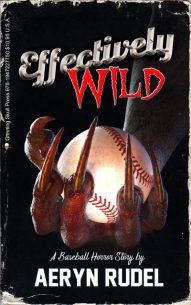
Effectively Wild – A Baseball Horror Story
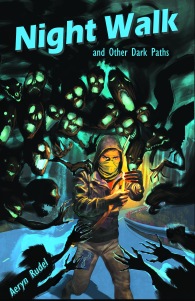
Night Walk & Other Dark Paths
Acts of War: Flashpoint

Acts of War: Aftershock

Acts of War: Stormbreak


