
Rules for Good Writing? How I Relate – Part Two

Last week, I published an article about the first five of Elmore Leonard’s famous Ten Rules for Good Writing and how strictly I adhere to them. You can check out that post here, but as a quick reminder, what I did was rate each rule on a scale of one to five. A one means I almost never follow it, and a five denotes something I consider an absolute law. Again, this is only how the rules apply to my own writing, and that post and this one are not about how they should apply to yours.
Okay, so here are rules six through ten and how, when, and if I use them.
Never use the words “suddenly” or “all hell broke loose.” (4)
Another one I think that’s largely about avoiding narrative cliches and overused idioms. Obviously, there’s nothing wrong with using the word suddenly, and even “all hell broke loose” can be fine, especially in dialogue. Moreso than avoiding cliches, though, this one, for me, is about avoiding telegraphing. I try to write action scenes in particular that happen organically, and even if they are sudden or unexpected, I often find there’s a better word or framing device that doesn’t scream to the reader SOMETHING IS ABOUT TO HAPPEN. You may have noticed that I rated this a four, and that’s because I don’t like the word never, and you’ll find the occasional suddenly in my work. I don’t know if I’ve ever actually used “all hell broke loose”, but I certainly have my own crutch idioms.
Use regional dialect, patois, sparingly. (5)
Here’s one where Mr. Leonard and I are in complete agreement. You have to be careful with this stuff for a couple of reasons. The first is that it can sound pretty inauthentic if you’re not intimately familiar with the dialect or patois in question, even if you’ve done your research. Second, there are some cultural sensitivity issues to be aware of, and if you’re using patois or slang that’s associated with a specific culture or marginalized group, you should think about getting a sensitivity reader to make sure you’re not being unintentionally offensive. For me, accents, even very common ones, fall under this rule, too. I try to let folks know that a character HAS an accent with beating them over the head with it. For example, here’s how I wrote a bit of dialogue for a character with a (fake) Irish accent.
“I’m looking for a friend of mine,” Sonny said, his faux Irish lilt turning mine into moin.
I find that a few little reminders like that get the idea across without me having to torture a bunch of poor unsuspecting words. Obviously, this isn’t the only or even the best way to write an accent, but it’s one that’s worked for me.
Avoid detailed descriptions of characters. (2)
I’m a big fan of a good character description. I like them when I read, and I LOVE them when I write. That said, what I want is more of a charcoal sketch than a full-blown oil painting. Give me a compelling framework for a character’s appearance when they’re introduced, then fill in additional details, if necessary, later on, bit by bit. Some writers can do that initial sketch in a paragraph. Others can pull it off in a single sentence. Despite not using this “rule” very often, I do understand the reasoning behind it, and it, like the next rule, play into rule ten, which might be the most important of the bunch.
Don’t go into great detail describing places and things. (4)
While I will go into some detail describing a character, I generally agree with Mr. Leonard here. Some of this has to do with the fact that I straight-up suck at descriptions, and I try to minimize things I’m bad at and maximize things I’m better at. Still, again, there’s sound reasoning behind this rule. Long descriptions tend to be the kinds of things readers skim (see rule ten). This is not to say you shouldn’t describe locations—you definitely want to avoid the two floating heads in the void situation—but I tend to be as brief as possible, giving readers just enough data to visualize where the characters are and then filling out the narrative with dialogue and action. Now, things is a broad category, but I still mostly agree here. The vast majority of the objects in my character’s world don’t require description at all, and if they do, not more than a word or two. There are exceptions, of course, and, you know, if my characters come across Sauron’s ring of power or something, I’ll probably describe the hell outa that thing. The caveat with this one, like many of these rules, is that’s somewhat dependent on style and genre. If, like me, you’re writing lean crime and horror, then it’s a pretty good rule. If you’re writing epic fantasy, on the other hand, readers have different expectations, and this rule may not apply as much. So, where this is a solid four for me, it’s definitely like a two for George R.R. Martin, and last I checked, he seems to be doing okay with this whole writing thing. 😊
Try to leave out the part that readers tend to skip. (5)
Obviously, you should NOT write things that readers won’t read, so I’m in perfect agreement with Mr. Leonard here. This might seem a tad nebulous, but if you read the other nine rules, I think it’s clear what he meant. Cliches, long passages of exposition, info dumps, lengthy descriptions of people, places, and things, etcetera, can bog down a story and make your reader go a bit cross-eyed. From what I’ve read, Leonard prioritized dialogue and action, which tend to be more engaging, i.e., less skimmable. I tend to do the same and for the same reasons. Now, once more, this comes down to genre and style to some degree. Crime and horror tend to be shorter works and often have different pacing than SFF, where readers often want to see lavish descriptions and are more tolerant and even welcoming of more exposition.
And there you have it, Ten Rules for Good Writing and how, uh, good they are for MY writing. As I’ve stated over and over in this article and the last one, how these rules apply to your own writing is largely going to hinge on how and what you write. Don’t get me wrong; there’s good reasoning behind all these rules, as befits a master craftsman like Elmore Leonard, and it’s not a bad idea to think about that reasoning before you break one. If that reasoning doesn’t apply to you or your work, go ahead and use dialogue tags other than said, start your story with weather, and write page-long descriptions of people, places, and things. If you’re doing all that with intention, as many successful writers do, you’re gonna be okay. 🙂
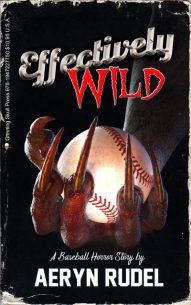
Effectively Wild – A Baseball Horror Story
Night Walk & Other Dark Paths

Acts of War: Flashpoint

Acts of War: Aftershock

Acts of War: Stormbreak

 Aeryn Rudel's Rejectomancy