
A Week of Writing: 8/6/18 to 8/12/18

Another week of writing in the books. Here’s how I did.
Words to Write By
I’ve been reading a fair amount of Elmore Leonard, a writer whose style I really enjoy. Today’s quote is another of his pearls of wisdom.
“Never use a verb other than “said” to carry dialogue.”
― Elmore Leonard
This is another one of Leonard’s Ten Rules of Writing (it’s #3). I agree with it, and I try not to use anything but “said” in dialogue if I can help it. In fact, lately, I’ve been using fewer dialogue tags of any kind, as I often find I just don’t need them. Of course, there are folks who disagree with this rule, and I get that. Elmore Leonard wrote in a pretty specific style, and since I’m typically going for something in the same ballpark with my own stuff (though I would never actually compare my work to the great Elmore Leonard’s), his rules, including this one, work for me and help me tighten my writing.
Leonard also says the following about dialogue tags, and I think this is the real heart of the rule.
“The line of dialogue belongs to the character; the verb is the writer sticking his nose in. But said is far less intrusive than grumbled, gasped, cautioned, lied.”
― Elmore Leonard
I believe dialogue tags are a little like adverbs. We sometimes overuse them (especially the more descriptive ones) because we don’t trust the reader to get what we’re saying without them. In other words, as Leonard says above, we’re “sticking our noses in” when we don’t need to.
The Novel
The novel is still with my critique partners. Well, the first wave of them, anyway, and I expect it’ll be a couple more weeks before I get anything back. Early feedback is positive, and so far the issues brought to my attention seem pretty easy to address. That’s not to say there won’t be larger issues, because of course there will, and I’m prepared to put in the work to set them right.
Last week, I also started going through the 35,000 words that I’ve written for the next novel. I like what I have so far, and I’m currently tinkering with the outline. I’m not quite ready to dive into full-on draft mode yet, but soon.
Short Stories
I heavily revised a short story last week, and I think it’s one of my best. It had been through my critique partners a few months ago, and there were a lot of notes. So I finally got my shit together and dove in, cut away a good 1,000 words, and ended up with something tighter, leaner, and I hope a whole lot better than what I started with. I subbed the story to Uncanny Magazine which recently opened to submissions.
Got a few submission out last week, including the aforementioned story to Uncanny.
- Submissions Sent: 2
- Rejections: 2
- Acceptances: 0
- Publications: 0
One of the rejections was for a shortlisted story from a pro market. That particular story has now been shortlisted by three pro markets, so it’s come close, but no cigar yet. I sent it out yesterday again.
The two submissions last week put my at 79 for the year (I’m actually at 80 total with the submission yesterday).
The Blog
Two blog posts last week.
8/6/18: A Week of Writing: 7/30/18 to 8/5/18
The usual weekly writing update.
8/10/18: Good Stories Get Rejected Too
This post is about dealing with the rejection blues with a positive attitude and some hard data.
Goals
This week I’m going to continue to assess what I have with my next novel while I wait for feedback on Late Risers. There’s also a couple of markets open to submissions that I want to sub to, and I need to revise at least one story for that purpose.
Submission Spotlight
As I mentioned above, I subbed a story to Uncanny Magazine. They’re an SFWA-qualifying market with pro rates (0.8/word) and very well respected in the industry. They haven’t said exactly how long they’ll be open to fiction submissions, so if you have something that fits, get it in. Link to the submission guidelines below:
Uncanny Magazine Submission Guidelines
That was my week. How was yours?
Good Stories Get Rejected Too

Rejections are tough, and getting bummed out is a perfectly reasonable reaction to being told your story isn’t going to be published, but it’s important to have a little perspective on rejections. This is the very core of rejectomancy, understanding that a rejection probably doesn’t mean what you think it means. It probably doesn’t mean you wrote a bad story or that your writing is terrible or any of the other catastrophic scenarios we writers like to read into a simple “not for us” form rejection.
But, hey, I’ve said this a dozen times on the blog, and since writers are supposed to show and not tell, let me show you something.
Last month two very cool pro markets opened their doors to submissions for a short time: Cemetery Dance magazine and Diabolical Plots. In addition to opening their submission doors to thousands of hopeful writers, these two markets did something awesome. They gave us a look at the actual submission stats. So let’s take a look at those numbers and see what we can see.
Cemetery Dance
- Stories submitted: 1,750
- Number of slots: 20 or 25
Diabolical Plots
- Stories submitted: 1,288
- Number of slots: 24
Now it might be easy to take a look at these numbers and despair. I mean, we’re looking at a sub two percent chance of acceptance for each market, but I would urge you to come at this from a different angle. With so many submissions and so few publication slots, the editors are going to turn away a lot of quality work. They have to because they can only publish two dozen or so stories out of the hundreds submitted. A rejection from one of these markets probably means you wrote a story that isn’t quite to the editor’s taste or is similar to one they’ve already accepted or half a dozen other reasons that have nothing to do with your writing ability. Want further proof and from the horse’s mouth? Check out this recent blog post from Brian James Freeman, one of the editors of Cemetery Dance magazine.
All I’m trying to say here is don’t let the numbers or a rejection get you down. I firmly believe good stories eventually get published, especially when they’re written by diligent authors who follow the guidelines and continually work on their craft. Personally, I think a lot of it comes down to putting the right story in front of the right editor at the right time.
So keep writing, keep submitting, and keep going.
Oh, and a big thank you to the editors of Cemetery Dance magazine and Diabolical Plots for making their submissions stats public. I think that information is immensely helpful to writers, and this writer really appreciates the peek behind the curtain.
A Week of Writing: 7/30/18 to 8/5/18
Hey, all, it’s Monday, or, uh, Tuesday. Anyway, here’s the week that was.
Words to Write By
Another quote from Mr. King. This one comes from his book On Writing: A Memoir of the Craft.
“I believe the road to hell is paved with adverbs.”
—Stephen King
There are lots of opinions on adverbs in writerly circles, but let’s see what else Stephen King says on this subject in his book.
“With adverbs, the writer usually tells us he or she is afraid he/she isn’t expressing himself/herself clearly, that he or she is not getting the point or the picture across.”
This is what I focus on when I look for adverbs in my own work. It’s less the adverb itself and more the adverb leading to weak, unsure sentences. Whenever I find one, I ask myself two questions. 1) Am I using the adverb only because I’m afraid the reader won’t understand what I’m trying to say without it? 2) Is there a more precise verb I could use instead of verb + adverb? The answers to those questions may (and often does) lead to adverb removal and/or a revised sentence.
The prime adverb offenders in my work fall into three main categories:
- Useless -ly adverbs like certainly, truly, obviously, simply, and likely (plus a few others). These words rarely add value or nuance to the sentence.
- Positional words like back, behind, down, and over. Like the aforementioned -ly adverbs, I often don’t need these either.
- Hedging, imprecise words like almost, nearly, around, and often. I do keep some of these because they’re often useful (especially in dialog), but I overuse them.
The Novel
Well, the first read through and revisions are done, and I sent the manuscript off to one of my critique partners. It’s as good as I can get it right now because I’ve gone story blind. I’ve reached that point where I can’t decide what’s good and what’s not, and that’s when it’s time to get eyeballs other than your own on the work. I’m gonna take a break from Late Risers for a bit and focus on short stories and the next novel
Short Stories
I finished one short story last week, which I’ll sub to the The Molotov Cocktail’s FlashBeast contest.
A big fat goose egg for submissions last week.
- Submissions Sent: 0
- Rejections: 0
- Acceptances: 0
- Publications: 0
- Shortlist: 2
With the push to get the novel finished and ready for my critique partners, I didn’t send any submissions. I did, however, get two shortlist letters from markets I’ve been trying to crack for a long time. I hope to hear good news on one of those soon.
Despite a slow month for submissions, I’m still at 77 for the year. Which means I need another 23 submissions over the next five months to hit my goal of 100. That should be a cinch.
The Blog
Two blog posts last week.
7/30/18: A Week of Writing: 7/23/18 to 7/29/18
The usual weekly writing update.
8/3/18: “Do Me A Favor” & Other Free Flash Fiction
Last week, I published another story with The Arcanist. This blog post features all the stories I’ve published with that market to date.
Goals
With the novel out to my critique partners, I want to turn my attention to short stories and get more submissions out. I’ve got stories that need quick revisions and then can go out again, so I’ll likely focus on those first. I’d also like to evaluate where I’m at with the next novel I want to write. I started it last year, got about 30,000 words into it, and then set it aside for Late Risers. Time to go back and assess what I’ve got with fresh eyes.
Story Spotlight
As I mentioned above, I published another story with The Arcanist last week. It’s called “Do Me a Favor” and you can check it out by clicking the link or the picture below.
“Do Me a Favor”

That was my week. How was yours?
“Do Me A Favor” & Other Free Flash Fiction

It’s great when you find a publisher who’s willing to publish your work. It’s even better when you find a publisher who’s willing to publish your work more than once. Today marks my fourth story with The Arcanist, an excellent publisher of speculative flash fiction. The story is called “Do Me A Favor,” and it’s a quirky little horror/black humor mashup. You can check out the story below, along with three other stories I’ve published with The Arcanist.
So, uh, do me a favor and read these stories. 😉
“Do Me a Favor” – Published 8/3/18

“The Food Bank” – Published 4/6/18

“Reunion” – Published 12/1/17

“Cowtown” – Published 8/4/17

I hope you enjoyed “Do Me a Favor” and maybe a few other stories I published with The Arcanist. If you’re a writer of speculative flash fiction, give The Arcanist a look. They pay pro rates, and they’re just generally great to work with. Submission guidelines right here.
A Week of Writing: 7/23/18 to 7/29/18
Monday has arrived, and it’s time to share my weekly writerly report card.
Words to Write By
This week’s quote comes from Elmore Leonard, whose “10 Rules of Writing” is one of my favorite pieces of writing advice.
“Try to leave out the part that readers tend to skip.”
—Elmore Leonard
This quote is the abbreviated version of rule ten in the aforementioned “10 Rules of Writing.” I’m currently trying to figure out which parts of my novel might fall into this category and then remove/rewrite them. A difficult task, and one I’ll ultimately need my critique partners to help me with, but I think I made some headway this week.
The Novel
Last week was very productive. I didn’t finish my initial revisions, but I’m three-quarters of the way done. I removed a problematic plot point, and I’m in the process of reworking the rest of the novel to match. It’s going pretty well, though I definitely have some plot and character motivation holes to shore up.
Short Stories
Finished revising one story and had just enough time to submit it to an anthology that closed to submissions on July 29th. I’m still working on one more revision I need to get out by the 31st.
Another fairly slow week for submissions.
- Submissions Sent: 2
- Rejections: 1
- Acceptances: 0
- Publications: 0
Two submissions this week and only four for the month. Disappointing, but the shorts have to take a backseat to the novel right now. I plan to send out a lot more short stories in August while my critique partners are caving up my manuscript.
The Blog
Two blog posts last week.
7/9/18: A Week of Writing: 7/16/18 to 7/22/18
The usual weekly writing update.
7/12/18: Iron Kingdoms Fiction – Confirmed Kill
A free Iron Kingdoms story published last year in No Quarter magazine. Privateer Press gave me permission to post this one in its entirety (plus a few others).
Goals
One big goal – finish the initial revision of the novel and get it off to my critique partners. Everything else is secondary.
Story Spotlight
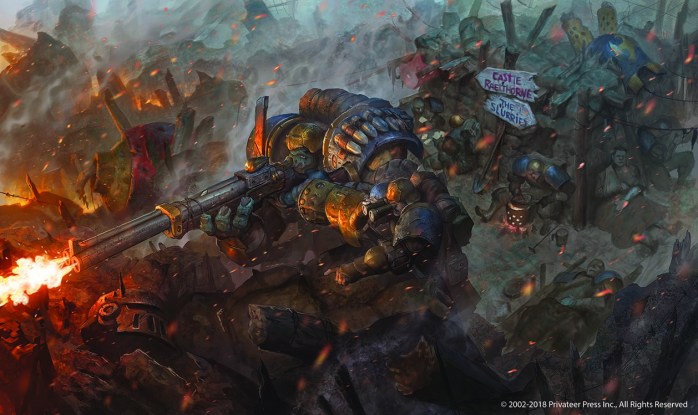
The spotlight story is the piece I mentioned above. As some of you know, I’ve been writing for Privateer Press for a long time, and I’ve published two novels and a whole bunch of shorter works in their Iron Kingdoms setting. Anyway, they’ve given me permission to post some of my old stories on the blog, the first of which you can read by clicking the illustration or link below.
“Confirmed Kill”
That was my week. How was yours?
Iron Kingdoms Fiction – Confirmed Kill

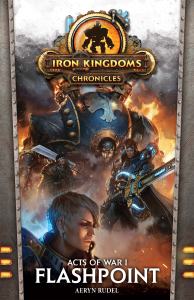
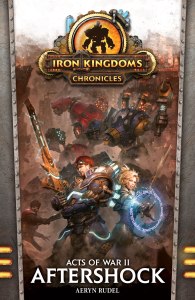
Got something neat to share with you today. Privateer Press has granted me permission to host a few of my published Iron Kingdoms short stories on the blog. Most of these come from old issues of No Quarter magazine, and this first one, “Confirmed Kill,” ties into the Acts of War novels, Flashpoint and Aftershock. The story features two of my favorite characters from the series, the trollkin sniper Horgrum and his spotter Sergeant Sharp. “Confirmed Kill” is the story of how these two came to work together in the Cygnaran Army.
New to the Iron Kingdoms? Check out this link for an introduction to this war-torn world of steam power and sorcery.
Confirmed Kill
by Aeryn Rudel
Northern Thornwood, 606 AR
“Take them and go!” Horgrum’s father shouted, pointing his axe at the tree line. Vargal Oakheart was an aging trollkin, but still mighty, and his voice boomed over the din of gunshots and battle cries.
Horgrum shook his head. “No, I will fight.” He had his own axe in hand, but its blade was clean, unlike his father’s, which was stained red with the blood of the invaders.
Vargal glanced behind him, where their village burned, where humans in crimson armor slaughtered their people. He turned back to Horgrum and put a heavy hand on his son’s shoulder. “We are lost, Horgrum,” he said, his voice thick with sorrow. “Take your brother and sister and flee.” Solissa was thirteen and Kolor only ten, too small and too young to fight. They cowered behind their older brother, wincing at each booming report of an enemy rifle.
“And go where?” Horgrum demanded. He was twenty years old and a seasoned fighter, and the thought of leaving his village and kriel sickened him.
“South, to Cygnar,” Vargal said. “You will be safe there.”
Horgrum opened his mouth to challenge his father, but the sound of hooves cut short his protest. A human in bright red armor astride a great black horse emerged from the smoke and flame.
“Go!” Vargal shouted and shoved Horgrum backward. He took his axe in both hands and turned to face the enemy.
Horgrum pushed Solissa toward the trees, and she took Kolor’s hand. They ran.
Before he entered the woods, Horgrum turned back to see the human warrior barreling down on his father. Vargal twisted aside from the Khadoran’s lance and lashed out with his axe at the passing horse. The great blade hewed through one of the animal’s legs, and it crashed to the ground, throwing its rider. Horgrum smiled as his father closed on the enemy and split the human’s skull with a short overhand strike.
Horgrum’s grip tightened around his own axe. These humans, these Khadorans, were not so strong. The kin could defeat them. He took a step toward the clearing.
“No, Horgrum.” Solissa’s hand on his arm stropped him.
Vargal had pulled his weapon free from the corpse and turned back toward the battle. Through the smoke Horgrum could see more trollkin and humans fighting. He could help his people. He could defend them.
He took another step, and a single sharp report rang out. His father stopped midstride, and blood poured down his back from a fist-sized hole that had blossomed between his broad shoulders. He collapsed to his knees, and then pitched over into the dirt.
Horgrum shook off Solissa’s hand and raced toward his father, screaming in rage. He made it five paces before another shot rang out. The bullet struck his axe, smashing it from his grip. He dove to the ground. Bodies lay everywhere, human and trollkin. His hand fell across the butt of a rifle as something huge loomed out of the smoke, a human warrior encased in steam-powered armor that made him nearly as large and powerful as a full-blooded troll.
Horgrum picked up the rifle. It was big by human standards, long-barreled and finely machined. He had never used such a weapon, but he’d seen them fired. He rested the butt against his shoulder and curled his smallest finger around the trigger; the others would not fit inside the guard. The armored man charged, and Horgrum stared down the rifle’s barrel. A sense of calm flowed over him, his rage and fear drained away, and only the enemy and the rifle remained. He drew in a breath and aimed as best he could, peering through the attached scope and adjusting until he felt centered over the enemy’s heart. He pulled the trigger, and the gun bucked and spat smoke.
The armored human stumbled, and Horgrum couldn’t tell if his shot was the cause, or if he’d even hit his target. Then the man faltered again, blood sluiced down his helmet from the visor slit, and he fell over backward. Horgrum had not hit the spot he’d intended, but Dhunia had graced him with a bit of luck.
Horgrum had no time to celebrate. Another shot rang out and dizzying pain lanced through his right shoulder. Another soldier appeared. This one wore no armor, but he carried a rifle like the one Horgrum had taken from the enemy corpse. He was an older man, with graying hair falling beneath a red cap. A livid scar marred his angular face and ran from his right brow to the middle of his nose. This had to be the human who killed his father.
Despite his wound, he wanted to find a way to kill this man, but Solissa’s voice from the tree line called him back to reality. “Horgrum, more soldiers are coming!”
He turned and lurched toward his sister, expecting the human to shoot him in the back as he ran. No shot came, and he made it to the trees, the enemy rifle gripped tightly in his right hand.
* * *
Ceryl in Cygnar, autumn 609 AR
“Is that a Vanar Liberator?” the soldier asked incredulously, rising up from behind his desk.
Horgrum looked down at the rifle in his hand. He hadn’t known it had a name. He’d brought it to the Ceryl recruitment office because he thought human soldiers supplied their own weapons, just as the warriors in his kriel had.
“I took it,” he said, unsure how to respond. He’d waited in line for an hour. The army in Ceryl, his home for the last year, was looking for volunteers to serve in the trencher corps, the name for warriors in Cygnar that had a reputation for being tough and capable. Regular folk seemed to look up to them, at any rate.
The soldier’s eyes narrowed. “Took it from whom? These are pretty rare.”
Horgrum glanced around the small, square room. There were two other men here, both wearing the same blue uniform. They stared at him. “One of the Khadorans who attacked my village carried this weapon. I took it from his corpse to defend myself.”
“You don’t say?” The first soldier’s expression changed from suspicious to approving. “When and where?”
“Three years ago, in the northern Thornwood,” Horgrum said. Maybe what had happened to his kriel would strengthen his chances of acceptance. He needed what the army offered. He, Kolor, and Solissa lived in one of the squalid trollkin slums, and though he often found work on the docks—his strength made him a good laborer—it paid little. The army paid more and consistently, and with that money, he could take better care of his brother and sister.
“If he killed a Widowmaker and took his gun, you should pin a bloody medal on him,” someone said from the long line of others hoping to join the trenchers.
The soldier chuckled at that. “Experience killing the reds isn’t a requirement, but it doesn’t hurt. I’m Corporal Newsome. What’s your name?”
“Horgrum, son of Vargal Oakheart.”
“Well, Horgrum, the trenchers can always use someone of your size, strength, and, uh, durability, and we’ve recruited a number of trollkin in the past . . . ” He paused and looked down at Horgrum’s rifle again. “You any good with that thing?”
“I have become skilled with this weapon,” Horgrum said. He’d practiced with the gun as often as possible. It was difficult to get ammunition, but he hunted game outside the city whenever he could to put more food on the table for his siblings. The gun was not designed for a trollkin, but over the years he’d traded work with a gunsmith who had modified the stock and trigger guard to fit his frame and thicker fingers. He’d developed a knack for the weapon, finding if he was patient, he could usually make his shot. He enjoyed stalking his prey and taking it down with a single, perfectly placed shot.
“Well, if that’s the case, maybe lugging around a chain gun in the trenches isn’t the best spot for you,” Corporal Newsome said. “Stay here for a second.” He turned and walked through a door behind him. Horgrum could hear him talking to someone else, and then Corporal Newsome and another human appeared. The second man was older, gaunt-faced, and of middling height. Rather than the simple uniform Newsome wore, this man was attired in partial trencher armor and gear, including a nicked and much-repaired steel breastplate that suggested combat time. He carried himself with the ease of someone well accustomed to the weight and encumbrance of his gear.
“Sergeant Sharp, this is Horgrum Oakheart. He’s got a Vanar Liberator he took off a dead Khadoran,” Corporal Newsome said. “Says he can use it too.”
Sergeant Sharp approached. “Fought some Reds, have you?”
“They attacked my kriel in the northern Thornwood. Killed my people. I took one of their weapons and killed one of them before I . . . fled. I’ve been practicing with it ever since.”
Sergeant Sharp frowned, and Horgrum saw something on the man’s face he did not expect: sympathy. “I’m truly sorry to hear that,” he said. “Can you shoot well?”
“I can,” Horgrum said confidently.
“Show me.”
* * *
The recruitment office was part of small garrison near the Ceryl docks. Behind it were barracks for some of the trenchers stationed in the city, and behind that a rifle range. The soldiers here used the ocean to their advantage, and their “range” was a series of targets attached to floating buoys at various distances.
“Those targets are at 100, 200, 300, and 500 yards.” Sharp pointed to the target buoys as they approached the firing line. The other soldiers in the recruitment office and some twenty of the potential recruits had followed them, all eager to see a trollkin fire a Khadoran rifle. “That Liberator has the range to hit any one of them.”
Horgrum nodded. He’d taken a deer at a distance greater than the farthest target—once. The man-shaped targets on the buoys were smaller, and the wind here would affect a shot at the longer ranges. “If I show you I can shoot this gun. You will let me be a trencher?”
Sharp smiled. “Oh, you’ve already got that locked. Trollkin never have any problems meeting trencher physical requirements. We take ’em whenever we can, but I’m looking for snipers. If you can shoot that rifle well enough, there could be a better place for you, one more suited to your talents and with better pay.”
Better pay. That got Horgrum’s attention. Solissa and Kolor would not go hungry on a trencher’s salary, but if he could make more, he could provide more: better food, a better place to live, and more opportunities to make a good life for themselves.
“What must I do to prove I can use this rifle?” Horgrum asked.
“I’ll give you six shots. Two each at 200, 300, and 500 yards. If I like what I see, we’ll talk further.”
“No,” Horgrum said. “I will put a bullet through the head of the farthest target. If I do, you make me a sniper. If I miss, I will ‘lug a chain gun’ for Corporal Newsome.” He hated to gamble this way with the future of his brother and sister, but his need was too great for empty promises. This Sergeant Sharp seemed an honorable man who respected such a challenge.
Sharp said nothing for a moment, then grinned. “Okay, Horgrum. You hit that target, with one shot, and you’re in.” Behind them, the assembled soldiers and recruits began making wagers.
Horgrum nodded, put the rifle to his shoulder, and pulled back the firing pin. He set the front sight on the head of the target buoy. It bobbed up and down on the water, and he felt a breeze blowing in from the south—and it was shifting. It would slow his bullet, and he would have to adjust for that. All in all, this was a much harder shot than he had let on. Why had he promised it all on one shot? It now seemed reckless. He gritted his teeth and put doubts aside. He needed this, for his kith, and the buoy was not running away from him at top speed through the brush. He drew in a breath, letting the silent calm of rifle and target settle over him. The voices of the men around him faded away, and his world became the wind, the sight, and the target in the water.
He waited, getting used to the rhythm of the target’s movement on the waves. He curled his finger around the trigger. The target bobbed down, up, down, up. He squeezed. The rifle bucked his shoulder and the explosive report drowned out everything.
He looked back at Sharp.
“Pull it in, private,” Sharp said, and one of the soldiers ran forward to pull at the thick rope connected to the target buoy.
As the target neared the dock, all were silent until the hole just left of center in the target’s head became visible. Then, laughter and cheers, plus a few groans from those who had bet against him, rose from the crowd.
Sharp held out his hand to Horgrum. “Welcome to the trenchers, Private Horgrum. We’re going to need to get you a bigger rifle.”
* * *
The Black River in Occupied Llael, summer 611 AR
Horgrum cradled the Raevhan Express prototype in his arms and crouched low to the ground near the river’s edge. Designed for a trollkin’s frame, the massive rifle, with its oversized trigger guard, enlarged stock, and weight of nearly thirty-pounds, was engineered to propel a gigantic projectile with force and accuracy unequaled by any other military rifle. Since passing basic training and gaining a position as a trencher sniper, he’d become intimately familiar with the gun. He’d named it Dhunia’s Mercy. Sometimes he missed his old Vanar Liberator, especially on long, grueling hikes.
“What do you see, Corporal?” Sergeant Sharp asked and squatted down next to him. He’d been assigned to the sergeant soon after basic, teaming up as one of the first Trencher Express Teams, each consisting of a trollkin sniper and a human spotter. Sharp was his commanding officer, but more than that, he was a brother in arms and one of the only true friends he had among the Cygnaran military. He had come to think of Sharp as an extension of his kith.
“Boots, soft,” Horgrum said. “Moving north toward Riversmet.” They were in Khadoran territory, scouting along the Black River for Lord General Coleman Stryker, who had quietly led an invasion force into occupied Llael.
“Not Man-O-War or Winter Guard,” Sharp said. “How many?”
Horgrum studied the tracks again. “Three—two men and a woman.”
“Widowmakers?”
Horgrum nodded.
Sharp rubbed at the stubble on his chin. “They usually travel in groups of four. They must have lost a man somewhere.”
“Greywind Tower isn’t far from here,” Horgrum said. “The Resistance may have gotten one of them.”
Sharp grimaced. He didn’t like that answer. “Maybe. Suggestions?”
“Follow the tracks, find them, and kill them.”
Sharp frowned. “That simple, eh, Corporal?”
Horgrum shrugged. It was simple, just very dangerous.
“You know hitting a Widowmaker team, even with a man down, is risky,” Sharp said. “You look me in the eye and tell me you want to do this because of our mission in Llael and not because you’re looking for Red Cap.”
This had been a bone of contention between them since the beginning. He and Sharp were often tasked with counter-sniper operations, and they’d killed dozens of their Khadoran counterparts. Each time, Horgrum had looked for Red Cap, the name he’d given the sniper who’d killed his father. Several times they had gone out of their way to seek out Widowmakers, sometimes pushing against the limits of their orders. The thought of his father brought back memories as vivid as the day they had happened. Sharp was familiar with the destruction of Horgrum’s kriel, and though he sympathized with his partner’s desire for vengeance, he did not approve of Horgrum’s singular pursuit of it.
Horgrum could not look Sharp in the eye, but he said, “Widowmakers are also scouts, and if they’ve come this far south, they may have seen the army. We can’t let them return to report.”
Sharp’s frown deepened, but Horgrum knew his reasoning was sound, even if it wasn’t his primary motivator. The sergeant let out an irritated sigh after a few moments. “Bloody hell. Then let’s hope we spot them before they spot us. I’d like to keep my head on my shoulders for a few more days.”
* * *
“He’ll have heard the shots,” Sharp said, staring through his spyglass at the small Khadoran camp at the bottom of the hill.
Horgrum viewed the darkened camp through the scope on his rifle. Two corpses lay splayed out near the river, illuminated only by soft moonlight. He could only tell the gender of the first corpse. The top two-thirds of the man’s head had been torn away by a bullet the size of a shot glass. He’d taken the Khadoran sniper from nearly six hundred yards—a good shot—but he frowned as his scope moved to the second body. The woman had moved from a crouch to standing just as he fired, and the bullet had struck her neck. She’d bled out quickly, but it was not a clean kill.
“Yes, he will have heard,” Horgrum said. There was no ignoring the thunderous report of the Raevhan Express.
“I can see tracks moving away from the camp,” Sharp said. “Looks like he went off for a piss or something, heard the shots, and decided to stay gone.”
“He will look for us,” Horgrum said. They knew a third sniper lurked nearby, but they hadn’t seen him yet. They’d found the camp and taken the opportunity to eliminate two of the Widowmakers, figuring they’d eventually track down the third.
“Agreed,” Sharp said. “And if he’s any good. We’re going to need to flush him out.”
Horgrum didn’t like the sound of that. “What do you mean?”
“I think he’s in those trees there. By the river. Good cover and sight lines. He’s waiting for one of us to stick our head up so he can shoot it off.”
“Likely,” Horgrum said.
“Well, we can’t just bugger off and leave him to hustle it back to home base. So, one of us needs to draw him out, and since you’ve got the big gun, that’s me.”
“No, Sharp,” Horgrum said. “I can take a bullet. You can’t.” Trollkin healed quickly and could survive wounds that would be fatal to softer-skinned humans.
Sharp chuckled. “One of these days you’re going to figure out I’m in charge, and you do what I say, not the other way around. Now, keep your rifle on those trees. I’m going to work my way down the hill on my belly. It’s dark, and a man on his stomach is a bitch of a target. He’ll need some time to aim properly, which means you’ll see him before he shoots.”
Horgrum took his eye away from the rifle’s scope to protest further, but Sharp had already left, and Horgrum could hear him wriggling through the leaves on his belly. “Dhunia, protect him,” he said under his breath and put his eye back on the scope.
The copse of trees where the sniper likely hid was dark, and it was difficult to make out individual trees. He waited, knowing Sharp’s peril grew with every moment that passed.
Then, something moved. A spot of color in the black, illuminated briefly by the full moon overhead–a red cap. The sights and smells of his burning village came roaring back to Horgrum. Fear and rage mingled at his inability to protect his father and kriel from the enemy.
He drew in a deep breath and set his cross hairs in that spot of crimson. He would protect Sharp. He saw the glint of moonlight on the enemy’s scope as his rifle came up, and Horgrum squeezed the trigger. The thunder and fire of the Raevhan lit up the night for a split second, blinding him. When he could see through the scope again, the red cap had disappeared. He hadn’t heard another shot, but if they’d fired simultaneously he wouldn’t have.
“Sharp?” he called out.
Silence. And then, “You get him?”
Relief poured over Horgrum, and he took the rifle away from his shoulder. “I got him.”
* * *
“This one’s been around awhile,” Sharp said, squatting over the body of the dead Widowmaker. “That red cap means one-hundred confirmed kills. Could be him.”
Horgrum frowned. His bullet had all but disintegrated the Widowmaker’s head. He thought he’d seen a flash of silver hair beneath it just before he pulled the trigger, but he couldn’t tell if this red cap was his Red Cap. “I didn’t see his face.”
Sharp’s snatched the red cap from the ground and waved it at Horgrum. “This is the second marksman we’ve killed with a red cap. Do you know how many marksmen like that there are in the entire goddamn Khadoran army?”
Horgrum stared at his feet, rage and shame warring for control of his emotions. “Not many.”
“And you’ve killed two of them,” Sharp continued. He held the cap out to Horgrum. “Send this back to your brother and sister, and tell them you killed him. Let them put your father to rest in their hearts, even if you can’t.”
Horgrum accepted the hat, trying to recall the face of the sniper who had killed Vargal Oakheart. He recalled a scar and white hair, but nothing else. The man had become a symbol of the vengeance he craved and little more. It ate away at his heart, and he was letting it. He loosed a long, steadying breath and said, “Red Cap had one-hundred confirmed kills?”
“A lot of them good Cygnaran soldiers,” Sharp said. “You’ve put a stop to that.”
Horgrum stuck the cap beneath his breastplate. “I’ll send this to Ceryl, to Solissa and Kolor. They’ll know what it means.”
Sharp smiled. “Sounds like a confirmed kill to me.”
Originally published in No Quarter #72, June 2017
Want more Horgrum and Sharp? You can read about their adventures alongside Lord General Coleman Stryker and Asheth Magnus in the Acts of War novels.
A Week of Writing: 7/16/18 to 7/22/18
Another week gone by, another week of writing, revising, and submitting in the books.
Words to Write By
This week’s quote is something I definitely struggle with at times.
“If I waited for perfection… I would never write a word.”
—Margaret Atwood
Though I think Margaret Atwood approaches a level of perfection I can only dream about, I can certainly relate to the sentiment in her quote. Many, many times when I was writing the first draft of Late Risers, I had to tell myself “Get it done, get it down, fix it in post.” In other words, keep writing, even though it feels awful, even though every fiber of your being screams “This is garbage!” Strangely, now that I’m reading and revising, it’s those passages where I had to force myself to soldier on that are some of my favorites.
The Novel
I had a good week with revisions on Late Risers, and I’m about halfway done. I’d like to finish this week, but I have to change one major plot point at the end of the second act that will require changing a lot more downstream. That may slow me a bit, but the book will be better for it. Last week, I also had a few moments of “Hey, this might be pretty good.” Delusion? Maybe. I’m a terrible judge of my own work. It’s a lot better than how I usually feel, though, which sounds like “Hey, this is all a hot dumpster fire.” 🙂
Short Stories
Still revising stories for a pair of submission windows closing at the end of the month. Revisions on the novel have slowed me way down in this department, but maybe I can rally this week.
A slow, slow week for submissions.
- Submissions Sent: 1
- Rejections: 1
- Acceptances: 0
- Publications: 0
Yikes. Only one submissions this week. That puts me at 75 for the year, and despite a very slow month, I’m still ahead of pace for my goal of 100 submissions.
The Blog
Two blog posts last week.
7/9/18: A Week of Writing: 7/9/18 to 7/15/18
The usual weekly writing update.
7/12/18: Watch Out. That First Line is a Doozy
I return to one of my favorite subjects in this post: crafting a good first line for a short story.
Goals
I’d like to be at least three-quarters done with my initial revisions by the end of this week. I also need to get at least one story revised for a submission window closing at the end of the month. That one is kind of nonnegotiable if I want to submit to this particular market.
Submission Spotlight
As I mentioned above, I’m revising a story to send to a market that is only open to submissions this month. That market is Diabolical Plots. Why submit there? Well, for starters, they are a SFWA-qualifying market that pays .08/word. They also allow up to two submissions per author during the submission window (I’ve already got one in). The bad news? They close to submissions at the end of the month, so if you have a story that fits their guidelines, get it in now. Details in the link below.
Diabolical Plots Submission Guidelines
That was my week. How was yours?
Watch Out. That First Line is a Doozy

I’ve written a couple posts about the importance of the first line in a short story. The idea being that a great first line sets the tone, instantly engages the reader, gets them asking questions about the story, and, hopefully, keeps them reading. These posts were inspired by a Stephen King essay called “Great Hookers I Have Known” from his collection Secret Windows. According to King’s essay, a “hooker” is a term once used by pulp fiction editors to describe a great first line that immediately captures the reader’s attention.
In the previous two posts I examined first lines in some of my published stories to see if I was, well, any good at writing a first line. Since I’ve had kind of a bumper crop of acceptances this year, I thought I’d revisit the concept and see if I’ve improved. Here are the first lines from five flash fiction stories I published this year. Let’s see how I did.
1) “New Arrivals” published by Havok Magazine
Senior Agent Howard Townsend parked his Ford Explorer at the head of an old dirt road.
This is not the greatest first line I’ve ever written. “Senior Agent” is kind of interesting, but Ford Explorers and dirt roads not so much. I think what saves this is the first paragraph, which is a lot better. This one received two rejections before Havok accepted it, and that’s not bad. Still, if we’re just rating first lines, I’d give this one a C-.
2) “The Food Bank” published by The Arcanist
A beetle the size of a battleship came out of the afternoon sky, its gargantuan wings buzzing like the drone of a thousand helicopters.
Okay, this is pretty good if I do say so myself. At the very least it should illicit a WTF from the reader. Giant beetle, droning wings, a thousand helicopters, that’s not bad. This story also received two rejections before it was accepted, but I’d give this first line an A-.
3) “Simulacra” Published by Ellipsis Zine
Ice and a snow weren’t the best material for the task, but Jason didn’t have much else to work with.
This one is okay, and it’s another where the first paragraph is better. The first line gives you a little info and starts with the main character doing something (important for flash, in my opinion), but it’s not exactly a knock-your-socks-off first line. Just one rejection for this story before it was accepted. I’d score this first line a C.
4) “Two Legs” published by The Molotov Cocktail
There had been no meat for too long.
Sometimes a good first line is short and simple, and I think this one is pretty good. Not my best, but solid. The word “meat” conjures all kinds of sightly disturbing images. This story received five rejections before The Molotov accepted it. I rate the first line a solid B.
5) “The Inside People” published by Ellipsis Zine
Victor wiped the spittle from his mouth after another coughing fit and stared up at the tower.
Not bad. Kind of gross, but not bad. It creates an image, I think, and maybe invites the question, “What’s wrong with Victor?” The tower by itself isn’t particularly interesting, but combined with the coughing fit, I think it works. This one received two rejections before acceptance, and I’d rate the first line a B-.
Does a killer first line help your chances at publication? Maybe, a little. You still have to write a good story, but a solid opener that pulls the reader in and gets them asking questions can’t hurt. That said, of the fives stories here, only one of them had what I would consider a great first line. The rest were solid to mediocre, and I think it was the first paragraph that did the heavy lifting. So, a killer first line is a good tool to have at your disposal, but it’s just one piece of the getting-published puzzle.
Got any great first lines of your own? Share them in the comments.
A Week of Writing: 7/9/18 to 7/15/18
Welcome to another week of writerly works.
Words to Write By
This week’s quote deals with those tricky endings and even trickier beginnings.
“The first sentence can’t be written until the final sentence is written.”
—Joyce Carol Oates
This quote reflects something I’ve been thinking about as I go through the first draft of my novel. It’s very clear that even if I stick the landing, I’ll almost certainly need to rework the beginning to match. For me, I think this has a lot to do with how I approach longer works. Though I work from an outline, the first couple of chapters are this “feeling things out” stage both with the plot and the characters. I hit something resembling a stride after about 10,000 words, but I leave a lot of clunky characterization in my wake before that. Anyway, I’m looking forward to getting that final sentence written (revised), so I can take another shot at the first sentence.
The Novel
Made more solid progress, and I’m about a quarter of the way through the initial revisions. I made some big changes last week again, matching chapters and character motivations to the new setup. I also completely changed an important secondary character. He just never quite worked for me, and a lot of it had to do with how blandly I described him. I happened to see someone on TV, I can’t even remember which show, and something clicked, and I was like, “That’s him. That’s the character.” It was more of an appearance thing than personality, though the change in appearance has opened a lot of new avenues for interesting character hooks.
Short Stories
Worked on revisions of a couple of short stories last week, though I didn’t write any new ones. This week will likely be focused on revisions as well, as I need to polish up a couple of stories for two pro markets briefly open to submissions.
A slow(ish) week for submissions.
- Submissions Sent: 2
- Rejections: 2
- Acceptances: 1
- Publications: 0
I only sent two submission last week, though one of them was accepted. (I’ll take a fifty percent acceptance rate any week.) I’m up to 74 submissions for the year, and I’d like to hit at least 80 before the month is out.
The Blog
Two blog posts last week.
7/9/18: A Week of Writing: 7/2/18 to 7/8/18
The usual weekly writing update.
7/12/18: Go for the Goal: 100 Submissions
In this post I talk about my goal of 100 submissions for the year and why I’m pursuing it.
Goals
Cue the broken record. Keep working on the novel and keep sending those submissions.
Submission Spotlight
Flame Tree Publishing has an open call for two more anthologies, Haunted House and Cozy Crime. Flame Tree is an SFWA qualifying market (with pay rates to match). They’re okay with reprints, simultaneous submissions, and multiple submissions. Deadline for these two anthologies is 7/29/18. More details in the link below.
Flame Tree Publishing Anthologies
That was my week. How was yours?
Go for the Goal: 100 Submissions
This year I set a goal to send 100 short story submissions. It’s similar to the 100 rejections goal, but the focus is a bit different. Let me explain why I’m doing it and subjecting myself to all those rejections. 🙂
Why 100 submissions? Here are my top three reasons.
- Number goals motivate me. This is more about me personally than any sage advice on submissions. I’m kind of a stats nerd, and these kinds of goals, as arbitrary as they are, keep me focused and push me to keep writing, submitting, and so on. Your goal needn’t be 100 submissions if you’re not a numbers person. It could be broader. Some like submit to more pro markets, for example.
- It keeps me writing new stuff. In order to send out 100 submissions, you need a fair amount of material to send. So I’ve been writing a lot more short stories this year. Sure, a lot of it is flash, but I’ve been pretty consistent with a new story every week or so.
- It’s pushed me to diversify. I’m primarily a horror writer, but the simple fact is I run out of horror markets pretty quick. There are a lot more fantasy and sci-fi markets, generally, so I’ve been writing more in those genres, with some success. Hell, I even wrote and sold a mystery story this year. Of course, a lot of my sci-fi ends up being horror/sci-fi and my fantasy is generally dark fantasy, but, hey, it still counts.
So, how am I doing with this goal? Let’s look at some numbers.
- Submissions: 73
- Pending Submissions: 8
- Unique Stories: 26
- Acceptances: 9
- Rejections: 55
- Withdrawals: 2
I’m satisfied with those numbers, and I’m well on my way to hitting my goal (and then some). I’m also happy with my acceptance rate so far (about 14% based on completed submissions), though I’d always like it to be higher. As usual, there have been a fair number of short-listed stories that ended up getting rejected, and I feel confident those stories will find a home and increase my acceptance rate down the line. Out of my 100-plus submissions, I’d really like to hit 15 acceptances, and I feel like that’s doable (he says, jinxing himself).
Got any submission goals of your own? Tell me about them in the comments.
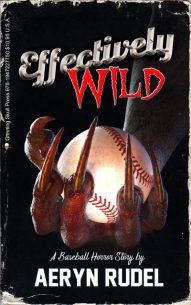
Effectively Wild – A Baseball Horror Story
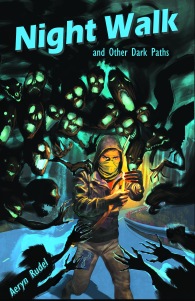
Night Walk & Other Dark Paths
Acts of War: Flashpoint

Acts of War: Aftershock

Acts of War: Stormbreak

 Aeryn Rudel's Rejectomancy