
Writing Acts of War II – Week 6 Update
Six weeks down, and I’m starting the third act of Acts of War: Aftershock. The epic conclusion is in sight, and, well, they don’t call it “WAR” MACHINE for nothin’.
Progress: I wrote 11,062 words and ended on chapter 24. Some of these chapters got a little long, so they might get broken into multiple chapters in revision. My total word count is just over 66,000 words, and we’re targeting between 90,000 and 100,000 for the book. In other words, the end is in sight, and a finished first draft is starting to become a tangible reality.
The Best Part: More secret stuff. I know, I’m kind of rubbing it in now, but I got the go ahead from Privateer Press to do some things in this book that will be pretty exciting for WARMACHINE fans. In the third act, I’ll be dealing almost exclusively with the shiny new coolness Privateer has put at the mercy of my grubby little keystrokes. Again, I will be revealing some of this stuff as we get nearer the novel’s release.
The Hard Part: So. Many. Characters. There’s no avoiding it with a novel that features actual armies of people doing big, exciting things. You’re gonna have a lot of secondary and minor characters in addition to your main POV characters. It can be easy to lose track of all those names. So, I keep a little spreadsheet of minor characters (names, where they appeared, and so on), so I don’t have to go hunting back though the manuscript when I want to use that Storm Lance lieutenant in chapter thirty-five that I created way back in chapter four.
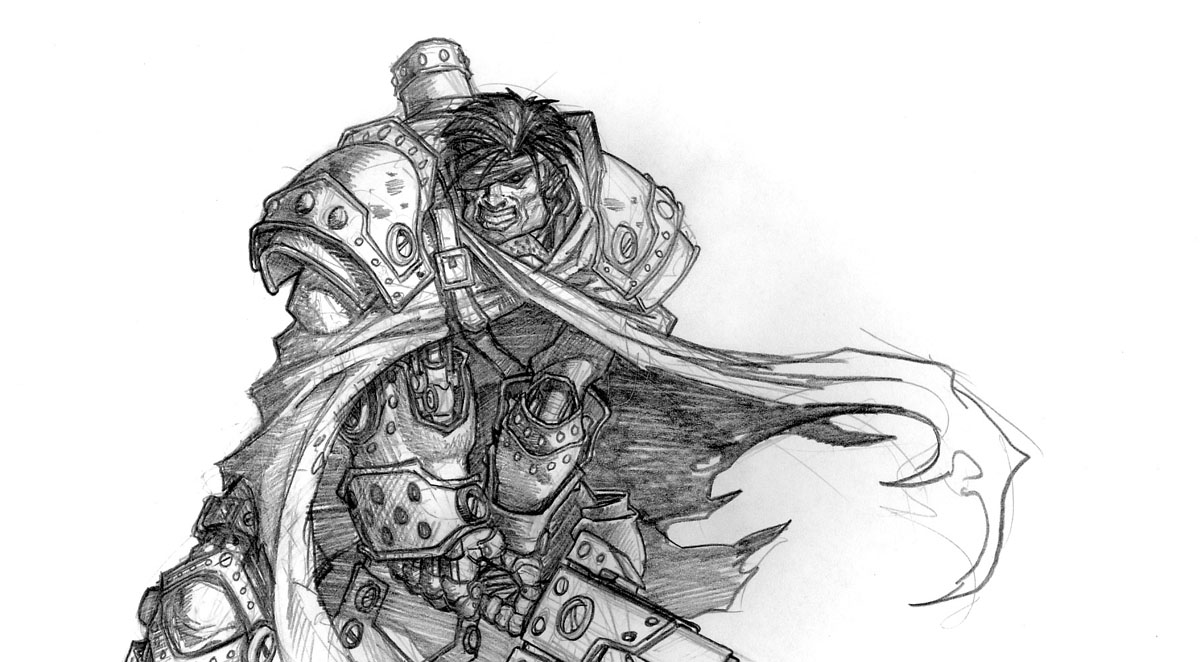
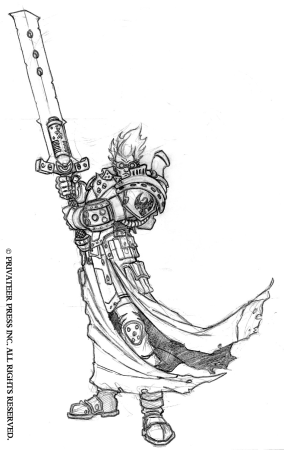
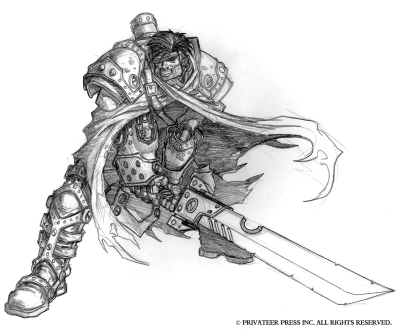
Mini Excerpt: This week’s mini excerpt features two of our main characters, Asheth Magnus and Lord General Coleman Stryker forced into a situation where they have to work closely together. If you’ve read the first book in the series, you know these two have a bit of a checkered past. We also get a glimpse of a villain (and there’s no gray area with this guy) from Flashpoint returning to torment our heroes. This weeks concept art showcases some early designs for Magnus and Stryker from Matthew D. Wilson.
More bullets slammed into the crates, kicking up splinters. It wouldn’t take long for Harrow’s men to reduce their cover to kindling. “We can either make for the door and get shot to pieces or make for Harrow and get shot to pieces,” Magnus said.
“Unless I can give them something to think about from here,” Stryker said, glancing around the ruined warehouse. “This place is already falling apart, so maybe I give it a little nudge.
“I think I know what you have in mind,” Magnus said, shaking his head. “Didn’t you just have a building fall on you?”
The threat of imminent death can heal all wounds. Well, a few of them. It was more than a little fun to write a scene where Magnus and Stryker work together. They actually make a pretty badass team. I just can’t decide which one is Riggs and which one is Murtaugh. I guess Magnus is kind of getting too old for this shit.
Got a question or a comment about the book or my writing process? Fire away in the comments section below. And if you’ve missed the progress reports for the previous weeks, you can find them right here:
***
Check out the first book in this series, Acts of War: Flashpoint, if you haven’t already. You can get the e-book at 25% off from the Skull Island eXpeditions website by entering the code ACTSOFWAR1 at checkout.
Flash Doom & The Molotov 10

Let me start this post by announcing my first acceptance and publication in 2017. My story “An Incident on Dover Street” received an honorable mention (7th) in The Molotov Cocktail’s Flash Doom contest. You can read it right now along with a nine other great stories in the Flash Doom mega-issue.
This publication also marks a fairly momentous occasion, as it is my tenth (10) publication with The Molotov Cocktail. Most of those publications have come in their various flash fiction contests. The themes for these contests always seem to be right up my alley, and, hey, they apparently dig my style enough to publish me in double digits. To celebrate this double-digit day, I thought I’d share all ten stories I’ve published with The Molotov Cocktail. You can read them all, for free, just by clicking one of the links below. So, in order of publication, here’s my Molotov 10.
- “At the Seams” – A little story about falling apart, literally.
- “Shadow Can” – A tale of a shadow gone rogue.
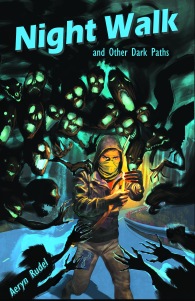
- “Night Walk” –This one puts a non-zombie horror spin on the post-apocalyptic story.
- “Side Effects” – A piece about drugs and spiders, mostly spiders.
- “Beyond the Block” – A head without a body, a body without a head–will they ever find one another?
- “A Man of Many Hats” – A weird one about, uh, hats.
- “The Sitting Room” – An art connoisseur with very specific tastes.
- “The Father of Terror” – Dead cats and Egyptian god-demons for the win.
- “Masks” – Children’s Halloween masks and ancient demons. A winning combo!
- “An Incident on Dover Street” – A story about dinosaurs. With feathers! (Screw you, Jurassic World.)
Got an opinion about any of the pieces above? Tell me about it in the comments section below.
Writing Acts of War II – Week 5 Update
Five weeks have come and gone, and I’m past the halfway point in the first draft of Acts of War II. Before we get started, though, I’m pleased to announce the book now has an official title, Acts of War: Aftershock.
Here’s the skinny on week five:
Progress: I wrote 10,149 words and ended in the middle of chapter twenty-one. I’ve passed the midpoint in the book, and though it’s not exactly downhill from here, it’s a good milestone, and I feel like I’m right where I need to be.
The Best Part: Secret stuff. One of the best parts of writing these books is that I work closely with Privateer Press Chief Creative Officer Matthew D. Wilson and Jason Soles, lead developer for WARMACHINE. I can’t say anything yet, but damn there is some exciting stuff in this book for WARMACHINE players, the kind of thing I want to talk about so bad I can taste it. But, you know, NDAs and all that. Anyway, I will get to reveal some of this cool stuff as the updates go on, so make sure you stay tuned (or even subscribe to the blog).
The Hard Part: Fantasy weapons. I’m a weapons nerd, and I’ve been doing stuff like SCA and HEMA for a long time. In other words, I generally know what a functional sword or axe or whatever is a) supposed to look like and b) how it should be used. With any fantasy setting, realism in melee weapons is not a huge priority, looking really goddamn cool trumps it every time. Don’t get me wrong; I love the style of the weapons in WARMACHINE, but sometimes, when I’m writing a battle scene and I need to describe how a certain weapon works, it can be challenging from the perspective of historically accurate(ish) combat. There’s always a way to write it believably, but some weapons take a bit more inventiveness on my part. Yeah, I’m lookin’ at you, Storm Lances. On the flip side, I just love Ashlynn d’Elyse’s weapon Nemesis. It’s got all the things that make Iron Kingdoms weapons cool and it’s a totally realistic and useable sword design. No fudging required.
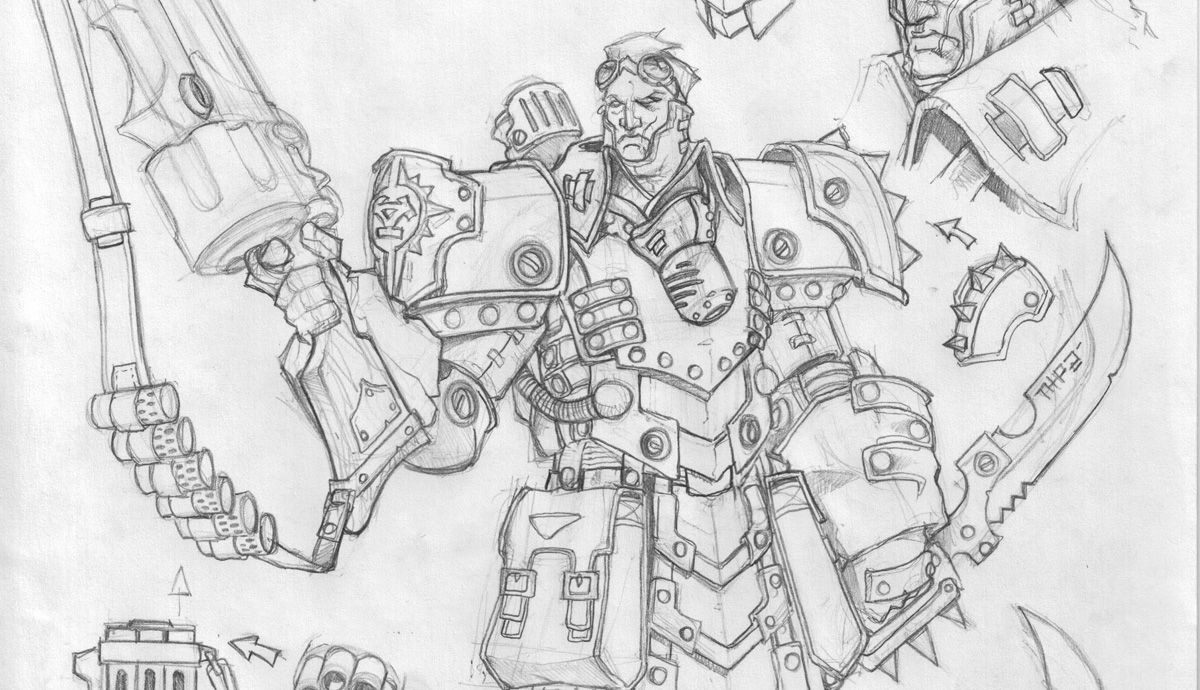
Mini Excerpt: This week’s mini excerpt features both a new character and a familiar face for Khador fans, Kommander Oleg Strakhov. Today’s awesome art comes from former Privateer Press concept artist Chris Walton.
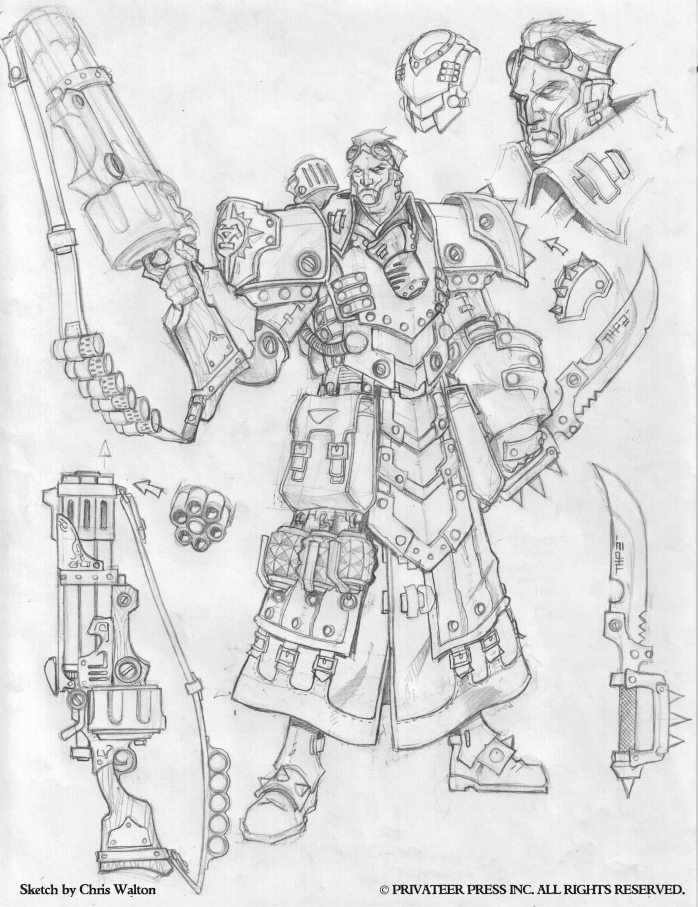
Four men and three women entered the cell, two Assault Commandos behind them, carbines at the ready. The prisoners wore little more than rags, and it was clear they had been guests of the Khadoran Empire nearly as long as he. Lucas didn’t recognize any of them until he got to the last woman in the group. His breath caught in his throat, and both fear and joy seized hold of him. Alyce. No. He had believed his wife had escaped the attack on the Resistance stronghold in Laedry where he’d been captured. Knowing she was safe was the only thing bolstering his failing sanity. It seemed even that was to be taken from him.
His captor had said nothing about Alyce in all the time Lucas had been imprisoned. Was it possible Strakhov did not know who she was? He clung to this scant hope.
“Line them up,” Strakhov said, and his commandos faced the prisoners against the far wall of the cell.
“Please don’t do this,” Lucas said, knowing what was coming. “These people aren’t involved.” He needed Strakhov to believe he had no personal stake and that he simply wanted to avoid further bloodshed.
Strakhov put his hand on the hilt of the trench sword he wore on his left hip. Lucas had seen the brutal weapon in action. It was twenty four inches of mechanika-driven steel, stout enough to puncture warjack armor. Flesh and bone would offer no resistance. “I don’t want to do this,” the warcaster said. “Tell me what I need to know and I won’t have to do this.”
What is Strakhov trying to find out? Who is Lucas and why is he in a cell? All will be revealed; I promise. In the meantime, keep checking these updates for more info on Acts of War: Aftershock.
If you have a question or a comment about the book or my writing process, ask away in the comments section below. If you’ve missed the progress reports for the previous weeks, you can find them right here:
***
Remember to check out the first book in this series, Acts of War: Flashpoint, at a 25% discount from the Skull Island eXpeditions website by entering the code ACTSOFWAR1 at check out.
4 Reasons for the Same-Day Rejection

Here’s the scenario. You fire off a short story submission, fully prepared to wait the two weeks or one month or however long it takes for them to read your story and make a decision. You check your email a couple hours later and BAM! They’ve already sent you a form rejection. Yep, it didn’t take months, weeks, or even days for the editors to decide your story wasn’t a good fit. It took mere hours.
Cue the alarm bells.
Was your story that bad? Are you a terrible writer whose work is such monumental garbage the reek of it nearly caused the editor to blow chunks all over his or her computer after reading a single sentence? Well, probably not to both questions, but let’s unpack this a bit.
Normally, I don’t like to spend a lot of time on form letters because they just don’t tell you much other than the publisher isn’t going to publish your story. The same-day rejection, however, can be jarring because, hey, you kind of expect a mulling-over process with your submission and not instantaneous rejection. So let’s talk about four possible reasons for the same-day rejection based on my own experiences. Remember, this isn’t absolute fact, it’s hypothesizing based on anecdotal evidence; in other words, we’re gonna rejectomance this motherfucker.
- You didn’t follow the submission guidelines. Pretty self-explanatory, right? This is the only reason on the list that isn’t rejectomancy; it’s cold, hard fact. If they asked for your manuscript in Courier New and you sent them Times New Roman, you’re gonna get rejected, and fast. If they asked you to put your story in the body of the email and you sent it as an attachment, you might get a rejection in minutes instead of hours. In other words, and say it with me, kids: ALWAYS FOLLOW THE SUBMISSION GUIDELINES.
- They’re just that fast. Yep, there are a couple of spec-fic markets that are well known for same-day rejections. If you routinely submit horror, sci-fi, or fantasy, then you likely know the ones I’m talking about. But how are they so fast? The possible answers to that question could fill their own blog post, but the two most likely reasons are they have a sizeable staff of first readers who read submissions the instant they come in, and/or they can tell from the first few paragraphs that a story is not for them. I can’t say for sure those are the reason these markets respond so quickly, but they make the most sense to me. To sum up, if you get a same-day rejection from one of these markets, don’t worry about it. For them, it’s just SOP.
- First in line. Sometimes when you send in a story right when a market opens the flood gates on their submission period you get lucky and end up at the front of the line. It’s just luck of the draw that your story happened to be one of the first the editors read, and if it’s not for them, then a same-day rejection could be the result. One thing to keep in mind is that for many markets the reason it takes weeks or months for them to get back to you is there are dozens even hundreds of submissions to read before yours. It really doesn’t take an editor too long to read and make a decision on a short story, so if you get read first, your chances of a lightning-fast rejection are pretty high.
- They like your stuff. One thing I’ve noticed is that markets that have previously published my work generally get back to me quicker with subsequent submissions. Sometimes they even get back to me in the same day. This could be because they recognize my name, remember they liked and published something I wrote, and move my submission to the front of the line. That doesn’t necessarily mean they’re more likely to publish what I’ve sent them, but it might mean they’re more likely to read it first. And if they read it first, well, then my chances of a fast or even same-day rejection increase dramatically. I’ve received form rejections and personal rejections in the same day under this scenario.
So, as alarming as a same-day rejection can be, you probably shouldn’t view the the speed of the response as a measure of the quality of your work. As with any rejection, there are lots of things happening behind the scenes you’ll never know, and few of them have anything to do with the how good or bad your story might be. Take a deep breath, and send that story out again.
Do you have any experience with the same-day rejection? Tell me about it in the comments.
Writing Acts of War II – Week 4 Update

I’ve completed week four of the first draft of Acts of War II, and I’m well beyond the one-third mark. Here’s the details on week number four.
Progress: I wrote 11,185 words, completed act one, and ended in the middle of chapter seventeen. I’m pleased with this number, though it should have been closer to 15,000. I was hobbled a bit by my primary computer going down, which cost me about a day of work. Fortunately, I’m very diligent about backing up my work and no progress was lost in the melt down. Despite a bit of adversity, I’m still ahead of schedule and moving right along.
The Best Part: Fish out of water. This week I had the chance to take one of the main characters and put him in a situation where he was out of his element and stripped of what he relies on to achieve success. It gave me the opportunity to make this character think outside the box and draw upon skills he hadn’t used in quite some time. This led to some scenes that were a lot of fun to write and showed this particular character in a different light.
The Hard Part: Pacing. Always an issue in an action novel, and something the writer needs to be aware of from outline to final draft. In a book like Acts of War II, it’s important the story move swiftly and nimbly from one scene to the next and maintain a sense of urgency that is vital to the plot. This week had me examining several previous scenes to see if they were bogging down the story, and I marked a couple for possible revision and even removal in the next draft. That kind of thing will continue as I write the first draft and will absolutely be part of the editorial process when I hand it over to Privateer Press.
Mini Excerpt: This week’s mini excerpt features one of Cygnar’s antagonists from the story, Khadoran warcaster Kommander Andrei Malakov. WARMACHINE players will likely recognize one of Malakov’s signature moves in the excerpt. This week’s concept art comes from the exceptionally talented Andrea Uderzo.

Stryker leveled Quicksilver and fired a blast of voltaic energy, shunting his will into the bolt to increase its lethality.
His attack should have struck Malakov, but the warcaster reacted with almost precognitive speed and pulled a nearby Winter Guard rifleman in front of him, practically yanking the man off his feet. Stryker’s blast hit the unlucky soldier, reducing his head and most of his upper torso to ash. Behind what remained of Malakov’s human shield, the Khadoran warcaster was untouched.
Despite what Stryker knew about the man, he was stunned by Malakov’s callous disregard for his own soldiers. In his mind, death was preferable to living with such an act of cowardice.
I think it would be fair to say Malakov’s leadership style isn’t always a great morale booster for his soldiers.
If you have a question or a comment about the book or my writing process, I’d be happy to answer it in the comments section below. And if you’ve missed the progress reports for the previous weeks, you can find them right here:
***
You can still get the first book in this series, Acts of War: Flashpoint, at a 25% discount from the Skull Island eXpeditions website by entering the code ACTSOFWAR1 at check out.
Writing Acts of War II – Week 3 Update
Week three has come and gone, and the first draft of Acts of War II has passed the 30,000-word mark. Below is my progress report for the week.
Progress: I wrote 10,022 words for week three and made it to the end of chapter eleven and very nearly to the end of act one (one more chapter to go). That’s less raw words than the previous weeks, but with the holidays and another large project intruding on my writing time, I’m more than happy with this number. I’m still well on track to finish ahead of my deadline.
The Best Part: Big battle scenes. This week included the first big set-piece battle in the book, and I always have a lot of fun writing those. One of my favorite things about these scenes is that I can really pull out all the stops and show my main characters, most of which are warcasters (that’s a kind of sorcerer who combines magic with steam-powered technology), doing what they were made to do. That means spells, feats, and all the other fun little bits WARMACHINE players see on their stat cards.
The Hard Part: Game to narrative. When you’re a media tie-in author for a company that produces tabletop miniatures games or RPGs, one of the challenges you will invariably face is turning abstract game language into narrative fiction. I mean, you have to take a rule like “automatically hits and gains an additional die on the damage roll” and turn it into something that makes some sense in the real world. That said, these are fun challenges, and I typically get a kick out of coming up with new ways to translate game to fiction.
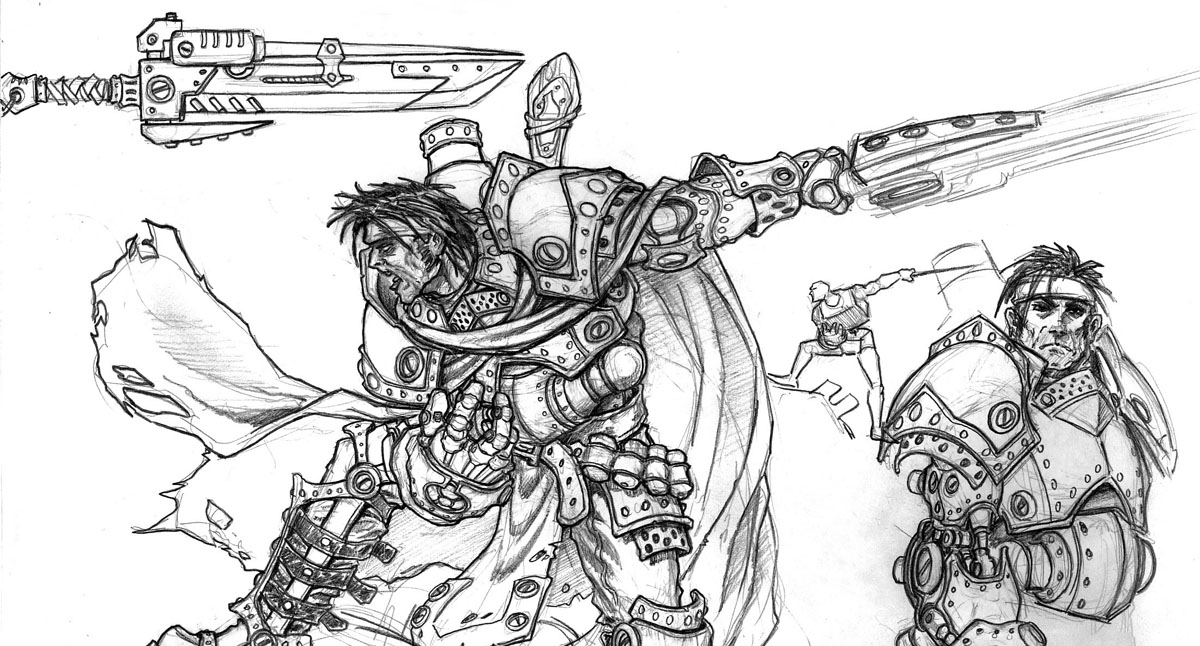
Mini Excerpt: This week’s mini excerpt features warcaster versus warjack, and once again, we’ve got some awesome concept art for one of the main characters in the book, Asheth Magnus.

Magnus charged, the weight of his armor and the nagging pains of old wounds sliding away in a surge of adrenaline. The Sentinels parted before him, and the Spriggan loomed, its war lance swiveling in his direction. He spun away from the first thrust, which would have impaled him–armor, power field, and all–and hit the Khadoran warjack holding Foecleaver like a lance of his own. Magnus focused his will into the strike, and the mechanikal blade ripped through the Spriggan’s hull below its head, showering him in sparks and the black spray of hydraulic fluid. The Spriggan swung its assault shield at him as he wrenched Foecleaver free and tried to leap away. He wasn’t quick enough to avoid a glancing blow, and his power field blazed, absorbing some of the impact, but the attack still had enough momentum to smash him off his feet and stave in the right side of his breastplate.
Man, I hope Magnus did some serious damage to that Spriggan, or our favorite ex-mercenary antihero might be in serious trouble. 😉
Got a question or a comment about the book or my writing process? Ask away in the comments section below.
And if you’ve missed the progress reports for the previous weeks, you can find them right here:
***
Remember, you can still get the first book in this series, Acts of War: Flashpoint, at a 25% discount from the Skull Island eXpeditions website by entering the code ACTSOFWAR1 at check out.
2016: A Writing Rearview Review

And that’s a wrap on 2016, some might say mercifully so. As for how 2016 treated me and my writing career, I would rate the year as “not too shabby.”
Let us now turn to a whole bunch of stats because they are the super-duperest, most fun thing ever. Full disclosure: I love stats. It’s a personal failing, I know.
Fantasy/Horror/Sci-Fi Submissions
Total Submissions Sent: 54*
Better than last year but not nearly as many as I would have liked. The biggest reason I didn’t get as many short story submission out there is pretty easy to figure. I was writing novels for a lot of the year, the first of which was published in 2016. That ate a lot of writing time with, uh, more writing. Anyway, not too bad.
Acceptances: 9
Okay, this is a better number, and it’s almost double what I did last year. I also increased my acceptance ration from 13% to 17%, a number I hope to raise even further in 2017.
Form Rejections: 29
I actually received more form rejection than last year, but since I primarily submitted to top-tier markets in 2016, that’s not too bad. In addition, I received a number of higher-tier form rejections from this publications, which tells me I’m getting closer to an acceptance (I hope).
Personal Rejections: 10
About the same number of these as last year. A number of these were for stories for which I received a further consideration letter but the publisher ultimately decided to pass. Disappointing, but still a step in the right direction.
Never Responded/Withdrawn: 1
Just one of these in 2016, and it was because the publication went out of business. Disappointing because the story was short-listed. Oh, well; it’s a tough ol’ market out there for small genre zines.
*I still have five submission pending, so percentages are based on the submissions that have received a response.
Privateer Press
I still write a bunch for Privateer Press, and here’s what I did in 2016.
Novels: 1.3
I finished one novel in 2016 for Privateer Press, Acts of War: Flashpoint, which was published in July. I’m currently writing another one, Acts of War II, and I’m blogging my progress as I go along. You can see those blog posts right here.
Novellas: 1
I wrote one novella for Privateer Press that I can’t talk about yet because it’s still going through revisions. I’ll have more info on that soon.
Short Stories: 4
I wrote four short stories for Privateer Press in 2016, one of which was published in No Quarter magazine, and three others that were part of an introductory product for Privateer’s primary game lines WARMACHINE and HORDES.
Articles: 4
I also penned four articles for No Quarter Magazine, which is about par for the course. All of these were about the Iron Kingdoms setting.
Rejectomancy
Lastly, there’s this blog itself, and 2016 was my first full year of blogging. I couldn’t quite keep up with three posts per week like I had initially set out to dao, but I was routinely able to put out two posts. I learned a lot this year about the kinds of things folks like to read and the kinds of things they’re unlikely to read. One thing that will change in 2017 is the amount of self-promotional posts on the blog. I won’t go crazy, but I’ve got some big projects this year I want to talk about in addition to the usual rejectomancy stuff.
Here are the raw stats for the blog.
- Total Posts: 88
- Total Visitors: 7,816
- Total Likes: 646
- Total Comments: 470
I didn’t write that many more posts than I did in 2016, and I think I likely should have done a few more. Again, the novels ate into my writing time, but that’s not a great excuse. This year, I’d like to get those numbers up and hit at least 10k visitors.
Summary
Here’s what my total output for 2016 looked like in hard numbers. It’s less than last year for a number of reasons, but I’m not too unhappy. Like last year, I’m only counting stuff I wrote that was either published or is slated for publication.
- Words Written: 194,250
- Articles/Stories/Novels Published: 19
2017 Goals
I’m not going to go into too much detail here because my goals basically amount to write and publish more stuff. Here’s a couple of things, though.
- Write more stories, submit more stories, and get more stories accepted.
- Write three novels: two novels for Privateer Press and one novel for my agent to shop (my own IP).
- Blog more. More promotional posts and more rejectomancy/writing posts.
2016 Free-to-Read Published Stuff
If you’d like to have a look at some of the things I published this year, here are some links to short stories you can read (or listen to) for free.
- “Night Games” – Published by Pseudopod: Pseudopod has done an audio version of my story “Night Games.”
- “Scare Tactics” – Published by The Devilfish Review: This is a quaint tale about a girl, her pet demon, and her budding parapsychology career.
- “A Man of Many Hats” – Published by The Molotov Cocktail: A weird one about, uh, hats. This one was awarded an honorable mention in The Molotov Cocktail’s Flash Phenom contest.
- “The Father of Terror” – Published by The Molotov Cocktail: Dead cats and Egyptian god-demons for the win. This story was awarded second place in The Molotov Cocktail’s Flash Icon contest.
- “Masks” – Published by The Molotov Cocktail: Children’s Halloween masks and ancient demons. A winning combo! This story was awarded third place in The Molotov Cocktail’s Flash Fear contest.
And that, friends and colleagues, was my 2016 in the wild world of freelance writing. How was your year? Tell me about it in the comments.
Writing Acts of War II – Week 2 Update
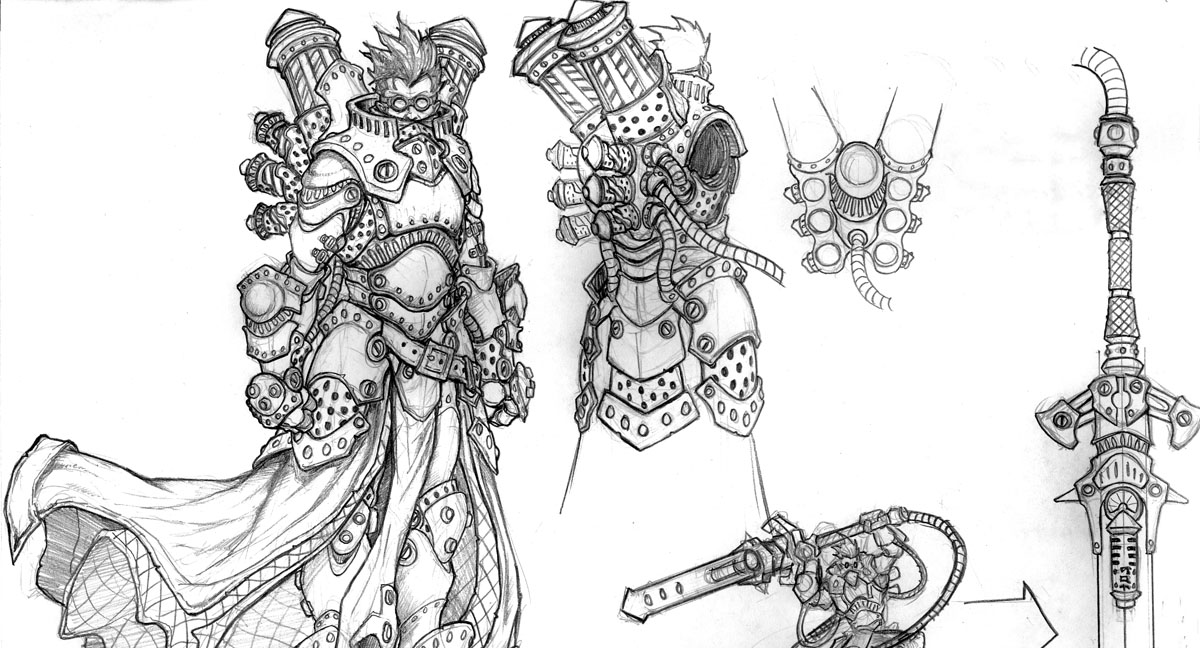
Week two is in the books, and the first draft of Acts of War II is coming along. Here’s my writing report card for the week. If you missed last week’s update, you can find that right here.
Progress: I wrote 12,021 words for week two, slightly more than week one. I ended my writing for the week in the middle of chapter eight and pretty close to the end of act one (should have that wrapped up this week). That’s solid progress, and if I keep it up, I’ll finish the first draft well ahead of schedule.
The Best Part: Secondary characters. If you are not familiar with the work I do for Privateer Press, you might not know the Iron Kingdoms is not a world I created. Far from it. It was created by Privateer Press, my publisher, and many of the major characters in the novel are preexisting characters from the setting. While I love writing about the famous heroes and villains of the Iron Kingdoms, I do get to create a bunch of secondary characters from whole cloth in each novel. That’s always fun because I get to add a little to the lore of the Iron Kingdoms.
The Hard Part: Secondary characters. Yep, this week it’s a double-edged sword. When I’m writing about Stryker or Magnus, I don’t have to worry about coming up with a setting-appropriate background; that’s already built in. When I create a character from scratch, I have to make sure he or she actually fits in the Iron Kingdoms. This can often be a challenge because I don’t want to give you the character’s life story in a massive info dump. Instead, I try to find little details that anchor the character in the setting and don’t require a lot of space to communicate. For example, one of the men under Magnus’ command is a former merc who worked with the warcaster while he was a mercenary. That’s easy to get across in a sentence or two, and it grounds the character firmly in the setting. The fact that he’s a former pirate that once served aboard one of Captain Bartolo Montador’s ships is just icing on the cake (and me having a little fun).
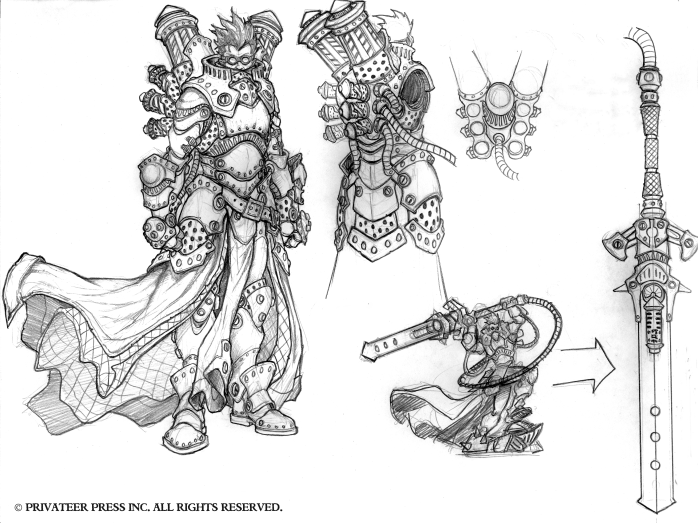
Mini Excerpt: This week’s mini excerpt features Lord General Stryker interacting with one of those secondary characters I spoke about. This one, a captain in the Steelheads Mercenary Company, isn’t exactly impressed by the famous Cygnaran warcaster (despite the awesome concept art from Matthew D. Wilson below).
“I am surprised Marshal d’Elyse would not ride out to meet an old ally,” Stryker said. From a strategic perspective, he understood why she had sent an envoy, but she had sent a mercenary, not one of her own men. The message and the slight were clear.
“Is that what you are, Lord General?” the Steelhead captain said. “There are some who think different.”
“What is your name, mercenary?” Captain Archer said, her disgust plain. Many knights had little regard for mercenaries, finding their shifting loyalties distasteful, but Stryker couldn’t say if Captain Archer numbered among them or if she was simply taken aback by this particular Steelhead’s impertinence.
“Captain Artis Keller, at your service,” the Steelhead said and touched one finger to his helmet. “And, ma’am, I don’t consider that word an insult, even when you spit it at me.”
Gotta love a sassy Steelhead, right?
Have a questions or a comment about the book, the Iron Kingdoms, or my writing process? Ask away in the comments section below.
***
Oh, and remember, you can still get the first book in this series, Acts of War: Flashpoint, at a 25% discount from the Skull Island eXpeditions website by entering the code ACTSOFWAR1 at check out.
Writing Acts of War II – Week 1 Update

I’ve begun writing the first draft for Acts of War II, and this is this first update on my progress. Before I get into the numbers and whatnot, let me tell you a bit about what these updates are going to look like.
First, I’ll give you my progress on the draft for the week prior, which will come in the form of how many words I’ve written and what chapter I’m on. Next, I’ll tell you one thing that was fun about writing that week and one thing that was a little challenging. Finally, I’ll give you a very short excerpt from the week’s writing. These excerpts will be raw text from the first draft, so there’s every possibility they’ll change a little or even a lot in the final version of the book. Don’t worry; I won’t spoil major plot points or anything.
Okay, now that you know what you’re getting, here’s what week one looked like.
Progress: I wrote 11,678 words, which put me right at the end of chapter three. That number exceeds my daily and weekly writing goals, and it keeps me on track for a first draft of between 90,000 and 110,000 words in about nine to ten weeks. So, in all, a solid first week.
The Best Part: I got to write from Ashlynn d’Elyse’s POV for the first time. She’s always been one of my favorite characters in the setting, and it was a lot of fun to get into her head. Plus, she’s a renowned sword master and duelist, so I can really nerd out and get a little more technical with her fight scenes (see below).
The Hard Part: Location, location, location. Describing places in the Iron Kingdoms that have never been described before in narrative fiction can be challenging because you want to make sure what you’re writing matches the existing information (of which there is often quite a bit). Luckily, I have excellent resources for that kind of thing, so it just takes a little bit of extra research.
Mini Excerpt: This week’s mini excerpt features Ashlynn d’Elyse doing one of the things she does best—kicking ass! (By the way, check out the original concept art for Ashlynn below.)
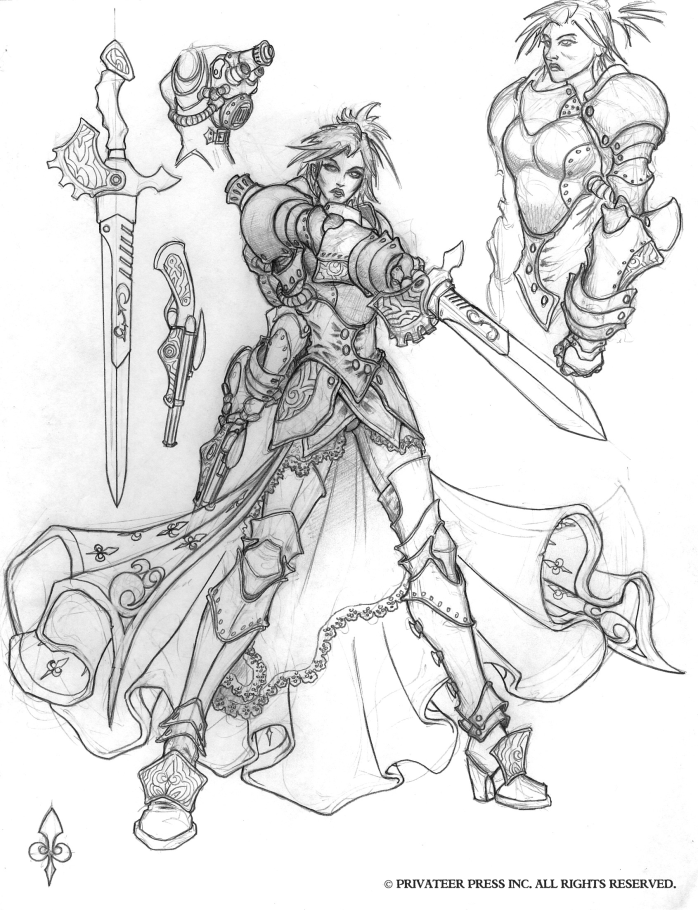
Ashlynn thrust at the ‘jack marshal’s throat, and he knocked Nemesis aside with a crisp parry, binding her weapon with his heavier blade and what he must think superior strength. It was good form, but not good enough. She allowed her sword to be pushed away, then snapped Nemesis out of the bind. Her opponent had been using too much pressure, and his blade dropped for a split second without her weapon to resist it. The opening was small, but she was quick, and a short, powerful cut from Nemesis split the Khadoran’s skull before he could bring his saber back up to defend himself.
That’ll learn him, right? Tune in next week for more progress, more art, and more mini excerpts from Acts of War II.
Got questions about the book or the writing process? Fire away in the comments section below.
Check out the first book in this Acts of War series, Flashpoint, if you haven’t already. You can get a digital version of the book at 25% off from the Skull Island eXpeditions website by entering the code ACTSOFWAR1 at check out.

Acts of War II Character Profile: Ashlynn d’Elyse

Time for the first character profile for Acts of War II, where I’ll give you some basic information on the major characters from the upcoming novel. If you’re a fan of the Iron Kingdoms and WARMACHINE, you’ll be very familiar with some of these characters (but not all of them). If you’re new to the land of steam and sorcery, these profiles will give you valuable information on the characters and the world they live in.
To kick things off, we’ll start with a character who’s new to the Acts of War series, Llaelese Resistance leader and warcaster Ashlynn d’Elyse.
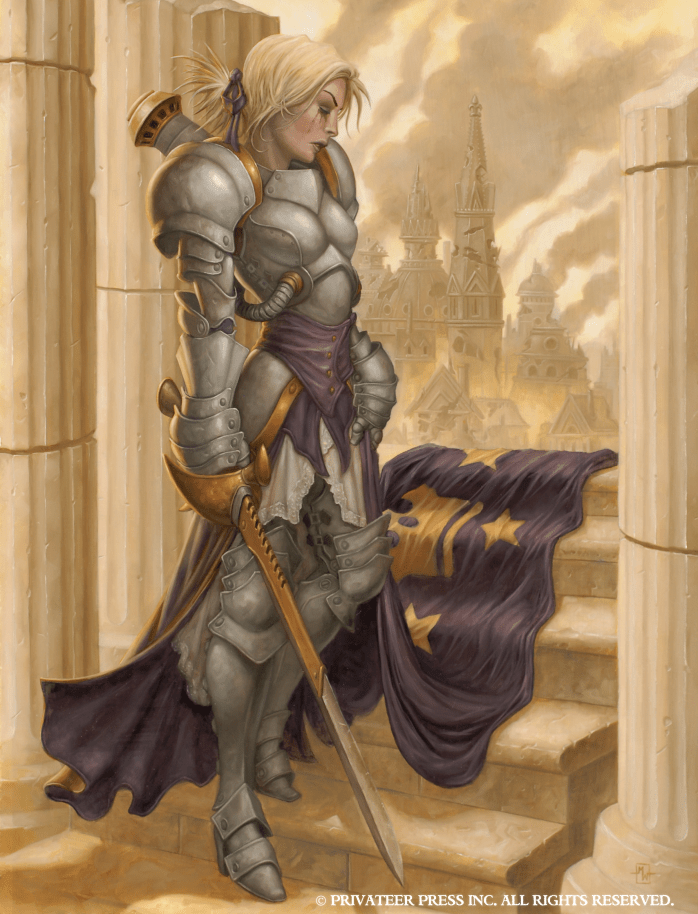
Name: Ashlynn d’Elyse
Nation: Llael
Resume: warcaster, master swordsman, battle leader in the Llaelese Resistance, part-time mercenary
Signature Weapon: Nemesis
History: The only daughter of Llaelese noble and renowned master duelist Benoir d’Elyse, Ashlynn was destined to be a great warrior and swordsman like her father. When her arcane abilities manifested, she earned a place at the Royal Arcane Academy, and became one of Llael’s few warcasters.
Her full potential as a warcaster was realized on the front lines when Khador invaded Llael, and she quickly became known among her enemies and allies as a fearsome warrior and battle leader. The execution of her father and many other nobles after the fall of the capitol city of Merywyn only made her more determined and ruthless.
When Cygnar withdrew its aid and Llael fell, Ashlynn fought on, offering her services as a mercenary to fund a growing rebellion. The Resistance has long been a thorn in the side of the Khadoran occupiers, and Ashlynn d’Elyse and her warcaster abilities are behind much of the damage caused by the Llaelese freedom fighters.
Present: When Cygnar invaded Llael to drive out Khador under their new king Julius Raelthorne, the Resistance was not a large part of their plans. Much of this was because of the Resistance’s relationship with the Protectorate of Menoth, a nation of zealots whose interests often put them at odds with Cygnar. Ashlynn resents Cygnar’s invasion of her lands and sees them as only slightly better than the Khadoran occupiers they are attempting to remove. She and the Resistance fight on, against Khador and any who would stand in the way of a free Llael.
Check out the first book in this Acts of War series, Flashpoint, if you haven’t already. You can get a digital version of the book at 25% off from the Skull Island eXpeditions website by entering the code ACTSOFWAR1 at check out.
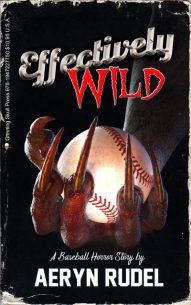
Effectively Wild – A Baseball Horror Story
Night Walk & Other Dark Paths
Acts of War: Flashpoint

Acts of War: Aftershock

Acts of War: Stormbreak

 Aeryn Rudel's Rejectomancy