
Which Is It? Criticism or Feedback?

As a writer, you hear the terms criticism and feedback a lot. The first carries a (sometimes undeserved) negative connotation, the other, a more positive and constructive one. The truth is, feedback and criticism are both necessary and helpful to a writer, as long as the writer understands the context in which each is given, and, more importantly, the context in which they should be given.
This’ll be reductive, but here’s how I look at the two terms. Feedback is given to an author while the work is still in process and unpublished. Criticism is the analysis of a work’s flaws or merits after it’s been published. Like I said, reductive, but let’s see if I can get a bit more nuanced.
Let’s talk about feedback first. Here are its three defining traits, in my opinion.
- For the author. Feedback is given directly to the author with an aim to improve the work. It is given by critique partners, beta-readers, agents, and editors–all people with a vested interest in improving the piece. In other words, the author can still do something about any flaws in the work.
- Constructive. Good feedback is not just an opinion. It’s an opinion paired with solutions or actionable advice. Not everyone agrees with that second part; I know. Still, I think a comment without actionable advice can still be constructive, but unlike criticism, an author needs to understand WHY with feedback.
- Requested. The vast majority of the time when an author gets feedback on an unfinished or unpublished piece, they’ve asked someone to provide it. This is even true of magazine editors, agents, and book publishers where an author might send a story or novel in hopes of representation or publication. Feedback isn’t specifically asked for in that situation, but I think there’s a tacit understanding that it would be welcomed, and such feedback is given in the spirit of improving the work (or at least improving the author’s understanding of the publisher or agent’s preferences.)
Now criticism–but before we get into this, I want to get this out of the way. Criticism is NOT a bad thing. In fact, it is a necessary thing when given in the right context. We, as authors, might not like all the criticism we receive, but it’s the price of fame and glory. 😉 Here are what I consider to be the four defining traits of criticism.
- For the reader. When someone offers criticism of a work, it’s generally in the form of a review. That might be a reader review on Amazon or a full write-up in the New York Times. In both cases, the reviewer is not analyzing the work in an attempt to improve it. They are simply, and hopefully objectively, analyzing its merits and flaws. This is because that analysis is meant for potential readers of the work, steering them to or away from it based on the critic’s opinion.
- Not necessarily constructive. I know that sounds bad, but remember, criticism is not really for the author, so any flaws a reviewer might point out aren’t about improving the piece. That’s largely pointless because the work is finished and published. So, criticism doesn’t often come with actionable solutions (and it doesn’t need to). That said, the critic might explain why something doesn’t work for them and why it may not work for other readers, and that can be helpful to an author.
- Biased. Feedback is a biased opinion, too, of course, but when we’re comparing bias in criticism and feedback, proximity to the author is the important difference. Someone giving feedback is likely (but not always) predisposed to the author’s genre, themes, style, and so on. If you’re writing a horror novel, your critique partners are probably familiar with the genre’s tropes. A critic can be all these things, but they might be none of them. This isn’t to say that a critic’s opinion isn’t informed, just that their biases might be at odds with the author’s work in a way someone providing feedback wouldn’t be, and that’s okay.
- Optional for the author. For the author, criticism is optional because, remember, it is generally given in reviews, a place that isn’t necessarily for the author. The author is under no obligation to read reviews. Mind you, I’m not saying an author shouldn’t read reviews, but it should be on their own terms.
So that’s how I define criticism and feedback. Like all things, the quality of both can vary a lot, so let’s discuss what good/bad criticism and good/bad feedback look like
- Good criticism is about the work, not the author. This does not mean that the critic has to like the work, only that their opinions should be aimed at informing potential readers of the work’s strengths and weaknesses.
- Bad criticism is generally colored by extreme bias. It could focus entirely on the author rather than the work, or be so uninformed as to be useless (the “I didn’t actually read the book” one star reviews, for -example). This is not to say that a critic cannot have biases (everyone does), but good critics might state them in the review if they know those biases are at odds with the work. For example, I don’t like ghost stories. No idea why. I just don’t. I’m a poor judge of what constitutes a good ghost story. If I were to review one, I’d let folks know that up front (or I just wouldn’t review it).
- Good feedback is a partnership. It is solicited and given with the aim of improving the work and getting it ready for publication. It points out issues and provides possible solutions. It is a joint effort, even if the person providing the feedback is doing so on a one-time basis (a declining editor or agent, for example).
- Bad feedback often attempts to change the work in ways that ignore the writer’s voice, style, and goals for the piece. Essentially, bad feedback is an attempt to rewrite the work as the feedback-giver would write it. Bad feedback is also feedback without actionable solutions or explanations. These are of little use to the author.
So, what can we learn from criticism and feedback? Quite a bit, actually.
What we learn from feedback is obvious. It’s a workshop environment where ideas and solutions are traded to improve a story, novel, etc. With good feedback partners, an author can learn a lot about their work, their style, and, most importantly, where and how they need to improve. Feedback is vital to the development of any work. It is typically solicited and provided by people at least somewhat knowledgeable in the craft and/or genre and who are committed to making the work the best it can be.
An author can learn from criticism as well, but it takes a more careful eye. What I call “not my cup of tea” criticism is not as useful to the author (though still absolutely valid and useful to readers). A reviewer who doesn’t like horror, and states that, then gives a horror novel a mediocre review is not as worrisome as a critic who is in tune with the genre and points out things that didn’t work for them. That kind of review should be considered, especially if it’s not an isolated event. Again, criticism, even the actionable kind, isn’t useful to a completed, published work, but it can be helpful for an author’s future works.
So, there you have it: my rambling thoughts on criticism and feedback and why they’re both necessary in the right context. Understanding the differences, I think, can save a writer a lot of time and pain.
Thoughts about my definitions? Tell me about it in the comments.
The 700 Club (No, Not That One)

Recently, I sent my 700th short story submission. That number spans a period of ten years since I started tracking them religiously (hah!) on Duotrope. Whenever I hit a big milestone like this, I like to break down all numbers, get WAY too analytical and then inflict the result on my readers. So, here we go. 🙂
First, here are the basic stats for the 703 submission I’ve sent since April 16, 2012.
- Acceptances – 97
- Rejections – 569
- Non-Responses – 5
- Withdrawals – 26
- Pending – 6
I’m closing in on 100 acceptances, which is pretty good. The rejections numbers are about what you’d figure for that many submissions, and my acceptance percentage comes out to just over 17% (not counting non-responses, withdrawals, and pending subs). I can live with that.
Lets get a little more granular and look at the number of markets I’ve submitted to and the number of stories I’ve sent.
- Total Distinct Markets – 167
- Total Distinct Stories – 151
- Most Subbed Market – The Molotov Cocktail (65)
- Most Subbed Story – Set in Stone (28)
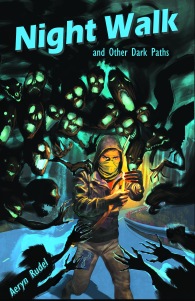
That’s a lot of stories and a lot of publishers. Most of those stories have either been accepted or retired, though there’s still a few crusty old tales making the rounds. I’ve sent a ton of stories to The Molotov Cocktail, but they’ve accepted a ton of stories. They even published my collection of flash fiction Night Walk, which, if you’re so inclined, you can buy here. “Set in Stone” is my number one loser. It’s racked up plenty of close-but-no-cigar rejections but never quite made the cut. It has been put out to pasture now where it can live out the remainder of its days in peace and quiet with the all my other also-rans.
Now let’s dig even further and examine how the numbers reveal the trials and tribulations of being a short fiction writer.
Here are the top five markets I’ve subbed most to where I’ve had at least ONE acceptance.
- The Molotov Cocktail – 65 (17)
- The Arcanist – 50 (16)
- Flame Tree Press – 23 (4)
- New Myths – 23 (1)
- Factor Four Magazine – 18 (2)
Clearly, The Molotov Cocktail and The Arcanist dig my work, and my hit rate is 26% and 32% respectively. Flame Tree Press and Factor Four Magazine are in that 10% to 15% range of pro markets that I’ve actually cracked. I’ve only managed to sell a single piece to New Myths, though I’ve gotten close a couple of other times. I guess I should go back to that one story and see what I did right.
Okay, now the bad news. Here are the top five markets I’ve subbed most to WITHOUT an acceptance. Read ’em and weep.
- Flash Fiction Online – 34
- Daily Science Fiction – 24
- Apex Magazine – 21
- The Dark Magazine – 17
- The Magazine of Fantasy & Science Fiction – 16
If you write and submit short genre fiction, you’re gonna be familiar with these markets. Of the five, I’ve gotten closest with Flash Fiction Online, making their final round of deliberations three times. I’ve made it out of the slush pile at Apex a handful of times but no further. I’ve received some nice personal rejections from F&SF, but I don’t think I’ve come very close to publication based on Duotrope stats for acceptance response times. I’ve only received form rejections from The Dark and Daily Science Fiction. I’m going to keep trying with all these markets except Daily Science Fiction, as they are, sadly, going on indefinite hiatus. I think I have a good chance of cracking Flash Fiction Online one of these days. The others? Who knows. I’ll just have to keep submitting and find out.
Now lets look at number for individual stories. First, here are my most subbed stories that I eventually sold.
- Paper Cut – 19
- The Scars You Keep – 19
- Caroline – 18
- The Downer – 17
- Hell to Pay – Installment Plans Available! – 14
Although “Paper Cut” and “The Scars You Keep” have the same number of submissions, the latter was accepted on its 19th submission and the former on its 16th. I’ve sent “Paper Cut” out as a reprint a few times. The same goes for “Caroline”, which I sold on the 13th attempt and then sold again as a reprint on the 18th. Both “The Downer” and “Hell to Pay – Installment Plans Available!” are recent sales, and what you see is the actual number of submissions it took me to sell each piece. One thing I should point out is that all these are short stories in the 3,000 to 5,000 word range, and they all received multiple final-round rejections before I eventually sold them. It always takes me longer (more subs) to sell short stories, whereas I sell flash fiction in the first three to five attempts. I have no idea why. Regardless of how many submissions were needed, I was happy to find a home for these pieces.
And now for the list of luckless losers. Here are the stories with the most submissions WITHOUT an acceptance.
- Set in Stone – 28
- After Birth – 13
- Coffin Shopping – 13
- When Gods Walk – 12
- Time Has No Memory – 11
I mentioned “Set in Stone” earlier, but it is the king of not for us’s and we’re gonna pass’s in my list of stories. It and “After Birth” have been retired. The latter was never ready for prime time, and I think the idea is one I no longer want to explore. The other three stories are of more recent vintage, and two of them, “Coffin Shopping” and “Time Has No Memory” are currently out on submission. I’ll submit “When Gods Walk” again at some point when another suitable market appears. Of the five, “Time Has No Memory” is the best, in my opinion, and it’s come close with a number of pro markets. I have a lot of faith in that one, and I think I’ll sell it eventually. Maybe even to the market it’s currently under consideration with. 🙂
Well, that’s a quick look 700 submissions. There’s a lot more data I could dump on you, but I think I’ll refrain for the moment. 🙂
Have you hit any major submission or publishing milestones lately? I’d love to hear about it in the comments.
Submission Statement: November 2022
November was a very slow month in submission land, but it wasn’t a total bust.
November 2022 Report Card
- Submissions Sent: 3
- Rejections: 2
- No Response: 1
- Acceptances: 1
- Publications: 0
- Further Consideration/Shortlist: 0
- Withdrawals: 1
Pretty terrible submission numbers despite the acceptance. November was a rough month in a lot of ways, and I got a little off track with submissions, focusing more on other aspects of my writing. Anyway, I’m sitting at 79 total submissions for the year, and it is highly unlikely I hit 100 for 2022. That’s okay, though. A dozen acceptances has made the year a decent one, and if I can hit 90 subs with another acceptance or two, I’ll call 2022 a marginal victory. Here are more overall yearly statistics via Duotrope.
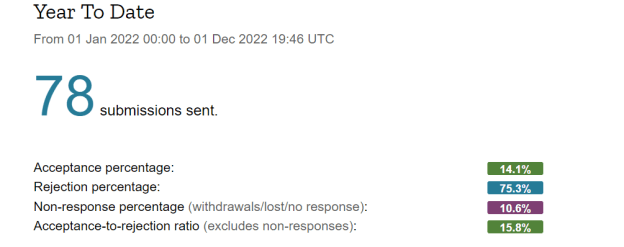
That acceptance percentage is right where I want it to be. I’ve always said that if you can hit a 10% acceptance rate, you’re doing okay. Anything over that is gravy. Now, this graphic illustrates a problem, and it’s a simple one. If I were to submit more, I’d get more acceptances. Let’s say I doubled the number of subs, but my acceptance percentage stayed the same (which I think it would), I’d be looking at 25 acceptances for the year. That’s pretty damn good, and it’s doable I think. Oh, one quick note. It’s actually 79 subs because one of my submissions in 2022 is to a market, Diabolical Plots, that is not in the Duotrope database.
Rejections
Just two rejections in November.
- Standard Form Rejections: 2
- Upper-Tier Form Rejections: 0
- Personal Rejections: 0
Just a couple of garden-variety form rejections last month. Absolutely nothing interesting to show you.
Other Business, aka, Twitter Troubles
Unless you’ve been living under a rock, then you know that Twitter is experiencing some, uh, difficulties. As such, I am expanding my social media presence to other platforms. If you’d like to follow me elsewhere, here are the best places to do it.
FB Author Page: I’ve started a Facebook author page where I post about my writing. It’s different than what you’d find on the blog here, but I do update daily with microfiction and discussions about writing in general.
Instagram: I’m learning how to use IG as an effective tool for writers. It’s a work in progress, but I’m starting to get the hang of it.
I may look into some other social media platforms like Mastodon and Hive, but the two above plus whatever Twitter is at the moment are sufficient.
And that was November. How was your month?
Writerly Wonderings: What’s My Brand?

I think it is important for a writer to have a brand to some extent, so they can more effectively and precisely market to potential readers. This doesn’t mean an author can’t stray from that brand a bit, but if it gets too fractured, then it’s possible to alienate readers. I have a more specific problem with my own brand(s), and that’s because I have four that are somewhat at odds with one another. Let me see if I can explain.
Brand One — Rejectomancer
If you follow this blog, then you most certainly know this brand. I’m the rejection guy. I’m the guy that overanalyzes the noes and the not-for-us’s and makes them a bit more palatable to my fellow writers. This brand has served me well, and it’s gained me a fair number of followers and readers. Of all my brands, I have cultivated this one in the most purposeful manner.
Brand Two — Speculative-Fiction Author
Another brand that won’t be unfamiliar to folks who read this blog, and, hell, maybe a few of you actually follow the blog because of it. I write and publish a lot of speculative fiction. I talk about this work a lot on the blog, and it ties into the whole submission and rejection thing.
Brand Three — Media Tie-In Author
With a few exceptions, I don’t talk much about this aspect of my work on the blog. I’d be willing to wager that most of my followers, especially those who found me in the last three or four years, have not read and maybe have no idea I write this kind of material. Those who read this material don’t generally follow the blog (with some exceptions).
Brand Four — Game Designer/Editor
This is the most ancient of my brands, For over a decade, starting in 2004, I designed RPG material for various companies, and then I took a job with Privateer Press, where I became the editor for their inhouse magazine No Quarter and then the managing editor of their fiction line. I do talk about this experience on the blog, more so lately, and lots of folks know me from this past career (but generally follow me elsewhere).
***
Okay, those are my four brands. Now, what’s the problem? It’s pretty simple. You can draw a line between the first two and the second two brands. People who follow me for submission and rejection advice and/or who read my spec-fic are not particularly interested in the media tie-in and game design stuff. Conversely, those who know me from the media tie-in and game design world are not particularly interested in my rejectomantic ramblings or my speculative fiction. Now, of course, there is SOME crossover, but I have pretty solid data (from this blog, in fact), that it’s not as much as you’d think.
Let me get this out of the way right now. The problem above is 100 percent my fault. Part of it is due to the way my career has developed, which I would call haphazardly, and the other part is how I’ve gone about cultivating one brand over another. So, what’s the answer? Consolidation. Rejectomancy cannot be my author website. It’s just not good at that, and the brand I’ve cultivated for it isn’t particularly conducive to promoting my own work. What I need is a place for Aeryn Rudel Rejectomancer, Aeryn Rudel Spec-Fic Author, Aeryn Rudel Media Tie-In Author, and Aeryn Rudel Game Designer to live harmoniously under one roof. In short, I need an honest-to-god author website where all these things are component pieces of a singular brand – Aeryn Rudel.
A website is not a cure-all, of course. It’s the first step in cultivating that ME brand. There’s still a lot of hustle and work that needs to happen on social media, the website itself, and a few other places I’m considering. I’m taking a good hard look at other authors who have come from the gaming/media tie-in world and who now write speculative fiction of their own. All of these folks have done an excellent job of making their brand, well, themselves. Now, even if I do marry all these disparate parts together, some people are just not gonna be into all the things I do, and that’s totally cool, but I think I’d get more cross-pollination than I currently do. Well, that’s the hope anyway.
So, in 2023, look for some new and improved authorly things and a slight rebranding of this rejectomantic spec-fic writing, media-tie in slinging, former game designer/editor person. 🙂
Thoughts on author brands? Tell me about it in the comments.
Evolution of an Author Bio III
This is the third post I’ve done about my ever-changing author bio. The last post was in 2020, and a lot has changed in the intervening two years. So, I find myself once again in need of a new bio. In this post, we’ll take a look at how I construct an author bio, what’s changed, and my thoughts on how to best implement those changes. First, here’s the bio I was using in 2020.
Aeryn Rudel is a writer from Seattle, Washington. He is the author of the Acts of War novels published by Privateer Press, and his short fiction has appeared in The Arcanist, On Spec, and Pseudopod, among others. Aeryn is a notorious dinosaur nerd, a baseball fanatic, and knows far more about swords than is healthy or socially acceptable. He occasionally offers dubious advice on the subjects of writing and rejection (mostly rejection) at www.rejectomancy.com or Twitter @Aeryn_Rudel.
My bio has certainly grown over the years, but I’m still trying to keep it between 50 and 75 words. As usual, all my bios contain the following three basic elements.
- Basic details
- Accomplishments
- Where to go/buy
Basic Details
The who, what, and where. Like I’ve said in these posts before, I wholeheartedly believe you should keep sensitive data out of your bio. By sensitive, I of course mean anything that would allow someone to find you or direct abuse/scams at you. I’m comfortable sharing the city I live in, but other’s may not be.
Here are my basic details in 2020:
Aeryn Rudel is a writer from Seattle, Washington.
One big change here. I am no longer a writer from Seattle, Washington. 🙂
Aeryn Rudel is a writer from Tacoma, Washington.
Now, I could just vague this up and say I’m a writer from the Pacific Northwest, and I might do that at some point because, honestly, Seattle is a little more impressive than Tacoma.
Accomplishments
Okay, this is where things have changed quite a bit. I’ve had some major publication in the last two years, and I’d like to get them into the mix.
My accomplishments looked like this in 2020:
He is the author of the Acts of War novels published by Privateer Press, and his short fiction has appeared in The Arcanist, On Spec, and Pseudopod, among others.
That’s a fair amount, but, as I said, I want to get those other accomplishments in as well. So here’s what I’m going with.
He is the author of the baseball horror novella Effectively Wild, the Iron Kingdoms Acts of War novels, and the flash fiction collection Night Walk & Other Dark Paths. His short stories have appeared in Dark Matter Magazine, On Spec, and Pseudopod, among others.
I’ve added a fair bit, primarily my novella and my flash fiction collection. I’ve left out the publishers to save space and because they’re not as important to someone who goes looking for these books. I’ve also added brief descriptions of each publication, which is, I think, most important with the Privateer Press novels. Adding Iron Kingdoms is an indication that these books are media tie-in, an important distinction. I’ve kept the short fiction publications, but changed them so they’re all short story markets instead of flash markets. This section has gone from 29 words to 44 words.
Where to Go/Buy
You gotta give folks a place to find more of your work and potentially buy it. So this is a pretty important section.
In 2020, my where to go/buy looks like this:
Aeryn occasionally offers dubious advice on the subjects of writing and rejection (mostly rejection) on his blog at www.rejectomancy.com.
Here’s what it looks like now:
Learn more about Aeryn’s work at www.rejectomancy.com or on Twitter @Aeryn_Rudel.
I shortened this section considerably since I added a lot elsewhere. If I’m permitted a longer bio, I’ll add personal details and try to be witty/funny.
The Finished Bio
Let’s look at the before and after.
Here’s 2020:
Aeryn Rudel is a writer from Seattle, Washington. He is the author of the Acts of War novels published by Privateer Press, and his short fiction has appeared in The Arcanist, On Spec, and Pseudopod, among others. He occasionally offers dubious advice on writing and rejection (mostly rejection) at www.rejectomancy.com or on Twitter @Aeryn_Rudel.
And here’s 2022:
Aeryn Rudel is a writer from Tacoma, Washington. He is the author of the baseball horror novella Effectively Wild, the Iron Kingdoms Acts of War novels, and the flash fiction collection Night Walk & Other Dark Paths. His short stories have appeared in Dark Matter Magazine, On Spec, and Pseudopod, among others. Learn more about Aeryn’s work at www.rejectomancy.com or on Twitter @Aeryn_Rudel.
My 2020 bio is fifty-four words, and my 2022 bio is sixty-three. I’ve gained nine words, but I think those nine are worth it. Now, I find most publishers are okay with bios up to about seventy-five words, but some might want no more than fifty. In that case, I can easily trim the new one down by removing one of the publications, shortening the descriptions, or honestly, removing the where I’m from bit.
If I am given a little extra room from a publisher or if the bio is going into a novella, novel, or collection, I might have a little more fun with it and do something like this.
Aeryn Rudel is a writer from Tacoma, Washington. He is the author of the baseball horror novella Effectively Wild, the Iron Kingdoms Acts of War novels, and the flash fiction collection Night Walk & Other Dark Paths. His short stories have appeared in Dark Matter Magazine, On Spec, and Pseudopod, among others. Aeryn is a heavy metal nerd, a baseball geek, and knows more about dinosaurs than is healthy or socially acceptable. Learn more about his work at www.rejectomancy.com or on Twitter @Aeryn_Rudel.
This one gives a reader a few of my interests beyond, you know, writing. It’s a little goofy, but I think that’s fine.
So there it is, the fancy new 2022 model of my author bio. Thoughts on author bios? Care to share your own? Let’s hear it in the comments.
Submission Statement: October 2022
October was another solid month. Details below.
October 2022 Report Card
- Submissions Sent: 6
- Rejections: 2
- No Response: 0
- Acceptances: 2
- Publications: 2
- Further Consideration/Shortlist: 0
Although I didn’t send as many submissions as I would have liked, I still managed to nab a couple of acceptances. Two publications (one BIG one) and only two rejections made this a pretty excellent month. I’m at 76 total submissions for the year, which puts me behind pace for my goal of 100. I’d need 12 subs per month In November and December to pull that off. At my current rate and work load, I think I’ll end up closer to 90, and I’m fine with that.
Rejections
Just two rejections in October.
- Standard Form Rejections: 1
- Upper-Tier Form Rejections: 0
- Personal Rejections: 1
The only rejection of note was the personal rejection. It came with some feedback that I chose to ignore, and I sold the story on the next submission. This is not to say the editors of the market that rejected the story were wrong or that their feedback was not well thought out. It was the correct feedback for their market and their editorial tastes. Had I made the changes suggested, it would have changed the central theme of the piece, and I didn’t feel that was necessary. The next editor liked the story, and a sale was made. So, the lesson here is that feedback is great, but it has to align with the story you want to tell. It’s okay and, in my opinion, vital to ignore feedback that doesn’t.
Publications
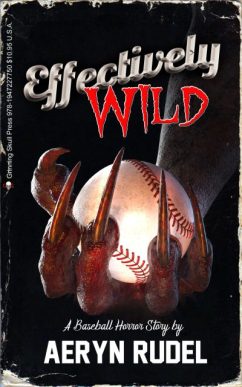
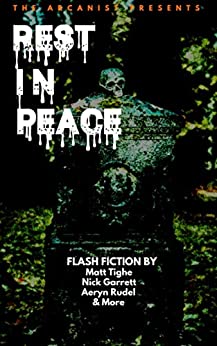
Two publications last month. The first was my baseball horror novella Effectively Wild and the second was a flash piece titled “The Death of Me” published by The Arcanist. Links to both below.
Effectively Wild
“The Death of Me”
And that was October. How was your month?
Three Things I Learned from Writing RPG Adventures
Before I embarked on the perilous journey of speculative fiction author, my primary writing gig was in the tabletop RPG and tabletop miniature game industries. Though writing material for roleplaying games is a different animal than writing fiction, there are certainly parallels, and I absolutely still use lessons I learned there in my fiction. The best and most useful type of RPG writing I did for that purpose was designing adventures for Dungeons & Dragons, so here are three things I learned from that experience.
1) Outline, Outline, Outline. My first adventure attempts were free-form, and I found that a difficult way to write them. When I started outlining, it became so much easier. A D&D adventure is still a story, with three acts, and each of those acts contains a number of scenes that move the story along. In an adventure, those scenes are NPC encounters and combat scenarios, but they serve the same purpose as far as storytelling goes. They drive the players along a story path. Now, of course, in an adventure, the players are telling part of the story, too, so it’s a collaborative effort, but the bare bones of the story, the outline, is still an incredibly useful tool for the author to map out the story path the players will follow.
Now, when I write fiction, I approach my outlines in a very similar fashion. I use a three-act structure, and each of those acts contains various scenes and story beats that keep me on track when I’m writing. My fiction outlines are longer and more detailed than my adventure outlines were, but they serve the same purpose. I need to build the skeleton of the story before I can flesh it out, and without that structure, I tend to lose my way. Fast.
2) Memorable Characters. As I said above, an adventure is a story, and stories need strong, memorable characters. In an adventure, the players are the star characters. They are the protagonists, but if you want to keep them engaged, you need to introduce NPCs or secondary characters that make an impression. This is often a character who starts the adventure for the players and other NPCs they must interact with , but the most important character in the adventure, in my opinion, is the villain or antagonist. That character, whether they be an evil wizard or a rampaging monster needs to be memorable, it needs to motivate the players to take action and to move along that story path.
When you’re writing fiction, you need memorable character, too. Your protagonist has to be interesting, of course, but those secondary characters need to pull their weight, too. My adventure writing days definitely taught me a lot about that, and I think the biggest lesson was that bit about motivation. In the adventure, you motivate the players to take action. In fiction, you need to motivate the reader to keep turning those pages.
3) Brevity. In a Dungeons & Dragons adventure, you have to get a lot across to the players and dungeon master in a short space. This can be something like read-aloud text that describes a location to the actions and reactions of nonplayer characters and monsters. You also need to give background to the dungeon master, such as the history of the location where the adventure takes place or the backstory for the villain or the monsters that will challenge the players. The DM needs to be able to quickly and confidently relate this information to players, and you, as the writer have to work it in along with all of the mechanical information needed to run the actual game. So, brevity is key, but all of these details still need to be compelling and drive the players through the story.
Brevity is also important in fiction, especially the style of fiction I tend to write. I want to get across a character’s description and personality or set the scene in an important location in as few words as possible so I can do what I do best: dialogue and action. However, just like in a D&D adventure, those little details need to be interesting and compelling AND they need to convey important information. If I fail to do that, I’m gonna lose the reader before I get to the meat of the story. This kind of brevity generally more important in the short fiction I write, especially flash fiction, but I tend to be brief with these elements in my long form fiction as well. That said, It might not be as pivotal to other authors.
So, that’s what I’ve learned from my adventure-writing days. Thoughts about my lessons learned? I’d love to hear them in the comments.
If you’re curious about the adventures I’ve written, here are some of my best, in my humble opinion.
- “Dead by Dawn” published by Wizards of the Coast in Dungeon #176
- “The Vault of Darom Madar” published by Wizards of the Coast in Dungeon #181
- “Heart of the Scar” published by Wizard of the Coast in Dungeon #197
- The Lost Cistern of Aravek published by Wizards of the Coast
- Tomb of the Blind God published by Goodman Games
- The Drowning Caverns of the Fish God published by Goodman Games
Novellas by the Numbers
I recently had a novella published by Grinning Skull Press called Effectively Wild, and I’m currently writing a follow-up novella. I’ve also written novellas for Privateer Press in their steampunk fantasy setting of the Iron Kingdoms. Since I’m focused on novellas right now, I thought I’d talk a little about how I go about writing them as opposed to writing novels. Of course, there’s no right way to do this. What follows is how I approach fiction between 20,000 and 40,000 words. You might have a completely different take, and, if so, I’d love to hear about it in the comments.
Okay, here’s my three-part novella formula or guidelines. Much of this is adapted from my flash fiction formula, and the comparison between writing flash and writing short stories I find to be very similar to the difference between writing novellas and novels.
1) Plot with room to pants. With a novel, I do a very detailed thirty-chapter, three-act outline. It’s easy to lose my way in 90,000 words, so I like to have a reliable road map. With a novella, I play faster and looser. I still write an outline, and it’s still three acts, but I don’t get as granular. I don’t break it down by chapters/beats; instead, I write a general synopsis of what I want to happen in each act. With a novella, I feel more comfortable figuring things out as I write, using my outline as a loose suggestion rather than a detailed map. To me it feels like free climbing up a mountain, which is both terrifying and exhilarating.
2) Limit the scope. This is a lesson I learned from writing flash fiction. I have a lot of room to tell an intricate story with a novella, but it’s not novel-sized room. So, like with flash fiction, I’ll reduce both the number of secondary characters and the number of location changes and transitions. Too many secondary characters cuts into important screen time for primary characters (and vital secondary characters). I tend to adopt a “cast of thousands” approach. I can give the impression of a full, vibrant world with some quick descriptions and even a few names here and there. The characters that interact with the MC on a more direct basis, get the full secondary character treatment of course. Location changes and transitions eat up a lot of precious word count, too. I don’t want a novella to take place in a single room or anything, but I like to keep things to somewhere between three and four key locations. In Effectively Wild, that’s the ballpark (locker room, manager’s office, field, etc.), the MC’s apartment (not much time is spent here), and a one or two important outside locations. I think it was enough so the novella didn’t feel static, but I think it also created a nice, cozy, even intimate atmosphere.
3) Get to the point. Another lesson from flash fiction here. With a novel, you can build to the central conflict at a more measured pace (though getting right to it is certainly good for novels, too). I don’t feel I have that luxury with a novella, and I want to get to the main course fast. If I’m writing a 30,000-word novella, I want to hit the central conflict within the first 5,000 words or so. I want to introduce the main character, get you to like, loathe, or sympathize with them, and then get them in the soup. Like with flash fiction, I want to start closer to the end than I might with a novel.
These are, of course, just loose guidelines that get me from page one to a complete draft. They work for me. They may not for you. I’d love to hear how other folks approach novellas, so, please, tell me about it in the comments.
If you’d like to see how some of these guidelines look in the wild (hah!), check out my novella Effectively Wild available now from Grinning Skull Press.
Effectively Wild Launch Day & Other Weird Baseball Stuff

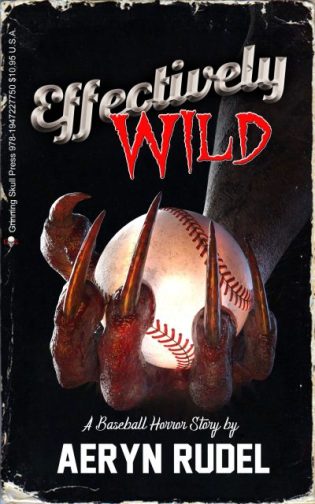
Today, my baseball horror novella Effectively Wild launches in print and e-book. Be a friend, and head on over to Amazon or your online book retailer of choice and grab a copy.
Okay, now let’s have a little fun. While you don’t need to be a baseball aficionado to enjoy Effectively Wild, the novella is sprinkled with the colorful jargon that pervades the sport. It’s all very clear through context, but I thought it would be fun to give folks a little baseball jargon glossary. Some of these terms are in the book, but most of them are just a collection of fun weird words and phrases baseball has developed over 150 years.
Home Run
- Homer – Just a shortening of home run.
- Dinger – Like many baseball terms, the origin of this one is lost to history.
- Tater – The ball used to be referred to as “the potato”, though not as much anymore, so tater or long tater is, uh, a home run. I don’t understand why it isn’t “mashed potato.” :).
- Big fly – Pretty obvious. A home run is almost always a fly ball, and it’s, obviously, the biggest fly ball.
- Oppo taco – This is when a batter hits a home run to the opposite field instead of his “pull” side. So a left-hand hitter would hit it to left, and right hand hitter to right. It’s usually harder to hit a home run to the opposite field, so the oppo taco is considered a more impressive feat.
Pitching
- Effectively Wild – Kind of an important one. When a pitcher is effectively wild, he’s throwing more balls than strikes, but his “stuff” is still good enough that batters can’t do anything with it. It still has excellent velocity or movement, even when it’s outside the strike zone. The pitcher is unpredictable, and the batter can’t get comfortable or guess what might be coming. There’s also a considerably higher chance of a batter getting hit by a pitch.
- Uncle Charlie – A curve ball, generally one thrown by a pitcher who has a particularly good one. Origin unknown.
- Yellow Hammer – A curve ball that generally drops straight down, or 12 to 6. Origin unknown.
- High and Tight – When a pitcher throws a fast ball inside and high to a batter to move him off the plate. The intent is not to hit the batter but to set up an outside pitch.
- Brush Back – Same as above, but generally done with more, uh, pointed intent.
- Buzzing the Tower – Yeah, there are a lot of terms for pitchers throwing at or near batters. This is a pitch that’s thrown head-high (kind of a no-no) that might set the batter down on his ass. This can lead to another baseball term – charging the mound. 🙂
- Cutter – Generally a two-seam fastball that moves horizontally away from a batter or, often, in so that contact results in a weak grounder and a broken bat.
- Sinker – A fastball with considerable late drop that cause the batter to swing over it or hit the top of the ball and ground out.
- Punch Out – When a pitcher strikes out a batter.
- K/Backward K – This is a term for a strikeout. A regular K denotes a strikeout where the batter swung and missed, The backward K denotes a strikeout where the batter took a called third strike.
- Battery – The duo made up of the pitcher and the catcher.
Other Hits
- Line Drive – As opposed to a fly ball which is hit at a steeper angle, line drives have a flatter trajectory and are some of the hardest hit balls in the game.
- Frozen Rope – A line drive that is hit particularity hard.
- Worm Burner – A hard-hit ground ball that theoretically could prove lethal to any worms in its path. 🙂
- Bloop – A softly hit fly ball that manages to drop over the infield or between outfielders for a hit. Detested by pitchers because they generally mean the batter was fooled or made bad contact and then got lucky. But, hey, that’s baseball.
- Can of Corn – A medium-depth fly ball that hangs up in the air long enough for the outfielder to settle under it and make an easy catch. Thought to have originated from a time when cans of food were kept on high shelves at markets and knocked off with a stick for the the stock person to catch and give to the customer.
- Gapper – A hard hit fly ball that lands between the outfielders and rolls to the wall. The batter winds up with at least a double.
Miscellaneous
- Speed Never Slumps – Many things in baseball go through ups and downs. A batter or pitcher is a tick off and goes on an extended streak of subpar play. This is called a slump. A fast player, one who steals bases, never loses that ability in a “slump.”
- The Tools of Ignorance – The catcher’s gear. Called this because no one on the field takes more physical punishment than the catcher, so, the idea is that in order to be a catcher, you have to be a little unhinged,
- Cup of Coffee – When a minor league player gets called up the majors for a short stint, usually to cover for an injured player or make a spot start and is then sent back to the minors. The idea being the player is only in the big leagues long enough to have a cup of coffee.
- Bonus Baby – A player who is drafted high in the MLB draft and given a significant (seven figure) signing bonus by the team. When the player reports to the minor leagues, he is often called a bonus baby. The term is slightly derogatory and equivalent to “silver spoon.”
Well, that’s just scratching the surface of the staggering amount of baseball slang and jargon. I hope you found it interesting, and I hope you employ this new-found knowledge when you grab a copy of Effectively Wild in print or e-book. 🙂
The Accidental NaNoWriMo
November is on the horizon, and that means thousands of writers are preparing to jam out 50,000-word novels in a month as part of NaNoWriMo. I’ve never done an official NaNoWriMo, but I keep meticulous records of how much I write per day when drafting a novel. I thought it might be interesting to look at the first draft timelines for four of my novels and see how they stack up against the NaNoWriMo pace.
These numbers and dates are for first drafts only. For the first three novels, there were, of course, revisions that added months to the whole process. (There are revisions on the fourth as well. I just haven’t finished them yet.)
- Started: 12/7/15
- Finished: 2/19/16
- Total Days: 65
- Actual Writing Days: 40
- Total Words: 82,559
- Average Words Per Day: 1,270/2,063 (total days/writing days)
This was the first novel I wrote for Privateer Press. The first draft took me about two and a half calendar months, which I think is a good pace. My goal was to write 2,500 words, five days per week. I fell short of that and ended up writing a bit over 2,000 words per writing day. The closest I came to NaNoWriMo production was between the dates of 1/4/16 and 2/2/16, where I produced a total 42,897 words.
- Started: 12/12/16
- Finished: 2/9/17
- Total Days: 60
- Actual Writing Days: 44
- Total Words: 95,303
- Average Words Per Day: 1,588/2,166
I started the second Privateer Press novel almost exactly a year after I started the first and finished in just under two calendar months. This first draft of Aftershock was longer by some 13,000 words than Flashpoint, and my average output per day is correspondingly higher. My goal this time was 2,000 words per day, five days a week, and I accomplished that for the most part. I did pull off what would be an official NaNo with this novel, writing 50,006 words for the first 30 days between 12/12/16 and 1/10/17. I wrote 22 days of those 30, and averaged 2,273 words per writing day.
Late Risers
- Started: 1/24/18
- Finished: 5/4/18
- Total Days: 111
- Actual Writing Days: 48
- Total Words: 92,684
- Average Words Per Day: 835/1,931
Late Risers is the first novel I wrote without a deadline. It took me roughly four months to finish the first draft, but I took almost three weeks off right in the middle of that period. On the days I did write, I was productive, and managed almost 2,000 words on average. Compared to the Privateer Press novels, this one took a long time, but I don’t think four months is unreasonable for a 92,000-word first draft. I didn’t get anywhere close to NaNo-ing on this book. The best I managed was the last 30 days, where I wrote just over 31,000 words.
Hell to Play
- Started: 4/13/20
- Finished: 7/14/20
- Total Days: 93
- Actual Writing Days: 53
- Total Words: 89,188
- Average Words Per Day: 959/1,683
The last novel I finished is called Hell to Play. I wrote this one during the first months of the pandemic, mostly so I’d have something else to think about. The pace of this novel is pretty much my ideal. I wrote 90,000 words in almost exactly three months. Interestingly, I produced less on a day-to-day basis with this novel than any of the others, managing, on average, just over 1,600 words on the days I did write. This novel is currently in revision, and I hope to have it ready to go by the end of the year. There was no NaNo-ing on this novel either, but I did write almost exactly 30,000 words every 30 days.
#
As I said, I’ve never done an official NaNoWriMo, but I was curious to see if I’d unwittingly pulled it off. Looks like I have, once, but I’m much more comfortable around 30,000 words per month. That feels like a good fit.
Don’t get me wrong; I think 50,000 words in 30 days is an awesome goal to strive for, and the motivation and sense of community NaNoWriMo promotes is fantastic. Maybe I’ll give it a try this year. I do have some monster baseball novellas I need to write. 🙂
Are you doing NaNoWriMo this year? Thoughts on 50,000 words in 30 days? I’d love to heart about it in the comments.
Effectively Wild – A Baseball Horror Story
Night Walk & Other Dark Paths
Acts of War: Flashpoint

Acts of War: Aftershock

Acts of War: Stormbreak

 Aeryn Rudel's Rejectomancy