
2019 Writing Rearview Review
Well, it’s that time of year when writers the world over tell you all about the stuff they wrote and published for the prior year. So here I go! 🙂
Short Story Submissions
Okay let’s start off with short story submissions, rejections, and acceptances:
| 2019 | 2018 | Difference | |
| Submissions | 81 | 120 | -32% |
| Rejections | 61 | 100 | -39% |
| Acceptances | 14 | 19 | -26% |
| Accept % | 17% | 16% | +1% |
| Publications | 17 | 16 | +6% |
As you can see, my production in 2019 was down significantly from 2018. The only thing that increased were the number of publications and my actual acceptance percentage, which is good, though I can’t help but think if I’d had the same output in 2019 as I did in 2018, I might have 20+ acceptances for the year (or maybe just 20 more rejections).
So, why fewer submissions this year? Mostly because I was focusing on long-form fiction, a novel, and more specifically revising that novel, and it ate up a lot of time. Also, I didn’t write much new stuff, and the new stuff I did write was, well, harder to sell until I figured out where I should be sending it (that happened late in the year). The truth of the matter is that some of the old stories I’ve been shopping probably need to be retired, and I need a new crop of pieces for 2020.
Words, Words, Words
Okay, so the above is what I submitted, but how much did I actually write in 2019? Let’s have a look.
- Written in 2019: 183,632 words
- Published in 2019: 90,494 words
- Written AND Published in 2019: 74,978 words
That total written number includes 54,745 words of blog posts, 12,455 words of microfiction, and 6,950 words of stories I began but did not finish (yet). The published numbers do NOT include blog or microfiction totals. I spent a lot of time revising my novel and a bunch of old stories, but it’s hard to quantify that in terms of words written. It feels like another 50,000 or so, but, hell, it could be 100,00 for all I know. Anyway, I stuck with the most easily quantifiable numbers.
Those numbers on a whole aren’t bad, but if you look a little deeper, there are some things I want to change for 2020. For example, of the words written and published in 2019, a measly 2,068 came from submitted short stories, the rest are the novel I wrote for Privateer Press. I simply did not write enough new material this year. Most of my short story publications came from material I wrote last year or the years before. I need to finish and write more new stories for 2020 and stop being lazy and trying to sell old stories that, well, aren’t selling.
There were 260 work days in 2019, and I average a bit over 700 words for each of those days. I’d like to get that up to 1,000 in 2020. That shouldn’t be too difficult, as I’m starting a new novel and revising another.
Goals for 2020
You gotta have goals heading into the new year, right? Well, here are the broad strokes of a few things I’d like to accomplish in 2020.
- Write and submit more short stories. Let’s say a solid 100 submissions and at least 20 new stories. This year, I’d also like to crack more pro markets. You know, markets like Fantasy & Science Fiction, or The Dark, or Nightmare, or any of a dozen others. That’s no small feat, and I know I’ll need to up my game, but I think I learned a thing or two in 2019 that might give me a fighting chance. We’ll see.
- Release at least one short story collection. I’ve been threatening to do this for years, and now that I have enough published pieces for a respectable page count, it’s time to pull the trigger. Gonna shoot for first quarter, but I won’t hate myself too much if it’s second quarter.
- Write a new novel and revise the one I have. I spent a lot of time last year revising my novel Late Risers, but it’s still not where it needs to be, so I’m taking a short break from it and I’m writing another novel, something more inline with what I normally write, more me. That’s not to say that Late Risers isn’t me, just that it’s more experimental, and I struggled with it in places. So the goal is to write the new novel in the first quarter of the year and return to Late Risers after that. It generally takes me about two to three months to bang out a first draft of a novel, so this should be an achievable goal.
- Redesign Rejectomancy. The blog needs a fresh coat of paint and slight refocus in 2020. Don’t worry; it’ll still be chocked full of rejections and advice about rejections and all that jazz, but you might have to endure a few more shameless plugs of *gasp* my own writing. 🙂
And that’s my rambling review of 2019. How was your year? Tell me about it in the comments.
The Way I Write Part 2: Evolution

Last week, I delved into the earliest existing examples of my fiction (all unpublished) to see how and what I was writing back in the early aughts. I gave examples from two short stories and used the Flesch-Kincaid readability scores, plus the old-fashioned eyeball test, to gauge the quality and publishability of what I was churning out back then. To refresh your memory, both stories were crazy wordy and very purple. If you’d like to see for yourself, check out The Way I Write Part 1: The Early Years.
Now we’re going to jump ahead a few years and look at two more pieces (still unpublished) and see if I improved at all. One quick note, I was working and publishing in the tabletop gaming industry during this time, but that is a decidedly different kind of writing, and these posts will focus solely on narrative fiction.
“The Tow” (circa 2006 A.D.)
This passage comes from a 3,500-word story I wrote in early 2006. I remember when I finished this one I really thought I had something, but I was still too chickenshit to submit it. Of course, what follows is not publishable, but let’s take a look and see if the work has improved at all.
Jack owned the only towing service in town, and for that matter, the only tow truck. Most of his time was spent hauling the broken-down junkers that dominated the streets of Arbuckle, dragging their rusting metallic carcasses to the scrapyard, or, if the owners had any money, to Kyle’s Repair. But this tow was different. The call he received from Norman Gaston at the Lucky Load this morning offered Jack the rare opportunity to make some money from his small impound yard.
Jack could not suppress a smile when he thought of the exorbitant amount of money he was going to charge the owner of the Mercedes to get it out of hock. He figured a person who owned a car like that was bound to have enough spare cash to make Jack’s morning one of the best he’d had in weeks. He sat for a moment behind the wheel of his modified Ford F-650 super cab, idling thirty feet away from the Mercedes, soaking in the sight of the lonely German luxury car. He was grinning and imagining crisp hundred-dollar bills floating out of an expensive alligator skin wallet and into his own dirty canvas and Velcro rig. He savored his good fortune a minute longer, then put the truck into gear and rolled forward to claim his prize.
What I think is interesting about this passage and what surprised me when I dug it up is that it’s kind of an embryonic version of how I write now. Yeah, it’s still way too wordy and it’s definitely clunky in places, and, yes, it highlights some of the issues I STILL deal with (like being overly procedural), but I think there’s maybe, kind of something that could be called a voice here. Anyway, let’s look at the numbers.
- Passive Sentences: 0%
- Flesch Reading Ease: 61.6
- Flesch-Kincaid Grade Level: 10.7
Like I said, still very wordy, but this is a definite improvement over the two stories from my first post. Both of those had reading ease score below 55 and grade level scores above 13 (college textbook density). This is better. Not great, but better. All that said, I love the concept in this story (which you can’t really see from the excerpt), and I’ve started rewriting this one from scratch. I dig what I have so far, and I hope to finish it and submit it in the new year.
Let’s jump ahead to 2007 and switch to fantasy instead of horror and see if things improved.
“The Fate of Champions” (circa 2007 A.D.)
This passage is from an unfinished story I began in 2007. It is decidedly high fantasy and thus includes some fantasy tropes (like long, impossible-to-pronounce names) that tend to bloat readability scores.
Umbar stared up at the ragged battlements of Illumar’s Shield, counting the wasted, ashen faces staring down at him. The fortress had once been a shining beacon of purity and law, its white towers gleaming like the halo of Illumar himself. It was now a decrepit, magic-scorched wreck. Still, the walls had held. After six months of relentless pounding, both magical and mundane, Illumar’s Shield stood defiant of everything Umbar had thrown at it.
A single arrow soared out over the battlements, wobbling in its flight from the unpracticed hand that had loosed it. The shaft, guided by luck or perhaps even the vengeful hand of Illumar himself, struck Umbar’s blackened steel breastplate with a hollow clang. It had been a simple hunting arrow with a blunt iron point, and it failed to pierce Umbar’s armor, doing little more than adding yet another scratch to its battle-worn surface.
Hey, now we’re getting somewhere. It’s not perfect, and it’s still far wordier than I write today, but this a bit more readable than the earlier excerpts (once you get past the names). I even like some of the imagery here, and I’m not wracking the poor sentences (as much) to do it.
Let’s have a look at the numbers:
- Passive Sentences: 0%
- Flesch Reading Ease: 62.3
- Flesch-Kincaid Grade Level: 9.1
That’s a definite improvement, and it’s getting closer to what you might actually find in popular fiction, especially fantasy. One interesting thing here is that you see a divergence of styles. The first excerpt is the beginning of how I writing everything but fantasy, and the excerpt above is the beginnings of a style I use for things like Privateer Press and the steam-powered fantasy setting of the Iron Kingdoms.
This is another story I actually quite like and I think might have legs with a serious rewrite.
I think there is definite improvement in these two excerpts over the very early ones from the first post. The work is becoming less wordy, more readable, and, dare I say, more publishable (but not actually publishable) than what I was doing a few years earlier. So, yeah, I’d call this improvement, evolution, or, you know, positive yardage. For reference here are the readability score and dates for the excerpts we’ve covered so far.
| Date | Story | Reading Ease | Grade Level |
| 2000 | Lullaby | 53.5 | 13.4 |
| 2005 | Rearview | 37.9 | 14.4 |
| 2006 | The Tow | 61.6 | 10.7 |
| 2007 | The Fate of Champions | 62.3 | 9.1 |
Next week we’ll continue on and look at some of the first short stories I actually published and see if those readability scores improve further.
Aeryn’s Archives: The Lost Cistern of Aravek
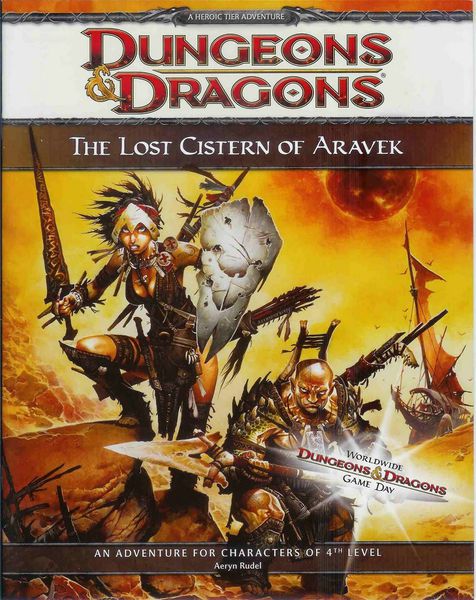
In this week’s installment of Aeryn Archives we journey to the scorched world of Athas and the first Dark Sun adventure I wrote for 4th edition Dungeons & Dragons, “The Lost Cistern of Aravek”. I’ve been a fan of this particular campaign setting for twenty-five years and the chance to write official material for it is one of the highlights of my tabletop RPG career.
So what is Dark Sun and why is it cool? Way back in 1991, TSR, the owners of Dungeons & Dragons at the time, were releasing scads of campaign settings, boxed worlds with various flavors you could set your D&D game in. One of those campaign settings took place on the scorched, post-apocalyptic planet of Athas, a brutal desert world where metal was scarce, water scarcer, and everyone and everything was out to kill (and usually eat) you. It was a huge departure from the standard fantasy settings that had come before it both in tone and lethality, and I fell head-over-heels in love with it.
Fast forward to 2010. I’d been working with Wizards of the Coast as a freelance game designer, and I’d written a handful of adventures and articles for Dungeon and Dragon magazines. One day, in February of that year, I got an email from Chris Perkins, then Creative Manager for Dungeons & Dragons at Wizards of the Coast. (Chris is still there, by the way, and still doing all kinds of cool stuff with D&D). In the email, Chris said he’d been talking to Chris Youngs, who ran D&D Insider, and whom I’d been working with for Dungeon and Dragon articles. My name came up as a possible fit for a freelance assignment that would be part of the 4E launch of the Dark Sun campaign setting. Chris Perkins offered me the assignment, and, well, I was over the fucking moon. I mean, the chance to work on Dark Sun, the campaign setting I’d loved for 20 years? Yes, please!
The assignment was to write a short 16-page Dark Sun adventure which would be released as part of D&D Game Day, an annual promotional event where WotC supplied game stores with a special adventure and pre-generated characters to run in-store. Chris Perkins gave me the basic details for what they wanted and then let me come up with a story outline. The idea I came up with was fairly simple and focused on one of the main problems players face in Dark Sun: water scarcity. Essentially, the players are hired to track down some ancient wind-trap technology that could solve a lot of the water issues in the area. Of course, this is Dark Sun, so that technology is guarded by terrible monsters, coveted by merciless brigands, and generally incredibly damn dangerous to find, But, hey, that’s what makes it fun! Long story short, I wrote the outline based around the premise above, it was approved with a few tweaks, and then I wrote the adventure that became “The Lost Cistern of Aravek.” It would be the first of two Dark Sun adventures I would write. The other, “The Vault of Darom Madar,” was released in an issue of Dungeon magazine (we’ll cover that one too at some point).
You’ll notice I’m not providing a link so you can go buy this adventure. That’s because “The Lost Cistern of Aravek” was a Game Day adventure and a special giveaway, so it was never for sale and as a result it’s kind of rare. I see it go for around seventy-five bucks on Ebay from time to time. That’s pretty neat, and I’m so glad I held on to my authors copies (still in the shrinkwrap). 🙂
The Tiny Adventures of Lucky & Sal

So, as many of you know, I’ve been writing microfiction over on Twitter (@Aeryn_Rudel) under the #vss365 hashtag, and having a lot of fun with it. Much of my microfiction falls into the crime genre, and a while back a created two characters, a pair of hitmen Lucky and Sal. I’ve written a bunch of them, and most are little snippets of conversation between these two killers, usually with a humorous slant. Anyway, I thought it would be fun to collect the ones I’ve written thus far right here. They’re not all winners, of course, but I had fun with them. Hopefully, you will too. Who knows? Maybe there’s a complete short story or even a novel waiting to be written about these two guys. 🙂
Oh, the hashtagged word is the prompt for that day. If you click the date for each entry, it’ll take you directly to the tweet, you know, if you wanna throw me a like or a retweet or something. 😉
I don’t watch Lucky work. It creeps me out. My job is talking, his is making people receptive to talking. He comes out of the garage, wiping blood from his knuckles, that weird satisfied look on his face. “You’re up.”
“Can he still talk?”
Lucky shrugs. “He can #listen.”
(In this first one, I was still figuring out their voices, hence the first-person).
“Hey, Lucky, are we #villains?” Sal asked, wiping blood from his knife.
“Nah, just bad guys,”
“There’s a difference?”
“Sure,” Lucky said. “Bad guys work FOR villains
“Man, it would be great to be a villain.”
Lucky nudged the body with his shoe. “Keep working at it, Sal. You’ll get there.”
“And that works?” Sal asked, grimacing.
“Sure does,” Lucky said. “Most guys don’t get past the fingers before they start singing.”
“Jesus, what happens when you run out of fingers?” Sal shuddered, dreading the answer.
Lucky shrugged. “Lots of stuff fits in a vise.”
“Gun, knife, or garrote?” Lucky asked.
Sal rolled his eyes. His partner would often #vacillate between tools of the trade.
“What?” Lucky said. “It’s an important decision.”
“And a fuckin’ easy one,” Sal said. “The gun’s too loud, and you wore a white shirt today.”
Lucky put his gun away and frowned. “I need a #vacation.”
“Yeah? Where do you want to go?” Sal said.
Lucky pointed to the splatter of blood on the wall behind Mr. Favero’s head. “Hey, what’s that look like?”
“Kind of like Florida.”
Lucky nodded. “Florida it is.”
“Sal,” Lucky said. “Little help here.”
“Sorry. You caught me #reminiscing.”
“About what?”
“The first time we, uh, cleaned up.”
Lucky chuckled. “Jesus, we made a mess with that hacksaw.”
“We’re smarter now.” Sal smiled and picked up the chainsaw. “Head or feet first?”
“Hey, Lucky, do you #love your job?” Sal said, looking up from an issue of Cosmo.
“I don’t know. Why?” Lucky said.
“This article says if you don’t love your job, you should quit.”
Lucky looked down at the corpse of Joey Fritz, partially wrapped in plastic. “And do what?”
“Something else. Whatever.”
Lucky shook his head. “You ever heard the term institutionalized, Sal?”
“What’d this guy do?” Sal asked and stooped to pick up the spent .45 casing.
Lucky rolled the corpse up in the carpet they’d brought with a grunt. “I don’t know. Something #vile, probably.”
“You think?”
Lucky blinked. “What, you think we’re offing guys who do Doctors Without Borders and work at soup kitchens in their spare time?”
“He looks kinda peaceful, don’t he?” Lucky said.
Sal nodded. “Yeah, guy looks like he’s lost in #reverie.”
“What?”
“You know, reverie. Daydreaming. Pleasant thoughts.”
Lucky glanced at the hole in Donnie Ranallo’s forehead and chuckled. “I doubt that last one was pleasant.”
“Don’t stand too close,” Lucky said. “That #smoke ain’t good for you.”
Sal stepped back from the two-story bonfire consuming Ivan Petrov’s house, lit up a cigarette–Camels, unfiltered–and took a drag. “Thanks, Lucky. I’d hate to get the wrong kind of lung cancer.”
“Hey, Lucky, do I lack #empathy?” Sal asked.
Lucky shook his head. “Nah, you’re a real sweetheart as hitters go.”
“You think so?” Sal pulled his knife from the body with a wet squelch.
“Sure. I’ll bet Mr. Luciano there appreciates you only stabbed him the one time.”
“What’s around your neck, Lucky?” Sal asked.
Lucky held up a coin on a gold chain. “Magic quarter. Keeps the bullets off me.”
“Uh, you’ve been shot eight times.”
Lucky smiled and showed Sal the lead bullet embedded in the other side of the coin. “But not nine.”
“Sal, what do you want to eat?” Lucky shouted.
Sal shut off the chainsaw and wiped blood from his face. “What?”
“Dinner? When we’re done with Mr. Russo. What are you in the #mood for?”
“Oh. I don’t know. Kinda feelin’ roast beef or steak.”
“You run last month’s numbers?” Lucky asked.
“Yep,” Sal replied. “Five hits. Twenty-five Gs.”
“Not bad.”
“Less expenses, we netted only fifteen.”
“What? Why?”
Sal sighed. “The Rosetti job. Clients thought he was a werewolf. Silver bullets cost a #fortune.”
“This might #sting,” Lucky says and pours hydrogen peroxide over the bullet hole.
His partner gasps. “Jesus, that hurts.”
“Come on, Sal. Just a little through and through.”
Sal brightens. “You think it’ll scar good?”
“Yep. It’ll be a nice addition to the collection.”
“No way. I’m not going unless we drive,” Sal said and crossed his arms.
Lucky sighed. “You’re a goddamn contract killer. You work with some of the scariest motherfuckers on the planet. HOW are you afraid to #fly?”
Sal rolled his eyes. “I can’t shoot a plane, Lucky.”
Sal handed Lucky another #stack of hundreds and sighed. “Getting paid in cash sucks.”
Lucky shrugged. “What do you want? Something like Venmo?”
“Yeah, but for contract guys.” Sal grinned. “Maybe call it Kilmo.”
“Oh, genius. You should take that shit on Shark Tank.”
“The gun, the knife, and the garrote?” Lucky said as Sal packed for the job. “How many times you gonna kill this guy?
“I just don’t want to play #favorites.”
“I don’t follow.”
“They’re like my kids, you know?” Sal grinned. “I want them to know I love them all the same.”
“This article says killers are triggered by the full moon,” Sal said, tapping his iPhone.
Lucky glanced at the corpse at his feet. “Uh, there’s no moon tonight.”
“Guess we’re doing it wrong.”
“Yep, we’ve just been killing for money like a couple of assholes.”
Sal handed Lucky the cordless #drill. “You do it.”
“Me?” Lucky said. “Why the fuck me?”
“I got a code. You know that.”
“Bullshit. I watched you dismember a guy with a hacksaw last week.”
“Sorry, Luck. No kids, no civilians”–Sal shuddered–“and no fuckin’ teeth.”
“Damn it, Lucky,” Sal said, “Look what you did.”
“I shot him. He’s dead. That’s our job.”
“Right, but look at your shot placement.”
Lucky shrugged. “So?” “Heart, liver, kidneys.”
Sal flicked the driver’s license at his partner. “Guy’s an #organ donor, asshole.”
“He ain’t #invincible,” Lucky said. “Just huge.”
“Bullshit,” Sal replied. “He strangled four hitters AFTER they shot him.”
Lucky closed the cylinder of the .500 S&W Magnum and grinned. “Those guys went after a man.” He patted the giant revolver. “I’m packing for bear.”
“You going to Jonny Fazio’s wedding?” Sal asked.
Lucky picked up shell casings from the ground and nodded. “Yeah, just need a few more of these.”
“What for?”
“You ever been to a hitman’s wedding?” Lucky shook the brass casings in his fist. “You don’t throw #rice.”
“Lucky, what the fuck is on the end of your gun?” Sal said.
“Huh? Oh, #jingle bells. The recoil makes ’em jingle.”
Sal rubbed his eyes. “Why would you do that?”
“It’s Christmas. Everyone deserves a little holiday cheer.”
“Even dead guys?”
“Especially dead guys.”
Well, I hope you enjoyed the exploits of Lucky & Sal. Keep an eye on my Twitter account (@Aeryn-Rudel) for further adventures. 🙂
The Way I Write Part 1: The Early Years
This will be the first of three (maybe four) posts that explore my writing over the last twenty years, focusing on how it has changed, and, hopefully, improved. With twenty years of writing under my belt and about fifteen of those years being the paid, professional variety, I have a lot of examples to draw from. I’ll be using the Flesch-Kincaid readability scores to assess passages from various stories so we can get good hard numbers on each piece of work and see how it differs from those that come after it.
Okay, let’s start with the early years, basically 2000 to 2005. This is before I actually published anything besides poetry (a whole other story), and though I think I had some solid ideas, the execution of those ideas were, well, lacking. A quick disclaimer before we dive into this. This post is an examination of my writing, what worked for me, and what eventually led me to publication and full-time writing and editing gigs. (Getting the whole me thing?) If I say something is bad or purple or whatever, I’m only doing so to compare my unsuccessful works with my successful ones. Much of what is coming is going to be opinions on style based on personal experience, so, please, keep that in mind.
“Lullaby” (circa 2000 A.D.)
The first passage comes from 6,500-word short story called “Lullaby” I wrote sometime in 2000. This is one of my first true attempts at a short story and the first I actually finished. I never sent it out for submission, well, because by the time I started doing that, I realized the story had some issues. That said, there is still a compelling idea here, but it REALLY needs a rewrite. Anyway, have a look.
I am not sure what woke me that night, but near three o’clock in the morning my sleep-numbed mind began the rigorous ascent to consciousness. I opened heavy lids to absolute darkness and a shivering chill that filled the room and pierced even our heavy comforter. As my eyes adjusted to the weighty gloom, I heard Karen breathing in short quick gasps and felt the tension in her body even through the heavy padding of our mattress. As I reached out to shake her from the grip of whatever nightmare held her, I caught, from the corner of my eye, a visible shifting in the deep shadows in one of the corners of our room near the floor. I froze, my hand hovering over Karen’s trembling form and watched with growing horror as a single shadow separated from its brethren and began a slow, stalking undulation towards my wife’s side of the bed.
As the shadow grew closer, and my eyes adjusted further to the darkness, I was able to discern a definite, fiendish outline to our unwelcome visitor. There was most certainly a roundish protrusion from the central mass of shadow that could only be a head, and two amorphous appendages projecting from either side that pulled the thing along the floor towards my slumbering wife. There were no legs to complete the vaguely man-shaped bulk, only a wispy trail of fading darkness that ended in the corner among the shadows that pooled there.
So this is how I wrote twenty years ago. Can you say purple? I knew that you could. Talk about tortured sentences. I mean, “. . . my sleep-numbed mind began the rigorous ascent to consciousness” is, uh, well, one way of saying “I woke up,” and probably not a good one. The other issue is that I’m aping the voice of writers I was reading at the time, such as Jack Vance and Robert E. Howard, who are very wordy. For the record, there’s nothing wrong with writing Vancian science fiction or Howardian sword & sorcery, but it’s important to have your own voice while playing in the literary sandboxes of those authors. I was obviously struggling with that.
So what about the raw readability numbers for this passage? Have a look.
- Passive Sentences: 0%
- Flesch Reading Ease: 53.5
- Flesch-Kincaid Grade Level: 13.4
No passive sentences is great, but, oof, those readability scores are off the charts, in the wrong direction. You’ll find very little popular fiction this dense and wordy. Most of that is going to have reading ease scores between 65 and 90 and grade level score between 4 and 9, with most of it being in the middle of those two ranges. For actual literary comparison, you’d have to look at the writers like H. P. Lovecraft and other pulp fiction and turn-of-the-century authors. In other words, not many folks write like this anymore, and those that do it successfully do it way better than this.
Okay, let’s jump ahead a bit and see if a few years taught me anything.
“Rearview” (circa 2005 A.D.)
This next passage is from a 3,500-word story called “Rearview” that I wrote in 2005. The difference between this one and “Lullaby” is I actually submitted this one. I’ll tell you how that turned out after you read the passage.
Jacob first noticed the object at midnight, a small luminous shape hovering silently in the center of his rearview mirror. It lacked any real substance or definition and called to mind the infamous unidentified objects, the “foo fighters,” that military pilots sometimes encountered over lonely stretches of the Pacific Ocean. Jacob struggled to discern the distance that separated him and his unidentified pursuer, but the isolated section of Interstate 5 cut through the featureless Nevada desert in a straight and unwavering path, making such a judgment nearly impossible. The object was the only thing he had encountered for most of a very dark and moonless night. The gloom receded, somewhat reluctantly it seemed, from the twin glow of his Mustang’s headlights, but beyond this splash of yellow illumination Jacob felt the ominous weight of a truly stygian darkness.
Despite the eerie atmosphere, Jacob felt nothing more than a mild curiosity regarding the object in his mirror, dismissing it as the monocular glow of a motorcycle’s single headlight or something equally harmless. The fact it had stayed with him – neither receding nor gaining ground – also didn’t concern him. The motorcycle, or perhaps it was a car missing a headlight, was likely traveling at the same speed he was, allowing the distance between them to remain a constant. Jacob was traveling at seventy-five miles per hour, trying to keep a tight rein on his notoriously leaden foot. Despite his caution, Jacob could not bring himself to drive the speed limit, figuring ten mile-per-hour over wouldn’t tempt any Nevada Highway Patrol he might run afoul of.
Uh, yeah, not better, and, honestly, a little worse. It just so wordy, and, I mean, how many adjectives do you need in one paragraph? The answer is less than this. I really did a bang-up job making that second paragraph sound like a complex math problem too. Hey, and how about the term “monocular glow”? Yeesh.
Anyway, let’s check the numbers and see if it’s more readable than my 2000 story.
- Passive Sentences: 0%
- Flesch Reading Ease: 37.9
- Flesch-Kincaid Grade Level: 14.4
Ye gods, that is dense. Folks, the only things with readability scores this low are like technical manuals and, well, H. P. Lovecraft again. This is not an improvement. I’m still trying to sound like the writers I’m reading (and not doing a great job of it), and I don’t have a clear voice. Like “Lullaby,” there is a decent story in all this mess, but it would need a complete rewrite.
As I said, I did actually send this one out for submission, and if you’d like to see how that turned out, check out the post Baby’s First Rejection. 🙂
So those are my first attempts at writing fiction. In the next post, we’ll look at some of my work that was actually published in the late aughts, and see if things improved at all. Thoughts or opinions on these passages? Let me know in the comments.
Aeryn’s Archives: No Quarter #30

The next episode of Aeryn’s Archives is one that changed my career trajectory completely. I went from freelance game designer and editor to full-blown editor-in-chief of a bi-weekly magazine from a well-known wargame publisher. So let’s dive into No Quarter #30.
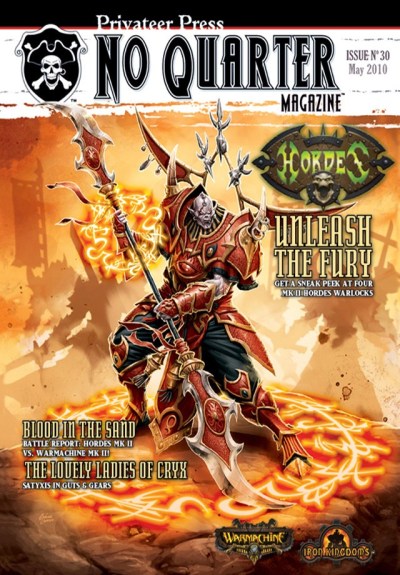
This was the first issue of No Quarter with yours truly as editor-in-chief, and how did I land this illustrious gig? Well, it turns out I knew a guy. 🙂
In early 2010, I was working fulltime as a freelancer in the gaming industry, writing short adventures and articles for companies like Goodman Games and Wizards of the Coast. I also did a spot of editing on occasion. I liked what I was doing, but it didn’t pay much and my wife and I were scraping by and living in a town we absolutely loathed. Then, one day in February, I got a call from my buddy Ed Bourelle. Ed and I had become freelance friends over the years and talked almost daily over the phone about the trials and tribulations of working in the biz. Anyway, Ed had recently taken a position at Privateer Press, publisher of the miniature wargames WARMACHINE and HORDES, and the company needed an editor-in-chief for their inhouse magazine No Quarter. Knowing I had experience in the magazine department, plus writing and editing skillz, Ed asked if I’d like to come out to Seattle and interview for the job. My answer was in the “Does a bear shit in the woods?” area, and soon enough my wife and I were on our way to Seattle. Well, needless to say, the interview with Privateer Press owners Matt Wilson and Sherry Yeary went well, and I was offered the position. We moved to Seattle the following month, and I’ve been here ever since.
As I said, I had previous experience running a magazine, a 64-page black and white quarterly called Level Up for Goodman Games, but No Quarter was a completely different animal. When I started, it was 96-pages, full color, and bi-monthly (we eventually increased it to 112-pages). In addition, where Level Up was an RPG magazine that primarily included articles with illustrations, No Quarter was a wargaming magazine, and that meant miniatures and tons of photos of miniatures. That was all new to me, and I’m not ashamed to admit when I sat down at my desk and got the full picture and scope of what I needed to do on the first day, I was more than a little terrified. I left wondering if I could even do the job, but I came back the next morning with a plan that was essentially to break the magazine down into its component parts. Each article and photo spread (or cover or table of contents) was an individual job I could focus on and not become overwhelmed by the magazine as a whole. It got me through that first issue (as did the help of all the incredibly talented people who worked there), and I learned a lot. I eventually had a system in place that made publishing the magazine easier and more efficient, and I found ways to put my personal stamp on No Quarter. That’s not to say there weren’t bumps in the road. With a magazine there always is, but that’s a tale for another time.
Anyway, when No Quarter #30 showed up from the printer, and I held that first glossy 96-pager in my hands, it was one of the highlights of my career. So, thanks, Ed, for making that phone call back in 2010, and thanks Matt and Sherry for letting some guy you’d never heard of run your magazine. 🙂
All the back issues of No Quarter are available through the Privateer Press online store, including #30. Click the cover image and the link below to check it out.
Reading Your Readability Scores

How easy (or difficult) is your work to read? This is a question that can be answered to some degree with the Flesch–Kincaid readability tests, which (in very simple terms) are designed to provide a readability score and indicate what grade-level education is needed to understand the work.
The purpose of this post is to explore how and if the Flesch–Kincaid readability tests are useful to writers (well, this writer anyway). Why am I using the Flesch–Kincaid readability test when there are other readability tests out there? Simple. Flesch–Kincaid comes with MS Word, so most writers have access to it and are probably familiar with it. To get the Flesch–Kincaid readability scores in MS Word do the following. File > Options > Proofing > Show Readability Statistics. Then, simply run a spelling/grammar check on your document. When it finishes, you’ll get a popup box with your readability scores (plus a bunch of other numbers that factor into those scores). We’ll be focusing on three numbers:
- Passive Sentences – The percentage of passive sentences in your work.
- Flesch Reading Ease – This is a score between 0 and 100 that indicates how easy or difficult your work is to read. Higher is easier.
- Flesch-Kincaid Grade Level – This is a score, usually between 1 and 12 (but can be higher), that indicates the years of education someone would need to understand the work
So, now that we know what these number mean let’s take a closer look at what might influence these scores. Note, I might compare my scores to those of famous authors referenced in a very in-depth article on this subject by Shane Snow (and in my own research), but I am in now way inferring I write as well (or as successfully) as these authors. All I’m saying is that based on some raw stats, there may be similarities in things like sentence length and word choice (stuff the Flesch-Kincaid readability scores take into account).
One thing that tends to influence readability scores in my stories is the amount of dialog in them. So let’s look at a couple of pieces and see if that pans out.
1) “A Point of Honor” published by Radix Media
- Passive Sentences: 1%
- Flesch Reading Ease: 86.6
- Flesch-Kincaid Grade Level: 3.7
“A Point of Honor” is a 5,000-word near-future sci-fi/horror piece. Looking at the readability scores, a couple of things jump out at you. Grade level and reading ease are very high, in the same ballpark as Hemingway. Why is that? Well, out of of the story’s 544 sentences, 191 of them are dialog, around 35%. I do my best to write dialog like people might actually talk, and that generally means shorter sentences, simpler language, and so on, which is reflected in the readability stats. Now, let’s see if that changes in a story without a lot of dialog.
2) “Paint-Eater” published by The Arcanist
- Passive Sentences: 1%
- Flesch Reading Ease: 78.3
- Flesch-Kincaid Grade Level: 5.8
This is a 3,800-word horror story, and looking at the stats, it’s still pretty readable, somewhere around Stephen King and Stephanie Meyer. Out of this story’s 257 sentences, only 29 are dialog, about 10%. The lack of dialog here means I have to tell the story in a different way. It’s more descriptive and introspective, which for me means more complex sentences, multisyllabic words, and so on. That lowers my readability score. Of course, these scores are still well within the parameters for popular fiction, but the lack of dialog does change my stats in a noticeable way.
What else might influence my readability scores? How about genre? Let’s take a look at two more stories and see what that looks like.
1) Acts of War III: Stormbreak published by Privateer Press
- Passive Sentences: 3%
- Flesch Reading Ease: 72.3
- Flesch-Kincaid Grade Level: 6.8
This is roughly 20,000 words of steampunk fantasy, and as you can see, it yields my densest prose yet. Now why might that be? Fantasy, especially steampunk, is filled with jargon and pseudo-technical words. This piece is littered with words like necromechanikal and Vindicator warjack and annihilator axes, which, uh, all have more than a few syllables. In addition, even when there’s dialog, these words tend to pop up because they’re important to the story. Also, the folks talking are trained experts in various fields from magic to military, which can increase sentence length and complexity. All of that adds up to lower readability scores. Now, compared to some genres, like lit-fic, and authors, like, say, Lovecraft, this is still incredibly readable stuff, but you can see how genre can affect readability. Let’s check out another piece and another genre.
2) “The Back-Off” to be published by On-Spec Magazine
- Passive Sentences: 1%
- Flesch Reading Ease: 82.5
- Flesch-Kincaid Grade Level: 4.6
“The Back-Off” is a crime/noir/urban fantasy mash-up, but I think it shares more stylistic elements with the first two genres than the last. As you can see, readability goes way up, and I think that’s due to a couple of things. One, the story’s primary characters aren’t the type to wax poetic in dialog, and there is a lot of dialog in this one. Two, there’s a fair bit of action in this story, and I generally write action with short sentences and short paragraphs to convey urgency and motion. Those two things equal lower readability scores. Now, does everyone write crime fiction this way? Of course not, but a quick a dirty look at some excerpts available online showed me that Michael Connelly’s scores are in this range, as are Elmore Leonard’s.
One question I think is important is can you use these readability scores in real time when you’re writing a story? I think so, and they can be a useful tool if you’re going for a very specific voice. Case in point, I published a story a while back called “Where They Belong,” which is from the first-person perspective of a six-year-old boy, and I wanted the language to reflect that. Here are the readability scores on the final version of that story:
- Passive Sentences – 0%
- Flesch Reading Ease – 94.1
- Flesch-Kincaid Grade Level – 2.7
Pretty simplistic, and that’s what I wanted. As I was writing, I would grab a passage, run it through Flesch-Kincaid, and see how complex it was. If I got reading ease and grade levels that felt too high, I’d go and see if I could simplify the prose a bit more. You could do this the other way as well. If you’re writing a story and you want a character to sound particularly erudite, you might check and see if their dialog is scanning a bit lower on the readability scale. Of course, this is just one factor of getting a character’s voice right, but it can be a useful data point.
So, what does all this mean and should you worry about these scores? I’d say if your work is falling somewhere between 60 and 90 for reading ease and between 4 and 9 for grade score, you’re probably in good shape. That’s gonna put you within the norms for most published adult fiction (from Shane Snow’s article and the separate research I’ve done). That said, I think the Flesch-Kincaid readability scores can be useful when you’re trying to get a handle on whether or not your work is consistent with what readers expect from a genre. I don’t think you should look at these numbers as hard and fast rules for how to write any genre, but they can be one more piece of data that helps you target markets more effectively. For example, if you’re writing middle-grade fiction and getting readability scores in the 50s and grade levels in the low teens, maybe it’s time to take a look at your prose. That’s an extreme example, but I think you get the idea.
If you’d like to know more about how Flesch-Kincaid readability scores are calculated, the Wikipedia entry is actually a great place to start.
This is just the tip of the iceberg when it comes to what might influence a story’s readability scores. For example, POV might be a factor, as would something obvious like a writer’s personal style, but what I referenced above is where I tend to use them in my own work. You might find another use for these numbers, and if you have, I’d love to hear about it in the comments.
Aeryn’s Archives: Dungeon Magazine #171
The next project from my personal professional vault is one of my favorites. I’ve been a lifelong Dungeons & Dragons player, and what you see below is the first time I got to work on the official game, and in Dungeon no less, a publication I’d been collecting for years. (Still got boxes of them around here somewhere.)
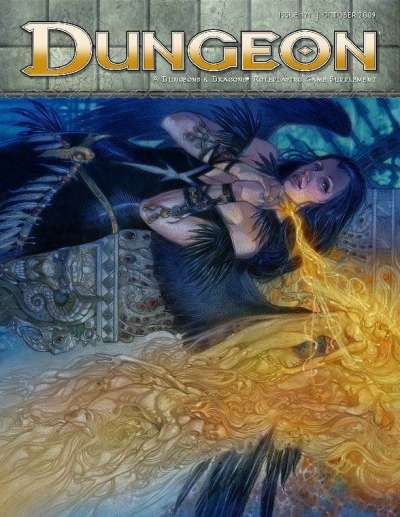
My contribution to Dungeon #171 was a short adventure for 1st-level characters titled Stick in the Mud that pitted heroes against, uh, frog people called bullywugs. It was part of The Chaos Scar, a small campaign setting on the border of civilization chock-full of monsters and bad guys. Perfect for adventurers looking to make their mark. It was a call back to classic D&D adventures like Keep on the Borderlands and a real hoot of a location to run an old-fashioned D&D game.
How did I get the gig? Well, the short version is I, uh, asked for it. Kind of. The longer version goes something like this. It was early 2009, and I was already working in the RPG industry, mostly with Goodman Games as a freelance writer and editor. Part of my duties was as editor-in-chief of Goodman’s inhouse quarterly magazine Level Up. The magazine brought me into contact with a number of folks from Wizards of the Coast, including Andy Collins, the RPG Development & Editing Manager for WotC at the time. At some point, I mentioned to Andy I was available for freelance work on D&D. I actually can’t find that email, but I remember it being a quick, BTW kind of thing. I never thought anything would come of it. Then, three months after that conversation, I got an email from Chris Youngs, the editor-in-chief of D&D Insider (who was then producing digital versions of both Dragon and Dungeon magazines). That email started with “Andy Collins passed your contact information to me, and mentioned you might be interested in some 4th Edition design work.” I was overjoyed that not only had I NOT shot myself in the professional foot by asking for a gig, but my “pitch” led to a chance to work on the game I’d loved for decades. Anyway, that email from Chris Youngs eventually turned into Stick in the Mud plus more adventures and articles to boot (I’ll cover some of those in later installments).
If you’d like to check out Stick in the Mud, this issue of Dungeon is still available in PDF at DriveThruRPG. Click the link below or the big-ass cover illustration above. 🙂
Submission Spotlight: Payday
On this installment of Submission Spotlight we’re going to talk about what happens after the blessed event of an acceptance and it’s time for you to get paid. Sounds simple, right? It usually is, but there are some things to be aware of before the money hits your bank account. As always, you should read all the guidelines before you submit a story, and how a market will pay you is part of those guidelines. (If you’re looking for a breakdown on the levels of payment–from token to pro–I cover that in another post.)
1) Have the right account. The method by which a market will pay you is, uh, pretty important, and you need to have the right type of account set up so the publisher can quickly and effortlessly transfer the money to you. That’ll usually look like this:
We pay a flat $50 USD rate for stories. We use PayPal to process all of our payments.
Whatever your feelings are about PayPal, if you want to get paid for your work, you’re gonna need an account. I’m not saying all publishers only pay through PayPal. Some will happily send you a check if you like, but a large majority either only pay or prefer to pay with PayPal. So, set up that account, friends.
2) Dollars: Not just for Americans! If you live in the United States, and you send out a lot of submissions, at some point you’re likely to send them to markets outside of your home country. I send a fair amount of subs to Canadian and Australian publishers, for example, and I’ll often see this in the submission guidelines:
Pay rates are as follows and in Canadian dollars:
Yep, Canadian dollars. But it might also be:
[Publisher] pays between A$20 and A$60 per 1000 words.
Right, that’s Australian dollars. You might also see these two currencies as CAD or AUD. Of course, if you submit to publishers in the UK, you might see GBP offered for payment. So what do all these currency differences mean to your submission? Not much, really, until it comes time to be paid. You need to understand that when a publisher says they’re going to pay you $200.00 CAD what shows up in your PayPal account is going to be $152.00 USD (based on current exchange rates). If you’re lucky enough to get paid in GBP, then you’d end up with $264.00 USD. PayPal will make the currency conversion for you (and charge you a small fee for the service), but just be aware of the those exchange rates so you’re not surprised on payday.
Yes, there are other countries that use dollars, and besides the two I listed above, you might see the New Zealand dollar (NZD), but it’s not nearly as common in my experience. But, hey, if you’ve been paid in Fijian or Hong Kong dollars for stories, let me know. 🙂
3) When do I get paid? Okay, so you’ve scored an acceptance, and you’re already doing the per-word multiplication, but when do you actually get the money? That can vary by publisher, and unlike many of the things I talk about in these articles, that information isn’t always in the submission guidelines. It’s often in the contract a publisher sends after an acceptance. That said, it is likely to be one of the following:
Payment is 8-12 cents per word on acceptance.
This sounds like you get an acceptance and you get paid, right? Not quite. In my experience, it means you get an acceptance, you get and sign the contract, and then you get paid (often immediately after the publisher receives the signed contract). I find about half the publishers I submit to do it this way. The others do something like this:
We pay 6 cents/word for original fiction up to 6,000 words on publication.
In this case, payment is made after the story is published. How long after the story is published depends on the publisher. Sometimes it’s right away, and sometimes publishers may include additional language such as “payment will be made within 90 days of publication.” Again, this information might not be in the guidelines but in the contract. It’s fairly common for a publisher to make payment this way, and it’s just something to be aware of, especially if you’re expecting a quick cash infusion to your PayPal account after an acceptance.
These are some of the issues you might run into with regards to payment in publisher guidelines. As with everything else, there shouldn’t be any surprised come payday because you read the guidelines carefully and completely, right? Of course, this one does come with the caveat that pertinent payment info isn’t always in the guidelines. So, if you’d like to be surprised when the contract states payment will be made within six months of publication, I’ll allow it. 🙂
Seen anything else of note in the guidelines when it comes to getting paid? Tell me about in the comments.
If you’d like to check out the other posts in the Submission Spotlight series, just click the links below.
Aeryn’s Archives: Vault of the Dragon Kings
This is the first in a series of posts where I’ll talk about the projects I’ve written and worked on over my professional career, from fiction to RPGs to tabletop war-gaming stuff. I’ll try to add insights into how the project came together and maybe an amusing anecdote or two. Anyway, with over 400 writing, editing, and development credits, we could be at this a while, but I’ll try to restrict my posts to the more interesting projects. 🙂
Let’s kick things off with my very first professional job in the tabletop gaming industry way back in 2005: Dungeon Crawl Classics #30: Vault of the Dragon Kings.
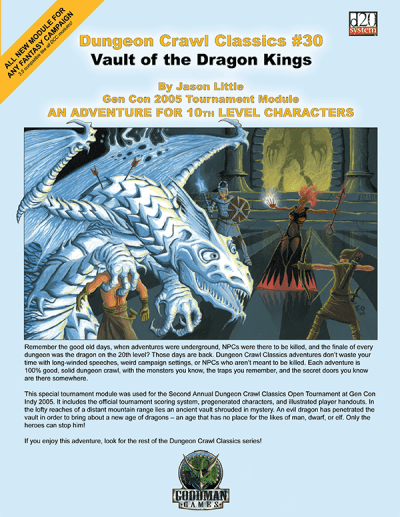
For the uninitiated, what you have here is a module or adventure for the Dungeons & Dragons roleplaying game. This is not an adventure produced by the publishers of Dungeons & Dragons, Wizards of the Coast, but a third party product created under license by Goodman Games. The lead writer on this one was Jason Little, and my role was as a stat editor and monster creator (I was credited under Stat Blocks & Creature Development and Additional Writing & Development). This essentially means I checked a lot of math and created some monsters for the adventure. That’s not the interesting part of this gig, though. How I got it is.
When Wizards of the Coast released the third edition of Dungeons and Dragons (often just called 3E) back in 2000, they created a version of the game that was more versatile than any before it. The rules let you build characters and monsters in a clearly defined way that allowed for endless customization. In addition, they opened up the game to third party publishers to produce material through something called the Open Gaming License (or OGL). I won’t go into the specifics because it’s mostly a bunch of math and legalese and stuff, but this new system sparked a creative fire in me. So I started making monsters, mostly by taking existing D&D critters and upgrading them with the new rules system. I also wrote little backstories for my creations and posted them on a popular Dungeons & Dragons message board. In some ways it was similar to fan fiction, though the OGL made it more commercially viable. (I also actually wrote fan fiction, but that’s a story for another day).
My creations earned me a small following from D&D players who frequented that message boards, and a few of those folks turned out to be publishers as well. One of them, Joseph Goodman of Goodman Games, liked what he saw and reached out to see if I’d be willing to work on a module in his very popular Dungeon Crawl Classics series. Needless to say I was thrilled for the opportunity, and thus began my career in tabletop gaming. Better yet, it also started a great professional relationship that’s lasted nearly fifteen years, and I still do the occasional job for Goodman Games to this day.
Oh, for you old school gamers, you might recognize the cover artist on this one. Yep, that’s a piece by the incomparable Erol Otus.
If you’d like to check out this module up close and personal, it’s still available through Goodman Games via the link below (or the giant cover illustration above):
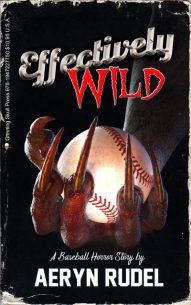
Effectively Wild – A Baseball Horror Story
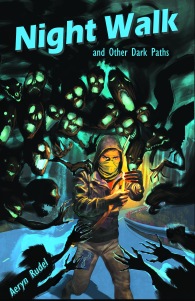
Night Walk & Other Dark Paths
Acts of War: Flashpoint

Acts of War: Aftershock

Acts of War: Stormbreak

 Aeryn Rudel's Rejectomancy