
Ten Years of Rejectomancy: Year Two- Maybe I’m Good at This?

My second year as a blogger and serious story submitter gave me legitimate hope that there might actually be a future to this whole writing thing. In addition to short story sales, I also published my first novel with Privateer Press and was doing a lot of freelance writing to boot. Still, this post will focus on the short story stuff, and, well, 2016 was a pretty good year. Let’s take a closer look.
Here are my total stats (pulled once again straight from Duotrope) for 2016.

Fifty-four submissions was my new high, and of those fifty-four, I managed to sell nine, which netted me a very respectable acceptance percentage of 20.8. It goes without saying that 20% is rarified air, and I’ve only managed it three times in the decade-plus I’ve been doing this. I also made over 400 bucks in story sales for the year, though much of that was from a couple of contest cashes with The Molotov Cocktail. Again, all proceeds from story sales very likely went to directly into the coffers of Door Dash or Uber Eats. 🙂
Okay, let’s look at the acceptances.
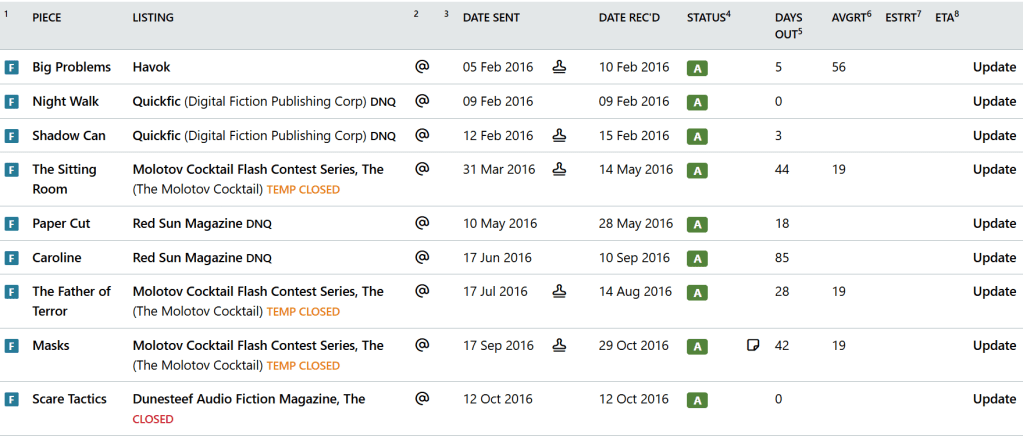
Despite selling more stories than I’d ever sold before, I didn’t manage a pro sale in 2016. There was some very nice semi-pro sales, though, including two with the now sadly defunct Red Sun Magazine, both stories I’d been shopping for quite some time. I also managed to snag second place in The Molotov Cocktail’s Flash Icon contest and third place in their Flash Fear contest, netting cash prizes for both that essentially amounted to pro-payment or very good semi-pro. The rest of my acceptances were a mix of one-offs, in that I never submitted to those particular markets again, or in the case of Havok, the first of what would be multiple sales. (Havok has completely changed, by the way, and is no longer a semi-pro market).
In addition to the nine acceptances, I had a bunch of close-but-no-cigar rejection in 2016 with various markets, a few of which were pro zines. Those definitely boosted my confidence, and netted me some solid feedback that helped me strengthen my writing for future submissions.
And there you have it, Rejectomancy Year Two. As I stated in the opening, this year also saw me publish my novel Flashpoint with Privateer Press, the first in an eventual trilogy. I also started writing a novel based on my own IP that I shopped pretty heavily a few years ago with limited success (some full manuscript requests but not offers of representation). I’m still shopping that novel to small publishers, but it might be destined for the trunk.
Thoughts or opinions about Rejectomancy Year Two? Tell me about it in the comments.
Ten Years of Rejectomancy: Year One – To Pro or Not to Pro
I started Rejectomancy in July of 2015, a period of time that coincided with me getting serious about short story submissions. So, in many ways, Rejectomancy is kind of detailed record of my writing journey as I transitioned from game designer/writer to a fiction writer. The first year of Rejectomancy was a pretty eventful one. I sent out more submissions than I ever had, and I started getting some good acceptances, too. The real theme of this year was trying to figure out where my work belonged. Was I good enough for the pro markets? Or should I spend more time sharpening my game with token and semi-pro publishers. Let’s take a look.
Here are my total stats (pulled from Duotrope) for the year of our lord 2015.

I sent forty-six submissions in 2015 and seven of them were accepted. That gave me a respectable acceptance percentage of just over 11%. Not bad. In addition, I scored my first and second pro sale. Below, are the details of all seven of my acceptances for the year. I also pulled in the princely sum of 185 bucks, which I’m pretty sure when directly to Door-Dashed burritos.
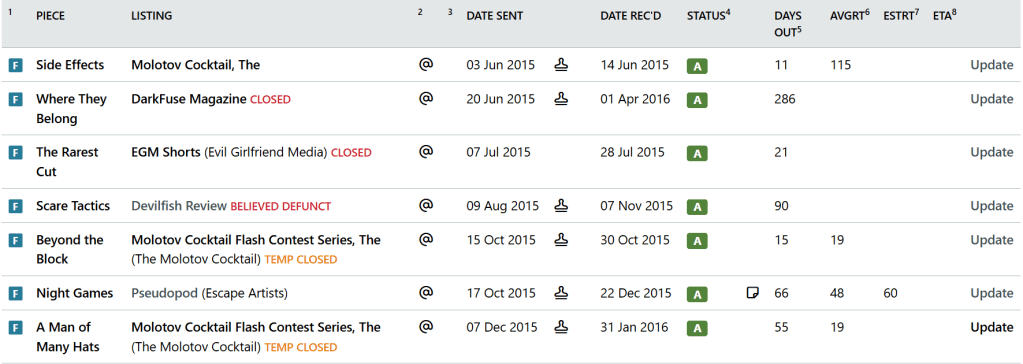
Just one bit of clarification on the acceptances. Duotrope counts an acceptance for the year the submission was sent not the year it was actually accepted, which is how I tend to calculate things. Since I’m pulling screen shots from Duotrope directly, we’ll go with their method for consistency.
Anyway, my first pro sale was to the now-defunct DarkFuse Magazine, a zombie-apocalypse story told from the perspective of a seven-year-old boy called “Where they Belong.” My second pro sale was to Pseudpod, and it was actually a reprint. I’d sold “Night Games” first to Devilfish Review in 2014. The rest of my acceptances were semi-pro or token, but it should be noted that the second story I sold to Devilfish Review, “Scare Tactics”, I went on to sell twice more as a reprint, and to pro markets. Obvs, this year I began to submit a lot of stories to The Molotov Cocktail, a practice that would continue for the next decade.
In all, a pretty good year, especially since I was really just getting warmed up. Looking back, I wish I’d had the confidence to send my work to pro markets right away. The fact of the matter is I didn’t think I was good enough yet, but two sales to two pro markets would seem to indicate otherwise. This is not to say that the markets I did sell to weren’t quality or that I’m not grateful, more that I wish I’d been able to see the quality of my own work and realize that I could sell it anywhere. Oh well, live, learn, and resubmit. 🙂
So that’s Rejectomancy Year One. In addition to ramping up my submission efforts, I also left my job at Privateer Press in June of that year with an agent and a book deal. To say I was optimistic about my literary future would be an understatement. Of course, things have a tendency to change in unexpected ways, but all you can do is keep writing and keep going.
Thoughts or opinions about my first year as a baby blogger? Tell me about it in the comments.
Ten Years of Rejectomancy: The Pre-Blog Years
A few months ago, Rejectomancy turned ten years old, and I celebrated that momentous occasion with a guest post from the supremely talented and supernaturally prolific Ai Jiang. (Check out that post here.) This series, however, will focus on my own submission efforts over the decade I’ve been inflicting them on y’all through this blog. We’ll do one year at a time, and I’ll give you all the crusty details on subs, rejections, and acceptances. That said, to kick things off, we need to talk about what came before the blog, a prequel, if you will. This will be the only post to cover multiple years, and I’ll give you all the deets for 2012, 2013, and 2014. I’ll be pulling all the data from Duotrope, as usual. Let’s get to it!
2012

Exciting, huh? Six whole submissions with no acceptances. Obviously, I took my first tentative steps into submitting short fiction in 2012. I was employed in the gaming industry at the time, and I had plenty of writing credits there, but no general fiction pubs to my name yet. All six submissions ended in form rejections. Sadly, the six markets I submitted to in 2012 are now defunct or on indefinite hiatus. (This will be a running theme.)
2013
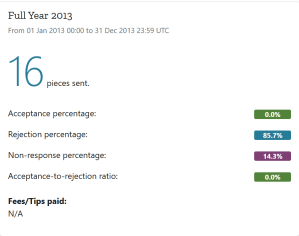
Still nothing much to talk about in 2013, though I did send more submissions. Again, all subs ended in rejection, but I did get a few personal notes on a story that would eventually become my first-ever acceptance. Once more, most of the markets I was subbing to in 2013 (ten of fifteen) are now closed or on indefinite hiatus. Although 2013 was ultimately disappointing, I was writing better material, and I felt that first acceptance was right around the corner.
2014
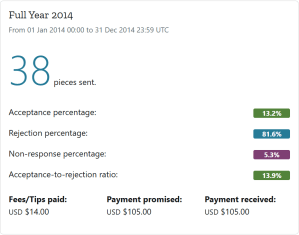
Success! I sold my first story, “Night Games,” to the now-defunct Devilfish Review on May 1st, 2014. To say I was excited is a bit of an understatement. In fact, I scared the shit out of my wife and our cats when I bellowed “FUCK YEAH!” when the acceptance email came through. I went on to sell another four stories in 2014, giving me a total of five for the year and a not-too-shabby acceptance percentage of 13.2%. I also made a cool hundred bucks, which, of course, isn’t much, but getting paid anything for my fiction felt pretty good. This was also the year I figured out that I have knack for flash fiction, and I started writing and submitting A LOT of it toward the end of 2014. In addition, I began to think that folks might be interested in an honest and detailed account of my submission journey. Little did I know I’d soon sign myself up for an entire decade of no’s and not for us’s. 🙂
And there you have at, my nascent, pre-blog submission efforts. As this series goes on, I’ll devote an entire post to each of the ten years Rejectomancy has been in operation. Hopefully, it’ll be inspirational, educational, or at a minimum, entertaining. 🙂
Questions or opinions about my first baby submission steps? Tell me about it in the comments.
Submission Statement: July 2025
I’ve missed the last few submissions statements, but I’m back on the beam for July, and ready to share all the glory and pain of the last few months. This’ll be a three-fer, and I’ll give you stats for May, June, and July. So let’s jump in.
May – July 2025 Short Story Stats
- Submissions Sent: 20
- Rejections: 21
- No Response: 2
- Acceptances: 4
- Further Consideration/Shortlist: 5
- Withdrawals: 2
- Pending: 11
- New Stories: 6
The number of submissions I sent over the last three months fell off considerably compare to the prior months, though I still sent a fair amount. Twenty subs averages out to about seven per month, which isn’t too bad. It also gives me a total of 72 for the year, which is just over ten per month. I should still easily hit 100 submissions, but my initial goal of 150 might be difficult.
The 21 rejections I received over the last three months are a real mixed bag. There are plenty of garden variety form letters, but there’s also more than the usual final-round heartbreakers in there, a few of which came after nearly six months of waiting. More about those in the rejections section of this post.
The good news is that I sold four stories in the last three months, three semi-pro and one pro sale. The pro sale was especially sweet because it came after six months of waiting, and those have NOT been going my way of late. This brings me up to seven acceptances for the year. Not too bad.
As I said in my last update, that one-story-a-week goal was getting tough to maintain. This proved very true, and I only managed six new stories over the last three months. That gives me a total of 20 for the year, which still ain’t bad, and I think I still have a good shot at 40 new pieces by the end of 2025.
Rejections
Twenty-one rejections between May and July.
- Form Rejections: 16
- Personal Rejections: 4
- Close-But-No-Cigar Rejections: 5
Although most of the rejections I received over the last three months were form rejections, there were some real heartbreaker close-but-no-cigars in the mix, three of which came from pro markets. That’s just how it goes sometimes, and though it can be encouraging to make it to the final round of consideration with some of these prestigious markets, there’s no denying how disappointing it can be as well, especially when the story in question has been final-rounded so many times before.
I’ll share the toughest of the heartbreaker rejections below.
Heartbreaker Rejection
Thank you for sending in your work. Unfortunately, we’re going to pass on “Trapping Disaster.”
There were many things about this story that stood out for us, especially the protagonist’s relationship to loss, grief, survivor’s guilt, and their own mental health. The pacing was brilliant and it had us on the edge of our seats. At this stage of decision making, we want you to know that a rejection does not speak to the quality of your work, and more to our inability to fund all the stories we are in love with.
We hope you find a great home for this story soon. We appreciate having the chance to read it, and we are grateful for the gift of your imagination and world weaving.
There’s a number of factors that made this rejection particularly tough. First, this story, “Trapping Disaster”, has been subbed twenty times and reached the final round of consideration with a pro market four times. Second, this is one of my bucket-list markets, one of those publishers I’ve wanted to place a story with since I started subbing seriously over a decade ago. Finally, as the rejection says, it’s not about the quality of the piece, and more about just not having the resources to publish everything they want to publish. I appreciate the honesty–I really do–but there’s something even more disappointing about knowing there wasn’t anything wrong with the story. Still, this is just the way subbing goes sometimes, and the only thing you can do is focus on the positives (and there are positives) and send that story out again, which is exactly what I did. 🙂
2025 Writing Goals Bingo
And, finally, here’s my updated 2025 Writing Goals Bingo card. Nice to see a bit more green on it now.
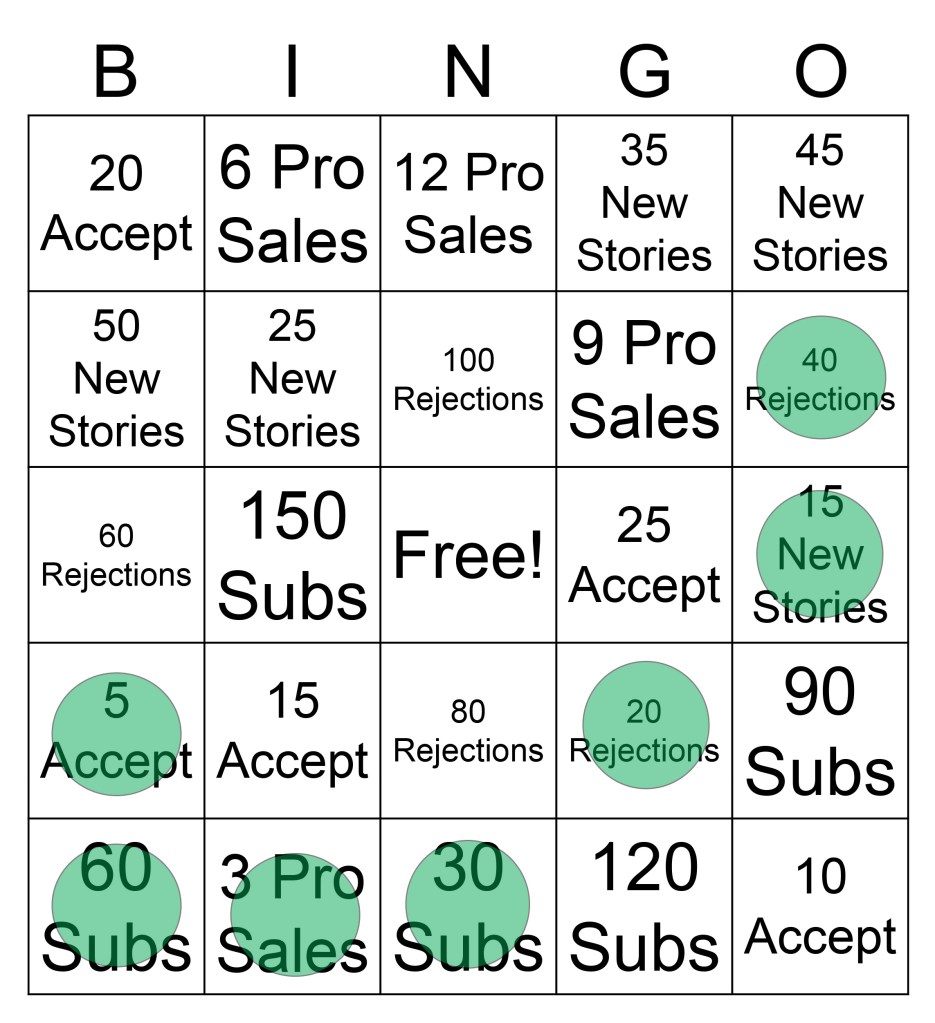
I’m finally starting to fill in some of the acceptance goals, which makes filling in the rejection goals a little less painful. At this point, I’m going to try and hit as many goals as I can, but even if I only get halfway with the acceptance and writing goals, it will have been a very good year.
And that was May, June, and July. My goals in August are to send more submissions and write more short stories. Some of that will be tempered by the fact that I’m querying a new novel, but I should be able to improve on my numbers from the last three months.
That was my, uh, quarter, I guess. How was yours?
27 Submissions: My Most-Rejected Story SOLD!

No, this is not a new rom-com starring Katherine Heigl; it is a tale of literary woe and eventual triumph. You see, last weekend, I set a new rejectomancer record. I sold my most rejected story. That’s right; “Time Has No Memory” finally sold after twenty-seven submissions and twenty-five rejections. I thought I’d celebrate this momentous occasion by looking back on the five-year journey of this poor, beleaguered story as a reminder to myself (and hopefully to you) not to give up, and that acceptance is, as always, putting the right story in front of the right editor at the right time.
Okay, first, let take a look at the arduous submission journey of “Time Has No Memory.” Below is a screenshot of the Duotrope record for the piece. I should note that this is in now way whatsoever a call-out of the publishers that rejected the story. They all had perfectly valid reasons for passing, and sometimes it just takes a long time to find the right market for a piece. I’m showing you the complete record just to give you an idea of the types of markets I was submitting to and nothing more.
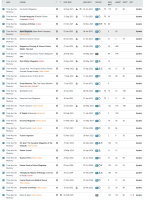
If you don’t want to stare at a blurry screenshot, here are the basic submission stats for the story.
- Submission: 27*
- Personal Rejections: 6
- Final-Round Rejections: 6
- Form Rejections: 18
- No Response: 1
- Acceptances: 1
*One of the subs was to Diabolical Plots, which is not listed on Duotrope.
I’m thrilled I ended up placing the story with Abyss & Apex, but you might be wondering why did it take so long for me to sell this piece? Excellent question, and the real answer is I don’t know, but let’s go ahead and speculate anyway. Here are three things that may (and in some cases did) contribute to the story getting a rejection 🙂
- Overused Trope: The story is a time travel story, and, well, time travel is kinda like vampires and zombies in horror. It’s been done a lot, and many publishers are tired of seeing it. In addition, I don’t go into a lot of depth about the science behind the time travel, and that can be a deal breaker for some sci-fi markets. It’s even in the guidelines of some of the big ones.
- Narrative Style: The story is an epistolary, told through journal entries, and I know for a fact that some markets don’t like those. How do I know? They told me. 🙂 Of course, I bear none of these publishers any ill will, and now that I know some are not fans of epistolary, I won’t send them any. It’s excellent info to have.
- Kinda bleak. Like a lot of my work, “Time Has No Memory” is a bit of a downer, and while there’s definitely still a market for that, I do find that a lot of publishers are gravitating toward more hopeful fare (I can’t imagine why).
With some exceptions, I don’t know for sure if any of the elements above were a factor in any of my rejections, but In the end, it really doesn’t matter. A lot of this comes down to timing. If I’d sent the story to Abyss & Apex first, well, you wouldn’t be reading this blog post. 🙂
The most important thing to take away from this post is that if you believe in a story or a poem or a novel or whatever, don’t give up on it. All those rejections likely have more to do with timing than the quality of your work. Keep writing, keep submitting, KEEP GOING.
Thoughts on my most-rejected story? Want to share your own tale of rejection woe? Tell me all about it in the comments.
Guest Post – A Numbers Game by Ai Jiang
Hey, folks, today is a momentous day on the blog, and we’re celebrating two pretty awesome events. First, this day and this post marks TEN YEARS of Rejectomancy. That’s a lot of no’s, not for us’s, and we’re gonna pass’s, somewhere around 800 if my math is right. But those numbers are a drop in the bucket, a measly fraction of the awe-inspiring numbers of one extremely talented and nigh supernaturally prolific Ai Jiang. Her submission, acceptance, and rejection numbers are simply off-the-charts, and she was kind enough to compile those numbers and share some words of wisdom for the second awesome event for today, my first ever guest post. Needless to say, I am absolutely thrilled to have someone as talented and just plain cool as Ai Jiang to help me kick off the next ten years of Rejectomancy.
Chance, Fortune, Persistent: Publishing, a Numbers Game?
When I set out to make publishing a career, I didn’t have a very clear plan in mind, it had simply been “write, continue to write, and send out my work to as many places as possible as many times as possible and see where they land.” That, and improving my craft using short form, refining at the sentence level, before moving onto tackling longer narratives and larger worlds. I still haven’t gotten the hang of properly writing novels.
As someone mighty competitive, especially when it comes to competing against myself, one thing I’d found myself doing the deeper I dove into publishing, at least the short fiction world at the start, was that I had sort of come into a gamified strategy, the kind of grinding quantity mindset of gamers when they’re trying to cross into the next level.
For the first two and a half years of writing and submitting short stories, I aimed for volume, because I’d thought the more stories I had and the more submissions I sent meant the higher the chance I had at getting published. I’m also someone who learns largely by doing, so writing a large quantity of short stories helped me in figuring out how to tackle the form. That, and craft videos and workshops, both paid and free, though mostly the latter in terms of whatever resources I can find online at the beginning. But ultimately, reading and simply consuming literature and analyzing it helped place my mind in a space that’s constantly thinking about stories and the creation of them.
But without further ado, below are the stats I’ve wrangled together from late 2020, when I first forayed into the short fiction world, to the end of 2022, when my submissions became fewer in number, and I’d been fortunate enough to receive numerous anthology solicitations that cleared me of my backlog. I’d also begun building my backlog in long form because of just how long I realized publishing takes—from the process of querying and acquiring an agent, going on sub, selling the book and negotiating the contract, along with the lead up before the book is actually published and out in the world.
Currently, in the long form backlog, I have one book on submission, a novella completed and edited, a novel in the editing stages, a short story collection, and a poetry collection.
What I’ve learned in the past few years is not just how important persistence is in this industry, but also how important it is to keep plowing forward unhaltingly in working on the next project because you never know just when or if something will sell. The only thing we can really rely on are the things within our own control when so much else in publishing is dependent on the decision of others—falling to chance and timing.
Submission Stats from September 2020 — September 2021
This includes both literary + genre journals/magazine submissions, and I’d noticed that I’d had a higher chance of landing genre work than I did with literary, but that could also be because the response timelines for literary magazines were often much longer on average as well
Submissions Sent
- Total — 604 (544 excluding withdrawn submissions)
Acceptances
- Total — 24 (Including reprints)
- Acceptance rate — ~4.4%
Rejections
- Total — 434
- Personal Rejections — 132
- Form Rejections — 302
(This is a rough estimate for personal vs form, sometimes I might get it wrong)
Withdrawn
- Total — 60
Pending Submissions at Time of Stats
- Total — 86
Submission Stats from 2021 Alone
Acceptances
- Total — 25
- Genre Breakdown — 8 literary | 17 speculative
- Sales Breakdown — 2 SFWA Pro Sales | 5 HWA Pro Sale | Semi-Pro/Token 16
Stories Published
- Total — 16
- Genre Breakdown — 6 literary | 10 speculative
Poem Acceptances
- Total — 13
- Genre Breakdown — 7 literary | 6 speculative
- Total Paid Sales — 6
Poems Published
- Total — 9
- Genre Breakdown — 7 literary | 2 speculative
Submission Stats from September 2021 — September 2022 Stats
Below are the stats for a mix of stories, poetry, CNF, anthology invitations, and reprints — doesn’t include withdrawn/no response submissions.
Submissions Sent
- Total — 797
Acceptances
- Total — 77
- Sales Breakdown — 24 SFWA/HWA | 41 Semi-pro/token | 12 Unpaid
- Overall Acceptance Rate — 9.7%
Published
- Total — 53
Rejections
- Total — 578
Submission Stats from January 2022 — September 2022
Submissions Sent
- Total — 477
Acceptances
- Total — 59
- Sales Breakdown — 20 SFWA/HWA Pro Sales | 30 Semi-pro/Token | 9 Unpaid
- Overall Acceptance Rate —12.4%
Published
- Total — 39
Rejections
- Total — 364
Overall Publication Stats
- 2021: ~26 publications, ~38 acceptances
- 2022: ~53 publications, ~59 acceptances
- 2023: ~28 publications, 2 books + 1 mini collection
- 2024: ~17 publications
- 2025: ~22 publications (including forthcoming later this year), 1 book
- 2026: 2 books forthcoming, other publications yet unknown
Total Earnings from 2021-2024
- 2021 — $2,677.39
- 2022 — $6,075.64
- 2023 — $13,871.21
- 2024 — $49,389.43
*The # of publications is a mix of short stories, poetry, and nonfiction sales. In 2023 and 2024, the income stream was much more diverse with books, editing, workshop, and reading payments as well.
Some fun POV Stats out of the stories I’ve had published from late 2020-2022
Out of 73 stories sold (not including reprints/CNF), the POVs include:
- 1st past: 19
- 1st present: 16
- 1st past/2nd address: 2
- 1st present/2nd address/2nd present: 1
- 1st present/2nd address: 1
- 1st plural present: 4
- 1st plural past: 2
- 1st past/1st plural past/3rd past: 1
- 2nd past: 1
- 2nd present: 8
- 2nd present/past: 1
- 3rd past: 14
- 3rd present: 1
- 1st/2nd/3rd: 1 (Linghun)
- 1st past/3rd past: 1
- 1st present/past: 1
Huge thanks to Ai Jiang for sharing her submission numbers with us and for always being open and honest about the trials and tribulations of being a working writer. To learn more about Ai Jiang and her work, click the images below or head over to her website and check out all the riveting sci-fi, fantasy, and horror she’s written in both short story and long form.


900 Submissions: An Analysis
I recently hit another big story submission milestone. I sent my 900th submission since I started tracking them on Duotrope back in 2012. Like I usually do with this big round numbers, I’ll break down my overall stats, but this time, since 800 subs was almost exactly one year ago, we’ll do a little side-by-side comparison, too.
First, the basic numbers.
| 800 Subs | 900 Subs* | |
| Rejections | 642 | 718 |
| Acceptances | 104 | 112 |
| Withdrawals | 26 | 29 |
| Lost/Never Responded | 22 | 22 |
| Pending | 6 | 21 |
So, I’ve definitely been more active in the last year than I have in a long time. In fact, the time it took me to get from 700 subs to 800 subs was almost two years, as opposed to the one year it took to go from 800 to 900. But how did these most recent 100 subs treat me? I’d say fair to middling.
I gained 76 rejections along with 8 new acceptances. That’s not terrible, especially since I still have 21 stories pending, and a few of those might turn into acceptances. As it is right now, I’m looking at about a 10% acceptance rate, which is lower than my historical average of about 15%. Still, I can live with one acceptance out of every ten subs.
*It was actually 902 submissions by the time I got around to running the report off Duotrope.
Okay, now lets look at distinct pieces and distinct publishers.
| 800 Subs | 900 Subs | |
| Total Distinct Stories | 164 | 183 |
| Microfiction | 4 | 4 |
| Flash Fiction | 127 | 136 |
| Short Stories | 29 | 39 |
| Novellas | 1 | 1 |
| Novels | 3 | 3 |
| Total Distinct Markets | 228 | 240 |
I’ve been writing a lot of new stories, which is evident in the chart above. In the past year, I’ve added nineteen new distinct stories, ten short stories and nine flash fiction pieces. Those stories also make up the bulk of the 21 pieces I currently have pending. Not bad.
I also added twelve new markets to my database, and a lot of that has to do with the fact that a bunch of brand-spanking-new, pro-paying zines have sprung up in the last twelve months or so. I’ve sent submissions to most of them, and it’s great to have more markets for flash fiction and shorts, seeing that we tend to lose a half dozen good ones every year.
Although 900 submissions is a big milestone, I’m really hoping I can hit 1,000 by year’s end. Hard to believe I’ve sent that many unsuspecting stories out into the cold, cold dark of submission land, but here were are.
Hit a submission milestone of your own lately? I’d love to hear about it in the comments.
Submission Statement: April 2025
April was a slightly better month than March, but though I made decent headway on a number of writing goals, it was still largely a disappointing month.
April 2025 Short Story Stats
- Submissions Sent: 12
- Rejections: 11
- No Response: 0
- Acceptances: 1
- Further Consideration/Shortlist: 0
- Withdrawals: 0
- Pending: 20
- New Stories: 2
I sent twelve submissions in April, which gave me a total of fifty-two for the year. That works out to an average of thirteen submissions a month, and puts me on pace for 156 by year’s end. That’s right on target, and even leaves me a little wiggle room if I have a slow submission month.
Eleven rejections is about average for the amount of submission I’m sending. In my experience, rejections tend come in waves, so I figure there’ll be double-digit months and months where I see as few as five or six. April, like March, saw a number the rejections of the 100-plus-day, final-round variety, i.e., heartbreakers. Despite some success, these rejections that cast a pall of disappointment over the entire month, but, you know, that’s the gig.
I did manage to sell a story in April and to a pro market to boot, so it’s not all bad news. I’m still behind when it comes to my acceptance goals, but there’s still time to make up ground in the coming months.
At some point, I knew my story-a-week goal was going to get tough, and I reached that point in April. I only wrote two new stories last month, which gives me fifteen (out of eighteen weeks). So I’m three off my pace. I might be able to catch up in the coming months by writing multiple stories in a week (especially if they’re flash), but I’m not going to worry too much about it. If I end up writing only 45-plus new stories by the end of the year, that’s still pretty damn good.
Rejections
Eleven rejections in March.
- Form Rejections: 8
- Personal Rejections: 3
- Close-But-No-Cigar Rejections: 3
Like March, April featured too many final-round, close-but-no-cigar rejections. Two were from pro markets and had 145-plus-day wait times. The last one was from a good semi-pro and came quite a bit quicker, after only 75 days. I don’t want to read too much into these rejections, but it does feel like I’m getting a lot more of them than I used to. Now, some of that could be just luck of the draw, but after talking to some writer pals who are also in the submission trenches, there’s a general sense that it’s gotten a bit tougher to break through than in years past. That’s anecdotal, of course, and I might get three acceptances in May that completely change my tune, but right now it does feel pretty damn challenging out there.
Like I did last month, I’ll share a couple of the heartbreaker rejections with ya.
Heartbreaker Rejection 1
Thank you for submitting [story] to [publisher]. We very much appreciate the chance to read your work, but we are regretfully saying no to this submission. We wish you luck with placing it elsewhere and hope you will continue to consider us in the future.
This was a tough one. It came from a professional market after a further consideration letter and a 154-day wait. The rejection is a simple form rejection, which isn’t that unusual even after a further consideration and a long wait. Like always, I’m not upset at the publisher or editor or anything silly like that. This kind of outcome is just a reality of submitting short stories, but like I said in my intro, there have been a lot of these lately, and I’m not to proud to admit they can take a mental toll on even a veteran rejectomancer. 😉
Heartbreaker Rejection 2
Many thanks for your interest in this anthology, and your patience while final selections were made. This is the sixth book in a collaborative series of annual horror anthologies with [editor], and we have enjoyed reading through the stories that were sent in for consideration. We received over 900 submissions in response to this call, which made the final decisions especially tough as [editor] was again only able to choose 4 stories for publication from this route.
I’m afraid we won’t be going ahead with your work this time, though we look forward to seeing more stories from you in future. If you’d be interested in submitting to us again please watch out for opportunities via our newsletter, website and social media pages.
Although this was certainly a heartbreaker rejection because it came after 149 days and was, as the rejections stated, part of final selections, the reason I’m posting it is not to elicit sympathy (that’s what the first one’s for), but to showcase the kind of odds you’re often up against when submitting stories to magazines and anthologies. In this case, only four stories were chosen out of 900 submissions. For the math nerds, that’s a miniscule 0.44%. Tough to break through with that kind of odds, but still worth trying.
2025 Writing Goals Bingo
Once more, here’s my writing goals bingo card after another full month of submissions.

I really would have liked to have filled in one of the acceptance goals, but I fell just short of both the first overall acceptance and pro acceptance marks. Hopefully, May will allow me to add a bit more green to my bingo card.
And that was April. May goals are the same: write more, submit more, and hopefully, get accepted more.
That was my month. How was yours?
Submission Statement: March 2025
To put it bluntly, March was a brutal month, but I did make some positive yardage. All of my trials, tribulations, and so, so many rejections below. 🙂
March 2025 Short Story Stats
- Submissions Sent: 14
- Rejections: 11
- No Response: 0
- Acceptances: 0
- Further Consideration/Shortlist: 0
- Withdrawals: 0
- Pending: 19
- New Stories: 4
I sent fourteen submissions last month, which gives me a total of forty for the year. I sent out another two this morning, so I’m technically up to forty-two. The goal is 150 subs for 2025, and I’m on pace with an average of about thirteen per month. I’m also on pace for hitting a secondary goal of 1,000 total submissions since I started recording my subs on Duotrope back in 2012. If I keep up the level of writing and submitting I maintained in the first quarter of the year, I should hit both goals.
The eleven rejections I received is not an overwhelming amount, especially for how many submissions I’m sending, but the fact that so many of them were close-but-no-cigar, final-round rejections from pro markets made for a tough month. More on that in the rejections section of this post.
I managed to write another four stories, which isn’t too bad as I was on vacation for over a week. That gives me a seventeen for the first quarter or roughly five stories per month. My goal is fifty-two stories for the year, and I’m well on my way to that mark. I’ve already finished the first story for April, so the second quarter is off to a good start, too.
Rejections
Eleven rejections in March.
- Form Rejections: 8
- Personal Rejections: 3
- Close-But-No-Cigar Rejections: 5
So, the big story here are the CBNC rejections, and I got a bunch of them last month. These kinds of rejections are especially tough because you know the story is good enough to get published, just not good enough this time. It comes with territory, and you just have to roll with it, but CBNCs do sting a bit more than your usual no. I’ll share a couple of my heartbreakers below. Keep in mind, this is not me calling out editors for rejecting me. That’s stupid and immature. As usual, this is just me pulling back the curtain a bit on how tough the writing industry can be sometimes.
Heartbreaker Rejection 1
I’m sorry to say that [publisher] will not be purchasing [story] for an upcoming issue. We received an overwhelming number of excellent pieces during this submissions period, and were ultimately able to choose fewer than 1% of them for publication.
Our longlist was made up of our favourite pieces, and yours was certainly among them. Thank you for giving us the opportunity to read your work. We’re grateful for the chance, and we wish you all the best in placing this elsewhere.
This rejection came after 146 days and a further consideration letter from a great pro market. I REALLY wanted this one, but it wasn’t in the cards this time. Still, as with all CBNC rejections, you have to look at the bright side. One, the story is definitely good enough to get published, and two, I know what kinds of stories to send this market so that next time, I might make the cut.
Heartbreaker Rejection 2
Thank you for submitting [story] to [publisher]. Unfortunately we have decided not to accept it for publication. I appreciate your patience with waiting for a final response, and best wishes with finding a home for this piece elsewhere.
The email subject line for this rejection was “Final round rejection / [story title] / [publisher]”, and I appreciate that. If I’m gonna get rejected, I’d rather the proverbial Band-Aid was ripped off quickly. This is a very cool new market, and I almost made their first issue. The only downside is they have a pretty specific theme, and I had just the one story that fit. So, if I submit again, I’ll need to write something specifically for their theme, which is certainly doable, and maybe even advisable seeing how close I got here.
2025 Writing Goals Bingo
The bingo card below breaks up my primary goals into 25 bite-size mini goals, and this month I get to mark another one complete.

I would have liked to have filled in one of the acceptance or new story goals, but I’ll take the first rejections goal, too. Hopefully, April will be a better month, and I can claim some more positive yardage.
And that was March. My goals for April are simply to write and submit more stories, and, hopefully, get a few of those stories accepted.
That was my month. How was yours?
Path to Publication: The Downer
Time for another path to publication, wherein I recount the long and painful journey of a story from creation to that vaunted state of publication. This time, we’ll be looking at “The Downer”, a spec-fic piece that I thought was an absolute slam dunk when I finished it and turned out to be a two-year, sixteen-submission death march that had me questioning my talent, my submissions targeting skills, and even my sanity by the end. Before we get into all the rejections and whatnot, let me tell you a little bit about the story.
Back in early 2020, I was vacationing in Hawaii, and one night I had a very vivid dream about a young woman who generated a kind of misfortune field, so that everyone who spent too much time around her would eventually suffer some kind of terrible accident. Now, I don’t generally dream that vividly, and even when I do, my dreams are a bunch of jumbled nonsense that are basically just manifestation of the brain weasels that chew on my gray matter every day. This time, however, I woke knowing I had a hell of a story idea, so I jotted down some notes, and when I got back home, I started writing. I decided to write the story as an epistolary, a decision that would later haunt me during the submission process. At the time, writing a story that was essentially a written job interview for the FBI seemed like the perfect fit for the character and the idea, but as you’ll see, it might have worked against me.
So, let’s dive into the submission data. I’m going to name each of the markets I submitted this work to just as a matter of record, but, please, do not misread that as me taking any of these publishers to task for not accepting the story. My intention here is not to point out publishers who “missed out” on my brilliant work (hah!); it’s simply to showcase how difficult it is sometimes to get a story published. Remember, it’s all about the right fit, and sometimes finding that fit can, well, give you fits (sorry).
| Submission | Market | Date Sent | Days Out | Result |
| 1 | The Magazine of Fantasy & Science Fiction (F&SF) | 1/31/20 | 1 | Rejection (Personal) |
| 2 | Escape Pod | 4/1/20 | 6 | Rejection (Personal) |
| 3 | Clarkesworld: Science Fiction & Fantasy Magazine | 4/7/20 | 8 | Rejection (Form) |
| 4 | Asimov’s Science Fiction | 4/15/20 | 1 | Rejection (Form) |
| 5 | The Dark Magazine | 4/16/20 | 0 | Rejection (Form) |
| 6 | Cossmass Infinities | 4/17/20 | 95 | Rejection (Form) |
| 7 | Strange Horizons | 7/21/20 | 63 | Rejection (Form) |
| 8 | Apex | 9/22/20 | 76 | Rejection (Form, Shortlisted) |
| 9 | Diabolical Plots | 1/1/21 | 3 | Rejection (Form) |
| 10 | Black Static | 1/4/21 | 1 | Rejection (Form) |
| 11 | Lightspeed Magazine | 2/8/21 | 31 | Rejection (Form) |
| 12 | Pulp Literature | 3/11/21 | 41 | Rejection (Form) |
| 13 | Lamplight | 3/16/21 | 28 | Rejection (Form) |
| 14 | Uncharted Magazine | 4/18/21 | 52 | Rejection (Form) |
| 15 | Boneyard Soup Magazine | 6/9/21 | 115 | Rejection (Form) |
| 16 | On Spec | 9/26/21 | 126 | Accepted |
As you can see, “The Downer” was definitely put through its paces in the submission process, and though I ended up selling it to a damn good market, getting there was trying at times. Now, some of this is simply luck of the draw. Had On Spec been open to submissions earlier than it was, I might have submitted it there far sooner than I did, and, who knows, maybe I would have saved myself ten rejections or so. Of course, that’s just part of the whole process. You have to put the right story in front of the right editor at the right time. Sometimes you do that on the first submissions and sometimes you do it on the sixteenth.
I think there were maybe a couple of other things working against this story as well. One, like many of my pieces, it’s kind of a mishmash of horror, fantasy, and science fiction, and doesn’t fit neatly into any of those genres. That can make it somewhat hard to sell to markets that specialize in one genre or the other. The fact I sold it to a general spec-fic market kind of supports this theory, but it’s still mostly conjecture, though it’s something I’ve long suspected about certain pieces of mine.
I think what really held the story back, though, is something for which I do have some concrete data. The fact that it’s an epistolary very likely hurt its chances somewhat. I’ll offer up two pieces of evidence for that theory. The first come from the rejection I received from F&SF.
Thank you for giving me a chance to read “The Downer.” I thought this was an interesting character and premise, but the narrative did not persuade me that the epistolary format was the best way to tell/show this story at this length. (I see the appeal of the epistolary format here, particularly in setting up the narrative arc for the turn/reveal at the end; it just didn’t work for me. Part of that may be that I’ve answered mail for a number of high level executives, including a CEO and an executive vice president, and I pretty much answer mail all day now, and nobody who reads mail for someone important or for themselves would get to page 2 of this without skimming and putting it aside: so it might be me more than the story.) I’m going to pass on this story for Fantasy & Science Fiction, but I wish you best of luck finding the right market for it and hope that you’ll keep us in mind in the future.
In the meantime, we all hope you are doing well and staying healthy.
Best regards,
Charlie
It’s always great to get a personal note and some feedback from an editor as great as C.C. Finlay, and he makes an excellent point about the story, especially given his personal experience. Note, I don’t think that Charlie is prejudiced against epistolary stories in general, just that the format didn’t work for him here, and I appreciated that he explained why it didn’t. Unfortunately, I had a 5,000-word epistolary story already written, and since this was the story’s first rejection, I decided to soldier on, and keep submitting it as is. With hindsight being 20/20, and knowing that this would be the first of fourteen rejections, I think there’s an argument to be made that I should have taken the idea and character, which did work, scrapped the story, and rewritten it in a standard third-person limited POV or something of that nature.
Now, as for the other piece of evidence that the epistolary format might have hurt this story, well, it comes from an unexpected place, a rejection for another story from On Spec, the same market that accepted “The Downer.” When you get a close-but-no-cigar rejection from On Spec, they, like many publishers, will include some of the first reader feedback. Well, the rejected story was also an epistolary tale, and two of their readers expressed an issue with the format, one even saying that “we don’t generally like [epistolary] tales”. Now, obviously, I did manage to sell On Spec an epistolary story, so those readers obviously thought it was good enough despite the format. Again, let me stress that I have no animosity or resentment toward ANY editor or reader that rejected this story or any other for any reason. Editorial (or first reader) taste is a thing, and it can often be the difference between an acceptance and a rejection.
Now, did any of the markets pass on “The Downer” because it was an epistolary? Maybe. They might have had similar objections to those of C. C. Finlay, and simply felt that the format was the wrong one for this story but not the wrong format for any story. I’ll never know, and I am, of course, engaging in a bit of rejectomancy here, but, hey, it IS the name of the blog. 🙂
Anyway, I sold “The Downer” to On Spec on January 30th, 2022, and it was published in issue #123. It was my second sale to On Spec. They’ve also published another one of my oft-rejected stories, “The Back-Off” (bless them), another double-digit rejectee that will likely be the subject of a future path to publication post.
And there you have it, another arduous tale of submissions, rejections, and eventual acceptance triumph. Questions about the piece and it’s twisting path to publication? Or, do you have a tale of your own about an oft-rejected story that eventually found a home? I’d love to hear about either in the comments.
Effectively Wild – A Baseball Horror Story
Night Walk & Other Dark Paths
Acts of War: Flashpoint

Acts of War: Aftershock

Acts of War: Stormbreak

 Aeryn Rudel's Rejectomancy