
Write What You Know: I Just Work Here
One of my favorite books about the craft is Stephen King’s On Writing. It’s chocked full of interesting anecdotes and useful tidbits about King’s approach to the written word (definitely check it out if you haven’t already). Much of that book has stuck with me over the years, but one of my favorite bits is not one you might expect. Here it is:
“People love to read about work. God knows why, but they do. If you’re a plumber who enjoys science fiction, you might well consider a novel about a plumber aboard a starship or on an alien planet.”
This jumped off the page at me, and not just because I want to read about a space plumber (and I totally do). It’s that I wholeheartedly agree, and I love to read about people’s work. If a novel or story goes into detail about a profession I know nothing about, be it carpentry or cattle ranching, I’m hooked. But why? King goes into a fair amount of detail about that, and here’s what I took away from it.
One, writing about something you know intimately–like your job–injects authenticity into your work. When an author knows the lingo and the ins and outs of a profession it increases immersion. Two, readers like characters they can relate to, especially if the story contains aliens, demons, or other fantastical things. If your story is written from the perspective of a recognizable profession, it gives the reader a familiar lens through which to view the more otherworldly elements of your story. It makes it easier to suspend disbelief.
I think this concept can also apply to a profession or activity you know a lot about (hobbies and the like) or one you have researched thoroughly. It doesn’t have to be your actual job. Also, if you’re passionate about the subject, that often comes through.
I make no bones about Stephen King being a huge influence on my work, so not surprisingly, I’ve written a number of stories about folks doing their jobs and running into something weird or horrific in the process. Here are some of my favorite examples.
“Night Games” – This short story is about a vampire that plays minor league baseball. The sport is a huge passion of mine, and I have pretty extensive knowledge of the rules and history of America’s Pastime. I used some of that knowledge and based the story loosely off one of the weirder incidents in baseball history (look up the name Tyler Colvin). Of course, the danger with injecting so much of one subject into a story is that, well, some folks (including editors) have no interest in that subject. “Night Games” received a couple of “Nope. Too much baseball” rejections before I sold it to Devilfish Review and then again to Pseudopod.
“The Back-Off” – I’m fascinated with gambling, especially cards, and I study poker and blackjack on a regular basis. (I only play rarely and not particularly well.) One thing that really interests me are card cheats, how they operate, and how casinos deal with them. “The Back-Off” is the story of a low-level mob boss who runs a casino and encounters what he thinks is a man cheating at blackjack. In the story, I go into a lot of detail about card counting, which is not technically cheating, but tell that to the casinos. Anyway, all the information I give the reader about card counting adds shape to the narrative and clues in both the main character and the reader that something far more dangerous is going on. Now, again, if you have no interest in blackjack or card counting, this story might not work for you, and it racked up more than a few rejections before I sold it to On Spec.
“Outdoor Space” – My wife works in real estate and has done so for nearly two decades. To say that I’ve absorbed a bit of real estate knowledge over the years is an understatement. Now, real estate may not sound like the kind of job you want to base a story on, but if you add a little twist, well, you might have something. “Outdoor Space” is a humorous flash fiction story about a real estate agent in a post-apocalyptic world. Imagine Mad Max running an open house and you’ll get the idea. Admittedly, it’s a kooky concept, but it was a lot of fun to write, and folks seemed to dig it. I sold that one pretty quick. 🙂
Oddly, I’ve never written a story about an author or editor, which are two professions I’ve obviously done. Other writers–King among them–do a fine job writing about writers, but for some reason, I can never do it convincingly.
A Week of Writing: 2/15/21 to 2/21/21

Another week of writing, submitting, revising, the works.
Words to Write By
This week we return to the bottomless well of writerly wisdom that is Elmore Leonard.
“All the information you need can be given in dialogue.”
―
If you’re not particularly adept at describing people, places, and things and you don’t want to commit the sin of dropping massive chunks of exposition on your readers, well, then dialogue might be your best friend. My work is often dialogue heavy–it’s the first thing I hear when a story starts to take shape in my head–and I often use it to shore up some of my writerly weaknesses. Like Mr. Leonard says, you can give a lot of information in dialogue, and if you do it right, it doesn’t feel like you’re hitting folks over the head with the ol’ exposition hammer. My characters often move the story along by talking to each other, and the pacing of my longer works is dictated by dialogue. Of course, I can get a little self indulgent at times and write chapters that feel like two people nattering away without much purpose. That’s usually a sign that the chapter needs to be written in a manner I’m not comfortable with (those writerly weaknesses I mentioned) or that I just need to cut the whole thing. In my current novel revisions, I’ve done a bit of both.
The Novel
Had a good week with revisions, and I made it through some 120 pages of Late Risers, tightening the prose and cutting a fair bit of material to improve pacing. There’s still more to do, but I can see the light at the end of the tunnel. My goal is to be finished with this revision by March 2nd, then start shopping the book soon thereafter. Then I’ll move on to an interim project–a novella I’ve been wanting to write. After that, it’s back to revision land with my other novel Hell to Play.
Short Story Submissions
Not exactly killing it with submissions in February
- Submissions Sent: 1
- Rejections: 0
- Acceptances: 0
- Publications: 0
- Shortlist: 0
- Pending: 8
Only a single submission for the second week in a row. No rejections is nice, but I should hear back on some of my pending submissions soon, and there’s bound to some no’s and not for us’s in there. I’m sitting at fifteen for the year, which is still on pace for 100 submissions, though I should get three more out by the end of the month if I want to start March on the right foot. The lack of submissions is largely due a lack of new stories, compounded by the fact that I’m spending a lot of my writing time on other projects. That’s not a bad thing, but it does have consequences. Once Late Risers is finished, I expect my submission pace to pick up.
Night Walk
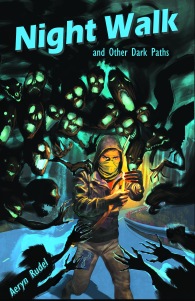
In case you missed it or don’t follow me on social media, The Molotov Cocktail is publishing my first collection of flash fiction this spring, titled Night Walk. Recently, Josh Goller, the publisher at The Molotov Cocktail, interviewed me about the collection, my take on flash fiction, my writing process, and a bunch of other writerly musings. You can read the interview by clicking this link or the cover for Night Walk below.

Goals
The big goal is to finish the revision of Late Risers this week. If I get a couple of submissions out too, great, but the book will be my focus.
And that was my week. How was yours?
A Week of Writing: 2/8/21 to 2/14/21
A little late, but here’s one more week of authorly activities.
Words to Write By
This week it’s one of my favorite Hemingway quotes.
“We are all apprentices in a craft where no one ever becomes a master.”
~ Ernest Hemingway
I don’t think there’s ever been a point in my writing career where I wasn’t keenly aware that I needed to get better and also striving to do just that. I believe in order to really get good at this whole writing thing, you have to embrace the fact that there’s no end point, no place where you can stop and say, okay, good enough. Yes, you may get to a point where you’re selling books and making a living and all those other dream scenarios, but I think that constant drive to improve, to make the next story or book just a little bit better is what makes for a “good” writer. I am still very much a work in progress, an apprentice in every sense of the word, and as Hemingway says, I will likely never become a master. That’s fine. Right now I’m setting my sights on accomplished journeyman. 🙂
The Novel
Made very good progress on the final revision of Late Risers last week, and I’m just about halfway through. A lot of what I’m doing is just tightening things up, but my critique partners suggested a few revisions that are more involved. Almost all of them are focused on improving the pacing in the middle of the novel, where the book gets bogged down with conversation and planning. A fair bit of that can be condensed, and I’ve already removed one entire chapter to speed thing sup. When I started revision, the book was at about 105,000 words. I think it’s gonna end up around 95,000, maybe a tad less when it’s all said and done. Anyway, getting there, and I think I’ll have a novel that’s ready to shop around by early March.
Short Story Submissions
Pretty slow week submission-wise.
- Submissions Sent: 1
- Rejections: 1
- Acceptances: 0
- Publications: 0
- Shortlist: 0
- Pending: 7
Just one submission last week along with one rejection. In other words, not much going on. I’m sitting on fourteen submissions for the year, which still puts me on track for my goal of one-hundred subs. I need to get a few more out this month, but that shouldn’t be difficult. I’m still hunting for that first acceptance of 2021, and I hope it’ll come this month. If not, I just have to keep writing, keep submitting, and cross my fingers.
Night Walk
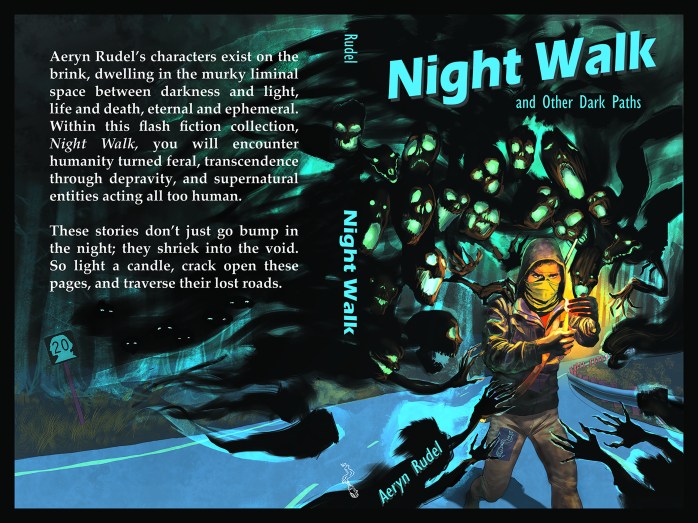
If you haven’t heard, The Molotov Cocktail is publishing my first collection of flash fiction this spring. The collection, titled Night Walk and Other Dark Paths, contains forty pieces of my best flash fiction. We were lucky enough to get artist Valerie Herron to create an original piece for the cover, which you can check out below. More details on how the collection came together, plus interviews, and other sneak peeks are on the way.
Goals
Keep plowing ahead on the revision of Late Risers and keep writing and submitting short stories. You know, the usual?
And that was my week. How was yours?
First Draft vs. Revision: One Plotter’s Preference
Writing a novel is a process of many individual steps, but all those steps generally fall under two very broad stages: drafting and revising. Just about every author I know prefers one or the other, and I thought I’d share a little about my preference and the challenges I face with the other side.
Well, I prefer drafting by a fucking mile. Like, it’s not even close. I’d rather write the first draft of ten novels than revise one. But why is that? Let me see if I can explain. It’s important to note that everything I’m about to say is how drafting and revising are for ME. It’s different for other writers, but some of you might relate to my challenges and maybe get some ideas from my solutions. Okay, let’s dive in.
Drafting is awesome because . . .
- Clear goals. When I’m writing a first draft, I start with a detailed outline, and I know where the story is going. I know how it begins, I know what happens in the middle, and I know how it ends. Sure, things might change a little in the writing, but generally the overall plan doesn’t change that much. Having that well-defined goal leads to my next point.
- Momentum. I write at least 2,000 words per day when I’m drafting, and I track it all in a spreadsheet. I can see the novel taking shape as the words pile up, and it motivates me. I target 90,000 words for a novel, so I KNOW when I hit 30,000, I’m a third of the way there. When I hit 45,000, I’m halfway done. Those little benchmarks are the wind in my sails, and they really drive me on.
- Fix it in post. For some reason, when I’m writing a first draft, I can shove all the self-doubt and fear to the back of my mind with one simple phrase. Fix it in post. Yep, I essentially tell myself, don’t look back, keep going, finish the draft, and anything that’s wrong you can fix in revision. Yeah, you see the problem too, huh? 🙂 Anyway, that mantra or philosophy allows me to crank out a 90,000-word novel in a two or three months.
Revision sucks because . . .
- Where am I going? When I start revising, I always have this aimless feeling of not knowing where to begin. Now, of course, I have notes from my critique readers ,and I’m generally pretty certain on what needs to be fixed. For some reason, it’s harder for me to just start at the beginning and work through the revision. I always feel like I need to jump around, which only enhances that lost feeling.
- I’m gonna fuck it up. The other thing that plagues me during revision is this unshakable dread that I’m gonna make the draft much, much worse. Even if I fix glaring issues, I feel like the novel is still gonna end up being worse off for the changes. This is nonsense, of course; the novel is almost always better in revision (most novels are). Still, the feeling remains, and I think one of the main culprits is the exact thing that helps me write first drafts.
- Fix it in post. Let’s look closer at this phrase and what it is I’m actually doing. Essentially, I’m taking all that self-doubt and fear and pushing it ahead to the future. It’s like I’m buying the first draft on credit, and at some point, the bill is gonna come due. So what I’ve done is turn the revision into a place where problems and doubt live, which makes the whole process more difficult. Maybe it’s a necessary trade-off, but is there a way to make revision easier for me? I think there is.
Revisions Revised
How can I turn the revision process into a more positive experience? How can I take it from something that is a painful (though necessary) chore to something I might actually derive satisfaction from? I have some ideas.
- Outline it. One of the primary reasons I do so well with first drafts is that I am a dedicated plotter, and I feel like revision is this grand act of pantsing. But does it have to be? If I plot out the revisions on a spreadsheet the way I do my outlines and word count goals, I could see that clear ending and beginning and how to get there. That might alleviate some of that aimless feeling.
- Fix it in post (mostly). Though I do believe this philosophy helps me get first drafts done, and I don’t want to mess with that, sometimes I’ll write a scene that needs work. I’ll know that when I finish it, and I might even leave myself a note on how to fix it when I start revisions. I think I could probably take some of the pressure off myself if I occasionally just went ahead and fixed the scene or chapter right away. One less problem to solve in revision is gonna make the process easier.
I have actually started to institute the first solution, and on my next novel, I’m going to try the second. I don’t think I’m ever going to love revision, but these two fixes might make the process more tolerable and therefore faster.
To close this out, I’ll ask a question I’ve been thinking about for awhile. As I mentioned, I’m a plotter. I outline everything, and it helps keep me on track. Revision feels like pantsing, which is a wholly unnatural state for me, and it creates quite a bit of anxiety. So, in general, do plotters have more trouble with revisions while pantsers struggle with first drafts? I honestly don’t know, but I’d love to hear your thoughts on the subject in the comments.
Weeks of Writing: 1/25/21 to 2/7/21
Missed a week, but I’m back with a double dose of writerly doings.
Words to Write By
This week’s quote comes from author Joyce Carol Oates.
“The first sentence can’t be written until the final sentence is written.”
—Joyce Carol Oates
I think I may have used this quote before, but it’s still a good one, and recently I’ve found it to be an absolute truism in my work. Now, sure, when I start writing a novel or story there IS a first sentence, but I’ve found nothing is more likely to change in subsequent drafts than the beginning. Be it a novel or a microfiction I dashed off in five minutes, the beginning almost always needs work. I think a lot of that is because the act of writing is an act of discovery. No matter how thorough my outline, no matter how much I think I know about the story, by the time I get to the end, I’ve learned all kinds of new things about the plot, the characters, the theme, you name it. So, when I go back and look at that first chapter or first paragraph or whatever, invariably where I started is not where I ended up.
The Novel(s)
Well, as I hinted at a few weeks ago, a certain situation that was hurting my productivity on my novels is now resolved, and I’m moving full steam ahead on revisions. I’m going over the notes from my critique partners, and I’ve started revising Late Risers with a goal of a final draft by the end of the month. The next revision of Hell to Play will begin after that. I’m feeling pretty positive about both books, and I’m already thinking about my next big project
Short Story Submissions
I’ve been fairly active with submission over the last couple of weeks.
- Submissions Sent: 4
- Rejections: 8
- Acceptances: 0
- Publications: 0
- Shortlist: 0
- Pending: 7
Four more submission gives me a total of thirteen for the year, though I did send a fourteenth this morning. My submission pace is right on target for one hundred submissions for the year. I am still hunting for that first acceptance of 2021, however, and, well, the rejections are rolling in. This kind of thing happens, and I’ve had much longer rejections streaks than the oh-for-thirteen I’m currently on. It’s certainly not time to panic, but if I don’t have at least one acceptance by the end of the month, THEN I’ll panic. 🙂
Night Walk
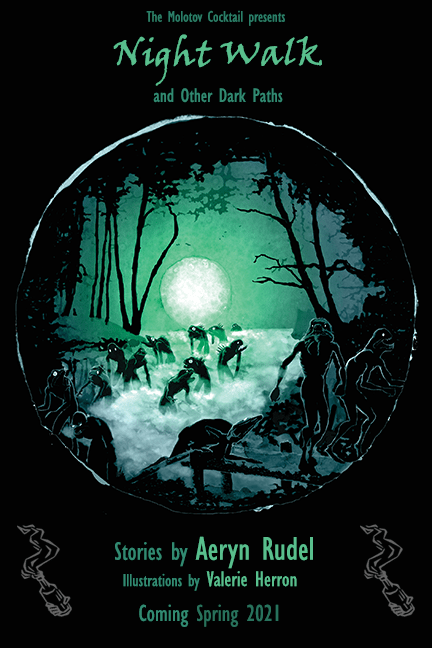
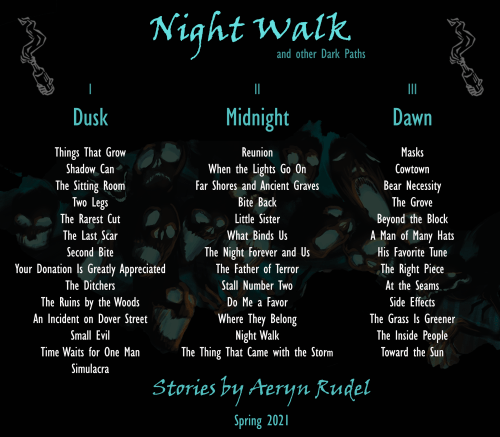
If you follow me on social media, you likely saw the announcement that The Molotov Cocktail is publishing a collection of my flash fiction titled Night Walk and other Dark Paths. Needless to say, I’m pretty damn excited about it. The collection will release in the spring of this year, but until then, there’ll be all kinds of previews here on social media, including interviews, a sample story, and some sneak peeks at the gorgeous cover and interior art by artist Valerie Herron. In the meantime, here’s the official announcement (with some of that aforementioned gorgeous art) and a peek at the table of contents.
Goals
As usual, my focus is on getting more submissions out, continuing to revise the novel(s), and, now, promoting my upcoming flash fiction anthology. 🙂
And that was my week. How was yours?
Withdrawing a Withdrawal: A Submission Saga

I often encounter a general sense among authors that magazine editors are waiting to pounce on them if they make a mistake or need to ask for an appropriate allowance in the submission process. The belief is that an error or request will result in a scathing rebuke and maybe even inclusion on the dreaded “do not publish” list. In my experience, this simply isn’t true. The editors I’ve had the pleasure of communicating and working with have been polite, professional, and understanding. Most of them are or have been writers too, and are quite familiar with the rigors of the submission process from the author’s side of the fence.
Let me see if I can illustrate how accommodating an editor can be with a little tale and timeline of a story submission I made back in 2015. This timeline will also give you a good idea of when and how I send submission status queries and withdrawal letters.
Just a quick note, I have removed parts of the publisher responses below because they contain unimportant details or they might help identify the publisher. The latter isn’t too much of a concern since, sadly, the publisher folded some time ago, but that’s how I do things on the blog.
It Begins – 6/20/2015
Over five years ago, I had a little horror flash piece I was quite proud of, so I took a chance and fired it off to a pro markets dealing specifically with horror flash fiction. Here’s my cover letter.
Dear Fiction Editors,
Please consider my short story [Story Title] for publication at [publication]. The story is approximately 1,000 words in length.
Bio: I currently work as the acquisitions editor for Skull Island eXpeditions, a fiction imprint of Privateer Press, Inc. My short fiction has recently been published by Allegory, Devilfish Review, and The Molotov Cocktail.
Thank you for your time.
Sincerely,
Aeryn Rudel
What you see here is an ancient version of my cover letter. The one I use now is pretty much the same, and the only real change is the bio ( I’d actually left Privateer Press on June 1st of this year, but I’d forgotten to update my bio). Since this was a Submittable submission I received the following acknowledgement the same day.
Dear Aeryn,
Thank you for sending your submission to [publisher].
You can review your submission online by going here: [Submittable link]
Thanks!
I settled in to wait, knowing it might be a while. I believe the market had a 120-day average response time.
The Long Wait – 12/21/2015
After six months had passed without any response, I sent a submission status query.
Dear Fiction Editors,
I am writing to inquire about the status of my short story [story title] submitted to [publisher] on 6/20/15.
Thank you,
Aeryn Rudel
Six months is plenty long to wait for a response, and there’s nothing wrong with firing off a status query if you’ve exceeded both the stated and the expected wait times (and the publisher guidelines do not prohibit it). So that’s what I did.
No Response & Withdrawal – 1/15/2016
I waited for a response to my query for over three weeks, and then I sent a withdrawal letter.
Dear Editors,
I have not received a response to my query sent 12/21/15 regarding the status of my submission [story title]. At this time, I would like to withdraw the story from consideration at [publisher].
Thank you,
Aeryn Rudel
At this point I’d ben waiting for seven months, well beyond the response time for the market, so I just chalked this up to a) the submission was lost through a glitch in Submittable or b) the publisher had essentially issued a no-response rejection. I figured it was the former because I’d received a rejection from this publisher before. Little did I know there was a third option.
I should note I do not use this withdrawal letter any longer. The template I use now is better worded, I think. Looking back, this one feels too confrontational, which is not my intention.
An Unexpected Response – 1/22/2016
Exactly one week after my withdrawal letter, the publisher sent me this notification.
Hello!
Just a quick update to let you know that your story has made it to the final round of reviews for publication in [publisher] magazine and anthology series.
Thanks for your patience!
Whoops! As you can see, I was in kind of a pickle. To be clear, I don’t think I did anything wrong by sending a status query and withdrawal letter, but I really wanted my story to remain under consideration. What to do, huh?
The Un-Withdrawal Letter – 1/22/2016
On the same day the editor sent me the shortlist letter, I responded with the following email. I agonized over what to say, but, in the end, I figured I had nothing to lose by just being completely honest about the situation.
Dear Editors,
I recently withdrew this story after sending a status query letter. I have not submitted the story elsewhere, and in light of the recent note you sent regarding the story making it to the final round of reviews, I would, of course, like to keep it under consideration at [publisher]. However, since the story’s status is now withdrawn, I understand if that’s not possible.
Thank you for your consideration.
Aeryn Rudel
I would have completely understood if the publisher decided to let my story go. I did withdraw it after all, and I was essentially asking him to do more work on my behalf.
A Second Chance – 1/22/2016
Thankfully, the editor did not leave me hanging after sending my un-withdrawal letter and responded with the following short email.
Aeryn,
Ok, I’ve added it back into the final round of reviews. Thanks!
Whew! It was quite magnanimous (and much appreciated) for the editor to put my story back on the shortlist. Maybe he did it because he liked the story that much, or maybe, like most editors, he’s just an understanding human being. Either way, I was more than a little relieved.
A Happy Ending – 4/1/2016
A few months after the editor put my story back on the shortlist, I received this letter.
Thanks for sending [story title] to [publisher]. I have finished my review and have decided to accept it and offer you a contract. Please look for a contract to be issued through Docusign shortly.
If you have any questions, please let me know.
Thanks again.
Needless to say, this was not the response I expected after withdrawing my withdrawal. I was quite pleased for the acceptance and that my persistence paid off.
The takeaway to my little tale is that polite, professional, and appropriate communication with an editor should never hurt your chances at future publication. So if you make a mistake or need to ask an editor to make an allowance for you, like I did, be honest and transparent and things will more than likely work out.
Submission Statement: January 2021

The first month of the new year is in the books. Here are all my submissions, rejections, and other writerly doings for January 2021
January 2021 Report Card
- Submissions Sent: 11
- Rejections: 7
- Acceptances: 0
- Publications: 1
- Further Consideration: 0
January was a good month for submissions, and eleven gets me off to a great start toward my goal of one-hundred for the year. The bad news is I got skunked, acceptance-wise, for the first time in twelve months. Yep, my acceptance streak is over. I think a combination of some slower responses and a dearth of new material contributed to me taking the L last month. Of course, the usual reasons also apply. Things like editorial taste and bad timing are ever-present. Hopefully, February will be better, though I still need to write more new material if I really want to get back on track.
Rejections
Seven rejections this month.
- Standard Form Rejections: 4
- Upper-Tier Form Rejections: 1
- Personal Rejections: 2
I actually thought I received fewer rejections in January, but, uh, nope. Seven isn’t a ton, but it’s more than I’d like without an acceptance to dull the pain. 🙂 Anyway, most of these rejections were standard form NOs, though I did get a couple of personal rejections. One of them was quite informative, as the editor let me know the rejection was largely a matter of taste (the story was a little too pessimistic for them). That’s incredibly useful information, as it lets me dial in future submissions to the same market. In fact, I’ve already sent them another story that’s more positive and uplifting in tone. We’ll see if it fares better.
Publications
I did have one publication in January. My story “The Night, Forever, and Us” was published at Love Letters to Poe. They’re a publisher of gothic horror, and though it’s not a subgenre I write in much, I did manage one a few years ago that fit the bill. You can read that story by clicking the link below.
Read “The Night, Forever, and Us”
And that was my January. How was your month?
Taking All the Credits: 15 Years of Writing
I’m currently in the process of putting together an author’s CV, something I’ve been meaning to do for a while, and it’s been fun to stroll down memory lane and to see what I’ve written and published over the last fifteen years. I presented a broad overview of my writing credits last year on the blog, but since I have to do it anyway for the CV, I thought I’d break down those credits in more detail so you can see what I’ve been up to in the last decade and a half. Plus, I’ve added a few since then. 😉
Long Form Fiction – 14
- Novels. 7
- Novellas: 2
- Novelettes: 5
All of my long form fiction is media-tie in, that is to say stories you’re contracted to write in someone else’s IP. In this case, the majority of these novels and such are set in the Iron Kingdoms, the principal setting for Privateer Press. I should also note than one of the novels and one of the novellas was co-written with my then colleague William Shick. This only comprises the works I’ve actually published. I’ve written three more novels, two of which I’m in the process of revising. So, hopefully, that novel total will increase in the near(ish) future.
Short Fiction – 118
- Microfiction: 4
- Flash Fiction: 50
- Short Stories: 50
- Other: 14
The categories above are self-explanatory, except for other. That category comprises two things. One, narrative fiction that isn’t really a complete story. For example, it might be narrative vignette introductions to gaming text or the times where I wrote one section of a longer narrative. The second type of fiction that falls into the other category includes odd ducks like the parody articles I wrote in support of Privateer Press’ alien invasion game LEVEL 7. They’re not really short stories, but they’re not really articles or gaming material either.
I should point out that this is the number of credits, not individual pieces. So reprint credits for the same stories are included in this total. There aren’t a ton of those, though, about half a dozen or so. The other big separation is gaming or media tie-in fiction versus fiction entirely of my own creation. There we have 47 gaming-related pieces (mostly short stories and the works in the other category) and 71 shorts, flashes, and micros all my own.
Tabletop Gaming and Other – 163
- Adventures: 16
- Setting Material: 46
- Rules Material: 96
- Other: 5
The first two-thirds of my writing career was focused on the tabletop gaming industry, and more than half my writing credits are derived from tabletop roleplaying and miniature games. Generally, those credits fall into three broad categories. Adventures, sometimes called modules, are pre-packaged stories, complete with monsters, villains, and other challenges, that a group of RPG players can play through. Setting material is articles and other short pieces that expand the fantasy world where an RPG or miniature game takes place. These read kind of like encyclopedia entries or history articles on, uh, things that don’t exist and never happened. They occasionally blur the line between fiction and nonfiction, but not enough that I’d include them in my fiction credits. Rules material are articles and supplements that focus on the nuts and bolts mechanics of a game: skills, spells, monsters, character classes, and so on. The “other” here is simply my recent Rejectomancy articles over at Dark Matter Magazine. (I wasn’t sure where else to put them.)
Most of this gaming material was written for two systems: Dungeons & Dragons and The Iron Kingdoms. There’s more nuance to those two categories, and those familiar with gaming will quickly see that nuance in my actual credits. For most readers, though, this is all the nuance that’s required, I think. 🙂 I should also note that about a dozen of these credits were co-authored with various folks I worked with over the years (co-authors are listed in the actual credits on my credits page).
Well, there you have it, 295 writing credits over fifteen years. Interestingly, a large portion of my fiction writing credits, like sixty percent of them (more if you go by actual words written), have come in the last five years or so. Of course, this post does not include any of my non-writing stuff, and I have another hundred-plus editing, developing, and production credits spread out pretty evenly over the years. If you want a more thorough picture of my writing credits and some actual examples, check out the credits page on this blog. Or if you don’t want to wade through sixteen years of credits and just want to see what I’ve been up to lately (and maybe read something), head on over to the publications page.
It’s nice to look back on all this work, and see how I’ve grown as a writer and how my career has switched tracks (a couple times). Of course, I’m now solely focused on fiction (though a particularly juicy gaming commission could possibly lure me back), and I hope to continue to add to my long and short fiction credits over the next fifteen years and beyond. 🙂
A Week of Writing: 1/18/21 to 1/24/21
Another week of writing come and gone. Have a look.
Words to Write By
This week’s quote comes from author Jane Yolen.
“Exercise the writing muscle every day, even if it is only a letter, notes, a title list, a character sketch, a journal entry. Writers are like dancers, like athletes. Without that exercise, the muscles seize up.”
–Jane Yolen
One of the pieces of advice you’re bound to hear when you’re a writer is that you must write as often as possible, every day if you can. Now, I have some opinions on the efficacy of the every day thing, but what I like about Jane Yolen’s quote here is that she doesn’t demand narrative writing to stay in shape, just any writing. I think this is a useful bit of advice, and it’s worked well for me. On days where I’m really feeling stuck, but I want to at least get the ol’ writing muscles limbered up, I’ll work on an outline, write a blog post, even the occasional journal entry. Generally, that’s enough to get the creative energies flowing in the right direction, and often as not, I’m am able to produce some narrative fiction in the same day.
The Novel(s)
Not much work on either novel last week. I have a good reason for this . . . Okay, I have A reason for this. Whether it’s good or not is open to interpretation. I can say that what is currently holding me back should be resolved this week, and I’ll be able to get on with things.
Short Story Submissions
Pretty decent submission total last week.
- Submissions Sent: 3
- Rejections: 1
- Acceptances: 0
- Publications: 0
- Shortlist: 0
- Pending: 10
Three submission last week gives me eight for the month, and the one I sent this morning gives me nine. That’s my quota met for January, though I’m likely gonna get a few more submission out before the 31st. Only one rejection last week, and it was same-day. I keep expecting a pile of others to show up, but nothing so far. It’s looking more and more like I’m going to end January without an acceptance, which will break my twelve-month streak. Such is the gig, and I’m sure February will catch me up. 🙂
Super Secret Project
The announcement is coming very soon now. So excited to share this one with you folks.
Goals
Still keeping it simple: write, submit, revise.
And that was my week. How was yours?
A Week of Writing: 1/11/21 to 1/17/21
Another week of writing in the books. Have a look.
Words to Write By
This week, we’re going back a couple hundred years for a great quote from Jane Austen.
“I am not at all in a humor for writing; I must write on until I am.”
— Jane Austen
My take on this quote is that it’s essentially how to deal with writers block, or more specifically how I deal with it. For me, writer’s block generally manifests in an inability to get started. I sit down at my computer filled with fear and apprehension that I won’t be able to write or what I do write won’t be any good. Not the greatest way to get into a creative headspace. So I do what Jane Austen did: I write through it. It’s not foolproof, but it has allowed me to finish half a dozen novels and hundreds of short stories and flash. What usually happens is the first couple of paragraphs are garbage because I’m forcing the words, and then something will click, usually on the turn of a good sentence or bit of dialogue. Then the words come faster and better, and I can usually hit my word count goal and achieve something good or at least something with potential. So when you’re not in a humor for writing, try to remember what Jane Austen said and keep going.
The Novel
I worked a bit on the revision of Late Risers last week, though I wouldn’t say I made much progress. Part of the problem is I got distracted with another novel that’s about a third of the way done. It’s one I started writing in 2017 and then put on the back burner. That book easily has the best concept of just about anything I’ve written, but the amount of research required to finish it is, well, daunting. So I stopped at about 33,000 words and wrote two other novels instead. I will return to it–I think it’s actually pretty good–but for the moment, I shouldn’t let it distract me from the task at hand. It’s just testament to how much I hate revising, and that I’ll do just about anything, up to an including writing another novel, to avoid it. 🙂
Short Story Submissions
Little bit slow in submission land last week.
- Submissions Sent: 1
- Rejections: 0
- Acceptances: 0
- Publications: 0
- Shortlist: 0
- Pending: 7
Well, only one submission went out last week. That’s not great, but it does give me five for the month, and I only need four more to hit my quota for January. I just finished a new piece that’ll go out today, so there’s one, and I’m waiting for a couple of markets to open so I can send a few more. I do need to finish/revise more pieces so I’ll have some submission fodder. No rejections last week, though some of the pending subs are getting a little crusty, so I suspect some rejections will arrive soon.
Super Secret Project
More progress was made on this project, and I am definitely getting excited about it. Shouldn’t be long before I can talk about it . . . and then talk about it constantly. 🙂
Goals
Let’s keep it simple: write, submit, revise.
And that was my week. How was yours?
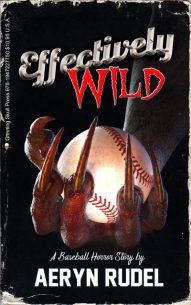
Effectively Wild – A Baseball Horror Story
Night Walk & Other Dark Paths
Acts of War: Flashpoint

Acts of War: Aftershock

Acts of War: Stormbreak


