
2015: A Rearview Review

Well, it’s a new year, a blank slate of dreams and possibilities, so instead of focusing on the future and what it might bring, let’s wallow in the past. Yep, it’s one of those year-end review/summary type things we bloggers just love to do. So here’s a look back at my writing in the year of our lord 2015.
This post with be filled with stats because they are super-duper exciting.
Horror/Sci-Fi Submissions
Total Submissions Sent: 46*
Honestly, this is fewer than I’d hoped, and a lot of this has to do with my position at Privateer Press, which I left in June. It kept me pretty busy, and I had a grand total of five (5) submissions from January to June. Things picked up a lot when I abandoned a good, steady-paying job with benefits to hang my hopes and dreams on the sure-fire, cannot-possibly-miss, super-good-decision of becoming a fulltime freelance writer. Anyway, I sent another 41 submissions from June to December, averaging almost seven (7) a month.
Acceptances: 5
Not too shabby since it’s really just the second half of the year we’re talking about. This is good for a 13% acceptance ratio, which is okay, but it could certainly improve. Some of the stuff I published this year is available to read online, right here:
- “Night Walk” – Published by The Molotov Cocktail
- “Side Effects” – Published by The Molotov Cocktail
- “The Rarest Cut” – Published by Evil Girlfriend Media
- “Beyond the Block” – Published by The Molotov Cocktail
Form Rejections: 23
Yeah, bunch of these things. Form rejections made up 56% of my total responses from publishers. Seems about right to me, but I’m sure there are writers who have gotten more than I have or a hell of a lot less.
Personal Rejections: 11
A fair number of these, and 27% of editors who didn’t actually publish my work had something (usually positive) to say about my writing. Personal rejections accounted for about 40% of my total rejections.
Never Responded/Withdrawn: 2
Just a couple of these, and one of them was my own damn fault. I sent a story to a publisher they’d already rejected like a giant fucking tool-bag. I fired off a very apologetic—i.e., I’m-a-dumbass—withdrawal letter soon after.
*I still have five submission pending, so percentages are based on the submissions that have received a response.
Privateer Press
As some of you know, I write a fair amount of material for Privateer Press, and that stuff is not included in the stats above. So, what did I do for the fine folks at Privateer? Hey, look, more stats!
Novels: 1.5
Privateer has commissioned me to write a series of novels set in their Iron Kingdoms universe. I’ve finished one, and I’m working on the second. The first book is slated for publication in the third quarter of 2016.
Novellas: 1
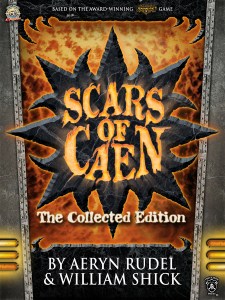
I wrote a long novella or a short novel with former coworker and talented writer William Shick. It’s called Scars of Caen, and hey, look at that–a link to Amazon where you can check it out.
Short Stories: 6
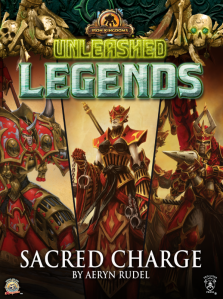
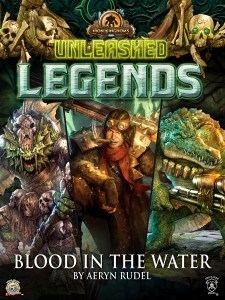
A wrote a total of six short stories for Privateer Press, ranging in length from 1,500-word flash pieces to 10,000-word novelettes. You can check out some of these via Amazon right here. The others appeared in the magazine No Quarter or will do so in the near future.

Articles: 4
In addition to short stories, I penned a number of articles for the Iron Kingdoms universe and its two primary games WARMACHINE and HORDES. These also appeared in the Privateer Press magazine No Quarter.
Rejectomancy
And lastly but no leastly, we have this here blog. It’s been a lot of fun to do, and it’s provided me an outlet for my opinions and my personal writerly woes. The response to the blog and the nonsense I write on it has been really positive, and I’m thrilled so many folks find my blathering useful or entertaining. Anyway, continuing our theme of stats and more stats . . . here are some more stats.
Total Posts: 75
Total Visitors: 4,015
Total Likes: 514
Total Comments: 252
I’m pretty satisfied with those numbers for my first six months, and I think I’ve found a groove for how often I should post. Those 75 posts and other bits and bobs total about 75,000 words of material, which is a fair amount, I think, and I’ll likely exceed that handily in 2016.
Summary
Okay, broad view, and, yes, more stats. Here’s what my total output for 2015 looked like in hard numbers. I’m only counting stuff I wrote that was either published or is slated for publication. I certainly started a lot of projects last year that I hope to finish this year, but that’s too many disparate bits to pull together
Words Written: 290,000
Articles/Stories/Novels Published: 16
2016 Goals
So, goals for next year. I’d like to double the number of horror/sci-fi submissions and shoot for an even 100. I’d like to increase my acceptance ration to 15%, which of course translates to 15 acceptances. One way I’d like to increase my submission rate is to complete at least one new story per month. I have ten or so in various states of completion, so this feels pretty reasonable.
I’m slated to write/finish three novels for Privateer Press in 2016, but if I can, I’d like to write a fourth novel for my agent to shop around. I’ve got some ideas for this book, but it’s another 90,000 words or so added to an already packed schedule. Might be tough, but it’s a goal worth shooting for.
As for the blog, I’d like to keep my pace of two to three substantive posts per week. That said, I have at least two novels coming out next year, so I’d like to use the blog to promote them. Don’t worry; I’m not going to turn the blog into a giant marketing platform, and the biggest change you’re likely to see is one additional post per week pimping out my latest book, story, or whatever. You can certainly ignore those posts, or, if you’re so inclined, click a link once in a while and behold the fruits of my labors.
Well, that’s my 2015 wrap-up post with too many numbers, self-aggrandizing drivel, and obvious excuses for failures and shortcomings.
How was your 2015? I’d love to hear about it in the comments.
Word Count Goals of the Rich & Famous
Here’s a nifty little article I found on a blog called Writers Write that details the writing habits, and more specifically, the word count goals of 39 famous authors. The article is called The Daily Word Counts of 39 Famous Authors, and it features big names like Stephen King, Anne Rice, and Mark Twain. It’s an interesting read, and I’m always fascinated by the routines of well-known authors, since it can vary a whole lot.
Go read the article, and if you dig it, throw the author a like or a Facebook or Twitter share. In the meantime, here are some things I took away from it:
- There’s no such thing as a “normal” routine for a professional writer. It’s a very specific, individual affair, and one man’s normal is another’s bat-shit crazy. (Yeah, I’m lookin’ at you R. F. Delderfield and your 10,000 words a day.)
- So, of course, I took an average of the word counts in the article. Throwing out the outliers, we get a rough average of 1,800 words per day. That’s lower than I would have guessed before reading the article, but it’s solid output, especially if you’re writing fulltime, five days a week. That’d be 9,000 words a week, 36,000 words a month, and a fairly staggering 468,000 words per year. Yeah, I know, most folks don’t write everyday, but even at half that number, you’re finishing two full-length novels or a metric fuck ton of short stories.
- You don’t have to write thousands of words per day to be successful. Yep, Ernest Hemingway wrote 500 words a day; that’s it. I think the key is consistency, and 500 words a day add up fast, especially if those words are as good as Mr. Hemingway’s.
To put my own spin on it, my goal is a minimum of 2,000 words a day, same as one of my favorite writers, Stephen King. Since I started doing this full time in June, I’ve been pretty consistent, enough to finish one novel, a good portion of a second, and a bunch of short stories and articles.
Do you have a daily word count goal? If so, which writer’s routine from the article does yours most resemble?
December 2015 Rejection Roundup

Let’s bring 2015 to a close Rejectomancy style with a summary of all the rejection letters I received in December. I know December isn’t quite over, but with the holidays, I’ve likely gotten all the responses I’m gonna get.
Like last month, December wasn’t all bad news, and I did get one story accepted. We’ll get to that, but first I’ll let you all indulge in a little schadenfreude.
Rejection 1: 12/5/15
Thank you for submitting your story, “XXX”, to XXX. Unfortunately, we have decided not to publish it. To date, we have reviewed many strong stories that we did not take. Either the fit was wrong or we’d just taken tales with a similar theme or any of a half dozen other reasons. Best success selling this story elsewhere.
Man, I’ve seen this letter a lot. This is from a pro-paying market I’ve been trying to crack for a long time, and this is their standard common form rejection. If you read my post Five Flavors of Form Rejection, then you know there’s only one thing to focus on in this polite, professional rejection letter. If you need a hint, I’ve highlighted the important part.
Moving on.
Rejection 2: 12/11/15
Thank you for sending “XXX” to XXX. While we appreciate the opportunity to review your work, we will have to pass on this submission. The story was well done, but not quite right for us.
We hope you find a good home for this story. Thanks for the read, and best of luck with your writing.
This is technically a personal rejection, I think. The line, “The story was well done . . .,” makes it feel like a personal rejection, but since this is the first time I’ve submitted to and been rejected by this publication, I’m not one-hundred percent sure. I’ll need to get rejected again to know for certain. I think my submission targeting was a little off here, but it’s hard to tell for certain because the magazine is putting together its first issue, so there were no example stories to refer to. I’m usually wary of fledgling publications, but this one is paying pro rates, which is rare, and, I gotta admit, really enticing. I’ll definitely send this publication something else.
Next rejection.
Rejection 3: 12/19/15
Thank you for sending us “Story X”. Unfortunately, this piece is not for us. We wish you the best of luck finding a home for it.
If you have other work which you feel we may be interested in, please do not hesitate to submit it to us.
This was yet another rejection for “Story X,” which I covered in detail in this post.
***
Okay, I’ve choked down all my vegetables, let’s have some motherfuckin’ dessert!
Acceptance: 12/22/15
We’re very happy to say we’d like to accept “XXX” to run at XXX! I very much enjoyed it – which I’ll admit kind of surprised me because sports and horror rarely mix well – but I think you made a very smart writing choice by focusing the piece on the moment of truth and tight suspense writing.
You can expect the contract in a separate email from our Contracts Administrator (usually within 2-4 weeks).
I’m always thrilled with an acceptance, but I’m particularly stoked about this one because it’s a pro sale. Technically, this is a reprint acceptance, and those familiar with my work can probably figure out which story this letter references. (Keep it to yourself for the moment, though.) The difference here is the format; this publication is an audio magazine, so my story will get the audiobook treatment. Cool, huh?
The editor says some nice things, and it’s always cool to hear that your story surprised a reader, in a good way. Then, like most acceptance letters I’ve received, this one has a few business details to get out of the way. The contract is the big part, but they also had me fill out a questionnaire about me, the story, and a few other details specific to the audio format.
Of course, when the story is published, I’ll let you know, and point you to the site to give it a listen.
***
That’s it for my December. How was yours?
Real-Time Rejection: The 7th Rejection of “Story X”

Well, damn, I thought sevens were supposed to be lucky. Yep, “Story X” has received its seventh rejection, and it looks a little something like this.
Thank you for sending us “Story X”. Unfortunately, this piece is not for us. We wish you the best of luck finding a home for it.
If you have other work which you feel we may be interested in, please do not hesitate to submit it to us.
This is one of those common form rejections that kind of feels like an improved form rejection, but I don’t think it is. Remember, my criteria for an improved form rejection is a request to send more work. The last line of this letter kind of looks like that, but if you read closely, there really isn’t a request in there. I’ve seen this slightly ambiguous phrasing on a number of rejection letters, and I believe it’s just another of the myriad ways editors employ to soften the blow of rejection.
Well, folks, we’re getting down to the nitty-gritty. “Story X” has three more shots at publication before I hang it up and post the story on the blog. I’ve identified the last three publication I’m going to submit to, and one of them has published me before, so there’s hope yet.
Got a rejection you’d like to share with the class? Put it in the comments, and we’ll overanalyze it together.
Previous Real-Time Rejection Posts
Intro: Real-Time Rejection: The Journey of “Story X”
Part 1: Real-Time Rejection: The 1st Rejection of “Story X”
Part 2: Real-Time Rejection: The 2nd Rejection of “Story X”
Part 3: Real-Time Rejection: The 3rd Rejection of “Story X”
Part 4: Real-Time Rejection: The 4th Rejection of “Story X”
Iron Kingdoms Fiction and Free Stories
The good folks at Privateer Press have given me permission to post a novelette I wrote for them back in 2012 on this here blog. It’s called “Tomb of the Deathless,” and it’s set in the Iron Kingdoms universe, a setting that is described thusly: It is a land like no other, a place where steam power and gunpowder meet sword and sorcery. If you’re into steampunk and sprawling worlds with tons of awesome backstory and history, then I urge you to have a look at the Iron Kingdoms.
Anyway, this particular story is a fantasy/horror mash-up featuring some existing characters from the Iron Kingdoms setting and a few of my own creation. It was written to support the 2012 organized play league for the tabletop miniature games WARMACHINE and HORDES, which, by the way, is an excellent way to check out Iron Kingdoms’ fiction.
In fact, the current league season, Path of Devastation, just wrapped up, and the complete accompanying fiction is available on the Privateer Press site. It features two of Privateer Press’ very talented writers . . . and also me! Here are some links to each chapter (these links will open a PDF).
Chapter 1 – “Misdeeds” by William Shick
Chapter 2 – “Test of Restraint” by Aeryn Rudel
Five Flavors of Form Rejection

Form rejection letters come in many different shapes and sizes, and it can be easy to read a lot into these boilerplate missives, largely because there is such a wide variety. In my experience, though, whether a form rejection is short and to-the-point or wordy and apologetic, they only communicate one thing of importance. To show you what I’m talking about, let’s look at five examples from my own personal collection.
Thanks for submitting “XXX,” but I’m going to pass on it. It didn’t quite work for me, I’m afraid. Best of luck to you placing this one elsewhere, and thanks again for sending it my way.
This a good example of the short and direct form rejection. It’s polite, professional, and tears the Band-Aid off quick. Now, you might get hung up on the phrase “It didn’t quite work for me,” and you might be tempted to read a lot into those six little words. Don’t. Remember, this is a form rejection, so it’s likely just the standard language this publisher uses in every single form rejection they send out. Plus, they don’t tell you why it didn’t work for them, so there’s nothing to be learned here. The only important part of this letter is highlighted in red.
Thank you for submitting your story, “XXX”, to XXX. Unfortunately, we have decided not to publish it. To date, we have reviewed many strong stories that we did not take. Either the fit was wrong or we’d just taken tales with a similar theme or any of a half-dozen other reasons.
This is a nice example of the longer, more apologetic form rejection. It’s easy to read into this one because it looks like they’re telling you why they didn’t accept the story. They’re not. They’re giving you reasons why they might not have taken the story, and there’s not much you can do with that. Again, this is a form rejection, the same letter they send out to hundreds of other folks. It’s not specific to you or your story. I’ve highlighted the only part of this letter you should focus on.
Thank you for showing us your fiction, but we’re going to pass on this particular submission. As writers, we know rejection can feel like a punch in the nose, but try not to be discouraged. This kind of decision is naturally arbitrary, and we’d be happy to see more of your work.
I gotta admit, this is one of my favorite form rejections because the publisher is really trying to be encouraging, and I appreciate that. Still, despite all the nice things in this letter, it doesn’t tell you why the story was rejected, so, like the two before it, there’s no sense dwelling on it. Again, I’ve highlighted the important part of this rejection letter. You might be seeing a trend by this point.
Thank you for your submission of “XXX” to XXX, but we’ve decided not to accept it for publication. Please forgive the form letter, but due to the high volume of submissions we can’t respond personally on each story. We appreciate your interest in XXX.
I like this letter because it tells you why you shouldn’t read much into form rejections. The publisher says, “…due to the high volume of submissions we can’t respond personally on each story.” The key word in there is personally. In other words, they don’t have time to tell you why they didn’t accept your story, if they hated it, if they liked it a lot but it wasn’t a good fit, if it almost made the cut, and so on and so on. This is the case with most form rejections, and it is the primary reason why you should not spend much time thinking about them. They don’t tell you anything concrete except for the highlighted bit.
Thank you for submitting “XXX” for consideration. I was glad to have the opportunity to read it. Unfortunately, the story isn’t quite what we’re looking for at this time.
Another short, polite, and apologetic letter. This one includes the phrase “…isn’t quite what we’re looking for at this time,” which is as common as dirt in form rejections. You might ask yourself, “Well, what are they looking for then?” The only sensible answer to this question is: not the story I sent them. If you’ve read the submission guidelines closely, read a sample story from the publication, and then based your own submission on that criteria, then, likely, all this phrase means is they’re not going to publish this story.
In summation, though form rejections come in hundreds of different flavors, they only say one important thing: they’re not going to publish your story. In my opinion, everything else, in almost all cases, is just fluff, a polite attempt to let you down easy. Again, you shouldn’t read anything into these canned niceties and synthetic bits of encouragement because they are not specific to you or your story. What you should do is file that rejection away after you read it, move on, and send that story somewhere else.
What are your thoughts on form rejections? I’d love to hear about them in the comments.
Baby’s First Rejection

A couple of days ago, I commented on a writer’s blog who had just received her first rejection. That first one is tough, and I wanted to offer a little sympathy and solidarity to this person. Of course, it got me thinking about my first rejection (on an unsolicited short story, anyway), so I immediately had to go and find it. I was forced to delve into the dark and forgotten vault of my now-defunct Hotmail account to unearth the beastly thing, but I found it, and here it is, coming at you from the dim, misty yesteryear of 2005.
Dear Mr. Rudel,
I’m going to decline “XXX” It’s not ready for publication.
1) You’ve used words incorrectly, and in redundance.
On the first page, Jacob is not “struggling to discern the distance.” He’s trying to estimate or gauge it. The result would not be a judgment, but an estimate or guess.
Stygian is capitalized. Refers to the River Styx. A monocular glow likely comes from a “single” headlight. Therefore, “single” is redundant.
“object” is vague…be more specific, in all instances in the story. Remember, the reader is going to fixate on this as the source of danger. He needs some details to hang onto.
“he might run afoul of” is unnecessary by implication.
2) The storyline is incomplete. Jacob flees Donna, reminisces of their relationship, is chased by a demon on PCP, and dies. There’s no story here. In a story, by definition, the protagonist changes in some way as a direct result of having experienced the events of the story…and this does not mean being consumed, unless the reason is clear, explicit, and serves a purpose.
In summary: do not overwrite your story. And adjust the storyline. Also, read more. There are lots of good horror short stories out there [we publish them in XXX, XXX, and XXX]. See what other writers are writing, and how they develop their stories.
Hope this helps.
At the time, over ten years ago, I was devastated. This was the first time I had sent a short story out for publication, and, you know, my friends said it was good, so my chances at publication had to be, like, what? Ninety percent? I remember reading this as a neophyte writer, as naïve about the craft and business of writing as you can possibly be, and feeling like someone had ripped my guts out, thrown them on the ground, and then danced a spiteful little jig on my poor, defenseless entrails.
I’ll admit, I let this rejection set me back, and it kept me from submitting my work for quite a while. That was stupid and immature because this is a good rejection. Sure, the editor pulled no punches with his comments, but he also didn’t send me a form letter. He took the time to break down what was wrong with my story, and that kind of feedback is invaluable to a new writer. By the way, pretty much everything he says is right on the money, and this story was absolutely, positively not ready for anything even resembling publication. I had a look at it again, and ten-plus years have not been kind to it. I think there’s a decent idea in there, but goddamn, it fucking screams amateur.
In the decade-plus since this rejection, I’ve put a lot of what’s in this letter into practice, and while I’ve gotten a lot more rejections over the years, I’ve also had some success, much of it owed to editors like this one, who took the time to tell me exactly what I was doing wrong.
Do you remember your first rejection? I’d love to hear about it in the comments.
November 2015 Rejection Roundup
November 2015 is in the rearview mirror, so it’s time to round up all the “we’re going to pass’s” and “not for us’s” for your viewing pleasure. This time, however, I’m gonna throw in some positive reinforcement and show you the other letters I received in November as well.
Rejections first, though. I mean, this blog isn’t called Acceptomancy, right?
Rejection 1: 11/13/15
Thank you very much for submitting “XXX” to us. It’s an interesting story, but it didn’t quite come together for us and we’ve decided to pass on it.
We appreciate your interest in XXX; thanks again for giving us the chance to look at your story.
What we have here is a fairly good example of a simple personal rejection. I’ve submitted to this publication (and its sister publications) a number of times, and I’ve gotten good feedback on a number of occasions. Obviously, this one didn’t hit the mark for them, and as vague as it might be, I think I actually know what they mean by “didn’t quite come together.” This particular story has received enough feedback of the “liked it, but . . .” nature that I’m going to give it a significant overhaul.
Rejection 2: 11/21/15
Dear Aeryn,
Thank you for submitting to XXX, and for your query regarding the status of “XXX.” We really liked this piece, and had been holding it for a while until we made a decision; ultimately, however, we decided it wasn’t a match for our needs at this time.
Thank you for your patience, and best wishes for future success!
Okay, this a nice personal rejection, and it looks like I got pretty close to an acceptance. That’s encouraging, but this rejection was 419 days in the making. I submitted this story almost sixteen months ago. As you can see, I also sent a query regarding the status of my story, and when I didn’t hear anything back, I assumed this was a no-response rejection and gave up on it. I’ve sent two stories to this publisher, this one and another that was rejected in a single day. That’s quite a gap. I’d love to have a story featured in this pro-paying market, but looking at their Duotrope profile, I now see that 419 days is about average on an acceptance (I should have checked this a while ago). They do accept sim-subs, which is nice, but, man, that’s a long time to wait.
Rejection 3: 11/25/15
Thank you for your submission, but this doesn’t quite catch my interest.
Short and to the point. This form rejection says all it needs to say in a single sentence. Some publishers appreciate brevity in rejection letters, and, honestly, so do I. Not much else to say about this one, so let’s move on.
Rejection 4: 11/30/15
Thank you for showing us your fiction, but we’re going to pass on this particular submission. As writers, we know rejection can feel like a punch in the nose, but try not to be discouraged. This kind of decision is naturally arbitrary, and we’d be happy to see more of your work.
The final November rejection is a form rejection for “Story X.” I cover that letter in detail in this post.
***
Okay, now let’s get to two other letters I received in November.
Acceptance: 11/7/15
Thank you for sending us “XXX”. We love it and would like to publish it in the next issue of XXX. Your contract is included in this email.
Please accept the contract by following the link at the bottom of this email and include your 100 word bio and mailing address, or PayPal email address if you’d prefer, in the Requested Information box. We’ll send an email with editorial suggestions two to three weeks before the issue publication date.
Thank you for your submission and we look forward to working with you!
November 7th was a good day because the dark clouds of rejection parted for the briefest moment, and a bright ray of hope and validation shown down upon my weary, chewed-up writer soul. Or something like that. Anyway, yeah, getting an acceptance letter is always awesome. So let’s take a look at it.
First, I want to point out that form letters are not just for rejections. Some publishers use them for acceptance letters too. I’ve published another story with this market, and I received this same acceptance letter for that story. Nothing wrong with that; there’s a lot of info a publisher needs to get across in an acceptance letter, and having a boilerplate version ready to go is just smart and efficient.
Like all acceptance letters, this one is asking for some basic things: sign the contract and send us a bio. They’re also letting me know to expect editorial suggestions, which I’m looking forward to. The editors at this publication had some great suggestions for the last story they published.
I signed the contract and sent them my bio the same day I received the acceptance letter. Do you have to do that stuff same day with an acceptance letter? Probably not, but I think you should do it within 48 hours unless there is a good reason you can’t, even then, it’s probably a good idea to send the publisher a quick thank you and let them know when you can sign the contract and whatnot.
Of course, when this story is published, I’ll announce it on the blog.
Further Consideration Letter: 11/22/15
Thank you very much for letting us read “XXX.” I enjoyed it, and have passed it up to the editors for review.
Thanks again, and best of luck!
Although not an acceptance, I was pretty happy to get this further consideration letter. It’s from a pro-paying market I’d very much like to crack, and I’ve been getting solid feedback from them with my last couple of submissions. This is the closest I’ve gotten, and, you know, finger’s crossed and all that.
Like many publications, it appears this one has tiers of editors, and this letter came from an associate editor. I don’t know where that is on the editorial food chain for this market, but I’m hoping there’s only one more hurdle to pass before rejection or publication. Hopefully, I’ll find out in December. Either way, the result will end up in that month’s rejection roundup.
Well, that’s it for my November. How was yours?
Ranks of the Rejected – Josh Goller (The Molotov Cocktail)
Today, we’re shaking things up a bit on Ranks of the Rejected. I recently spoke with Josh Goller, the editor-in-chief for the excellent flash fiction lit-zine The Molotov Cocktail. I asked Josh for the interview because he produces one of my favorite publications, and I really dig his approach to the editorial gig. My own association with The Molotov Cocktail began in July of 2014 when they accepted a quirky little story of mine called “At the Seams.” Since then, they’ve published four more of my flash stories, and I’ve placed in three of their quarterly contests (you can find links to these stories here).
Josh was kind enough to share his thoughts on writing and rejection from the editorial side of things, and I think you’ll find what he has to say interesting, enlightening, and maybe a little bit motivating. If you write or read flash fiction, The Molotov Cocktail should be on your “can’t miss” list.
1) Give us the quick and dirty on The Molotov Cocktail. What types of stories do you publish?
The whole concept behind The Molotov Cocktail is to serve as a projectile for explosive flash fiction. We’re a zine that seeks the dark and offbeat. Another way to put it would simply be that we like to publish weird stuff. We like strange and surreal, unsettling and uncanny. When we first started, the emphasis was perhaps a bit more focused on dark subject matter, whereas now we’re really looking for all sorts of unusual stuff, it doesn’t all have to be macabre or disturbing anymore (but hey, that doesn’t hurt either). Dark subject matter will always catch our attention, but some of the fiction we publish now is oddly funny, exhilarating, or even inspiring in its own offbeat way.
2) How did The Molotov Cocktail get started? For you personally: Why on earth did you decide to spend countless hours of your life reading through piles of slush?
The idea for the project came to me in grad school in 2009, when I was working towards my MFA in Writing at Pacific University. Going into the program, I hadn’t given much thought to electronic journals. But that was around the same time that major newspapers were shuttering up, and it seemed like print might actually be on the way out with Kindle and e-books emerging. So I attended a few lectures about the burgeoning online lit journal market, and I also learned about searchable lit journal databases like Duotrope, and I started doing my homework.
I got a few pieces of my own flash fiction published here and there. But what I was discovering was a chasm between the literary markets (the academia-backed journals and the hip, sometimes pretentious indie ones) and the more accessible genre venues. There wasn’t a whole lot of journals that tried to fill in the middle ground. So I started to realize that, not only was an online lit zine something I could totally start myself, but I could also try to create a space to promote exciting flash fiction that blends a literary approach with some of the vibrant imagination of genre work.
Our quarterly contests, which we started in early 2014, have really helped invigorate the zine and have taken it into some new, exciting directions. Associate editor Mary Lenoir Bond came onboard (we met in grad school) to help judge the contests, and we’re really happy with the results. Mary studied fiction at USC with some tremendous writers like T.C. Boyle and Aimee Bender, and she also has an MFA in poetry, so her insight and perspective has been invaluable in making our quarterly contests so successful. And while each contest has a specific theme, the overall aesthetic of the site still holds true: we want stuff that’s dark and offbeat but doesn’t take itself too seriously. (By the way, folks, The Molotov Cocktail has a quarterly contest going on right now. It’s called Flash Phenom, and you should absolutely check it out.)
3) Why did you settle on flash fiction as the sole format for The Molotov Cocktail?
Unsexy answer: Because 1,000 words or less was manageable enough that I could confidently get the project off the ground. Longer form short stories, those that stretch to several thousand words, would simply take too much time to comb through, especially before I really knew what I was doing. And I realized that, being a fledgling site, it would be a lot easier to gain some traction and some relevance by churning out issues frequently. So I decided on flash fiction, with new issues published twice monthly. Also, from a reader’s standpoint, flash fiction is short enough that the reader can digest a few pieces within a few weeks, whereas people might not otherwise have time to get through a batch of longer stories.
But we’re planning to dip our toes into poetry in the near future, if only for one special issue. Associate editor Mary Bond will be heading up a poetry contest, and we’ll see where that takes us. Flash fiction will always remain our bread and butter, but we’re not averse to experimenting.
4) What pointers can you give writers submitting to The Molotov Cocktail?
Read. Our. Guidelines. In our submission guidelines, we’re pretty candid and thorough about what we want to see, but it’s amazing how many submissions we receive from writers who have clearly only skimmed them. After doing this for nearly six years now, I can spot a mindless mass submission almost instantly. We also get plenty of submissions that clearly don’t fit our aesthetic, and it becomes clear that those writers aren’t familiar at all with The Molotov Cocktail. That’s understandable in some way; nobody has time to read every journal out there. But if a piece feels like an e-mail forward, it’s definitely starting off on the wrong foot. It’s basically a cliché at this point for a lit journal to advise writers to read an issue first, but when it comes to online stuff (and flash fiction, specifically), that’s not such a tall order, and it really will greatly increase your odds of us accepting your piece.
When it comes to the contests, however, we’re a bit more open-minded. For instance, our Flash Fool contest last spring required a twist ending of some kind, which is not something we’d usually go for (M. Night Shayamalan be damned!). The contests definitely branch out from what we typically look for. They’re also a great way for writers to get their name in print, since we’ve now started collecting each contest’s Top 10 finishers into an annual Prize Winners Anthology.
5) I know you’re a writer too; in what way (if any) does that affect your work as an editor?
I wouldn’t say that my writing affects my work as an editor nearly as much as being an editor affects my writing. I’m also the managing editor at Spectrum Culture, which involves editing a lot of film and music reviews, features, and lists each week. Do that for very long at all, and you’ll learn that one of the best ways to improve your own writing is to edit the work of others. It soon becomes clear what types of pitfalls writers tend to fall into. Editing almost inevitably tightens up your own writing.
Specifically with Molotov, I’ve come to realize that a lot of people tell similar stories. When it comes to fiction, the idea is as important as the quality of the writing itself. A technically well-written story doesn’t mean anything if the driving idea behind it isn’t unique.
6) Okay, since this blog is (mostly) about rejection, let’s get to the meat. What are the top three reasons The Molotov Cocktail rejects a story? Please, be blunt. We writers rarely understand subtlety.
- If a piece doesn’t fit our aesthetic, or it clearly ignores our guidelines, it doesn’t last long in our consideration process. Sad to say, but a piece can sink in mere sentences.
- A quick look at Submittable tells me that we’ve received nearly 3,000 submissions over the years—not including our quarterly contests, or the first year-plus of our existence when we misguidedly tried to handle all submissions with nothing more organized than a Gmail account. I think a lot of people think that, when they submit a piece, it’s an up or down vote on their individual worth as a writer rather than a mad dash to the finish line against many other writers. We’ve rejected tons of a good stuff simply because we only publish three pieces per issue and there’s simply not enough room for everything worth publishing.
- Overwritten or underwritten. We don’t want to feel like the writer is more important than the story, or that grammar and punctuation are just suggestions.
7) Do you provide feedback in rejection letters?
We don’t, actually. I’ve personally submitted to a few publications where I’ve received detailed feedback from the fiction editor. I’d love to be able to do this, but it would require a cloning machine—and a bunch of sugar and spice. However, we try to send the most encouraging rejection letters we can, especially to those stories that were close calls.
8) Rejection is an unavoidable part of being a writer. Do you have any pro tips for dealing with it?
Every time you hit “submit,” put that publication out of your mind. Just assume it’ll be rejected. Move on to others. Even if they tell you not to simultaneously submit (that’s bullshit, by the way), go ahead and spread that story far and wide to venues that you think might want it. When it’s eventually accepted, pour a drink.
As I said before, don’t take rejection personally. As writers, we like to think we’re bleeding all over the page, but when you think about it, everybody bleeds. Bleeding is so passé. Journals only have so much space, and even if a few dozen journals turn you down, there’s likely still one out there that will fall all over itself to publish you.
Josh Goller grew up in the Midwest, but he moved to Portland because frigid temperatures are (paradoxically) of the devil. He wishes the wages of sin would include a cost of living increase every once in a while.
Submission Protocol: Simultaneous Submissions
Let’s talk about one of my favorite writerly topics: simultaneous submissions. A simultaneous submission (sim-sub, for short) is when you send one story to multiple markets to increase the chance you’ll put the story in front of an editor who will publish it. As with all the subjects I’ve covered in the submission protocol series, you should check the submission guidelines when you’re considering sending out simultaneous submissions. In the case of sim-subs, most markets take a pretty unambiguous stance of “yes, we accept them” or “no, we don’t.” If a publication does not accept simultaneous submissions, I don’t send them one. My reason for this is simple: I don’t want to end up in a situation, unlikely as it may be, where I sell a story to two publishers, one or both of which does not accept sim-subs. That’s just a pickle I’d rather avoid.
You’ll notice I’m not taking the usual hardline approach here as I often do with submission guidelines. That’s because sim-subs can be a hot-button subject, and I know some authors do send sim-subs to publishers that don’t accept them. Why would an author do that? Well, for starters, some authors, myself included, view simultaneous submissions as a really good way to increase a story’s chance at publication. The more editors that are looking at it, the more likely it is to be published. When you send a story to a publisher that doesn’t accept sim-subs, the story is out of circulation while they make a decision. If a publisher can turn submissions in a reasonable amount of time, that’s not a big deal. Some publishers, however, may take quite a while to make a decision (120 days or more in some cases), and some of these publishers do not accept sim-subs. Because of these long turn times, an author might sim-sub these publishers anyway, taking the risk the no-sim-sub publisher will reject the story or accept the story first, and they’ll avoid the pickle I described earlier.
Is an author wrong for doing that? Tough call. I mean, I get it. When I look at a publisher’s guidelines and see no sim-subs and “please do not query until 180 days have passed,” it gives me pause, and I might not submit to that publisher if I think I can sim-sub the story to two or three good markets rather than just the one. That said, I also understand the other side of the coin and why a publisher might want to avoid simultaneous submissions. Having been a magazine editor for years, I know firsthand that putting a publication together is a pain in the ass. It’s a never-ending race against the clock to get the issue out on time, and the last thing you want to do is waste that precious time reading and reviewing an article/story the author might pull out from under you before you can make a final decision. How do you keep this from happening? You don’t allow sim-subs. Admittedly, this line of reasoning is easier for an author to swallow if a publisher can turn a story in a reasonable amount of time. What’s reasonable? Depends on the market, really. Longer turn times, for example, are more common in the literary genre, or so I’m told by friends who write that type of fiction. For the genre market, I think sixty days is reasonable, and the vast majority of publications I submit to have turn times in that range and/or allow sim-subs.
What are your thoughts on simultaneous submissions? I’d love to hear about it in the comments.
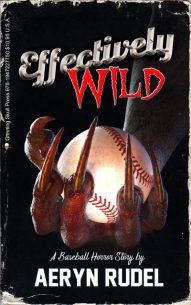
Effectively Wild – A Baseball Horror Story
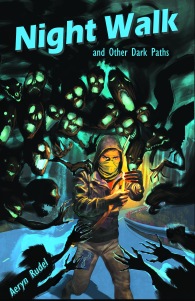
Night Walk & Other Dark Paths
Acts of War: Flashpoint

Acts of War: Aftershock

Acts of War: Stormbreak

 Aeryn Rudel's Rejectomancy