
Writing Acts of War II – A Novel Adventure
Hey, folks, I’ve been pretty transparent with my writing career here on the ol’ blog, what with all my rejections and over-analysis of said rejections, but let’s go all the way.
I’m going to start writing my next novel for Privateer Press, the sequel to Acts of War: Flashpoint. The working title for this book is Boiling Point, but that is very likely to change. Anyway, what I’m going to do (with Privateer’s kind permission) is document the entire process of writing the novel from first draft to publication and post it here for your amusement and edification. Before I go on, here’s a quick and dirty synopsis of Acts of War II:
War has come again to Llael. Lord General Coleman Stryker has inflicted a devastating defeat upon Great Prince Vladimir Tzepesci at the Khadoran-occupied city of Riversmet and now marches on the mining city of Rynyr to cripple Khadoran supply lines and weaken their position in the Llaelese capital city of Merywyn. But this one victory has done little to stem the avalanche of Khadoran might, and Empress Ayn Vanar has recalled one of her most fearsome warcasters and battle leaders to strike back at the Cygnaran invaders. He will summon to him a force so overwhelming that Stryker may be swept away on a tide of red steel.
Hope survives in the form of unexpected allies. Ashlynn d’Elyse, warcaster and leader of the Llaelese Resistance, fights a battle of her own against the Khadoran interlopers. She has no love for Cygnar but would still make a powerful ally if Stryker can convince her to join his cause. Meanwhile, old wounds fester as Asheth Magnus remains entrenched in the Cygnaran military machine, and Stryker must learn to use Magnus’ military prowess while keeping the cunning warcaster from undermining his authority.
So, as I write the first draft, we’ll do weekly check-ins, and I’ll update you on the raw numbers (how much I’ve written, how many chapters, etc.), give you some behind the scenes looks at the book in process (favorite lines, paragraphs), and occasionally give you a sneak peek into the process of things like cover design, developmental editing, revisions, concept art, and so on. You’ll also get character profiles on all the major characters, which will be handy for those new to the Iron Kingdoms and might serve as a nice refresher for those that know it well. But, never fear, longtime WARMACHINE players, there are some brand new characters in this book you are definitely going to want to learn about, and you WILL get sneak previews on these new characters during this process.
If you’re not into the whole Iron Kingdoms things, and you’re just interested in seeing how the sausage is made (well, at this particular factory), then there’ll be lots of info on how a novel is written, edited, marketed, and so on. This’ll all be from my own personal experience with Privateer Press, so what’s presented won’t be the ONE TRUE WAY or anything, but you might glean a few pointers here and there. At the end of this journey, there will be a shiny new novel I hope you will run out and read.
So, what do you say? Want to watch me pen the next thrilling chapter in my writing career and/or watch me crack beneath the stress of writing a novel in public? Either way, it’ll probably be entertaining.
Look for the first update, “How Outlining Destroyed My Soul” or something like that, in the very near future.
Oh, and since this is Acts of War II, you might be interested in reading Acts of War I: Flashpoint. Privateer is making that even easier by offering a 25% discount on the digital version of the book at the Skull Island eXpeditions website. Just click the the big ol’ picture of the book below and enter the following coupon code when you check out: ACTSOFWAR1
When Should You Reply to a Rejection Letter?

Should you reply to rejection letters? A good question, and 99.9 % of the time my personal opinion is a resounding NO. The most compelling reason is that many publishers will straight-up tell you not to reply to a rejection in their submission guidelines, and we always follow the submission guidelines, right? That said, here are some reasons writers sometimes DO reply to a rejection letter (and my opinion why they shouldn’t).
- To say thank you for an encouraging, personal rejection. A nice thought, but I think it’s generally unnecessary. Editors receive a lot of emails, and there’s a chance you’ll just be cluttering up their inbox with a (well meant) thank you. I think it’s kind of implied that you appreciate the editor’s time and consideration of your story, but if you really feel you need to say thanks for some encouraging words, I’d put a short note in the cover letter for your next submission to the publication. I’ve done that once or twice.
- You disagree with feedback. If you get actual feedback in a rejection and disagree with it, just ignore it and move on. This is a subjective business, and there are times an editor is going to give you feedback that doesn’t work for you. Replying to “correct” the editor isn’t going to get you anywhere, and it might hurt you chances at future publications with the same market. Now if that feedback is just off-the-wall bonkers, you might avoid submitting to that publisher again. In general, though, save your arguing for feedback on a story that’s been accepted.
- Because they were rude. Were they, though? I’m sure editors have been rude to authors in rejection letters, but out of the many, many I’ve received not once has an editor been anything but professional. When I see authors getting upset over rejections it’s often because they received a short, to-the-point form rejection which they’ve interpreted as clipped, terse, or dismissive. Editors are busy folks, and sometimes all they have time for is a short “No thanks” or “Doesn’t meet our needs at this time.” Don’t take that stuff personally, and absolutely don’t send a snarky reply. Again, it’s not going to get you anywhere, and it’ll likely hurt your chances for future publications.
Now for the big question: When should you respond to a rejection?
In my career there has been only one instance where I felt it was appropriate to respond to a rejection letter. Here’s why. I received a rejection that wasn’t meant for me. The publisher made a mistake because my story and another author’s story had very similar titles (an understandable error). When I received the rejection and realized it wasn’t for my story, I replied with a polite “I don’t think this was meant for me” and received an immediate and professional apology rescinding the rejection. My story was eventually rejected, but the publisher’s professionalism in correcting the mistake definitely left a good impression. I’ll be submitting there again.
So, that’s my opinion on when you should respond to a rejection letter, i.e., almost never. I’m willing to be educated on this point, though, and it you know some good reasons to reply to a rejection (or disagree with my reasons not to), please tell me about them in the comments.
October/November 2016 Submission Statement

I didn’t have a chance to recount my submission efforts for October, so I thought I’d combine them with November and do one big ol’ update. What follows is a two-month submission report, and since I was fairly active, especially in November, there’s a lot to get through.
October/November Report Card
- Submissions Sent: 9
- Rejections: 8
- Acceptances: 1
- Other: 2
- Publications: 2
Rejections
I finished new stories in October and November and began sending them out to the usual suspects. I’m also documenting the progress of one of those stories through the submission process in Real-Time Rejection II: The Saga of “Story X1.” A good portion of the rejections that follow are for the two new stories.
Rejection 1: 10/22/16
Thank you for sharing your story with us at XXX. While it doesn’t meet our editorial needs at this time, please keep us in mind for future submissions.
This is a higher-tier form rejection from one of the top markets in the fantasy genre. That’s a bit of a rarity for me since I don’t write a lot of fantasy. I sometimes stray into dark urban fantasy, which is what this submission was. Anyway, this is the first time I’ve submitted to this particular market, and getting a higher-tier rejection isn’t the worst way to begin. I have another submission under consideration with them at the moment.
Rejection 2: 10/29/16
Thanks so much for entering our Flash Fear contest. We had so many quality entries this time around.
Unfortunately, your entry, “XXX,” did not make it into our Top 10. However, we are happy to report that the piece did make it through several rounds of cuts and was still in consideration until the last stages of judging. As a result, we’ve given you a “Close But No Cigar” shout-out on our Flash Fear results page.
We encourage folks who didn’t quite make the cut to think about submitting those pieces for consideration in our regular issues (free to submit). While there’s no guarantees, we have published a few that way in the past.
Thanks again for your participation, and for writing such an entertaining story.
The Molotov Cocktail held another flash fiction contest in October, and I sent off three submissions. This is one of the few times where I’ll violate my blog rule of keeping the name of the publisher secret (I cleared it with editor Josh Goller first) because they’ve published a bunch of my stuff and I have nothing but great things to say about them (not that I have anything negative to say about other publishers), and it’ll be obvious who the publisher is once we get to the publications part of this post.
Anyway, this is a “Close but no Cigar” rejection, which is kind of like a higher-tier form rejection. I’ve since sent this particular story out again.
Rejection 3: 10/29/16
Thank you for submitting “XXX” to our Flash Fear contest. We were very happy to see such high quality submissions. The judging process was a particularly arduous one.
Unfortunately, “End of the Line” was not selected for our Top 10, but we very much enjoyed the chance to read it.
Thanks so much for your participation. We couldn’t do these contests without you.
This is a standard form rejection from The Molotov Cocktail for one of my three submissions to the Flash Fear contest.
Rejection 4: 11/9/16
We have read your submission and unfortunately your story isn’t quite what we’re looking for right now. While we regretfully cannot provide detailed feedback due to the volume of submissions, we thank you for your interest in our magazine and hope you continue to consider us in the future.
This is the first rejection for “Story X1,” and it’s a higher-tier form rejection from one of the top markets in the horror genre. This is the first time I’ve managed anything but a standard from rejection from this particular market after many tries, so not a bad way for “Story X1” to kick things off.
Rejection 5: 11/10/16
Many thanks for sending “Story X1”, but I’m sorry to say that it isn’t right for XXX. I wish you luck placing it elsewhere, and hope that you’ll send me something new soon.
Another rejection for “Story X1.” This one is a standard form rejection from another top-tier horror market. I generally hit all the pro markets with a new story first, so you’ll see a bit of a theme with the rejections for “Story X1.”
Rejection 6: 11/11/16
Thank you for the opportunity to read “XXX.” Unfortunately, your story isn’t quite what we’re looking for right now.
In the past, we’ve provided detailed feedback on our rejections, but I’m afraid that due to time considerations, we’re no longer able to offer that service. I appreciate your interest in XXX and hope that you’ll keep us in mind in the future.
Here we have rejection #3 for “Story X1,” and it’s one my fellow horror authors will likely recognize. This is a standard form rejection from one of the toughest markets to crack in the biz, and I could probably wallpaper my office with these things if I were to print them all out.
Rejection 7: 11/12/16
Thank you for your patience while our editors reviewed your submission. Unfortunately, XXX has not been accepted for publication in XXX. We hope you continue to submit to XXX in future and I wish you all the best with your publishing endeavours.
When you’ve received as many rejections as I have, they really do lose their sting, and I barely even notice form rejections at this point. This rejection, however, is the type that still leaves a bit of a mark. It’s a personal rejection after I received a further consideration letter from the publisher. These are always a little disappointing because you know got close to an acceptance (well, closer than usual, anyway). Still, this was my first submission to this publisher, and I got close. That means I need to send them more stories, which I certainly will.
Rejection 8: 11/30/16
Thank you for your interest in our magazine. Unfortunately, after reviewing your submission, we have decided that it is not for us at this point in time. As much as we hate to reject any work of fiction, please remember that it is not a value judgment based on your lovely skills and talent; it really is us, not you. We hope to see you on our submissions list in the future!
This is the fourth rejection for “Story X1,” and it appears to be a standard form rejection. Though this has some verbiage you sometimes see in higher-tier form rejection, this is a new market, and this is my first submission to them, so my gut says standard form rejection.
Other
I received a couple of further consideration letters in October and November.
Further Consideration 1: 10/31/16
Thank you for your submission to XXX.
Your short story XXX has made it through to the next stage of submission. This involves your story going to our editors at the end of the month for a final decision and can take a little while so we appreciate your patience.
Following is feedback from our readers.
– Nicely crafted urban fantasy story.
– Edgy piece, nicely written. I had to look up Baba Yaga to get the full meaning of the ending of the story, however.
I or the editors will update you on the outcome as soon as we are able.
This is a further consideration letter eventually resulted in rejection #7 above. This one is interesting because it offers some feedback from their readers. I discuss this rejection in further detail in this post.
Further Consideration 2: 11/20/16
I love this story! I have short-listed it. And it’s a short list.
Would you mind if I held on to this story until the close of submissions, February 1st? We just opened and we’ll receive a lot more submissions.
Please advise.
This particular further consideration letter is interesting for the simple fact the publisher gives me the option to pull the story if I so choose. I’m not going to do that, and I hope my story survives the winter. I discuss this letter in further detail in this post.
Acceptances
One acceptance for the last couple of months.
Acceptance 1: 10/29/16
You’ve done it again! 3rd place in Flash Fear for “Masks,” a truly imaginative piece with some bite to it. Really enjoyable read.
By now we have your PayPal ID and you just sent over another bio, so just let us know if you want anything different for either. We’ll issue your prize payment within about 14 days.
Thanks again for writing such kick-ass stuff.
An acceptance and a third-place finish in the most recent flash fiction contest from one of my favorite publishers. It’s always great when you can find a publisher that digs your stuff enough to keep publishing you.
Publications
Two publications this month: a short story and a gaming article.
Publication 1: 10/31/16
“Masks” – The Molotov Cocktail
My one acceptance is one of my two publications in the last couple of months. My story “Masks” took 3rd place in The Molotov Cocktails Flash Fear contest. I’d been sitting on that particular story for years, but I thought it might be a good fit for the contest. Looks like I was right. You can read it by clicking the link above.
Publication 2: 11/21/16
“Weapons & Warriors: The Protectorate of Menoth – Privateer Press/No Quarter magazine #69
My second publication is in No Quarter magazine for Privateer Press. I still write game-related articles for my former employer on a pretty regular basis, and this one kicks of a new series where I take elements of real-world fighting styles and apply them to the weapons and warriors of the Iron Kingdoms. The series lets me nerd out with two of my favorite subjects: fencing/martial arts and WARMACHINE/HORDES.
My apologies for the overly long post, but it was a fairly active couple of months. How was your October and November? Tell me about it in the comments.
Submission Protocol: The Escape Clause

I recently received a further consideration from a publisher that included what can best be termed an escape clause, and it prompted me to ask the following question. When should you, if ever, pass on a publication that is obviously interested in your story?
First, the letter:
I love this story! I have short-listed it. And it’s a short list.
Would you mind if I held on to this story until the close of submissions, February 1st? We just opened and we’ll receive a lot more submissions.
Please advise.
Thanks!
This is a great further consideration letter, and I’m thrilled the editor digs the story. He’s also given me the option of pulling my story if I don’t want to wait until February. That’s a very considerate and professional thing to do, and I appreciate it. I really want to see this story in this particular anthology, so I don’t mind waiting, and I communicated that to the editor. Hopefully, my story survives the winter.
Though I decided to be patient and wait for this editor to make a decision, it left me wondering: Under what circumstances might I have pulled a story when given that option by a publisher? Obviously, if I submitted a story to a publisher, it’s because I want to see my story published with them, and I usually don’t have an issue with waiting, especially if the editor is very communicative and upfront like this one. I really tried to come up with a reason I would pull a story in a situation like this, but I kept coming back to the fact that a foot in the door with one publisher is almost always better than a cold submission to another. That said, here are a two plausible(ish) reasons you might pull a story when it’s under consideration
- More appropriate market. Say, for example, you wrote a story about giant radioactive katydids terrorizing a small town, and you submitted “Colossal Katydid Killers” to a semi-pro horror anthology. You get a further consideration letter from the publisher like the one above but at the same time, another anthology, Six Legged Apocalypse, a collection of stories about giant radioactive bugs, begins taking submissions, and it pays a mind-boggling 10 cents per word. Your katydid story is a perfect fit for that anthology, so, yeah, you might consider pulling your story from the first publisher and submitting to the perfect-fit publisher.
- Really, really long wait. The editor above asked me to wait roughly two months for a decision, which is completely reasonable. Most publishers take around 60 days to render a decision anyway. But what if the publisher wants you to wait six months or nine? That’s a long time for a story to sit idle waiting for a decision. That’s not to say I haven’t waited that long or longer, but I’ve never been given the option to pull a story under consideration from one of those publishers. I’d probably wait, with a bit of grumbling, but I could see why some writers might decide to try their luck elsewhere.
Personally, if I get a further consideration letter like the one above, I’m going to wait. Though an enthusiastic response like this one isn’t a sure thing, I like my chances. Couple that with a perfectly reasonable wait time, and I can’t see a real reason to pull the story.
I’d love to hear from my fellow writers about this one. Would you pull a story in this situation or one like it? If you would or have done so in the past, tell me about it in the comments.
Rejections and the Revision Decision

How many rejections do I let a story accumulate before I revise it? That’s a question I get asked a lot these days (maybe because I plaster my rejections all over the internet). It’s a good question, and my answer usually is something like, “Well, what kind of rejections are we talking about?”
It’s really the type of rejection that informs my decision to revise rather than the quantity of rejections. To show you what I’m talking about, let’s look at some of my recent rejections, and I’ll tell you how they factored into my decision to revise or not revise.
Rejection 1: Standard Form
We have read your submission and will have to pass, as it unfortunately does not meet our needs at this time.
I’ve received rejections like this a lot—most writers have—and, honestly, they barely even register on my revision meter. I mean, this rejection doesn’t tell me anything other than this publisher is not going to publish the story. Because there’s so little information, I would likely never revise a story on a rejection like this or even a few rejection like this. Now, if I get this rejection like ten times in a row, then I might reconsider. Thankfully, that has yet to happen on any story I’ve submitted.
Rejection 2: Higher-Tier Form
We have read your submission and unfortunately your story isn’t quite what we’re looking for right now. While we regretfully cannot provide detailed feedback due to the volume of submissions, we thank you for your interest in our magazine and hope you continue to consider us in the future.
Yeah, it’s still a standard form rejection, but it does give me some information I can use. This letter doesn’t give me any specific feedback, but it’s from a very tough market, and a higher-tier rejection usually means they saw something they liked. If I get this rejection early in the submission grind, like the first three attempts, I usually take that as a sign to keep submitting the story as is. If this editor liked it a little (and these decisions often come down to matters of taste), the next editor might like it a lot.
Rejection 3: Further Consideration + Rejection
1) “XXX” has been accepted into our final round of consideration. We will be letting you know before the end of April whether or not it is accepted.
2) Thanks so much for letting us consider your story “XXX.” While it made it to the final round of consideration, I’m afraid that we chose not to accept it. We had a lot of submissions and there were difficult decisions to be made. Best of luck placing it elsewhere.
It’s always a good sign if your story makes it to the final round of consideration, or, with some of the top-end markets, past the first round of readers. A further consideration letter is always a positive in my book, and even if it results in a rejection, there was something in the story the editors liked. In this example, they didn’t offer any specific feedback, so it only strengthened my decision to send the story out again as is. That turned out to be a good decision, as the story was accepted by the next market I sent it to.
Rejection 4: Further Consideration + Rejection + Feedback
1) Your short story “XXX” has made it through to the next stage of submission. This involves your story going to our editors at the end of the month for a final decision and can take a little while so we appreciate your patience.
Following is feedback from our readers.
– Nicely crafted urban fantasy story.
– Edgy piece, nicely written. I had to look up Baba Yaga to get the full meaning of the ending of the story, however.
2) Thank you for your patience while our editors reviewed your submission.
Unfortunately, XXX has not been accepted for publication in XXX.
We hope you continue to submit to XXX in future and I wish you all the best with your publishing endeavors.
This further consideration letter was somewhat unique in that it included feedback from the market’s readers. They had some nice things to say about the story, but one of them had a solid bit of critical feedback that I definitely took note of. In this particular story, I banked on the reader being familiar with Baba Yaga, a powerful witch or ogress from Slavic folklore. I wouldn’t go so far as to call her obscure, but Baba Yaga is certainly not as well-known as other mythological figures. The problem, as the reader pointed out, is that the impact of my story’s ending suffers if you don’t know who she is. That’s a legit issue, and it has certainly given me reason to consider a revision.
It’s also important to note that this story has received a number of rejections like examples one, two, and three, so it’s been out there a lot and had a fair number of near misses. I didn’t revise it because it was getting close, but this little nugget of information might be one of the reasons it hasn’t been accepted yet.
So, there’s a little insight into how rejections play into my revision process. It’s not a perfect system by any means, and there’s no doubt I’m drawing the wrong conclusions from my rejections from time to time. That said, when I do revise based on a letter like the last example, I feel like I’m on firmer ground with a clear direction and clear problem to fix. In my opinion, that’s the best position to revise from.
How do rejections factor into your revision decision? Tell me about it in the comments.
Submission Protocol: The Waiting Game

If you’re a writer who regularly submits short stories and who also uses submission tracking sites like Duotrope, then the following scenario will likely be very familiar to you.
You send your submission to a publisher, noting on Duotrope their average response times for rejections and acceptances, then sit back and wait. Your submission crosses the rejection threshold, and you dare to hope, “Could they be considering my story?” Then your story crosses the acceptance threshold, and you start getting really excited. “They’ve held my story so long they MUST be STRONGLY considering it for publication!” You wait a few more weeks, more hopeful every day an acceptance letter is forthcoming, and then . . . BOOM! Form rejection.
So what happened? Well, there are a bunch of possibilities, but just because a publisher holds your story for longer than their usual response time for rejections or acceptances doesn’t necessarily mean it’s more likely to be published. I’m not saying it’s not being considered, but I’ve learned not to put too much stock in how long a publisher holds on to my story. I’ll explain why in a sec, but first a quick advisory note.
What follows is rejectomancy at its finest. It is the attempt of one writer to make sense of the grand chaos of the submission process by stringing together bits of disparate information that likely have no relation to one another. It is absolutely, one-hundred-percent anecdotal evidence and should be read with the clear understanding the author may be and probably is completely full of shit.
Okay, now that that’s out of the way, here’s how I approach the waiting game. Like everyone else, when my story is held longer than usual, I get hopeful, but then I remember two things.
1) Submittable. If you send a lot of submission to magazines, e-zines, and the like, then I’ll bet huge sums of money you have a Submittable account. If you’re unfamiliar with this service, Submittable is a submission management platform that many publishers use both for submission intake and submission tracking. The author side of things lets you see what the publisher has done or is doing with your story via a number of different status labels. After you send a story, it’ll be marked RECEIVED, which according to Submittable means: “Your submission has been successfully sent to the organization and is in queue or being printed and read outside the Submittable system.” It may also be marked IN-PROGRESS, which means: “Your submission has been received and additionally handled in some way (e.g. assigned, commented on, etc.).” The other two status tags are DECLINED and ACCEPTED, and those are self-explanatory.
Okay, so here’s the thing, in my experience, the RECEIVED tag only lives up to the first half of Submittable’s explanation. Basically, the publisher has received it, and it’s in a queue to be read. It’s not until that status becomes IN-PROGRESS that someone is actually reading/considering your story. This is all anecdotal, of course, but many times a story of mine has languished in RECEIVED purgatory, and once it became IN-PROGRESS I received a response in a few days to a week. Not once, not twice, dozens of times I’ve seen this happen. So, if you submit a story to a publisher via Submittable, I wouldn’t get too excited until you see the IN-PROGRESS tag. Are there exceptions to this “rule”? Absolutely, and there are very probably publishers who are reading stories while they’re in RECEIVED status.
2) Further consideration letters. Okay, I feel like I’m on slightly firmer ground with this one. In my experience, bigger publishers have first readers or editors who sort through the slush pile and decide which stories are good enough to pass up to the decision-makers. If your story is chosen by one of those first readers, you won’t have to guess if you’re story is being considered because the publication will tell you via a further consideration letter, like this one.
Thank you for submitting “XXX” toXXX. One of our first readers has read your story and believes it deserves a closer look. We would like to hold it for further consideration. Good luck!
With these publishers, how long the story has been held probably doesn’t matter. Your story is likely not being considered unless you get one of these letters. Now, of course, after the further consideration letter, it’s anyone’s guess. With the letter above, I received a form rejection 28 days later (funny thing, the submission was a zombie story), which put my total wait time at 49 days. That’s about half their estimated wait time for an acceptance.
I can think of three pro publishers in the horror market that send first-reader further consideration letters, and I’d be willing to bet many others follow suit. Again, like with most things on this blog, this is anecdotal evidence from my own experience, and there are definitely going to be publishers who work differently.
***
So, why would a publisher hold on to your story past their usual rejection or acceptance thresholds and not be considering it? The simple answer is they have a ton of submissions to get through. As I’ve said many times, the big, pro-paying markets receive hundreds of submissions a month, and it’s no surprise they get backlogged from time to time. Smaller publishers have the same problem; they might get fewer submissions, but they usually have less people to read them. Sometimes publishers just lose a submission. That’s happened to me a couple of times. Lastly, publishers go out of business. I’ve experience that scenario twice while one of my submissions was in the publisher’s queue.
At the end of the day, if your submission has been held for longer than seems typical, it’s probably best to send a status query to the publisher. Check the guidelines first, though. Some publishers only want status queries after a certain amount of time has passed (usually 60 days). In my experience, a status update query almost always speeds up the process, and I usually receive a response shortly after sending one.
How do you handle the waiting game? Any tips or tricks to share?
Tiered Form Rejections: Fact or Fiction?
If you’ve been submitting stories to the many literary and genre magazines, journals, and zines out there, then you’ve no doubt heard that some markets have more than one type of form rejection. Not only do these publishers have more than one, they have different tiered or higher levels of rejections, and the higher the tier, the closer the story got to an acceptance (in theory).
Here’s my two cents. I think tiered rejections are absolutely a thing, though they’re more common with larger markets, and I have examples!
First, let me tell you where I’m going to get the bulk of my evidence. I found a nifty little wiki called the Rejection Wiki, which is a database of rejections from various publishers. They have actual examples of real rejections submitted by real writers, and they break them down into standard and higher tier form rejections, as well as a few other types of form letters. It’s a great site, and I’ve been contributing to its database when I can, and you should too; it’s an invaluable resource for writers. Note, some of the letters in the database are a few years (or more) old, but, in my experience, many markets haven’t changed their form letters in that time or have changed them very little.
Oh, and one more thing. I’m actually going to name the names of the markets here because these are form rejections and and there’s no personal information involved. A rejection with an asterisk is one I’ve actually received.
Example 1: Fantastic Stories of the Imagination
This is one of the top markets in the fantasy and sci-fi genres. They’re a pro-paying market with a very low acceptance ratio, which is par for the course with top markets that receive hundreds of submission per month.
Standard Form Rejection
Thank you for sharing your story with us. Unfortunately it doesn’t meet our editorial needs at this time.
Higher Tier Form Rejection*
Thank you for sharing your story with us. Unfortunately it doesn’t meet our editorial needs at this time. Please keep us in mind for future submissions.
Further Consideration Letter
Congratulations, your story has been kicked up to the editor-in-chief [name]. He should have a final answer for you shortly.
Can you spot the difference between the standard and higher tier form rejection? It’s going to be a running theme in this post. Yep, the higher tier mentions future submissions. As with many top-tier publishers, Fantastic Stories of the Imagination sends a further consideration letter if your story makes it past the first round of readers.
Example 2: Apex Magazine
Another top genre market in the fantasy, sci-fi, and horror genres, Apex is also a pro-paying market that regularly publishes stories that are nominated or even win prestigious awards in the speculative fiction industry.
Standard Form Rejection*
Thank you for submitting XXX to Apex Magazine for consideration. Unfortunately, it does not meet our needs at this time.
Higher Tier Form Rejection
Thank you for submitting XXX to Apex Magazine for consideration. Unfortunately, I’m going to pass on it. It’s just not what I’m looking for right now.
I look forward to reading further submissions from you.
Further Consideration Letter*
Thank you for submitting XXX to Apex Magazine. One of our first readers has read your story and believes it deserves a closer look. We would like to hold it for further consideration. Good luck!
Again, the difference between the standard and higher tier is future submission, in that they mention or ask for them. And, again, like many big markets they’ve got a group of first readers that go through submissions and decide what gets passed up to the editors.
Example 3: Strange Horizons
Strange Horizons is one of the premier fantasy and sci-fi markets, and checks all the boxes for that level of publication: pro-paying, low acceptance ratio, quick to respond, etc.
Standard Form Rejection
Thank you for submitting XXX to Strange Horizons, but we’ve decided not to accept it for publication.
We appreciate your interest in our magazine.
Higher Tier Form Rejection
Thank you for submitting XXX to Strange Horizons, but we’ve decided not to accept it for publication. There was some lovely writing in this piece, but overall it didn’t quite engage us.
We appreciate your interest in our magazine.
Strange Horizons departs a bit from the pattern of the previous two magazines in that they do not ask for further submission in their higher tier form rejection. They do, however, note the quality of the writing, and I would say it’s safe to assume the “send more submissions” part is implied.
Example 4: Nightmare Magazine
One of my favorites, Nightmare Magazine is one of the top markets in the horror genre. Like all the big kids on the block, they’re a tough nut to crack.
Standard Form Rejection*
Thanks for submitting XXX, but I’m going to pass on it. It didn’t quite work for me, I’m afraid. Best of luck to you placing this one elsewhere, and thanks again for sending it my way.
Higher Tier Form Rejection
Thanks for submitting XXX, but I’m going to pass on it. It’s nicely written and I enjoyed reading it, but overall it didn’t quite win me over, I’m afraid. Best of luck to you placing this one elsewhere, and thanks again for sending it my way. I look forward to seeing your next submission.
Nightmare’s higher tier form rejection is the best of both worlds. They praise the writing and they ask for more submissions. Can’t beat that in a rejection from a market like this.
So, what’s the verdict? I’d say it’s pretty clear. Higher tier form rejections are absolutely a thing, and you should feel good about getting one from a top-tier market. You might ask why they don’t send a personal rejection instead of the higher tier form rejection. I think the answer to that is simply they don’t have the time. These markets receive hundreds of submission a month and writing out a nice personal note to every author who wrote a good story but didn’t quite make the cut would take a lot of time.
It should be noted that some markets include something about further submissions in their standard form rejection, so it might seem like a higher tier, but it isn’t. It’s just a nicety the editors decided to include in their form rejection. That’s why a site like the Rejection Wiki is so handy. You can actually see what type of rejection you’ve received. They have tons more examples than the ones I’ve posted here, so head on out and have a look, and if you’ve received a rejection that’s not in their database, be a pal, create an account, and add it.
Have any thoughts on tiered rejections? Tell me about them in the comments.
An Interview with Strix Publishing – The Book of Three Gates

Strix Publishing is at it again with another Kickstarter for fans of horror and H. P. Lovecraft in particular. This time it’s a collection of stories and essays called The Book of Three Gates. I recently spoke with Strix founder Simon Berman and the very talented artist Valerie Herron about their latest project. Check it out and see why you need to run right over to Kickstarter and support this bad boy.
AR: So Strix Publishing has launched another Kickstarter campaign with another very intriguing product called The Book of Three Gates. Tell us about it.
SB: I’m pretty excited about this one. It’s a companion volume to The Book of Starry Wisdom, the first book I published via Kickstarter. I’ve chosen three of H.P. Lovecraft’s stories as the centerpiece for the collection, and the brilliant Valerie Herron has returned to illustrate them. “The Dunwich Horror,” “The Dreams in the Witch House,” and “The Haunter of the Dark” were chosen for their common themes of alien horrors transgressing the thin walls between our world and others. “The Dunwich Horror” is one of my personal favorite Lovecraft stories, and this book also gave me the opportunity to bring in a good friend and talented cartographer to produce a map of the Township of Dunwich as the book’s endpapers. The book concludes with a selection of essays by some notable authors, all of whom were given the chance to write pieces that blur the lines between fact and fiction.

AR: Again, you’ve assembled a fantastic group of writers to contribute to The Book of Three Gates. Tell us about some of the contributors. Any returning from The Book of Starry Wisdom?
SB: Absolutely! I’m pleased that a number of authors have returned, including Adam Scott Glancy of Delta Green fame, noted poet and weird fiction aficionado Bryan Thao Worra, Orrin Grey of Never Bet the Devil & Other Warnings renown, C.A. Suleiman, known for his work on Mummy: The Curse, and artist and occultist, A.S. Koi. I’m particularly excited about that last one. Koi has promised me an instruction manual for how to bend time. The new authors I’ve chosen for this volume are all very accomplished writers as well. Evan J. Peterson, is a 2015 Clarion West writer, who is writing an extremely interesting academic essay on the queer history of Miskatonic University’s Apollonian Dionysian fraternity, and Don Webb, a noted occultist, is producing a piece on the history, theory, and practices of the Order of the Trapezoid of the Temple of Set.
AR: You’re also working with talented artist Valerie Herron again, so I’ll direct this question to her. How will your contributions to The Book of Three Gates differ from those in The Book of Starry Wisdom?
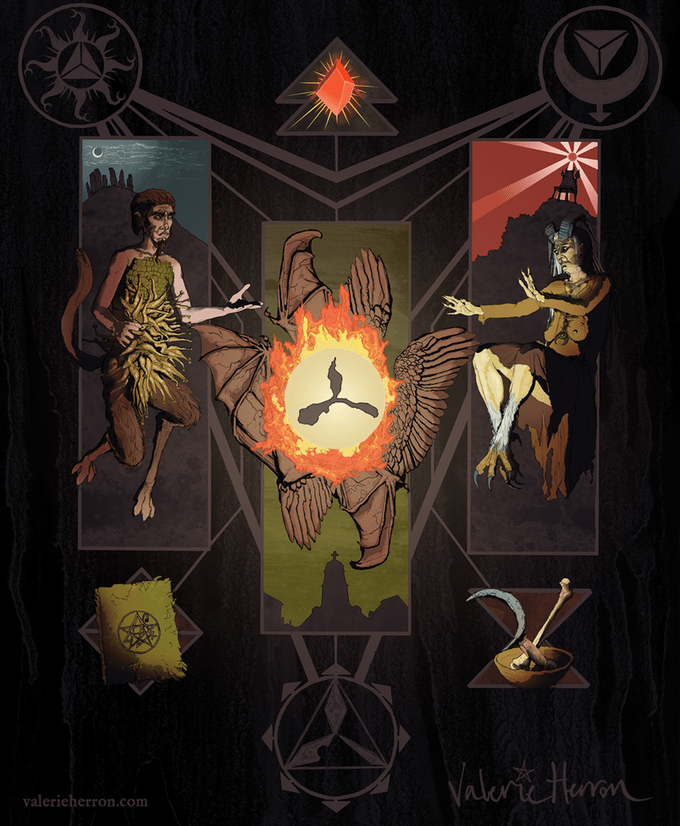
VH: The obvious difference will be the subject matter. While Starry Wisdom focused on the Cthulhu mythos, the subject matter in Three Gates gets into witchier and inter-planar territory. The illustrations will be less character-driven and more atmospheric, so expect more use of unsettling scenery and evocative visual texture. I will be preserving more of the traditional elements in the work to try and capture this ambience. Don’t worry, there will still be monsters!
AR: Another one for Valerie. You obviously have quite an appreciation for Lovecraft’s work. What about the mythos gets you drawing, painting, and creating?
VH: This work is largely my way of processing my own sense of cosmic horror. It’s a reaction to these titanic forces that govern our lives with no regard for our existence and how insignificant I feel at their mercy. I make this art because it’s much more effective than remaining frozen in panic or hopelessness while all of these slow-motion disasters in the world play out around me. This is the way I feel like I relate to Lovecraft as a creator. The crushing weight of a materialist’s reality left him catatonic as a young adult, but he was able to channel that particular anguish into timeless allegory. I am honored to give visual form to these unbridled forces.
AR: Simon, you’ve become quite the old hand at this Kickstarter thing, and you’ve funded your first four campaigns. What is the secret to your success?
SB: Being willing to go without sleep. Honestly, it comes down to having an idea for something that people want and then making sure you get it in front of them, treating your backers like the generous supporters they are, and being as transparent as possible about everything you’re doing. A high tolerance for sleep deprivation does help, though.
AR: Since The Book of Three Gates is a companion volume to The Book of Starry Wisdom, can we expect a third volume in the series?
I don’t want to say too much just yet, but if all continues to go well with Three Gates, there are two possible collections on the docket for a third volume. One goes beyond the wall of sleep, the other beyond the veil of death.
Simon Berman worked as a Social Marketing Manager and staff writer for Privateer Press from 2008-2016. He worked in both capacities for the award-winning miniatures war games, WARMACHINE and HORDES, and the Iron Kingdoms Full Metal Fantasy Roleplaying Game, winner of 4 ENnies awards. He also works on the ENnies nominated roleplaying game, Unhallowed Metropolis. He has also worked as a social media manager on Kickstarter projects for WARMACHINE: Tactics, Widower’s Wood, The Book of Starry Wisdom, the Problem Glyphs art book, APOCRYPHA: The Art of Jason Soles, and Orrin Grey’s Never Bet the Devil & Other Warnings.
***
With an enduring love for the unusual, Valerie Herron began expressing her interests through writing and illustration in childhood. Fantasy illustration, mythology, the occult, and the natural universe remain her greatest inspirations. Valerie’s work has evolved in time to be conceptually layered and mysterious. She collages together a powerful visual-vocabulary that is mystical and socially relevant. Valerie creates allegorical narratives that are poignant and beautiful, ugly and elegant.
Fascinated by contours, Valerie considers her primary medium to be line. She finds the synthesis of traditional wet media and digital media best communicates her visual style.
Valerie received her BFA in Illustration at Pacific Northwest College of Art in Portland, OR. She currently lives in Seattle, works for Privateer Press, and is also a freelance illustrator. Outside of her creative practice she spends her time listening to music and podcasts, being out in nature, writing, reading, and venturing a myriad of sorcerous activities.
The Long View: Genre Markets for Novelettes & Novellas
If you regularly submit short stories to genre markets, you’ve no doubt learned the longer your story the fewer publishers who will accept it. This post isn’t meant be a condemnation of longer stories, but it is beneficial to understand where many genre markets stand on novelettes and novellas.
I’m going to take a close look at the market for three popular genres—horror, fantasy, and sci-fi, i.e., the ones I know best—and see how many accept stories of the most popular lengths. All of my stats will be drawn from Duotrope, which is a pretty robust database of potential markets, but it is not a database of all markets. So my numbers are naturally skewed and will not include publishers that aren’t part of Duotrope’s database. Also, the data here is a snapshot, and counts only those markets that are currently accepting submissions. In other words, this is not a scientific study by any means; it’s a quick summation of the data I have easily at hand and should be viewed as such.
Okay, some definitions first.
In each of the three genres I named above, I’m going to see how many markets accept stories in the following four lengths: short story, flash fiction, novelette, and novella. Duotrope defines those lengths thusly:
- Short Story: 1,000 to 7,500 words
- Flash Fiction: Less than 1,000 words
- Novelette: 7,500 to 15,000 words
- Novella: 15,000 to 40,000 words
It’s important to note that while Duotrope’s definition of a short story is a piece up to 7,500 words, many publishers do not publish fiction at that length. In my experience, 3,000 to 5,000 words is more common for short stories, and of those publishers that do publish up to 7,500 words, some don’t do it very often and will often state that in the guidelines.
I’m also breaking the markets down into three payment tiers: token, semi-pro, and professional. (I’m keeping non-paying markets out of this simply to keep the numbers manageable.) Dutrope defines those payment theirs like this:
- Token: under 1 cent per word (often a flat rate)
- Semi-Pro: 1 cent to 5 cents per word (most of these markets tend to be on the low end of this scale)
- Professional: 6 cents per word and up
Okay, let’s look at our first genre—horror.
| Horror | Token | Semi-Pro | Pro |
| Total Markets | 98 | 42 | 9 |
| Short Story | 88 | 34 | 8 |
| Flash Fiction | 53 | 27 | 6 |
| Novelette | 31 | 7 | 4 |
| Novella | 9 | 3 | 2 |
As you can see, most of these markets accept short stories and a fair number of them also take flash fiction. (The ones that don’t take shorts often specialize in flash.) The numbers drop off dramatically the longer the story gets, hitting single digits when you get into novella length. In fact, if you want to submit a novella-length horror story to a professional market, it’s currently Clarkesworld Magazine or Orson Scott Card’s Intergalactic Medicine Show or nothin’ (according to Duotrope). It should be noted that Clarkesworld cuts off novellas at 16,000 words and Intergalactic Medicine Show at 17,500 words. So if you’ve got a 20,000-word horror novella, there currently isn’t a pro market to send it to in Duotrope’s database.
Okay, now fantasy.
| Fantasy | Token | Semi-Pro | Pro |
| Total Markets | 131 | 72 | 28 |
| Short Story | 112 | 57 | 22 |
| Flash Fiction | 71 | 44 | 17 |
| Novelette | 47 | 19 | 11 |
| Novella | 18 | 8 | 7 |
Fantasy is a bigger market than horror, but the numbers are similar. Lots of places that accept shorts and flash and far less that accept novelettes and novellas. You’ve got more options with longer works in this genre but not by much. Again, like with horror, most of the pro markets definitions of a novella falls well below 40,000 or even 30,000 words. Only one of the seven pro markets above accepts novellas up to 40,000 words; the rest cut off at 25,000 words and below (most are below 20,000).
And, lastly, science-fiction.
| Sci-Fi | Token | Semi-Pro | Pro |
| Total Markets | 149 | 78 | 30 |
| Short Story | 131 | 64 | 25 |
| Flash Fiction | 71 | 43 | 17 |
| Novelette | 57 | 19 | 11 |
| Novella | 20 | 10 | 8 |
Again, similar ratios as the other two genres, but since sci-fi is the largest of the three, you do have a few more options for longer story lengths. Like with horror and fantasy, novella writers will need to keep their works on the low end of the spectrum. Only two markets here accept novellas up to 40,000 words, the rest cut off at 25,000 words and below.
That’s a whole bunch of numbers for you, but the conclusion is simple: there just aren’t many markets in these three genres that accept longer stories (I’d guess it’s similar with mystery and romance, but I could be wrong). It’s something to keep in mind when you’re writing. If you’re targeting semi-pro and pro publishers, then you may have a more difficult time selling a novelette or novella simply from lack of potential markets. Again, I’m not saying don’t write to these lengths–a story needs to be as long as it needs to be–just be aware it’s a tougher road.
It’s not all bad news. Some of the big book publishers are actually open to and even looking for submissions of novella-length manuscripts. Here’s a couple I found with just a quick internet search (there are likely more):
- Tor is looking for fantasy novellas between 20,000 and 40,000 words that are not modeled on a European culture through January 12th, 2017. Check out the full guidelines here: Tor.com novella submissions.
- Hydra, a digital-only imprint of Penguin-Random House, is looking for horror, fantasy, and sci-fi works of 40,000 words and up. Technically, I think they’re looking for novel-length submissions, but 40,000 words is the upper limit of what most people consider a novella. They’re looking for queries first, and there’s a online form you can fill out right here: Hydra submission guidelines.
If you have additional info about potential markets for novelettes and novellas or if you have experience with a genre outside of fantasy, horror, and sci-fi, please tell me about it in the comments.
Rejection Letter Rundown: The Considered Rejection
Often you have to wait quite a while for a publisher to get back to you about a submission, which is just a reality of being a writer, but when you have good reason to hope your story will be accepted, the waiting can be pretty nail-biting and the possible rejection all bit more disappointing. The rejection letter du jour is the considered rejection, which is a whole process that begins with an encouraging note like this.
“XXX” has been accepted into our final round of consideration. We will be letting you know before the end of [the month] whether or not it is accepted.
What we have here is a further consideration letter, which is always a good thing. It says the publisher liked your story, and they’re, well, considering publishing it. I appreciate these largely because they often come from markets that can take a while to get back to you, so it’s nice to get some notification that a decision is in the works. Now, of course, getting a letter like this is no guarantee of publication, because it might eventually result in a letter like this:
Thanks so much for letting us consider your story “XXX.” While it made it to the final round of consideration, I’m afraid that we chose not to accept it. We had a lot of submissions and there were difficult decisions to be made. Best of luck placing it elsewhere.
Ouch. Bummer, right? My story was under consideration for about three months before they decided to pass on it. This is all part of the writing gig, and I have no doubt my story was up against some stiff competition. So what’s the takeaway from a rejection letter like this? Simple. I got close. The story got close. I like to think that’s evidence the story is pretty decent the way it is, and I should send it to another publisher right away, which is exactly what I did. If this publisher liked it enough to seriously consider it for publication, the next one might like it even more. We’ll just have to see.
Have you received a considered rejection? Tell me about it in the comments.
Effectively Wild – A Baseball Horror Story
Night Walk & Other Dark Paths
Acts of War: Flashpoint

Acts of War: Aftershock

Acts of War: Stormbreak

 Aeryn Rudel's Rejectomancy