
A Week of Writing: 2/18/19 to 2/24/19

Another week in the trenches, and other week of submissions, rejections, and miscellaneous literary endeavors.
Words to Write By
This week’s quotes comes from, uh, *checks notes* Wayne Gretzky?
“You miss 100% of the shots you don’t take.”
– Wayne Gretzky
This is a quote from the greatest hockey player to put on skates (I know that, and I’m not even a hockey fan), but, damn, does it apply to just about everything, including writing. I send out a lot of submissions–one-hundred and twenty last year–and those are, well, shots I’m taking. They don’t all score, of course, but each time I send a submission I have a chance of acceptance. If I don’t submit, I have zero chance. The writing and submission gig can be a tough one. Rejections are as common as weeds, and some of them have thorns. They WILL get you down, and that’s okay, but you still gotta take those shots. Just ask Wayne Gretzky. His career shooting percentage was 17.6%, so even he missed a few, and, hey, they still call him The Great One.
The Novel
My next revisions of Late Risers is on hold while I finish a novella for Privateer Press. I wrote 8,000 words of it last week, and I’ll bust out another 8,000 to 10,000 this week.
Short Stories
It doesn’t get much slower than this, folks.
- Submissions Sent: 0
- Rejections: 1
- Acceptances: 0
- Publications: 0
- Shortlist: 0
Yep, no submissions and a single rejection last week. I’m not exactly setting the world on fire in February. I did send a submission yesterday, and I’ll send a few more in the next day or so. That’ll put me up to 10 for the month, which keeps me on pace for 100 submissions for the year.
The Blog
Two blog posts last week.
2/20/19: A Week of Writing: 2/11/18 to 2/17/18
The usual weekly writing update.
2/22/19: The Rejection Archives: Rejection #84 (Personal)
Another entry into my Rejection Archives series. This one covers a personal rejection with excellent feedback.
Goals
I’ll finish up the first draft of my novella for Privateer Press this week, and then I’d like to get some short story submission out.
Very Short Stories
So, I’ve started writing microfiction on a daily basis on Twitter under the prompted hashtag #vss365. It’s a great exercise trying to fit a story into 280 characters and a hell of a lot of fun. I’m gonna start rounding up the weekly crop of scribbles on these updates. If you want to get these tiny tales in real time, follow me on Twitter @Aeryn_Rudel.
They call me a leg breaker, but that ain’t right. Bones hurt, but soft tissue remembers. A guy hears that meaty pop when I shred his ACL, and he knows he’s gonna hobble like a lame horse forever. If that don’t remind him what he’s done wrong, he’s always got another leg.
February 23rd – Prompt: Humble
The men who come for me with crosses and holy books are sinners in pride, Daddy says. He hurts them, and I’m always hungry after. I know it’s wrong to waste the Lord’s bounty, and Daddy makes what he calls humble pie. It’s warm and red and just what a growing girl needs.
How was your writing week? Tell me about it in the comments.
The Rejection Archives: Rejection #84 (Personal)

Time to dive back into the Rejectomancy vault and fish out another rejection from my collection of nos and not for us’s. We’re gonna stick with the same theme as last week, and I’ll show you another detailed personal rejection. Here it is:
Rejection Number: 84
Story Sent: 12/20/2015
Rejection Received: 1/31/2016
Rejection Type: Personal Rejection
Thanks for letting us see [Story Title]. I regret to say that it’s just not right for [Publisher].
It’s a solid piece, with some good characters and good tension. Unfortunately, by the end, I’m afraid it just didn’t “grab” me the way it might have. I’ve been sitting here thinking why not, and it occurs to me that I never really connected with [main character]. Maybe if it had been first-person instead of third-person. That’s not a request for a rewrite (I don’t make too many of those). It’s just a thought.
In any event, I’m sorry. Best of luck with this one in other markets.
Last week I showed you a personal rejection from an editor where I largely rejected the feedback (mostly because I thought it came down to an issue of personal taste). This rejection, however, got me thinking, because the editor highlighted something that does pop up in my work–main characters that are difficult to connect with. The editor’s suggestion of making this a first-person POV instead of third-person turned out to be what the story needed. I made that change, which allowed me to dig deeper into the MC’s thoughts, motivations, and personality. Now, that wouldn’t work for every story, but this one in particular benefited from the closer POV. This is a great example of a helpful rejection, and I’m grateful to this editor for taking the time to point out what they thought needed to change in the story.
I’m still shopping this piece, but I’m confident it’s a better story than it was, and I think it’ll find a home soon.
Thoughts about this rejection? Tell me about it in the comments.
If you’d like to read the other posts in this series, check out the links below:
A Week of Writing: 2/11/19 to 2/17/19
Yikes. How did it get to be Wednesday already. A little late with this update, but here’s my writing week that was.
Words to Write By
This week’s quotes comes from Sylvia Plath.
“I love my rejection slips. They show me I try.”
– Sylvia Plath
I’ve been in a bit of an acceptance drought to start the year, and the rejections have been piling up. Despite my admittedly thick hide, when rejections attack en masse they can wear me down. So, when that happens, and I feel like I’ll never sell a story again, I often read quotes about rejection from famous authors. This one is short and sweet and right on the money. Rejections are nos, certainly, but they’re meaning is greater than that. Like Sylvia Plath says, they say you tried, you put your work out there, and braved the literary minefields. Of course, if you follow this blog, then you know I think a lot of publishing is a numbers game. The more you submit (try), the greater your chances of acceptance, so it helps to think of each rejection as laying down another bit of road that will eventually lead to the next publication.
The Novel
I’ve started the next revision for Late Risers based on the notes from my agent. This time I’m going about things in a much more surgical manner. First off, I created a spread sheet that lists each chapter with a short summary of its content. That way I can treat the book kind of like a puzzle or maybe a delicately balanced Jenga tower. I can move or remove chapters and add in the new ones my agent requested. It’s been very helpful to view the novel this way, and it feels a lot less overwhelming. The first new thing I’ll write is the prologue, mostly because I know exactly what I need to do there, and the action in that bit will inform the rest of the novel. That said, this project is on temporary hold while I write the next piece of Stormbreak for Privateer Press.
Short Stories
This week was much more active than weeks prior.
- Submissions Sent: 4
- Rejections: 5
- Acceptances: 1
- Publications: 1
- Shortlist: 0
The 4 submissions last week give me 6 for the month and 15 for the year. That puts me a bit off my pace for the 100 submissions I want to hit by the end of the year. I’m not too worried about that, though. I’ll get a few more subs out in the next week to get back on pace. Five rejections this week, and they were a little tougher than usual, mostly because I thought I had a pretty good shot with a couple of them. That’s almost always a mistake, and as hard it can be sometimes, I find it best to treat each submission like an eventual rejection, and then just treat each acceptance like a wonderful surprise.
The Blog
Two blog posts last week.
2/11/19: A Week of Writing: 2/4/18 to 2/10/18
The usual (if not timely) weekly writing update.
2/15/19: The Rejection Archives: Rejection #7
The second entry into my Rejection Archives series. This one covers a detailed personal rejection.
Goals
This week and next I need to bang out the words on the next Privateer Press novella. As usual, I’m shooting for something between 2,000 and 3,000 words per day, and the first draft should go very quick. Looking forward to it, and it’s always a good time taking another trip to the Iron Kingdoms.
Story Spotlight
I did manage to publish a story last week with Mystery Tribune. This is a reprint flash fiction story called “The Father of Terror.” It was originally published by The Molotov Cocktail, where it took second place in their Flash Icon contest. I made some very minor changes to this version of the story, but it’s still 95% the same story Molotov published. You can read “The Father of Terror” by clicking the link below
“The Father of Terror”
How was your writing week? Tell me about it in the comments.
The Rejection Archives: Rejection #7 (Personal)

Got another rejection from the vault to share with you. This is the seventh rejection I received after I started seriously tracking my submissions through Duotrope. Let’s have a look.
Rejection Number: 7
Story Sent: 2/2/2013
Rejection Received: 2/21/2013
Rejection Type: Personal Rejection
Aeryn,
Thanks for letting us see [story title]. I regret to say that it’s not right for [publisher].
I loved the incredible vividness of this story, and thought the ending was rather awesome. [Redacted detail about the story] However, the long digressions into [theme of story], while interesting and well written, really slowed the pace for me. It ended up feeling like there was too much internal monologue for the bit of action the story provided.
Best of luck with this in other markets.
Regards,*
This was one of the first detailed personal rejections I received when I got serious about submitting short fiction. The editor kindly explains exactly what their issue with the story was. I also liked how they included qualifiers like “for me” rather than using imperative statements. Though I did not change the story based on this feedback, it does NOT mean the editor was wrong. It means my story was not a good fit for this market and this editor. I went on to sell this story to another publisher shortly after this rejection. Again, I am not trying to show this editor was wrong for rejecting my story. Instead, this is a good example that a rejection from one market absolutely does not mean it won’t sell elsewhere. These kinds of rejections can also be very informative, and I managed to sell a story to this particular market the following year, partly because the feedback here gave me a good idea of what they might like.
*You’ll notice I pulled some details out of this rejection. I did that because it would give away which story I’m talking about and possibly identify the publisher. That’s something I always try to avoid.
Thoughts on this rejection or this type of rejection? Tell me about it in the comments.
Also, check out the first post in this series below:
A Week of Writing: 2/4/18 to 2/10/18
After a month hiatus on the ol’ writing updates, it’s time to get back on that horse. Here’s how I did last week.
Words to Write By
This week’ quotes comes from Anita Shreve.
“To ward off a feeling of failure, she joked that she could wallpaper her bathroom with rejection slips, which she chose not to see as messages to stop, but rather as tickets to the game.”
– Anita Shreve
I love this quote. Referring to rejections as “tickets to the game” feels so on point to me, because I truly believe they’re part of the dues every writer pays to grow, to get better, and to get published. Basically, you don’t get into the show without spending some time in the minors taking your licks. (Sorry, baseball analogy.) While I don’t think you need to celebrate rejection, taking some solace and strength in what rejections signify, i.e., you’re writing and submitting your work, is a good thing in my book.
The Novel
About a month ago, I sent my novel Late Risers to my agent for his first read. Last week, he got back to me with feedback. He said the novel was interesting and even compelling, but there’s some work to do before he starts subbing it to editors. I won’t go into a ton of detail here, but the highlights are essentially as follows. Punch up the beginning so the book stands apart from others in the same genre. Fix some issues that do not pass the “reasonable man” test. Add more action-oriented scenes that demonstrate certain key plot points. What I’m most happy with about this feedback is that I agree with 99% of it. More than him hating the book, I was afraid he might want changes that would drastically alter what I wanted to say with the novel. That wasn’t the case, and I feel good about where the book needs to go. Better than that, I feel like I know how to get it there.
Short Stories
Slow week, and so far a slow month.
- Submissions Sent: 2
- Rejections: 1
- Acceptances: 0
- Publications: 0
- Shortlist: 0
I only have two submission for February to date, but one of my favorite markets opens for publication next week and there are some new contests I want to enter. So, I predict I’ll end the month somewhere between eight and ten submissions.
The Blog
Two blog posts last week.
2/5/19: The Rejection Archives: Rejection #1
A new feature on the blog where I’ll share a single rejection from my extensive library of no’s and not for us’s.
2/8/19: One-Hour Flash – End of the Line
Another entry into my one-hour flash series, hastily scribbled stories not quite good enough for submission.
Goals
The next revision of Late Risers will have to wait just a bit longer as I have a Privateer Press novella outline I need to work on. I’ll finish the outline soon, though, and get cracking on Late Risers again while the outline is under review.
Submission Spotlight
This week I’d like to call your attention to a short story contest hosted by one of my favorite publishers, The Arcanist. They’ve been a flash fiction publisher for the last couple of years, and this contest marks their first foray into longer fiction. The contest calls for short stories up to 5,000 words with a broad theme of magic. The deadline is 4/1/19. For more details about the contest, prizes, and whatnot, click the link below.
The Arcanist Short Story Contest
How was your writing week? Tell me about it in the comments.
The Rejection Archives: Rejection #1 (Form)

Something new on the ol’ blog today. I thought it might be fun to go through my extensive archive of rejections and share a few with you on a weekly basis. So let’s crack open the vault and have a look at some no’s, not for us’s, and we’re gonna pass’s.
Today I have the very first rejection I received in what I call the “Duotrope Era,” basically when I started seriously tracking my submissions.
Rejection Number: 1
Story Sent: 4/16/2012
Rejection Received: 5/5/2012
Rejection Type: Common Form Rejection
Thank you for submitting your story, [Story Title], to [Publisher]. Unfortunately, we have decided not to publish it. To date, we have reviewed many strong stories that we did not take. Either the fit was wrong or we’d just taken tales with a similar theme or any of a half dozen other reasons.
Best success selling this story elsewhere.
This is a pretty standard form rejection, but I like that the publishers lists some reasons why you’re story might have been rejected. As standard form rejections go, it’s a good one: polite, encouraging, and to the point. The publisher still uses this form rejection–I got one a few months back. If it ain’t broke, and all that. If you submit work in the same genres I do, you’ve likely seen this rejection a time or two.
The interesting thing about this rejection is when I received it, I hadn’t done much in the way of consistent story submissions, so despite this being a common form rejection, it stung. You see, I hadn’t developed that thick rejectomancer hide yet, and, like many authors, I read all kinds of things into this simple rejection. In the years since I’ve learned not to do that, that rejections are not personal, and the best medicine is to get back to work and submit the story somewhere else. Now I take rejections like this in stride because I know even if this publisher didn’t like the story, another might.
Thoughts on this rejection or this type of rejection? Tell me about it in the comments.
Submission Statement: January 2019
Well, here we are, one full month into the new year, so let’s see how 2019 is treating me so far.
January 2019 Report Card
- Submissions Sent: 9
- Rejections: 7
- Acceptances: 1
- Publications: 2
Nine submissions isn’t bad, and it puts me on pace for my 100-submission goal. Seven rejections is pretty average, and a lot of these were for submissions I sent in 2018. One acceptance and a couple of publications round out a decent month.
Rejections
Seven rejections for January.
- Standard Form Rejections: 3
- Upper-Tier Form Rejections: 2
- Personal Rejections: 2
Both personal rejections were for the same story, and one of them was a short list rejection. Those are always a little tough. You know you got close, just not close enough.
Spotlight Rejection
The spotlight rejection this month is one of the personal rejections.
Dear Mr. Rudel,
[Story Title] is a very good story, but unfortunately, it doesn’t quite match our needs for [upcoming] issues. I hope you find a good home for it elsewhere.
What I want to highlight here is something I talk about a lot–writing a good story is only one part of the equation (and important part to be sure) that gets you an acceptance. As the editor states here, sometimes a “very good” story does not get accepted because it just doesn’t fit the content needs of the publisher. There are, of course, many reasons that might be. The voice or style could be a little off for the market, or maybe the story doesn’t match up with stories they’ve already accepted for upcoming issues, or maybe they’ve recently published a story that’s similar, or maybe a dozen other perfectly valid reasons. The point is don’t take these kinds of rejections too hard, but do take the editor at their word and send that story somewhere else.
Acceptances
One acceptance this month from a market new to me. The story “The Sitting Room” is a reprint, and it’s one of the few pieces I’ve written that does not have a supernatural element. You can check it out under publications below.
Publications
Two publications in January, both reprints, both free to read online.
“The Sitting Room”
Published by Mystery Tribune (free to read)
“The Rarest Cut“
Published by EllipsisZine (free to read)
And that was my January. Tell me about yours.
Off the Hook: More Fun with First Lines
For the past couple of years I’ve written blog posts examining the first lines of my short stories. All of this is based on an essay by Stephen King called “Great Hookers I Have Known” from his collection Secret Windows. In the essay, he examines first lines (from his works and others) looking for “hookers,” which are (in old-timey publishing lingo) first lines that grab a reader’s attention. It’s a great essay if you can find it, and I do believe a great first line can help you land a publication, but how important is it?
Let’s once again try to answer that question by looking at my own work. We’ll focus on some of the stories I published last year, those that are free to read online, and see how I did. You can check out the first line here, and it it grabs you, follow the link to read the rest of the story. I’ll score each opening line with a letter grade and tell you why I think it’s a good one or not.
1. “The Food Bank” published by The Arcanist
A beetle the size of a battleship came out of the afternoon sky, its gargantuan wings buzzing like the drone of a thousand helicopters.
I think this a pretty good sentence. It’s definitely weird, and I think it does what a good first line should do – get the reader asking questions. Grade: A-
2. “Simulacra” published by EllipsisZine
Ice and a snow weren’t the best material for the task, but Jason didn’t have much else to work with.
Not terrible, but certainly not grab-you-by-the-throat good. I think it works a little because it might get the reader wondering what Jason is working on here. Still, not fantastic. Grade: C+
3. “Two Legs” published by The Molotov Cocktail
There had been no meat for too long.
Though it’s short, I think this one is solid. There’s something kind of icky and ominous about the word meat, and I think this sentence does enough to get the reader on to the next one. Grade: B
4. “The Inside People” published by EllipsisZine
Victor wiped the spittle from his mouth after another coughing fit and stared up at the tower.
Well, this one is definitely descriptive, and it does pretty well as an establishing shot. Grade: B-
5. “Do Me a Favor” published by The Arcanist
“I need you to shoot me in the head.” Howard tapped his temple.
This one gets your attention, doesn’t it? One of the better first lines I’ve written, I think. Grade: A
6. “The Last Scar” published by Trembling with Fear
The morphine is starting to kick in when Sergeant Freeman raps his nightstick against my door.
Like number four, this one falls into that establishing shot category. It’s descriptive and gives you a fair bit of information. It’s not knock-your-sock-off good, but it’s not bad either. Grade: B-
7. “What Kind of Hero?” published by EllipsisZine
“Look what I made.” Alyssa held up a black jumpsuit.
Yeah, not great. I think I got away with this one mostly because the story opens with some rapid-fire dialog, and the lines after are better and, well, you get to them quickly. Grade: D+
8. “Bear Necessity” published by The Molotov Cocktail
The knock on Jerry’s door startled him.
This is a first line saved by a much better second line. In this case, that’s – He nearly jerked the shotgun’s trigger and blew his TV to atoms. Those two together is maybe a B+. Alone, this is not much to look at. Grade: C-
9. “When the Lights Go On” published by The Arcanist
We don’t turn on the lights in Moore, Idaho.
I think this is the best of the bunch, edging out number five by a hair. It’s short, subtle, and I think it sets the tone of the story right away. Grade: A
Of course, these grades are entirely subjective, and you might disagree with my ratings. The question remains, though, does that first line help you get published? Let’s look at the two best (in my opinion). I sold “Do Me a Favor” on the first try, and, yeah, I do think that first line might have helped me a bit. On the other hand, I sent “When the Lights Go On” everywhere, and though it garnered a lot of short lists and personal rejections, it took me 10 tries to sell it. I honestly think “When the Lights Go On” is the better story, but the best first line in the world is just one piece of the publishing puzzle. You still need that winning combo of right story + right editor/market + right time.
Thoughts on first lines? Tell me about it in the comments and/or share some of yours.
Works in Progress: How Many Is Too Many?

I often go hunting for quotes from authors about writing, usually for my weekly writing update posts. I recently stumbled across the following quote from novelist Philip Roth, and I really dig it. He said:
“The road to hell is paved with works-in-progress.”
-Philip Roth
It’s a great quote, and I think it cuts to the heart of the most difficult thing a writer can do–call something “done.” If you’re like me, then your hard drive is chocked full of flash fiction pieces, short stories, and novels languishing under the label “work in progress.” So I thought I’d take a dig through my files and see just how many projects I’ve started and yet to finish.
First some ground rules. These rules apply to me and only me. You can, of course, make up your own mind for what counts as a work in progress.
- One, I will only consider a piece I’ve actually submitted as a work in progress if it is currently undergoing a major revision, like pretty much a total rewrite.
- Two, I will consider a work as “in progress” if I have actually completed an outline. Jotted-down story ideas don’t count.
- Three, anything I am contractually obligated to write I won’t count because it WILL be finished. To me, a true WiP needs a little uncertainty.
Okay, let’s have a look.
Flash Fiction WiPs: 13 (about 13,000 words)
The main difference with my flash fiction works in progress is that everyone of these is technically a finished first draft. That has a lot to do with how I generate my flash fiction, primarily in one-hour flash fiction contests/writing exercise that by their very nature ensure I end up with 1,000 words by the end. Most of these are in serious, serious need of revision, but a couple are almost there and will likely head out the door in the near future.
Short Stories WiPs: 22 (about 50,000 words)
My short story works in progress range from simple outlines to ancient completed works that need to be totally rewritten and everything in between. A fair number of these might never see true completion and submission, but there are a half dozen I’ll finish in the next few months, let my critique partners read, and then send them out into the world.
Novel & Novella WiPs: 3 (about 65,000 words)
This includes one novel in which I’ve written about 35,000 words (my next project), a full novel outline, and a finished novella I’m still tinkering with. The novel that has progressed beyond the outline stage will definitely be finished, and I’m working on it now. The outlined novel I might get to one day, but it’ll be down the road a ways. The novella needs some revision, mostly because it’s the sequel to a published short story, and I’m not sure it works without that short story.
In Summary
In total, I have 38 works in progress totaling about 130,000 words. That’s actually less than I expected, though if I counted stories that have been submitted at least once and are not undergoing major revision, that number would be much, much higher (maybe double).
Now let’s answer the question I posed in the title of this post. Do I have too many works in progress? Maybe, but it’s more a question of identifying which works are actually worth completing and which I should maybe set aside as ideas that are not gonna pan out. If I did that, I guess I’d end up with half the number of flash pieces and short stories, and, as much as I hate to say it, that outlined novel might not make the cut either. This kind of winnowing of WiPs is probably a good thing for every author to do at some point. Basically, I want my creative energies going toward works that are meaningful and might have a shot at publication. Of course, that’s a tough decision to make, and, as you can see, I kinda suck at it.
How many works in progress do you have going? Tell me about it in the comments.
Let’s Play Rejection Bingo

Today we’re returning to rejections, but we’re gonna have a little fun with it. If you’ve been submitting your work for any length of time, you’ve likely accumulated a bunch of form rejections, and you’ve no doubt recognized common phrases that appear in these rejections. So let’s play a little game, and see how long it takes to get a Rejection Bingo!
Before we get started, a little disclaimer/info. Editors use these phrases because they send out a lot of rejections, and they need a boilerplate template to save time. That’s a good thing because it generally means every writer gets a response to their submission. Plus, honestly, these phrases often are a good and gentle way to communicate the no. Keep in mind a boilerplate rejection does NOT mean the editor is not being sincere or they didn’t like the story. In fact, some of the phrases below often indicate a higher-tier rejection and/or even a short-list rejection.
Okay, with that out of the way, here’s the card (in standard manuscript format, of course). The card has 25 common form rejections phrases, so over the next week or month or whatever see if you can get a Rejection Bingo. Feel free to fudge the phrases a bit. For example, if you get a rejection that says “Elected not to publish,” go ahead and count that as a “Decided not to publish.” This is just for fun, after all. Finally, yes, it is absolutely possible to fill up more than one space on the card with a single rejection. In fact, I have one old rejection that would almost get me a bingo all by itself. 🙂
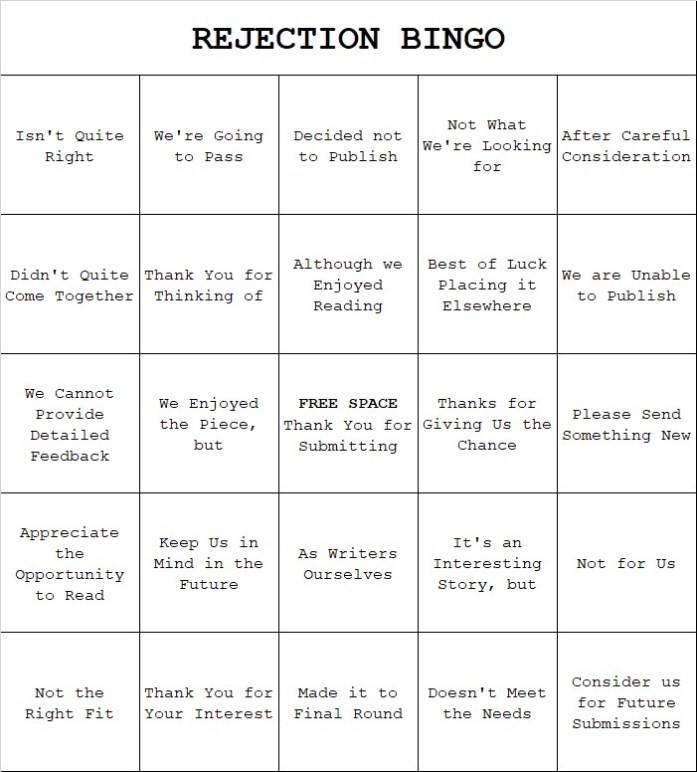
Did I miss any good/common phrases for my rejection bingo card? Let me know in the comments, and I’ll consider an edit.
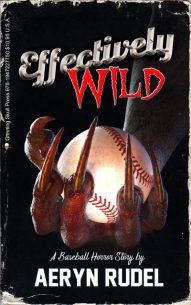
Effectively Wild – A Baseball Horror Story
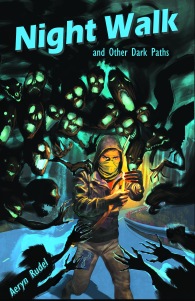
Night Walk & Other Dark Paths
Acts of War: Flashpoint

Acts of War: Aftershock

Acts of War: Stormbreak

 Aeryn Rudel's Rejectomancy