
A Week of Writing: 1/27/20 to 2/2/20

Well, I got the lead out last week and managed to make progress in a number of areas. Here’s how I did.
Words to Write By
This week’s quote comes from novelist E. L. Doctorow.
Planning to write is not writing. Outlining, researching, talking to people about what you’re doing, none of that is writing. Writing is writing.
-E. L. Doctorow
I think there’s something quite valuable in this quote by E. L. Doctorow. What I take from it is a warning against a very specific and subtle form of procrastination: overplanning. You can fall down a rabbit hole of research and outlining that while valuable (and I say this as a strict outliner) must give way at some point to, you know, actually writing the book. For me outlining is a crucial step that reveals much of the story before I start plodding away at the first draft, but I can get caught up in a kind of tinkering that’s probably best done in the draft. In other words, it’s easy to tell myself I need to keep preparing rather than committing myself to the terrifying task of writing.
The (New) Novel
Finished off the second act in the outline last week, and I’ll compete the third act and the outline this week. I have a plot issues to work out in the transition from act two to three, and that’s why I’m not finished outlining yet. I think I know how to resolved it, though, and I’ll see how that resolution looks on the page in the next couple of days.
Short Stories
Finally got motivation in the ol’ short story department and sent out some submissions.
- Submissions Sent: 4
- Rejections: 1
- Acceptances: 0
- Publications: 0
- Shortlist: 0
Four submissions is a solid week, and I ended up with nine for January, which is on pace for one-hundred subs for the year. I have so far sent one submission in February, but there a couple of flash contests this month that’ll push that total up. I also have a brand new story making the rounds and collecting rejections, and that’ll swell my February submission total as well. Only one rejection last week, but I’ve got a bunch pending that are past the standard response time for the publisher, so I expect a deluge of responses soon.
Microfiction
Here’s another batch of #vss365 microfiction. I struggled with a few of the prompts, and, well, this ain’t my best work. Still, it’s a good exercise, and that’s really the point.
“What is this one, Sam? Nine?”
The old hitman sipped his scotch. “You wound me, Rico. This is our tenth.”
“Apologies.” Rico lifted his martini. “To another year of trying to kill each other.”
Sam clinked his longtime foe’s glass with his own. “Happy #adversary, Rico.”
After each one I tell myself I’m in control and not the thing that lives in my head. I clean up the blood, destroy the evidence, cover my tracks. Then I dig a hole, and with each shovelful of dirt over yet another body I repeat my mantra. I #could stop if I wanted to.
“How big you think Tony the Giant is?” Sal asked.
Lucky rubbed his chin. “Well, you’re large, I’m huge, and, you know Cossack Carl?”
“Yeah.”
“I’d say he’s gigantic.”
“Tony’s bigger than all of us,” Sal said.
Lucky nodded. “I’d put him at #tremendous at least.”
My parents only wanted one child, but they had twins. Ever the pragmatic scientist, my father put my brother in a nutrient vat and let him grow. On my 18th birthday we were introduced. Dad said, “He’s an insurance policy. You never know when you’ll need an #extra part.”
When Max was born he had #rosy cheeks, chubby little legs, and a mouthful of shark-like teeth. He’s six now, and I tell him he’s a good boy. I also ignore the missing pets in the neighborhood or how he watches the other kids play, clacking his teeth together and drooling.
“You remember the #script?” Sal asked.
Lucky snorted. “Yeah, it’s one line.”
“So say it like we practiced. It’s a branding thing.”
“I got it. No sweat.”
#
Lucky kicked open the door and pointed his pistol. “Mr. Ranello, I’m kill to here you!”
“Goddamnit, Lucky.”
Max Sims killed five people with a claw hammer. Through the one-way glass he looks normal, like a man in full possession of his #sanity. I know the type. When I sit down to question him, he’ll pick at the blood beneath his fingernails and act like I’m the one who’s crazy.
Goals
Once again, I aim to finish the outline for the new novel and send more submissions out. I’m shooting for three submissions at a minimum, and I think that’s doable.
That was my week. How was yours?
Aeryn’s Archives: Cowtown

Today’s installment of Aeryn’s Archives continues a trend of firsts. My comedy/horror story “Cowtown” was the first story I published with The Arcanist and the first story they published after launching. In the ensuing two years and change, The Arcanist has become one of the best damn flash fiction markets in the industry. Now, here’s a cow.

So a little about how this story came to be and how it ended up at The Arcanist. Like the vast majority of my published flash fiction “Cowtown” started out as a one-hour flash fiction contest/writing exercise. I honestly don’t even remember what the prompt was, but I do remember it reminded me of my hometown of Modesto, California, which has a ton of dairy farms. In fact, my uncle owned a small one, and I spent no few summers bucking hay and trying not to get cow shit on my shoes. Anyway, the myth of the chupacabra is one of my favorites, and I thought it would be fun to do a “mistaken identity” story with that particular beastie.
How did the story end up at The Arcanist? Back in 2017 I was perusing the “Fiction Markets Added” section at Duotrope, as I often do, when I saw a new and interesting publisher. A couple of things caught my attention immediately. One, they were a flash fiction market. (Hey, I write flash fiction.) Two, they published fantasy, sci-fi, and horror. (What do you know; I write all three.) And, finally, three, they paid. (I like money.) So off I went to read The Arcanist’s guidelines. I found a professional and well-organized site with clear (and fair) guidelines, and I had just finished a slightly cooky flash piece I thought might be a good fit. My only hesitation with sending “Cowtown” was it’s comedic element. Now everything in publishing is subjective, but I find humor is VERY subjective. Luckily, the folks at The Arcanist share my (warped) sense of humor, and “Cowtown” ended up being the first of three horror/comedy pieces I published with them. (The other two are “Do Me a Favor” and “Small Evil”.)
Again, it was an honor to be the first story at The Arcanist, and it’s been great watching them grow and watching so many of my writer friends get published there too.
Anyway, you can read “Cowtown” by clicking the links scattered throughout this post, the big one in red below, or, if you prefer, the giant cow above. 🙂
A Week of Writing: 1/20/20 to 1/26/20

This is one of those weeks where I’m almost ashamed to post. To say I did not accomplish what I set out to accomplish is an understatement. That said, accountability (and shame) can be particularly motivating. 🙂
Words to Write By
This week’s quote comes from one of my favorite writers and dispensers of writerly wisdom, Elmore Leonard.
“I don’t think writers compete, I think they’re all doing separate things in their own style.”
-Elmore Leonard.
I really like this quote because it addresses a fear I think every author has, especially when you’re starting out. That fear is that you’re writing something exactly like another author or that by sharing your ideas they might be stolen. I think the truth is simply that if you gave two authors the same premise and had them write novels, you’d end up with two wildly different stories. Once you actually develop something resembling a style of your own, everything you wrote is probably going to sound much different than another author, even if the concepts and tropes are identical. I mean, think about how many vampire and zombie novels are out there. With a few rare exceptions, there’s not a lot of new ground to cover with those particular monsters, yet authors keep (sometimes quite successfully) putting their own stamp on them. So write what you want and don’t worry about what other folks are writing. Yours will be yours and theirs will be theirs, and there’s plenty for room for both.
The (New) Novel
The outline continues, far slower than I would like, but some progress was made last week, mostly with figuring out character motivations and the like. It’s important work, but it bugs me I didn’t get more done. These little hiccups are part of the process I’ve found, and it’s important to not let them deter you. So this week I’ll be forging ahead and focusing on wrapping up at the end of the week.
Short Stories
Yeah, this is pretty depressing. Nary a submission to be found.
- Submissions Sent: 0
- Rejections: 0
- Acceptances: 0
- Publications: 0
- Shortlist: 0
Very quiet week. I didn’t even get a rejection, which is odd when you have nine subs pending. I have that sinking feeling the rejections are coming, maybe all at once. I still have time to hit my monthly goal, but I need to get moving. The good news is I did finish two new short pieces I can polish up and start submitting, so, hopefully, I’ll get those January submission numbers up.
Microfiction
I think this week’s batch of #vss365 microfiction is pretty solid, better than last week’s anyway. I believe the January 25th entry is one of the better micros I’ve written in a while. Anyway, click the links in the dates to go to the tweet and like, retweet, etc.
His murders stank of #jasmine. The smell floated on top of the latrine odor of death, mixed with it, until the combination was fouler than dime store perfume or the ruptured bodies beneath it. Now, over twenty years later, even a hint of jasmine makes me want to vomit.
The big mule Sir #Obstinate listened only to our son James. The beast followed him everywhere, obeying every command. When brigands killed James, Sir Obstinate disappeared. We found him days later, his corpse hacked and bloody, six brigands crushed dead beneath his hooves.
“He talk yet?” Sal asked.
“Nah, still doing the crying and begging #rigmarole,” Lucky replied.
Sal tapped the magazine he was reading. “Says here the key to communication is honesty.”
“Well, I told him I’d honestly beat him to death, then he honestly shit himself.”
My mind blares with a #cacophony of foreign thoughts. It’s disorienting at first, but I quickly separate the good from the bad. Thoughts of impending violence I lace with telepathic poison and send back to their owners. The stroke usually keeps them from hurting anyone.
When people complain “That’s not supposed to #happen!” I laugh and show them the scar behind my right ear where I was struck by lightning in ’97. If they’re unconvinced, I pull up my pant leg so they can see the chunk I lost to a great white in ’01. That usually does it.
At my tenth birthday party I was angry I didn’t get a new bike. Instead my parents hired a magician. He asked how he could #amaze me; I said make Mom and Dad disappear. For thirty birthdays I’ve told myself the car accident wasn’t my fault. Some years I almost believe it.
“Anything in our #range interest you?” the Best Possess salesman asked.
Moloch glanced at an array of inert, youthful human bodies. “Anything older?” the demon said. “After five millennia I feel I’m just not possessing these twenty-somethings to their full potential.”
Goals
Finish. The. Outline.
Send. Submissions.
Yep, that about covers it. 🙂
That was my week. How was yours?
A Week of Writing: 1/13/20 to 1/19/20
One more week of writing in the books. Let’s see how I did.
Words to Write By
This week’s quote comes from novelist Hallie Ephron.
“Outlining is like putting on training wheels. It gives me the courage to write, but we always go off the outline.”
– Hallie Ephron
Since I’m deep into the outlining stage of my novel, I really like this quote from Hallie Ephron. I outline for a number of reasons, and one of them is it lets me dip my toe into the story before I dive into the deep, cold water of the first draft. It’s that training wheels aspect from the quote. Sure, an outline has a ton of other benefits too. It gives me a roadmap to write the story and lets me work out some of the plot and character issues before I get into the thick of a draft. Still, I do find, as Hallie Ephron says, that the outline gives me the courage to write the book and the courage to stray from it when the novel and its characters need to go off script.
The (New) Novel
I’ve mostly outlined the first act of the novel, and I like where it’s headed. I’ve also done some character plotting, using aspects of my own experiences in certain things for the background of the protagonist. My hope there is her backstory and motivations will ring truer to the reader. My outlines are always three acts and thirty chapters, so I’ve still got a bit of work to do. I hope to finish up by early next week with an outline that clock in between 8,000 and 10,000 words.
Short Stories
A sad week for short story submissions, unfortunately, as I didn’t send a single one.
- Submissions Sent: 0
- Rejections: 1
- Acceptances: 0
- Publications: 0
- Shortlist: 0
I need three more submission this month to stay on pace for one-hundred for the year. One would think I could do that, but we’ll see. The rejection was a simple standard form rejection of no particular note. I might pad my monthly total with a few reprints, as there’s a few anthologies coming that might work for some of the horror stories I’ve sold in the past.
Microfiction
Here’s this week’s batch of #vss365 microfiction. I’ll admit I struggled a bit with the prompt words this week (a failing entirely my own and not the prompter’s), so it’s not my brightest and best bunch of micros. I do like the last one, though. As usual, you can click the link in the date to go to the specific tweet.
“Look at that beautiful #opaline sky.”
“Opaline? It’s gray. It’s always GRAY.”
“Nah, you just have to learn to appreciate the weather here in Seattle.”
“Weather? WEATHER?! Weather changes, dude. This shit hasn’t budged from morbid murder clouds for six fucking months!”
He found the first growth on his palm. Hers bloomed on one pale cheek. They sat in the warm dark apartment, watching their growths multiply and extend #fibrous tendrils that laced together and intertwined. Soon, they were bound together by malignancy, closer than ever.
“Is that a revolver?” Lucky asked.
Sal drew the old single-action from its holster with a #flourish. “Yep, gonna try something new.”
“What? Like a gunfight?”
“Uh huh. I wanna see how fast I am.”
“Sal, it ain’t a good sign when just murdering folks loses its thrill.”
We had shelter, food and water for a lifetime, but as the immediate danger passed and years mounted, we all felt a terrible #yearning. The grim truth inside our concrete savior loomed over everything, and one by one we chose a quick end over decades of pointless survival.
The ancient ruins on the planet’s equator indicated a #riparian culture. The towering idols and strange domed structures hinted at a deeply religious society. Lastly, the mangled remains of the inhabitants spoke of a people plagued by sins we humans could easily recognize.
All contact guys drink. Unless you’re a psychopath, you gotta quiet the demons. But it makes you sloppy, #muddles your thoughts, puts you in situations that’ll get you killed. The truth is you hope for those situations. The drink just gives you the guts to look for them.
I’m not as #articulate as I once was. The bullet they dug out of my skull makes thoughts and words distant cousins at best. I don’t really need to speak, though. As I thumb back the hammer and point my pistol, the man who tried and failed to kill me understands perfectly.
Goals
Outline, outline, outline. Then, in between outlining, finish a short story or two and submit them. It would be great to finish the outline by the end of the week, but I feel like it might take me a tad longer.
That was my week. How was yours?
The Way I Write Part 4: Something Resembling a Style
Over the past month I’ve explored my writing as it’s developed these past twenty years. I’ve been using the Flesch-Kincaid readability scores and the old fashioned eyeball test to chart changes in my work. We’ve looked at some of very early pieces, purple and laden with adjectives, a more transitional phase where I started to reign in my wordier impulses, and then some of my published work, where my voice and prose began to resemble something similar to how I write today. In this last post we’ll look at recent work, and see how the writer I am today is different from the writer I used to be.
Before we get into to those recent examples. Here are the other posts in this series for reference.
- The Way I Write Part 1: The Early Years
- The Way I Write Part 2: Evolution
- The Way I Write Part 3: Refinement
“Night Games” (circa 2014 A.D.)
This is passage from my short story “Night Games,” which I completed in 2012 and sold in 2014 (after a revision or two). I sold it again to Pseudopod in 2016 (click this link to listen). “Night Games” is an important story to me because it’s one of the first pieces I wrote where I really felt like I knew what I wanted the story to accomplish, and then I went and did that (and it mostly worked).
Randall Simmons only plays night games. As he steps into the right-handed box and taps his bat on the plate, he reminds me why. His smile, aimed at the pitcher’s mound, is wide and predatory. The bright stadium lights catch for a moment on his teeth. Even from 60 feet, 6 inches away, those teeth are too long and too sharp.
Randall is showing me his secret smile, some of it anyway. His smile is for me because I’m here to preserve the Kansas City T-Bones’ one-run lead in the top of the ninth against his team, the Wichita Wingnuts. It’s also for me because I’m the only person in the stadium who knows Randall Simmons is a vampire.
Anytime I step out of the bullpen it’s a big deal. It’s a chance to earn a save, win the game, and even make someone notice a washed-up twenty-five-year-old pitcher trying to make it to the bigs. That’s a tall order in the independent leagues, where dreams of big-league baseball and big-league money go to die. Unlike most nights, I’m not thinking about my fastball, my curveball, or the good slider that got me drafted by the A’s five years ago. I’m thinking once the game is over Randall Simmons will kill me.
I’d had the idea for this story rattling around in my brain for a few years, and then one day it all clicked, and “Night Games” became a thing. I’d say it’s the first story I published in, well, my current era of writing, for lack of a better word. With this story I started to figure out what my strengths were and how best to utilize them, but let’s have a look at the numbers.
- Passive Sentences: 0%
- Flesch Reading Ease: 73.3
- Flesch-Kincaid Grade Level: 7.0
You might notice those numbers are a little higher than where I was trending in the last post. The difference here is that I am trying for a specific voice, one that’s going to come across as technical and a little wordy (baseball is a pretty nerdy sport). That voice is borne out in the numbers, but, as opposed to the wildly purple prose of my stories from the early aughts, this is still very readable.
Let’s move on a couple of years and look at another piece.
“Scare Tactics” (circa 2016 A.D.)
With this story I started using a voice and style that is very much what and how I enjoy writing. This story is one of the first of my horror/noir/urban fantasy mashups that features a healthy dose of black humor. It’s also one of my most successful stories, as I’ve sold it three times. The Dunesteef did a great little audio version of the piece you can listen to right here.
She got out of the car, popped open the trunk, and made a face at the awful stink within. A pungent mix of the worst fart overlaid with rotting meat and old garbage wafted up from the dark enclosure.
“Jesus,” Lindsey said, covering her mouth. “Can’t you control that?”
A jumbo-sized Raggedy Ann doll that had seen better days lay face-up in the trunk. Moth holes pocked its pinkish cotton, and its once-bright dress was dirty and stained. Only the red yarn hair retained its original color.
Adramelech’s voice drifted up from the doll, faint and irritated. “You know I can’t help it. You keep a demon in physical form, you get the stink. That’s the way it is. Maybe you shouldn’t stick me in a small, enclosed space.”
“And have that stench up front with me? No thanks. Hey, switch to silent mode. It’s almost show time.”
Ugh, are we doing this again? Adramelech’s voice spoke in Lindsey’s head now, as she’d requested. It wasn’t quite telepathy. He couldn’t read her thoughts, like she couldn’t read his, but they could “hear” each other when they wanted. It’s demeaning, you know. I’m a demon of the first order, a goddamn chancellor of Hell. I’m not some bullshit scare artist.
Lindsey stifled a chuckle. Chancellor, my ass. I’ve read de Plancy. He says you were primarily Lucifer’s fashion consultant.
I had so much fun writing Lindsey and Adramelech, and I’m about to write a whole lot more about them. Anyway, this story just clicked for me, the characters, the subject matter, the genre mashup, all of it. I think a lot of having any success as a writer is figuring out where you belong, and for me, this is probably it.
Okay, what about the numbers.
- Passive Sentences: 0%
- Flesch Reading Ease: 80.5
- Flesch-Kincaid Grade Level: 4.4
Yep, that’s right where I want it. Nice and conversational. These stories have a ton of dialogue (and a fair amount of four letter words), and so they make for quick and, well, easy reading, and that too is where I live now.
One more story.
“A Point of Honor” (circa 2019 A.D.)
The final story is one I published last year, and it’s a bit of a departure for me in genre and tone. It’s near-future dystopian sci-fi that deals with a real-world issue–cyberbullying–in a Twilight Zone-esque manner. You can check it out from the publisher, Radix Media, right here.
Jacob opened his mailbox and froze. The sight of the scarlet envelope between the bills and advertisements twisted his stomach into cold knots of dread. He’d never seen a declaration from the Bureau of Honorable Affairs in person.
Jacob glanced around the street, empty and quiet, terrified someone might see. He snatched the declaration from the mailbox, tucked it into his robe, and hurried inside.
Sara stood at the kitchen counter drinking coffee. “Anything in the mail?”
He pulled the declaration from his robe and tossed it on the counter. It looked like a fresh bloodstain on the white tile.
Sara’s eyes widened and she covered her mouth with one hand. “Why do you have that?”
“I don’t know. I haven’t hurt anyone.”
“Of course you haven’t. You’re a forty-year-old computer programmer.”
He grimaced at his wife’s blunt assessment. “Maybe it’s a mistake. They’re a big government agency. They screw up, right?”
“Yes, a mistake.” Sara seized on this scant hope. “Has to be.”
The difference between this story and “Scare Tactics” is mostly tone. The writing is fairly similar, with direct, even Spartan prose and a lot of dialogue, but let’s check the numbers.
- Passive Sentences: 0%
- Flesch Reading Ease: 75.1
- Flesch-Kincaid Grade Level: 4.5
Yeah, that’s still in what I’d call my sweet spot. The reading ease is a tad higher in this passage, but if you run the entire 5,000-word story its right at 84.
Before I wrap this thing up here are the readability numbers for all the stories in the blog series.
| Date | Story | Reading Ease | Grade Level |
| 2000 | Lullaby | 53.5 | 13.4 |
| 2005 | Rearview | 37.9 | 14.4 |
| 2006 | The Tow | 61.6 | 10.7 |
| 2007 | The Fate of Champions | 62.9 | 8.7 |
| 2010 | Blasted Heath | 75.1 | 6.0 |
| 2012 | At the Seams | 85.8 | 4.7 |
| 2014 | Night Games | 73.3 | 7.0 |
| 2016 | Scare Tactics | 80.5 | 4.4 |
| 2019 | A Point of Honor | 75.1 | 4.5 |
So what have I learned from this exploration of my writing over the last twenty years? I think the easiest conclusion to draw is as the writing became simpler and more direct, i.e., more readable, I started getting published. This is not the only way to get published, of course, but for me, stripping things down, focusing on dialogue and action (things I’m good at) instead of long descriptions and beautiful prose (things I’m NOT good at) has allowed me to publish a fair amount. I’m certainly still a work in progress, and there’s more growing and learning to be done, but I like where I’ve ended up. I don’t think I’m trying to sound like other published fiction (at least not on purpose), and I now have something resembling a style. But who knows? Maybe in five years I’ll change my mind and start trying to sound like H.P. Lovecraft’s dictionary again. 🙂
A Week of Writing: 1/6/20 to 1/12/20
Well, it’s a new year, so it’s time to start accounting for my writing and submission endeavors again. Here we go.
Words to Write By
This week’s quote comes from Vincent van Gogh.
“Great things are done by a series of small things brought together.
– Vincent van Gogh
This one resonates with me at the moment as I start writing another novel. Long-form fiction can be overwhelming, especially if you look at it as a single monolithic piece of work. I finish novels by breaking them down into smaller tasks, manageable bits and pieces, that once assembled create something greater than the component parts. Of course, this is oversimplifying to some extent, but I think the sentiment is sound. I approach a novel in terms of what can I can accomplish today, usually that’s a single chapter or somewhere around 2,500 words. That’s served me well in the past, and I hope it continues to for the foreseeable future.
The (New) Novel
I’ve started a new novel, yet untitled, based around characters from an existing short story. The story in question is one I’ve sold more than any other, and I think it may be the most quintessentially me of all the pieces I’ve written. I’m deep into outlining at the moment, putting together my typical three-act thirty-chapter roadmap for the story. That’ll probably take me most of the week and maybe part of next. Then it’s on to the first draft, which I’ll write at 2.000 to 2,500 words a day, five days a week, until I have a complete novel.
Short Stories
Last year I fell short of my goal of one-hundred submissions by nineteen subs. This year, I plan to stay on track. Here’s how I did last week.
- Submissions Sent: 6
- Rejections: 1
- Acceptances: 1
- Publications: 0
- Shortlist: 0
In truth, one of those six submissions was sent the week prior, but I’ll just count it here. So that’s five submission this week, and one last, which puts me on a very nice pace. I need to be around nine submissions a month to hit my goal of one-hundred. The rejection was your typical, garden variety form rejection, but the acceptance was a good one. It’s a story I shopped quite a bit, and it was even shortlisted at Flash Fiction Online and NewMyths. It’s nice to finally find a home for it. More on that acceptance when it’s published.
Microfiction
I’m writing microfiction everyday over on Twitter based on the #vss365 prompts. Here’s this week’s batch. If you’re unfamiliar with vss365, the hashtagged word in each micro is the prompt word for the day. You can click the link on each date if you wanna throw me a like or a retweet. 🙂
I drag my busted leg behind me. It’s gone numb, but at least I can’t feel the bone grinding into the sand anymore. That’s the least of my worries, though. The excited #yips and howls have grown closer. They smell the blood, the sickness, the meat. I used to think coyotes were cute.
“My shotgun #obviates the need for the .45,” Lucky said and hefted his Remington 870. “Leave it.”
Sal blinked and set down his 1911. “It does what to the .45?”
“You know, obviate. Removes.”
“Those word-a-day shit tickets are really workin’ out for you, huh, Lucky?”
Gary stared up at the new girl, eyes wide, nose gushing blood. At 6 feet tall and 200 pounds, he had ruled the 6th-grade playground, hurting any who resisted his bullying. His #usurper was half his size but had a boxer’s grace and a roll of quarters in each clenched fist.
She defied her opponent’s sword, his height and reach, with #kinetic and overwhelming skill. His feet and hands blared his intentions like a neon sign, heralding a clumsy thrust. With a languid turn of her shoulder, she slipped his blade and filled his heart with steel.
I’m not #inquisitive. That’s why I’m still here and all my friends are gone. Jon asked what they were. Amy wanted to know why they’d come. I just worked the jobs they gave us, ate their food, and kept quiet. Now, alone, I do have a question. What’s the point of going on?
“What do you tell people when they ask what you do?” Lucky asked and took a drag from his cigarette.
Sal shrugged. “The truth. I tell ’em I’m a contract killer.”
“And that doesn’t freak people out?”
“Nope,” Sal said and grinned. “Death makes for a #lively discussion.”
After he finished his work, rinsed off the blood, and disposed of the body, he would sink into a quiet #languor and ignore the terrible presence squirming beneath his skin. He’d feed it’s urges eventually, but the blessed peace following a kill made him feel almost human.
Goals
Continue outlining the new novel is priority one, but I need to finish some short stories if I want to keep up my submission pace. I have a number that are half-finished, and I’ll aim to complete at least one this week.
That was my week. How was yours?
The Way I Write Part 3: Refinement

Once more we’re taking a look at my writing as it’s progressed over the last twenty years to see how it’s changed and if it’s improved. The first post focused on pretty amateurish works of fiction from the early aughts. The second post jumped ahead a few years and we saw what might be called an evolution of style and voice. Still, the fiction in these first two posts was flawed, overly wordy, and pretty much the polar opposite of how I write now. In this post, we’ll jump ahead a few more years, starting with 2010, and see what’s changed.
“Blasted Heath” (circa 2010 A.D.)
This passage is ones of the first bits of fiction I wrote for Privateer Press, not too long after I took the position of editor-in-chief for No Quarter Magazine. This was a bit of league fiction supporting the organized play of the tabletop miniatures games WARMACHINE and HORDES.
Grim Angus stared at the faint tracks in the muddy ground, rubbing his chin with one blunt-fingered hand. He’d expected to find skorne tracks—the Bloodmseath was full of the murderous bastards—and maybe even tracks of the few humans that lived in the marsh. But these weren’t skorne; neither were they human or trollkin.
By the size and spacing of the tracks, Grim counted two dozen man-sized creatures. The depth of the depressions on some of the tracks suggested armor, and heavy armor at that for such narrow feet to leave lasting impressions in the swampy earth. Others tracks were fainter, left by lighter armored troops – scouts perhaps.
“What’s that, Grim?” A deep, gravelly voice asked over Grim’s shoulder. A resounding thud that shook the ground followed the question.
Grim sighed, stood, and turned to address the speaker. Noral Stonemapper was an immense trollkin, easily seven feet tall and so stoutly muscled he was often mistaken for a full-blood troll. The huge trollkin was a krielstone bearer. His honored burden, a six-hundred-pound chunk of granite inscribed with the great deeds of trollkin heroes, was sunk a full foot into the mossy sward in front of him.
What I like about this piece, as opposed to the earlier passages I’ve shown, is I’m definitely starting to simplify, to edit down, especially when the voice of the character demands it. In this case, Grim Angus, a trollkin bounty hunter, and a stoic and pragmatic one at that. In addition, this just sounds more like the stuff I currently write, but let’s look at the numbers.
- Passive Sentences: 6%
- Flesch Reading Ease: 75.1
- Flesch-Kincaid Grade Level: 6.0
Now that, folks, is pretty damn readable, and it’s well within the parameters of most published fiction. Additionally, if you look at the stuff I’m writing for Privateer Press today it’s within this range, so as far back as 2010 I was starting to dial in my fantasy fiction voice. Now let’s look at something in another genre.
“At the Seams” (circa 2012 A.D.)
This is from one of the first pieces of flash fiction I wrote back in 2012. I initially wrote it as apart of a one-hour flash fiction contest, and the following passage comes from that first draft.
My head is throbbing now, but I have to maintain focus. If I let the thought slip for just an instant, I’ll lose something—maybe just a bit of fingernail or a few flakes of skin and maybe a whole lot more. I almost look down at the smooth stump where my left foot used to be but manage to avoid it. I’d like to hold on to my right foot a little longer.
In the end, I know it’s pointless. How long can you keep thinking about not falling apart? How long can you think about any one thing at all? It’s not really possible. The mind wanders, and you just can’t—
Blinding pain in my right hand wrenches me away from thinking about thinking. I look down to see that my right index finger now ends after the second knuckle. The rest of the finger lies on the floor. There’s no blood or anything, just a clean separation, as if my finger never had that extra inch of flesh and bone.
If you were to look at a some of my fiction now, I think you’d see a lot similarities, but let’s look at the numbers.
- Passive Sentences: 0%
- Flesch Reading Ease: 85.8
- Flesch-Kincaid Grade Level: 4.7
Yep, this is pretty much where I live now. Sure, the occasional story goes a bit higher or even a bit lower on the readability scale, but for the horror, crime, and even sci-fi I write these days, this is my happy zone. My style has grown into something you might call streamlined, hell, even straightforward (I can even live with Spartan), and I’m happy with it. One other thing to note is I published this story with The Molotov Cocktail in 2013, my first flash fiction publication.
Well, I think the improvement between 2007 and 2010 was a big one, and it’s pretty clear my style became much more streamlined, less wordy, and well, actually publishable. Again, for reference, here are the readability score and dates for the excerpts we’ve covered so far.
| Date | Story | Reading Ease | Grade Level |
| 2000 | Lullaby | 53.5 | 13.4 |
| 2005 | Rearview | 37.9 | 14.4 |
| 2006 | The Tow | 61.6 | 10.7 |
| 2007 | The Fate of Champions | 62.9 | 8.7 |
| 2010 | Blasted Heath | 75.1 | 6.0 |
| 2012 | At the Seams | 85.8 | 4.7 |
In the final post in this series, I’ll look at stories I’ve actually published in the last few years and see if we can detect any further improvement.
Aeryn’s Archives: At the Seams
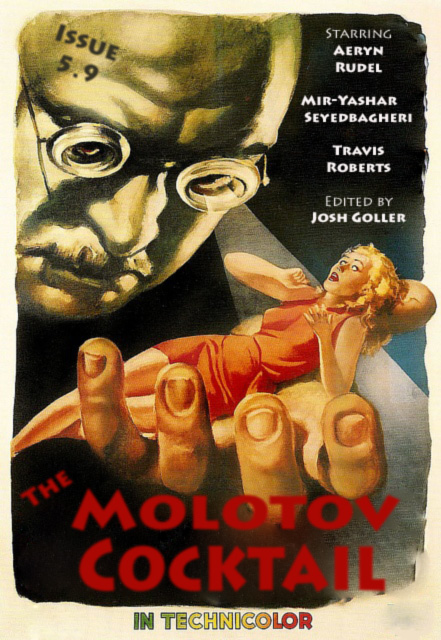
Today’s installment of Aeryn’s Archives features my very first flash fiction publication back in August of 2014, a weird little number called “At the Seams.” It was published by the good folks at The Molotov Cocktail, who have gone on to publish me another dozen times. Let’s have a look.

So how did this publication happen. Well, that part’s simple. I submitted a story, the editors liked it, and they published it. What’s more interesting, though, is how I started writing flash fiction in the first place. That actually took some convincing. I was working at Privateer Press at the time, and a number of the writers and editors there were participating in a bi-weekly one-hour flash fiction competition over on the Shock Totem. (Shock Totem is a horror magazine that sponsored the contest on their forums). Well, my colleagues said I should give this flash fiction thing a try. I don’t remember exactly what I said, but it was probably something like, “Fiction in a thousand words? How ridiculous!” (I know; joke’s on me, right?) They twisted my arm a bit more, and finally I took the plunge. After that first sweat-soaked, anxiety-wracked hour of trying to throw together a cohesive story, I was hooked. I started doing the flash fiction contest every other week, and I even ran it for a while. Hell, I still do it with my current writing group, and a good portion of my published fiction began life as a one-hour scribble.
Anyway, one of the best things about the one-hour contest is that it pushes you to write outside your comfort zone, and for me, weird is definitely outside my comfort zone. “At the Seams” is decidedly weird, and I think that’s what The Molotov Cocktail dug about it. I’m so glad I started writing flash fiction and that I discovered the wonderful folks over at The Molotov, who have graciously continued to publish me fairly regularly over the last six years.
You can read “At the Seams” by clicking the big ol cover illustration above or the link below.
2019 Writing Rearview Review

Well, it’s that time of year when writers the world over tell you all about the stuff they wrote and published for the prior year. So here I go! 🙂
Short Story Submissions
Okay let’s start off with short story submissions, rejections, and acceptances:
| 2019 | 2018 | Difference | |
| Submissions | 81 | 120 | -32% |
| Rejections | 61 | 100 | -39% |
| Acceptances | 14 | 19 | -26% |
| Accept % | 17% | 16% | +1% |
| Publications | 17 | 16 | +6% |
As you can see, my production in 2019 was down significantly from 2018. The only thing that increased were the number of publications and my actual acceptance percentage, which is good, though I can’t help but think if I’d had the same output in 2019 as I did in 2018, I might have 20+ acceptances for the year (or maybe just 20 more rejections).
So, why fewer submissions this year? Mostly because I was focusing on long-form fiction, a novel, and more specifically revising that novel, and it ate up a lot of time. Also, I didn’t write much new stuff, and the new stuff I did write was, well, harder to sell until I figured out where I should be sending it (that happened late in the year). The truth of the matter is that some of the old stories I’ve been shopping probably need to be retired, and I need a new crop of pieces for 2020.
Words, Words, Words
Okay, so the above is what I submitted, but how much did I actually write in 2019? Let’s have a look.
- Written in 2019: 183,632 words
- Published in 2019: 90,494 words
- Written AND Published in 2019: 74,978 words
That total written number includes 54,745 words of blog posts, 12,455 words of microfiction, and 6,950 words of stories I began but did not finish (yet). The published numbers do NOT include blog or microfiction totals. I spent a lot of time revising my novel and a bunch of old stories, but it’s hard to quantify that in terms of words written. It feels like another 50,000 or so, but, hell, it could be 100,00 for all I know. Anyway, I stuck with the most easily quantifiable numbers.
Those numbers on a whole aren’t bad, but if you look a little deeper, there are some things I want to change for 2020. For example, of the words written and published in 2019, a measly 2,068 came from submitted short stories, the rest are the novel I wrote for Privateer Press. I simply did not write enough new material this year. Most of my short story publications came from material I wrote last year or the years before. I need to finish and write more new stories for 2020 and stop being lazy and trying to sell old stories that, well, aren’t selling.
There were 260 work days in 2019, and I average a bit over 700 words for each of those days. I’d like to get that up to 1,000 in 2020. That shouldn’t be too difficult, as I’m starting a new novel and revising another.
Goals for 2020
You gotta have goals heading into the new year, right? Well, here are the broad strokes of a few things I’d like to accomplish in 2020.
- Write and submit more short stories. Let’s say a solid 100 submissions and at least 20 new stories. This year, I’d also like to crack more pro markets. You know, markets like Fantasy & Science Fiction, or The Dark, or Nightmare, or any of a dozen others. That’s no small feat, and I know I’ll need to up my game, but I think I learned a thing or two in 2019 that might give me a fighting chance. We’ll see.
- Release at least one short story collection. I’ve been threatening to do this for years, and now that I have enough published pieces for a respectable page count, it’s time to pull the trigger. Gonna shoot for first quarter, but I won’t hate myself too much if it’s second quarter.
- Write a new novel and revise the one I have. I spent a lot of time last year revising my novel Late Risers, but it’s still not where it needs to be, so I’m taking a short break from it and I’m writing another novel, something more inline with what I normally write, more me. That’s not to say that Late Risers isn’t me, just that it’s more experimental, and I struggled with it in places. So the goal is to write the new novel in the first quarter of the year and return to Late Risers after that. It generally takes me about two to three months to bang out a first draft of a novel, so this should be an achievable goal.
- Redesign Rejectomancy. The blog needs a fresh coat of paint and slight refocus in 2020. Don’t worry; it’ll still be chocked full of rejections and advice about rejections and all that jazz, but you might have to endure a few more shameless plugs of *gasp* my own writing. 🙂
And that’s my rambling review of 2019. How was your year? Tell me about it in the comments.
The Way I Write Part 2: Evolution

Last week, I delved into the earliest existing examples of my fiction (all unpublished) to see how and what I was writing back in the early aughts. I gave examples from two short stories and used the Flesch-Kincaid readability scores, plus the old-fashioned eyeball test, to gauge the quality and publishability of what I was churning out back then. To refresh your memory, both stories were crazy wordy and very purple. If you’d like to see for yourself, check out The Way I Write Part 1: The Early Years.
Now we’re going to jump ahead a few years and look at two more pieces (still unpublished) and see if I improved at all. One quick note, I was working and publishing in the tabletop gaming industry during this time, but that is a decidedly different kind of writing, and these posts will focus solely on narrative fiction.
“The Tow” (circa 2006 A.D.)
This passage comes from a 3,500-word story I wrote in early 2006. I remember when I finished this one I really thought I had something, but I was still too chickenshit to submit it. Of course, what follows is not publishable, but let’s take a look and see if the work has improved at all.
Jack owned the only towing service in town, and for that matter, the only tow truck. Most of his time was spent hauling the broken-down junkers that dominated the streets of Arbuckle, dragging their rusting metallic carcasses to the scrapyard, or, if the owners had any money, to Kyle’s Repair. But this tow was different. The call he received from Norman Gaston at the Lucky Load this morning offered Jack the rare opportunity to make some real money from his small impound yard.
Jack could not suppress a smile when he thought of the exorbitant amount of money he was going to charge the owner of the Mercedes to get it out of hock. He figured a person who owned a car like that was bound to have enough spare cash to make Jack’s morning one of the best he’d had in weeks. He sat for a moment behind the wheel of his modified Ford F-650 super cab, idling thirty feet away from the Mercedes, soaking in the sight of the lonely German luxury car. He was grinning and imagining crisp hundred-dollar bills floating out of an expensive alligator skin wallet and into his own dirty canvas and Velcro rig. He savored his good fortune a minute longer, then put the truck into gear and rolled forward to claim his prize.
What I think is interesting about this passage and what surprised me when I dug it up is that it’s kind of an embryonic version of how I write now. Yeah, it’s still too wordy and it’s definitely clunky in places, but there’s more and better interiority that creates something that could be called a voice. Anyway, let’s look at the numbers.
- Passive Sentences: 0%
- Flesch Reading Ease: 61.6
- Flesch-Kincaid Grade Level: 10.7
This is a definite improvement over the two stories from my first post. Both of those had reading ease score below 55 and grade level scores above 13 (college textbook density). This is better. Not perfect by any stretch, but better. All that said, I love the concept in this story (which you can’t really see from the excerpt), and I’ve started rewriting this one from scratch.
Let’s jump ahead to 2007, switch to fantasy, and see if things improve further.
“The Fate of Champions” (circa 2007 A.D.)
This passage is from an unfinished story I began in 2007. It is decidedly high fantasy and thus includes some fantasy tropes (like long, impossible-to-pronounce names) that tend to bloat readability scores.
Umbar stared up at the ragged battlements of Illumar’s Shield, counting the wasted, ashen faces staring down at him. The fortress had once been a shining beacon of purity and law, its white towers gleaming like the halo of Illumar himself. It was now a decrepit, magic-scorched wreck. Still, the walls had held. After six months of relentless pounding, both magical and mundane, Illumar’s Shield stood defiant of everything Umbar had thrown at it.
A single arrow soared out over the battlements, wobbling in its flight from the unpracticed hand that had loosed it. The shaft, guided by luck or perhaps even the vengeful hand of Illumar himself, struck Umbar’s blackened steel breastplate with a hollow clang. It had been a simple hunting arrow with a blunt iron point, and it failed to pierce Umbar’s armor, doing little more than adding yet another scratch to its battle-worn surface.
Hey, now we’re getting somewhere. It’s not perfect, and it’s still far wordier than I write today, still pretty clunky in spots, but this more readable than the earlier excerpts (once you get past the names). I even like some of the imagery here, and I’m not wracking the poor sentences (as much) to do it.
Let’s have a look at the numbers:
- Passive Sentences: 0%
- Flesch Reading Ease: 62.3
- Flesch-Kincaid Grade Level: 9.1
That’s a definite improvement, and it’s getting closer to what you might actually find in popular fiction, especially fantasy. One interesting thing here is that you see a divergence of styles. The first excerpt is the beginning of how I writing everything but fantasy, and the excerpt above is the beginnings of a style I used at Privateer Press for the steam-powered fantasy setting of the Iron Kingdoms.
There’s improvement in these two excerpts over the very early ones from the first post. The work is becoming less wordy, more readable, and, dare I say, more publishable (but not actually publishable yet) than what I was doing a few years earlier. So, yeah, I’d call this improvement, positive yardage, or, you know, an evolution. For reference here are the readability score and dates for the excerpts we’ve covered so far.
| Date | Story | Reading Ease | Grade Level |
| 2000 | Lullaby | 53.5 | 13.4 |
| 2005 | Rearview | 37.9 | 14.4 |
| 2006 | The Tow | 61.6 | 10.7 |
| 2007 | The Fate of Champions | 62.3 | 9.1 |
Next time we’ll look at some of the first short stories I actually published and see if those readability scores improve further.
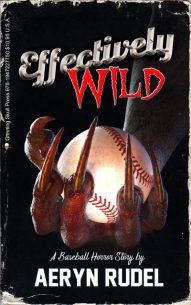
Effectively Wild – A Baseball Horror Story
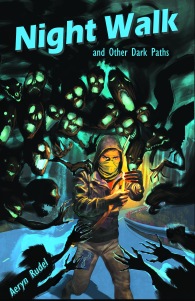
Night Walk & Other Dark Paths
Acts of War: Flashpoint

Acts of War: Aftershock

Acts of War: Stormbreak

 Aeryn Rudel's Rejectomancy