
September 2016 Submission Statement

September was a solid month, and my progress with short story submissions was much less sloth-like than previous months. It’s a mixed bag this time, with rejections, acceptances, and some noteworthy publications.
September Report Card
- Submissions Sent: 7
- Rejections: 5*
- Acceptances: 1
- Other: 0
- Publications: 2
*Three (3) of these rejections were for submissions sent in September.
Rejections
Here we go. This is what Rejectomancy is all about! Five rejections this month; let’s have a look.
Rejection 1: 9/3/16
Thank you for your submission to XXX.
We regret that we are unable to publish “XXX” We are grateful for the opportunity to consider it, and we wish you the best of luck in placing it elsewhere.
A common form rejection from one of the bigger horror markets. Nothing much to see here, really, and I’ve received this exact rejection numerous times. This will be a running theme for September, by the way.
Rejection 2: 9/3/16
Thank you for your interest in XXX, unfortunately, your story does not fit our needs at this time.
As this is a brand new publication with no real backdrop of study, you should not take this rejection personally. Please submit again in the future, however, no sooner than 20 days from the date of this notice.
The 3rd was a multiple-rejection day, and this one is from a brand new market. It’s a pretty standard form rejection, but I like the note they tacked on at the end. I don’t put a lot of stock in this canned niceties you often see in rejection letters, but this is always good advice. Rejections are NOT personal.
There’s one other thing about this rejection that’s a bit different. They ask you not to resubmit for a period of 20 days. It’s not uncommon for publishers to do this, though I usually see it in their submission guidelines. I think it’s a good idea for a publisher to remind writers of this particular rule in a rejection, since it’s likely you haven’t looked at the publisher’s guidelines in quite some time, and the rejection will be fresh in your mind.
Rejection 3: 9/12/16
Thank you for the opportunity to read “XXX.” Unfortunately, your story isn’t quite what we’re looking for right now.
In the past, we’ve provided detailed feedback on our rejections, but I’m afraid that due to time considerations, we’re no longer able to offer that service. I appreciate your interest in XXX and hope that you’ll keep us in mind in the future.
Remember that theme I talked about in rejection number one? So, I finished a new story this month, and, as I usually do, I’m sending it to all the top-tier markets that accept horror. These are all exceedingly tough markets to crack, and I’ve received lots of form rejections, like this one, from all of them. Anyway, this is another standard form rejection. Moving on.
Rejection 4: 9/14/16
Many thanks for sending “XXX”, but I’m sorry to say that it isn’t right for XXX. I wish you luck placing it elsewhere, and hope that you’ll send me something new soon.
Another standard form rejection from a top-tier horror market for the same story as the previous rejection. What’s great about these markets is they’re really fast, usually taking no more than a couple of days to send a rejection. So, I can usually hit three or four of them in the same week.
Rejection 5: 9/15/16
We have read your submission and will have to pass, as it unfortunately does not meet our needs at this time.
Remember when I said these top-tier markets are quick? This one is by far the quickest, and this rejection came within an hour and a half. That’s not even my record for this publisher. I once received a rejection in 46 minutes. I honestly don’t know how they do it, but I appreciate the lightning-fast response. Another standard form rejection, likely recognizable to anyone who regularly submits to the pro horror markets.
Acceptances
One acceptance this month, though it comes with a catch (see below).
Acceptance 1: 9/10/16
Normally, on the blog, I’ll share just about everything with you when it comes to ejections and acceptances, but this is one of those times where I can’t. The acceptance letter for this month contains some information I’m not at liberty to divulge, and there’s really no easy way to excise that info from the letter. I’ll just say that it’s an acceptance from a market that’s published me once before, and it’s a story I’m really excited about. I’ll post more info when I can.
Publications
My two publications this month are a little out of the ordinary in that they’re both audio publications.
Publication 1: 9/23/16
Man, I was excited for this one. I sold my vampire/baseball story “Night Games” to Pseudopod way back in December of 2015. As you can imagine, a market like Pseudopod needs a bit more time to prepare a story for publication, what with securing voice work, recording, editing, and so forth. In addition, the editors thought it would be fitting to publish the story at the end of the 2016 baseball season, and I wholeheartedly agree.
The narrator, Rish Outfield, did a fantastic job, and I couldn’t be more pleased with the way the story turned out. Normally, I wouldn’t harangue you to go out and read/listen to one of my stories, but in this case, I’m gonna. Why? Well, “Night Games” is my favorite of the stories I’ve written thus far, and I think it’s very indicative of my writing style (that’ll be good or bad depending on your point of view and tastes). And, seriously, the narration is just awesome. It’s worth the price of admission all by itself (the story is free to listen to, by the way).
Publication 2: 9/27/16
Flashpoint – Privateer Press/Audible
So the second publication is the audio version of my Iron Kingdoms novel Acts of War: Flashpoint. Again, the narration, this time by Noah Levine, is top-notch, and it was really cool to hear all the characters in the book come to life. I was really happy with the way this turned out, and I’m grateful to Noah and Audible for doing such a bang-up job.
Anyway, if you’d like to listen to Flashpoint, click the pretty picture below.

And that was my September. How was yours?
Author Self-Promotion: 4 First Steps

In today’s literary market, it pays to self-promote, and there are plenty of options available to authors for that purpose. So, if you’re just getting started with this whole publishing thing, how should you begin promoting yourself? I’m not a marketing expert, but I can point you at some basic and fairly easy-to-do things that have worked for me and can help expand your presence on the ol’ interwebs. Like the title of the post says, these are very basic first steps, not any kind of recipe for instant promotional success (if you have one of those, please post it in the comments :-)).
One more thing. Before you get started self-promoting, I suggest you obtain the following two items:
- A good author bio. There are a lot of good reasons to have an author bio ready to go, but you’ll need one for nearly all of the online marketing platforms I’m going to suggest below. Writing a bio is a very individual thing, and you’ll need to decide what’s important enough to include. If you’d like to see how I write MY bios, check out this post.
- Author photo. You might consider this one optional. Some folks don’t like having their picture taken, and there are some very real privacy and security risks that go along with letting the world know what you look like. Personally, I like the author photo, and I generally plaster my smiling mug all over the damn place. Like the bio, what makes a good author photo is up to the individual author. If you’d like to see what I think makes a good author photo, check out this post.
Okay, if you’ve got your bio and your author photo, here are four of the easier ways to get started down the self-promotional rabbit hole:
- Social media. I know, this sounds like a total no-brainer, but I know more than a few authors who don’t have any social media presence. Hey, I get it; Facebook and Twitter are full of inane bullshit, but, unfortunately, the vast majority of potential readers have Facebook and Twitter accounts (or start growing the ones you do have), and if there’s an easier way to reach a fuck-ton of people quickly these days, I don’t know what it is. So, at a minimum, I suggest you get a Facebook and Twitter account. If you’re the kind of author who tends to have a lot of illustrations in his or her books, then image-based platforms like Instagram and Tumblr could be good options too. The trick with social media is to stay active, posting often and with meaningful content. That said, the best way to do that is the subject of many, many articles, websites, and books, and is well beyond the scope of my humble little blog. All you need do, though, is type something like “grow my Facebook audience” into Google, and you’ll find hundreds if not thousands of resources on the subject.
- Set up a Goodreads author page. Goodreads is one of the premier book review sites, with something like 25 million members, so I definitely think having a presence out there is good idea. Obviously, you need to have published or self-published a book or have had a short story appear in a collection that was published (people need to have something they can actually read and review). Setting up an author page is super easy to do (and free), and once it’s done you get access to cool marketing tools like Goodreads Giveaways. You can also link your blog and other social media to the page. Basically, if someone has read one of your books and likes it, they can go to your Goodreads author page and see what else you’ve written, learn about you and your blog, and so and so on. Here’s my Goodreads page if you’re interested.
- Set up an Amazon author page. Maybe you’ve heard of Amazon; they sell a lot of books. If you’ve published or self-published books or short stories in collections that are sold through Amazon, I think an Amazon author page is a must. This is another freebie and setting up the page is really easy (go here for that). Like Goodreads, you can link your blog and other social media to your author page. Amazon also offers a lot of promotional tools for authors, but they’re usually of the pay-to-play variety, and you’ll have to decide if they’re worth it. You set up an Amazon author page for the same reason you set up a Goodreads author page: it’s a place for readers to go to learn more about your work, and with Amazon, buying that next book is just a click away for interested readers. Here’s my Amazon author page if you’d like to take a look.
- Start a blog. This is the most involved of my suggestions because running a blog requires a lot of time and effort, but it’s great to have a platform for your ideas and a place to promote your work. I wouldn’t say this is an absolute must, but it has been THE most successful promotional tool in my little repertoire. My suggestion is to pick some kind of hook or theme beyond, hey, here’s another author’s blog. Make sure that theme is something you actually want to talk about (and you can talk about a lot) and that ties into your work in some way. Starting a blog doesn’t have to cost you anything either, and WordPress and Blogger have perfectly serviceable free packages. That said, spending a few bucks to get a domain name and access to a few other useful features isn’t a terrible idea. Also, remember to point folks back at your blog in your author bio (and everywhere else it’s appropriate).
This really is just the very beginning/scratching the surface of promoting yourself as an author. You’ll need to invest time and effort into keeping these various platforms updated and current (for example, you often have to tell Amazon to add your latest book to your author page). As I mentioned earlier, there are TONS of books and websites devoted to helping authors promote their work though all of the platforms I mentioned above (and a bunch more). As usual, a little research goes a long way.
Got any tips to help new authors start promoting their work? I’d love to hear them in the comments.
Listen to “Night Games” on Pseudopod

My vampire/baseball story “Night Games” was published on Pseudopod today. If you’re unfamiliar with Pseudopod, they’re a top-notch horror podcast that features short stories in audio format. Their readers are fantastic, and my reader, Rish Outfield, did a hell of a job bringing my story to life. Anyway, click the link below to listen to “Night Games” and let me “stake” you out to the ballgame. (Hah! I’m a bad person.)
Click Here >>>>> “Night Games”
Picture Me: Some Thoughts/Advice on Author Photos
Along with a bio, a lot of publishers big and small will ask you for an author photo to display alongside your story, on the back cover of your book, and so on and so forth. I know lots of folks hate having their picture taken, and if that’s you, I understand, but if you DO want to have an author photo, here are some things you might consider. Note, I am not a professional photographer, so take any technical advice I offer with a grain of salt. These are things that have worked for me; you may want to go in a completely different direction, and that’s perfectly cool and acceptable.
- You should look professional. I’m aware that people’s ideas of what “professional” means can vary widely, so I’ll approach this from my own perceptions of the word. For me it means getting myself into presentable shape: freshly shaven (face and head), putting on a nice shirt of some kind that will photograph well (I prefer stretchy T-shirt type things in dark colors), and doing some light maintenance on the facial area. For you, professional may be completely different, and that’s cool; you just want to make sure the image you’re putting forth is the one you actually want (a lot) of people to see.
- The photo should look professional. Usually, this means hiring a professional photographer. I lucked out and married a woman whose hobby has been photography for the last twenty years. Your author photo should probably not be a selfie.
- Style. So I prefer a close-up type photo, what is usually referred to as a headshot. I find that it scales up or down a lot easier when publishers have different display requirements. Even with my meager Photoshop skills, I can take the original and resize it for whatever the publisher needs. As for background, I like simple industrial looks: brick, steel, stone. This is all stuff that’s available outside my front door in downtown Seattle. That said, the black or white “studio” background is perfectly acceptable.
- Format. I’m a little out of my depth here, but generally a publisher will ask for a hi-res jpeg or TIF file, so it’s a good idea to keep hi-res versions of both handy.
- Color or black and white. This is totally a personal preference, but I like black and white. To me it just looks more authorly. That said, I have a color version of my author photo if a publisher required one.
- Smile. Again, this is just personal preference, but I think looking like a friendly, approachable person is a lot better than looking like a brooding angry writer guy. Your mileage may vary, of course. My goal with my author photo is for people to see it and think, “Hey, I’d have a beer with that guy” rather than “I wonder if that guy will punch me if I ask him about his books.”
So, with all that in mind, here’s my current author photo, for better or worse:
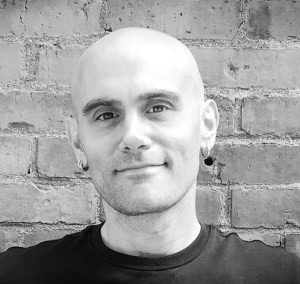
If I could change a few things, it would be the hole in the brick wall below my left ear and maybe a bit more contrast between myself and the background, but those are not deal-breakers for me, and I’m pretty happy with this photo. This one is over a year old, and I’m considering changing it out in the next few months. I think freshening your author photo every couple of years isn’t a terrible idea; you want people to recognize what you look like now not five years ago.
Got any tips for author photos (like, what might be wrong with mine)? If so, I’d love to hear about them (or share your own photo).
7 Top-Tier Horror Markets: My New Story Gauntlet
Once I’ve finished a new story and it’s ready for submission, I have a short list of top-tier spec-fic markets that it goes to first. I have dubbed this list “The Gauntlet,” and they are some of the toughest but most prestigious publications I know of that accept horror. They also work very fast, and I often get a response to my submission within a few days or even a few hours.
Here’s my list, presented in no particular order:
- Clarkesworld Magazine
- The Dark Magazine
- Nightmare Magazine
- Black Static
- Pseudopod
- Apex Magazine
- DarkFuse Magazine
My current record with these publications is one original acceptance (DarkFuse Magazine), one reprint acceptance (Pseudopod), one further consideration letter (Apex Magazine), and a whole bunch of rejections (every last one of them). The order in which I submit a story (or if I submit a story at all) is due in large part to when these markets are open to submissions, the length of the story, and which market is best suited for the piece. Like I said, these are some of the toughest publications to crack in the spec-fic market, and most of them have acceptance rates well under one percent according to Duotrope. And, let’s face it, that acceptance rate is probably a lot smaller because rejections are more likely to go unreported than acceptances.
One quick note about response times. I mentioned earlier that these publications work fast, and they do for an initial response. That’s usually a rejection, but in my experience, these markets will send you a note if they’re considering your story for publication. After that, the wait can be much longer, months even, before you hear from them again. That said, I’m thrilled to just be considered by these publications, so that second wait, when it happens, isn’t too bad. Some of these markets do accept sim-subs, by the way.
So, why submit to these markets first? Here are four good reasons.
1) Reach. From what I’ve been able to gather through a bit of internet research, most of these markets have readerships in the thousands or even tens of thousands. So if you can manage to get a story accepted by one of them, that story is going to be read by a lot of people interested in the type of fiction you write. That’s the kind of thing that helps you build a brand and can maybe affect the sales of something like that novel you’re thinking about self-publishing some day
2) Group memberships. Stories accepted by these markets often count toward membership in professional writing organizations like the HWA (Horror Writers Association) and the SFWA (Science Fiction & Fantasy Writers of America). If you want to be a member in one of these groups and get access to the benefits that entails, you have to publish at qualifying markets. All the markets in my list qualify for one or the other or both.
3) Awards. If you’re a spec-fic writer who dreams of winning awards like the Hugo Award or the Bram Stoker Award, then publishing at one or more of these markets (and others like them) is a good step toward the fame and glory you seek. Stories nominated for both awards and probably a few others are often drawn from the pages of some of the publications on my list.
4) Pro rates. Simply put, these markets pay the most. Nearly all of them pay the pro rate of .06/word, and some pay a lot more. For me, money is at most a tertiary consideration, but getting a chunk of cash for a story is still awfully damn nice.
Some of you might be wondering why I haven’t included one or more [super huge famous spec-fic] markets on my list, and the reasons are pretty straightforward. Factors that disqualify a market from my gauntlet include but are not limited to:
- Longer wait. I don’t usually submit to markets that take longer than 30 days to respond in my first go-around unless the story is just a perfect fit. I’ll invariably start hitting these markets once the story has run the gauntlet, so to speak.
- Bad fit. I write horror in a fairly specific style, and there are magazines that just don’t publish the kind of horror I write. For example, I rarely write anything that could be considered weird fiction, a popular fantasy/horror subgenre.
- Content restrictions. A few top-tier publications have a strict PG-13 content restrictions, and while there’s nothing wrong with that, I just have trouble writing without an R-rating. I have a strict rule that the word “fuck” must appear at least twice in every one of my stories (a personal failing, I know).
- Ignorance. Yep, finally, there are probably lots of great markets I just don’t know much or anything about. Please enlighten me in the comments if you know of one that should be on my list.
So, there’s my gauntlet run (so far) and the reasons new stories typically go to these markets first. Got a gauntlet run of your own? Maybe for another genre? I’d love to hear about it in the comments.
Fightin’ Fiction II: 3 More Melee Myths

Since the first article I did in this Fightin’ Fiction series was so popular, I thought I’d double down and do another one in the same vein. So, here you go, three MORE melee myths.
Like the last article, this one is aimed at authors who would like to add more realism to melee combat in their work. The first article covered some broad stroke concepts, but I’m going get just a bit more granular with this article. Again, everything here should be taken as advice on writing melee combat in a very specific way. It is NOT the only way to write melee combat nor is it the BEST way to write melee combat. It’s a stylistic choice, and if it suits you, awesome. If it doesn’t suit you, also awesome. Also, yes, I’ve broken every one of these “rules” in my own writing, shamefully bowing to the almighty “cuz it sounds/looks cool.”
And away we go!
1) Heroes don’t wear helmets (but they should). I can’t tell you how many times I’ve seen a hero on screen armored everywhere EXCEPT the one place that would likely result in her death if she were hit there. I mean, come on, if you armor everything else and leave your head bare, you’re basically saying to every enemy on the battlefield, “Hit me right HERE!”
Like armor and shields, helmets work really, really well. Hell, they might be the single most important bit of armor on a warrior’s body. Most helmets were shaped so that blows from weapons would slide off them to some degree, blunting the impact of the strike. As with body armor, thick padding was worn beneath the helmet to absorb even more of the impact. There’s ample evidence that helmets saved the lives of their wearers, and it’s kind of hard to imagine a warrior going into battle without one. I sure as hell wouldn’t.
The fix: So, yeah, I do understand why heroes don’t wear helmets on screen. They want you to see the actor’s face (and probably hear him or her speak). But you don’t have that limitation when you’re writing, so give your heroes (and bad guys) helmets to go along with their armor and show those helmets working every now and then. Have your hero take a shot to the head that rings his bell but doesn’t cleave his skull because of the helmet. Or, do the reverse: have your hero level a mighty blow against the bad guys melon, only to have her blade deflected by his cunningly wrought helm.
2) More than the blade. This one is kind of sword specific, but nearly every medieval and renaissance fighting manual I’ve seen teaches that the blade is not the only part of a sword that can be used to attack an opponent. The quillons and the pommel can make great weapons in certain circumstances, especially when close in. Smashing a guy in the teeth with the steel pommel of your longsword will definitely ruin his day. A warrior could also flip her sword around, grab it by the blade (it really won’t cut you that way), and use the quillons like a pick against heavy armor. There’s also half-swording, which is technically still using the blade, but the warrior grasps the blade in the middle with one hand and uses the sword more like a spear or dagger to gain extra power and control in a thrust, which can be useful against heavy armor.
The fix: Easy, have you hero smash bad guys in the face with the pommel of his sword when he’s in close, half-sword that dude in chainmail to death, or flip his sword around and use the pick-like quillons to end that mook in the flat-top helm.
3) Two weapons is better than one? I know; this one hurts. Wielding two weapons is cool, and hey, you have two swords or battleaxes or warhammers or whatever, so you can attack twice as much, right? Well, not really, especially if you have two longish weapons. One will invariably get tangled with the other and reduce your attack vectors. I’m not saying it was never done, just that it’s not all that great except in very specific circumstances. When you do see it historically, it’s almost never on the battlefield. Why? Well, it seems there were three primary weapon systems for foot soldiers on a medieval field of battle. (I really can’t see a situation where dual-wielding would be a good choice for cavalry.)
- Weapon and a shield. This system is great for a couple of things. As I said in the last post, having a small, mobile wall in front of you is handy for keeping the bad guys’ weapons from splitting your skull. In formation, shields let you make a big mobile wall with your buddies (a shield wall), which is damn good at keeping missile weapons from killing you (missile weapons were kind of common on medieval battlefields). Oh, and here’s a pro tip, weapon and shield IS dual-wielding because a shield can easily be used as an offensive weapon, and a very effective one at that. Just sayin’.
- Two-handed Weapon. The second weapon system was a two-handed weapon, usually something in the spear/polearm family. These are great for penetrating heavy armor (more leverage), and they’re just fucking wonderful in formations, allowing you to presents a forest of pikes or halberds to the enemy. That’s a pretty intimidating battlefield formation that’s effective against infantry and cavalry, who could absolutely murder foot soldiers out of formation.
- Missile weapon. The last weapon system is a missile weapon of some kind, which, with a few rare exceptions, requires two hands (and even the one-handed type were usually paired with a shield). Missile weapons are great because you can kill the enemy without getting close to him, and when there’s a bunch of folks with missile weapons you can do cool stuff like make Spartans fight in the shade and whatnot.
So, you see, there’s really not a good reason to dual wield on the battlefield. It’s not great in formation, it won’t keep arrows off you, it won’t let you fire arrows of your own, and it won’t keep cavalry from riding you down and slaughtering you. As I said, it’s not that dual-wielding was never done, but when you do see it, it’s typically in a civilian setting, and the off-hand weapon is smaller and primarily for defensive purposes.
Here’s a great video posted by Skallagrim (great channel, by the way), where two HEMA instructors discuss two-weapon fighting at length with demonstrations. They show a couple of ways it can work and some reasons it doesn’t. Keep in mind, this is not a discussion of a battlefield situation. It’s taken from the point of view of civilian dueling (no armor).
The fix: Hey, I can overlook the odd two-weapon fighting bad-ass here and there, but if you really do want something a little more realistic, use the dual-wielders sparingly and away from the battlefield if you can help it. Also, make those that do use that style all the time very special individuals (they’d have to be to fight like that and stay alive).
There you go. Three more melee myths to heed or ignore in your own combat scenes. As usual, if you have any experience in this area yourself, use the comments to chime in. Or, if you just want to tell me why your dual-battleaxe-wielding bad-ass doesn’t NEED a helmet, please do so below.
August 2016 Submission Statement
Well, August was certainly better than July, where I did pretty much nothin’ in terms of submissions. I managed to get a few stories out last month, and I even snagged an acceptance and a publication.
August Report Card
- Submissions Sent: 3
- Rejections: 1
- Acceptances: 1
- Other: 0
- Publications: 1
Rejections
Here’s the lone August rejection.
Rejection 1: 8/14/16
Thank you for submitting work to our Flash Icon contest. There were some incredibly high-quality entries submitted this time around.
Unfortunately, “XXX” didn’t make it into our Top 10. However, we encourage contest participants to submit these stories for consideration in our regular issues (free to submit) if you’d like to do so.
Thanks so much for your participation. We couldn’t do these contests without you.
This is another entry into one of The Molotov Cocktail’s flash fiction contest. This one was called Flash Icon and challenged writers to include an iconic person, place, or thing. I went kind of far afield on this one and chose an obscure monster from Greek mythology as my “iconic” thing. I don’t know why I thought a hecatonchire, even a named one, would be even remotely iconic, but there you go. I’m not saying that’s why this story didn’t place, but I’m guessing it didn’t help.
Acceptances
One acceptance, and, yep, it’s from the same place as the one rejection for the month
Acceptance 1: 8/14/16
Once again you’ve dazzled us with some strange and compelling flash fiction. “The Father of Terror” has won 2nd place in Flash Icon. Dead cats and slumbering Egyptian demons are right up our alley.
By now, you know the drill. This piece will be included in the mega-issue by mid-week and it will be in the Prize Winners Anthology due out this fall.
A very nice acceptance letter, and I always love working with the folks over at The Molotov Cocktail. My story “The Father of Terror” took second place in the Flash Icon contest. My iconic thing in this one was the Sphinx, and I’m not saying my choice of an ancient, immediately recognizable structure was the key to my story placing, but it’s a damn sight better than a Greek monster no one has heard of.
Anyway, always nice to get another one on the board, and the fact that it’s with one of my favorite publications is just icing on the cake.
Publications
Yep, it’s a three-for. The one publication is at, you guessed it, The Molotov Cocktail.
“The Father of Terror” was published in their Flash Icon mega-issue, which you can read right here. As usual, this contest collection is chocked full of great stories, and if you dig horror and flash fiction, it’s a must-read.
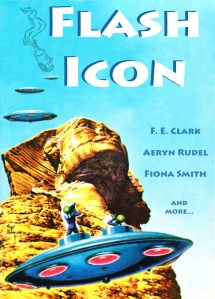
The other thing I’d like to call your attention to is not a publication but a flash fiction contest out at Red Sun Magazine. You might remember they published my story “Paper Cut,” and they’ve been kind enough to base this contest around my novel Flashpoint and to offer the book as part of the prize packages. Anyway, if you write flash fiction, head over to Red Sun for the official rules.

That was my August. Tell me about yours.
Rejectomancy Exclusive – The Barghest by Orrin Grey
As I mentioned in this post, my very talented writer friend Orrin Grey is re-releasing his first collection of short stories, Never Bet the Devil & Other Warnings through Strix publishing. You can check out the Kickstarter campaign right here. Orrin is a horror writer, and a damn good one, and he and Strix Publishing have given me permission to post one of the stories in the collection here. So, check out the “The Barghest” below for a taste of what you’ll get in the premium re-release of Never Bet the Devil & Other Warnings. If you’re a fan of weird fiction and horror in general, this is one you don’t want to miss.
The Barghest
By Orrin Grey
I was standing by the side entrance when they brought in the bones. Would you believe me if I said that as soon as I saw them I knew they weren’t human? Or any other indigenous animal? I wouldn’t blame you if you didn’t. It’s a difficult thing to credit.
It wasn’t any training that told me, or my experience at the museum. I didn’t see the bones long enough for that, just a glimpse of the brown skeleton–the wrong-size skull, the wrong-way legs–and some primal part of my brain said “monster.”
I threw away the butt of my cigarette and followed the men who were carrying the stretcher with the skeleton on it. I wasn’t surprised when I saw that they were carrying it to your part of the lab.
I remembered you on the phone, arguing with Kelso over a skeleton that was found out on the moors somewhere. You wanted it, you said. The museum had paid for the dig, and you were the senior paleontologist on staff so it belonged to you.
You were waiting when they laid the stretcher on the table. That’s when I got my first good look at it. It was the size of a big man, but it definitely wasn’t a human skeleton. Looking at the bones, I was hard put to say if it was a biped or a quadruped. I imagined that it moved like a bear, or like a great ape. Its hands were too big for a human and terminated in hooked talons, but they had clear opposable thumbs.
The skull was simultaneously apelike and doglike, a toothy muzzle like a baboon or a mandrill. I remember making some offhand comment about Lovecraft’s ghouls, but you were unfamiliar with Lovecraft. You never cared for anything you deemed “disposable culture.”
As the investigation into the remains went on I bought a copy of Tales of H.P. Lovecraft edited by Joyce Carol Oates, whose name I thought might lend it some credibility in your eyes, and gave it to you with the page containing “Pickman’s Model” tagged. I’ll bet it’s still on the shelf in your office, with the tag still on it. I’ll bet you never even picked it up.
If you had read it, though, you would have understood why I brought it up; you would have known what it was about the bones that left me at once intrigued and uncomfortable. How human they looked, and how inhuman. Not like the bones of some Neanderthal man, some earlier species of humanity, but instead like something that took an alternate evolutionary path, something that should have been human but became something else instead.
Those sorts of thoughts didn’t interest you, though. I know that. You were always dismissive of what you called my “supernatural thinking.” You always regarded the museum as beneath you, and me as beneath the museum. You treated me with a grudging tolerance, and never admitted that the reason we worked together was because none of the other interns would work with you.
“What is it?” I asked you that night, because for all your coolness you liked it when I asked you questions, and because I really did want to know what you thought. I was curious if you had some explanation that would take all the parts and somehow make of them something other than a monster.
“Something new,” you said, and that was all. It was less than encouraging.
Of course, it wasn’t something new, was it? It was as old as the dirt in which it was found, as old as men telling campfire stories. We learned that, you and I, but you learned it first.
#
I remember how carefully you cleaned the bones. The peat in which they were found had preserved them, like a fossil without the stone. They were perfect; no flesh left for us to macerate, just those ossified brown bones. I remember watching you work over them with your little brush, your magnifying glass, carefully turning over and examining each and every tiny piece.
I wasn’t allowed to do any of the real work, wasn’t to handle the skeleton. When I was in the lab, I stared at the skull.
As with most carnivore skeletons, the skull seemed too big for the rest of the bones. It dominated the table, drew the eye. Those teeth that seemed too big for the mouth they filled, those gaping sockets. If I looked at it one way it was pure animal, like a wolf or tiger, if I looked at it another it was disturbingly human.
I’ve spent a lot of the time since then wondering how it happened. You were so careful. Was it your eagerness that was your undoing, or did something else render you suddenly clumsy? Were the teeth simply sharper than you imagined they would be, after remaining buried for so long?
You know how, sometimes, when you walk into a room, you can tell that something has changed before your mind has processed what it is? When I walked back into the lab that night, I knew that something was wrong before I took in any of the details. From where I was standing in the doorway, I could see the skeleton on the lighted table, and my eyes naturally traveled to where the skull would normally have rested, only to find a blank white space where it should have been.
Only then did I notice that you weren’t there. I walked to the head of the table. The skull was on the floor, teeth and pieces of jaw scattered across the tile. And mixed in among them were fat red drops of blood.
I went to the break room then, but you weren’t there, just more drops of blood spattered on the back of a chair and the surface of one of the round Formica tabletops. The first aid kit on the wall hung open, and pills in individual packets lay scattered across the counter and the floor.
Why did you go to the ladies’ room, I wonder? Was it shame, fear of appearing mortal and fallible in front of the help? Or did you know, even then, that something was wrong, more wrong than the gouge in your palm or the blood you were losing from it?
I knocked on the door, and you knew it was me. “I’m fine,” you said, without my even needing to inquire. “It’s just a scratch. Go clean up the lab, and be careful.”
At the time I thought nothing of that “be careful.” I assumed it was concern over the integrity of the bones, displaced anger at the damage to the skull. But since then I’ve wondered. Did you know, even then? Was your concern not for the bones at all, but for me? It doesn’t seem like you, but then adversity sometimes brings out the best in people.
I have a lot of questions that I know will never be answered, but the one that troubles me the most is how soon you knew. When did you first realize what was happening, and how long did it take that realization to become knowledge, to become acceptance?
#
By the time you came out of the restroom I had already replaced the skull on the table and mopped up all the blood, both in the lab and the break room. If you were there I know you would have rolled your eyes at me, but as I put the skull back onto the table the black sockets looked darker and deeper than they should have, and I got the feeling that something was staring out of them at me.
I knew you’d been lying about it just being a scratch, I’d cleaned up too much blood for that, but it wasn’t until you came out of the restroom that I realized how bad it must have been. Your face was pale, the color bleached from it, like a person about a minute away from going into shock. Your eyes looked red, as if you’d been crying, and your right hand was swathed in most of the gauze and bandages from the first aid kit.
When you came into the lab you held your injured hand up to your chest like a cat with a hurt paw, and you put your other hand out to a table to steady yourself.
“That looks like it might need stitches,” I said, though of course I couldn’t see the wound itself. “You should probably let me take you to the emergency room.”
You nodded tightly but didn’t let me take you to the hospital until you’d examined the skeleton and verified for yourself that the damage wasn’t extensive enough to compromise the find. I noticed even then, though, that you were careful not to touch it.
#
The doctor at the ER put eleven stitches in the palm of your hand, and just like that I became necessary to you. With one hand out of commission, you couldn’t do the fine work needed to examine the skeleton, and so I became your hands on the job.
Did you ever stop to wonder why I worked with you when no one else would? Why I was willing to pull down the same preposterous hours that you insisted on? Did you think that I was attracted to you? Or did you just think that I believed you were the genius that you believed yourself to be, and that I wanted to ride on your coattails?
Maybe you didn’t think about it at all. That would be more like you.
Someone else might have noticed something different about you immediately, might have caught on sooner, for good or ill. Had I watched TV or read the papers I might have heard about the girl who was mauled to death in a park near your house that week, might have said something to you that would have forced a confrontation, elicited some response in you that I could have interpreted. But by the time I came home from the museum I was exhausted and all I wanted to do was to curl up with my ghost stories, which you regarded so scornfully, and then sleep.
Maybe it wouldn’t have mattered what I noticed, what I said. Maybe you still didn’t know yourself. I’ve not yet determined how aware you are when it happens, how much of you is left.
You always said that the surest road to combat superstition is study, but no matter how much we examined the bones I was never able to shake the sensation that they were not the remains of anything wholesome or natural, not even the bones of some mutation or aberration, some lusus naturae. You, of course, were no help.
I bought a book of folktales from the British Isles and took to reading it before I went to bed. I read about Black Annis, a cannibal witch who lived in a cave under an oak and ate children. She hung their skins in the branches to dry, and then wore them tied around her waist. I read about Black Shuck, a dog the size of a horse with eyes like saucers, and the more recent “shug monkey,” which reminded me more than a little of the thing on our table, with its mix of primate and canine features. I read about the shapeshifting Barghest, which may have inspired Dracula’s transformation into a monstrous wolf.
If I ever told anyone but you what I’ve seen since then, what I’ve learned, they’d send me to a psychologist, and that psychologist would undoubtedly blame my “hallucinations” on those stories. They’d say that I’d been priming myself, and that when events occurred that I couldn’t deal with, I used those myths to give context to a truth that I didn’t want to admit. But, as you always said, psychology is a soft science, and what happened to you, to us, is anything but soft.
Looking back now, everything seems so inevitable. Maybe if you’d been allowed to keep the skeleton, things would have gone differently. Maybe the charade could have been maintained a little longer, but I think it was doomed to come down, sooner or later.
I remember when, just two weeks after the night you cut your hand, Ms. Trevayne asked you to come into her office. She didn’t draw the blinds, and I knew just by watching what she was saying to you. You stood in front of her desk, your wounded hand drawn into a fist at your side, your other hand gesturing as you shouted at her.
When you stormed out of her office you called her a cunt, a word I’d never heard you use before, and told me that she was taking the skeleton away from you and giving it to Kelso, which I had already guessed. This would never have set well with you, even before, but you would have approached it disdainfully, with an “it’s their loss” attitude, as though you were too good to get upset. Your desperate rage took me by surprise, and when you walked back to the lab you forgot yourself and slapped both your hands palm down against the table. That’s when I knew. Knew that you weren’t hurt anymore, that your hand had healed completely even though the stitches weren’t due to be taken out for another week.
“She can’t do this to me,” you said, an under-the-breath growl I wasn’t intended to hear. “She can’t do this to me. Not yet.”
#
But of course she could, and when I walked into the lab that night and saw the table empty I knew she had.
You weren’t there, and I assumed that you’d already left in a huff. I almost just turned around and went home. How differently would things have gone then?
Instead, I decided to head across to the other side of the wing, to the lab that Kelso normally used. It’d be nice to say that some premonition prompted me, but I don’t think it did. I think I was just curious. I’d never seen you defeated, I was curious to see what someone else’s victory over you looked like.
As I rounded the corner I could see the light from Kelso’s lab flickering and swaying, like the illumination of some sideshow spookhouse. I think I ran to the door, then, but I don’t really remember. As vividly as I can recall everything else, the order of the next few seconds are jumbled in my memory. It’s as though everything I saw exploded into my mind at once, a kaleidoscope of snapshots.
The half-smashed light fixture that had come loose from the ceiling and was swinging back and forth, throwing its funhouse illumination on everything. The blood, shockingly red against the tile and the table and the wall. Kelso’s arm, in one corner, the rest of him crumpled behind the table. All of those things, though, were driven out of my mind when I saw the thing you had become.
It had taken only a glimpse of the bones for my primate brain to realize that they belonged to a monster, a teratism, something that should not exist. Seeing you like that took even less.
The thick black fur. The way you stood, crouched and bent, like a man who has been forced to crawl on all fours for years. The snout, like a wolf’s only crushed in, the teeth too large to fit in the mouth. The hands like Halloween monster gloves, only the claws making them seem real, reminding me of Black Annis and her iron talons.
You looked at me, I remember that. Your eyes weren’t big as saucers, but they were red and bright and amazingly clear and strangely human. I believe, to this day, that I saw recognition in them. That you saw me and knew me and chose to spare my life. Then you were gone out the window.
#
I didn’t call the police. I stumbled over to the wall, hit the fire alarm, and then collapsed to the floor beneath it. The sprinklers kicked on and I sat in the artificial rain, with my knees drawn up to my chest, and didn’t move until the authorities arrived.
The sprinklers probably destroyed the crime scene, but the police would never have been able to understand what had happened there anyway. I don’t even remember what I was asked, or what I told them, but I know that I didn’t mention what I really saw.
I remember being told that I was in shock. I remember someone wrapping a blanket around my shoulders as I was helped into an ambulance and driven to the hospital. It was only then, while I was sitting in the emergency room in my wet clothes, that I remembered the thing that I had seen but not noticed earlier.
The bones, of course. They hadn’t been on the table, and in one of your big, misshapen hands you had carried a canvas bag just big enough to contain them.
They let me out of the hospital eventually and took me back to my apartment. They told me to stay there, but I didn’t. I changed into dry clothes and then took a taxi to your place.
It wasn’t the first time I’d been to your house, of course. You’d sent me to pick things up for you from the museum before. I even knew where you kept your spare key stashed, though it didn’t turn out to matter because the back door was hanging open, the knob torn out of the wood.
I can’t say what made me walk through that door into the dark interior of your house. Maybe I was still in shock.
I didn’t turn on any lights. I walked through the kitchen, letting my eyes adjust to the darkness. There were smudges on the walls beside the staircase that looked like chocolate syrup in the dark, though I knew they weren’t. I followed them upstairs.
You were lying facedown on your bed. The blinds were drawn, but a wedge of streetlight came in through a gap in them. You were naked, your skin pale and human in the dim light, looking as smooth and new as the flesh of a baby. The bag of bones was on the floor beside the bed. I stood watching you for longer than I probably should have, measuring the rising and falling of your breath as you slept. Then I took the bag and walked back out.
#
I’ve not yet guessed why you wanted the bones so badly. Did you hope to extract from them the secret of a cure, some tincture of silver nitrate and wolfsbane? Or was it simply that you wanted to keep them close to you, your only connection to the thing you had become? Either way, it doesn’t matter anymore. I burned the bones in the incinerator in the basement of the museum before I made this recording. All but this one tooth.
Even if I hadn’t, though, it wouldn’t have made any difference. Cures are for movies, not real life. I don’t know what you are any more than I imagine you do, but I know it’s not something you get to come back from. Soon, though, you won’t have to be alone anymore. You’ll have something better than bones for company.
What does it feel like, when you change? I bet it isn’t like the movies, the gradual shifting and lengthening of bones, the sprouting of fur. I bet the beast just tears out of you, as though it’s been there all along and your skin is just a disguise that it’s been wearing. I’ll bet that’s what it’s like.
I don’t know if you’ll ever see this video. I don’t know how long it will take you to come for me, or even if what comes for me will be something that can properly be called “you.” But I know that you will come for me, sooner or later, and that when you do I’ll be here waiting for you, ready to meet you head on.
You see, I’ve torn my hand with this tooth, just as you did. I’m coming to meet you now, just as surely as you’re coming for me. I’m coming to join you in wherever you’ve gone, whatever you’ve become, and we’ll let nature–or whatever it is that governs things like us–take its course.
AUTHOR’S NOTES:
This one had its origins in, of all things, a terrible movie called Werewolf that I saw on an episode of Mystery Science Theater 3000. Maybe not the most auspicious of beginnings, but I thought the idea of someone becoming a werewolf because they were scratched with a fossilized tooth or bone from a werewolf was a setup that deserved some better treatment than a film starring Joe Estevez.
That was where it started, but once I was writing I realized that I didn’t want this to be a werewolf story exactly. At least, I didn’t want to use the word werewolf anywhere in the story. Giving something a name like that is an easy way to dismiss it. “Oh a werewolf, I know what that is,” so instead I decided to build the monster up using suggestion and allusion. I’d wanted to do something with some elements from British folklore like Black Annis and, of course, the Barghest, and I found that this was the perfect story for it. Throw in some more allusions to Lovecraft’s ghouls, and there you go.
Never Bet the Devil: An Interview with Orrin Grey
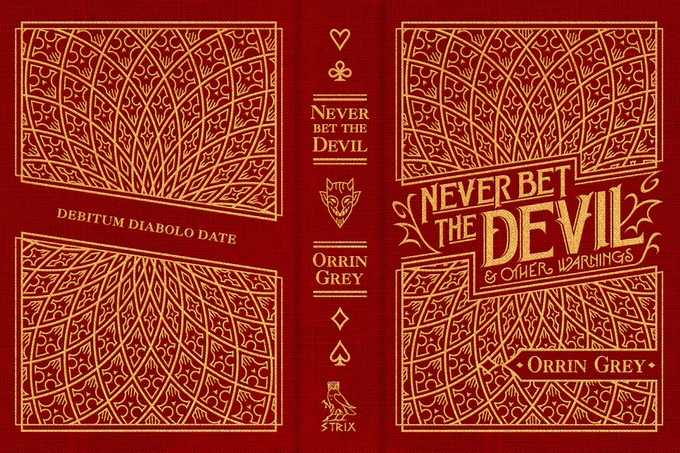
Orrin Grey is one hell of a horror writer, and I’ve had the extreme pleasure of working with him a number of times in my previous role as managing editor for Skull Island eXpeditions. He just gets horror, and creepy, disturbing things fall out of his head and on to the page like a burst pinata full of spiders. To bring his particular brand of darkness to the world, Orrin has recently partnered with another of my favorite people in the publishing biz, Simon Berman of Strix Publishing. Together, they are creating the definitive edition of Orrin’s first short story collection Never Bet the Devil & Other Warnings. I spoke with Orrin about this new project and some of the things that influence this master of the macabre.
1) Okay, Orrin, give us the quick and dirty on your literary career. Who are you main influences? And where can we check out some of your work?
Primarily, I write what I like to think of as “fun, smart horror.” At least, I hope it’s fun and smart. But I’m also a freelancer, and as you are no doubt well aware, Aeryn, freelancers will (and do) write everything. So I also do stuff ranging from work for Privateer Press to writing website copy for car dealerships…
When it comes to influences, I have a lot, and I tend to wear them on my sleeve. But Mike Mignola has a story that he likes to tell in interviews, about how when he first read Dracula he knew all he wanted to do in life was draw monsters. My similar moment of clarity came not with Dracula, but when I encountered Mike’s own work on Hellboy. Since I can’t draw, I had to settle for writing monsters instead.
As for where you can check out some of my work: My second collection, Painted Monsters & Other Strange Beasts, is available right now from Word Horde. I’ve got stories out or forthcoming in a bunch of exciting anthologies, including Children of Lovecraft (speaking of Mike Mignola, who did the cover) and Eternal Frankenstein, which features my story “Baron von Werewolf Presents: Frankenstein Against the Phantom Planet.” I don’t have as many stories online as I would like, but right now you can read my story “Black Hill” on the Strix Publishing website as part of our Kickstarter for Never Bet the Devil, or listen to it at Pseudopod.
2) You’re currently working with Simon Berman and Strix Publishing to breathe new life into your first collection of short stories, Never Bet the Devil & Other Warnings. Tell us about it.
Never Bet the Devil & Other Warnings originally came out from Evileye Books back in 2012, but they recently decided to stop publishing prose books entirely, so it unceremoniously dropped out of print at the end of last year. When that happened, I knew I wanted to get it back into print, but also that I wanted to do so in a way that would reward those who had already picked up the original edition. Enter Simon and Strix Publishing, who are helping me put together what I think is going to be the definitive edition of Never Bet the Devil: hardcover, cloth-bound, gold-foil-stamped, fully illustrated, and with a new introduction by Nathan Ballingrud, to name just a few of the features.
3) Which is your favorite story in Never Bet the Devil and why?
You know, I just got asked this on a podcast. I told them it was “The Seventh Picture,” and that’s definitely a favorite of mine, though right now if I had to pick a favorite story from Never Bet the Devil, it might be my odd take on a haunted house tale “Nearly Human,” which is one of those stories that seldom gets singled out by reviewers but that just really feels like it did exactly what I wanted it to do.
4) Are we getting any new stories in this premium collection?
There will be at least two new stories in the deluxe edition of Never Bet the Devil. One of them was previously published in The Mothman Files back in 2011, but has never been collected before. I wanted to include it in the original release of Never Bet the Devil, but rights issues prevented it, so now here it is, incorporated into the collection as I had always intended. The other is entirely new, written exclusively for this edition, and is a story about kids exploring an undertaker’s basement on Halloween night called “Goblins.” We’ve got several other stories planned as possible stretch goals, so if the Kickstarter does really well, who knows how many new stories might be in the final book?
5) I hear there are some truly kick-ass illustrations in the book. Tell us about the artist.
There are some truly kick-ass illustrations in the book! The original publication of Never Bet the Devil had a cover and some great interior spot illustrations by Bernie Gonzalez, which I loved, but they stayed with the previous publisher when the rights to the rest of the collection reverted back to me. When it came time to choose a cover artist and illustrator for the deluxe edition, M.S. Corley was my first and only choice. I’ve been a fan of Mike’s illustrations and cover design work for years, and we had previously worked together on a little chapbook called Gardinel’s Real Estate. For my money, Mike might be the best cover guy in the business, and when it comes to his interior illustrations, let’s just say that you ain’t seen nothin’ yet!
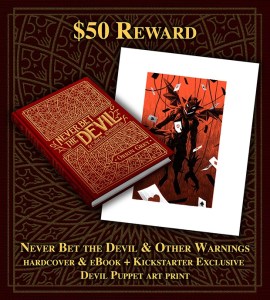
6) Who are the people that absolutely need to back this Kickstarter? What would you say to them?
Anyone who enjoyed my work in Painted Monsters or any of the recent anthologies that have featured my stories but never got a chance to pick up the previous edition of Never Bet the Devil. Anyone who has the previous edition and likes it well enough to upgrade to a fancy hardcover with more illustrations and new stories. Anyone who loves old-fashioned ghost stories, creaky old horror movies, fun weird horror, or Mike Mignola comics, I think you’ll find that I’m speaking your language in Never Bet the Devil. And even if not, I can guarantee that Mike Corley’s illustrations will be worth the price of admission all by themselves.
Orrin Grey is a writer, editor, amateur film scholar, and monster expert who was born on the night before Halloween. His stories of monsters, ghosts, and sometimes the ghosts of monsters have appeared in dozens of anthologies, including Ellen Datlow’s Best Horror of the Year. He’s the author of Never Bet the Devil & Other Warnings, Painted Monsters & Other Strange Beasts, and Monsters from the Vault. You can visit him online at orringrey.com.
Fightin’ Fiction: 5 Melee Myths

One of my many hobbies is HEMA, or historical European martial arts, wherein folks study various fighting manuals from the medieval and renaissance periods and attempt to recreate these martial disciplines as accurately as possible. Once you swing a sword the way it’s meant to be swung and then do a little historical research, you quickly find popular media presents combat with swords, axes, maces, and other crushy, stabby, pointy things . . . well, uh, incorrectly would the nicest way to put it.
So, from the author’s perspective, if you wanted to portray your melee combat more realistically, how would you go about doing it? Well, research is always the best answer, and it couldn’t hurt to at least watch some HEMA sparring to get an idea of what certain types of sword fighting probably looked like (or even take a few classes yourself). That said, I think the five “myths” I’m going to debunk below are a good place to start. At least, they’re things that jump out at me when I’m watching movies or TV that feature sword-fighting and such.
Let me preface this list by saying I have probably violated every one of these “rules” in my own writing for various reasons (“cuz its cool” being at the top of the list), so, please, don’t take this as me laying down the gospel. The idea here is not to remove the fun from fight scenes but to identify a few easy fixes if you wanted to present melee in a slightly more realistic fashion. If that’s not your thing, you’re not wrong by any means. There’re a lot of ways to write good action scenes in fiction, and ultra-realistic is not everyone’s cup of tea.
Okay, here we go.
1) Swords don’t go SCHWING! when drawn.
Go get a butter a knife, wrap it in the sleeve of your leather jacket, and then pull it free. What noise did it make? None, right? Yep, unless the sword is pulled from a metal scabbard, that cool SCHWING! sound you hear in every single movie doesn’t happen. Most scabbards are made of wood and leather, and even with a metal throat they don’t produce much noise at all. Swords also don’t sound like angry tuning forks, buzzing and hissing every time the hero flicks his wrist.
The fix: Easy; let your swords be silent, and let your hero’s deeds do the talking.
2) Back scabbards are impractical for big swords.
It’s a simple matter of physics, really. If you stick a big sword in a scabbard across your back, say a longsword with a 36-inch blade, your arm simply isn’t long enough to pull the sword up and out of the scabbard. You’ll get about halfway and then have to do some weird bodily contortions to get the sword all the way out. Even with a shorter blade, it’s going to take you a lot longer to draw the sword from your back than it would if it was on your hip. Not to mention, returning the sword to the scabbard is going to be a real bitch if you can’t, you know, see the scabbard. I see many unfortunate heroes dying from self-inflicted stab wounds to the top of their heads.
The fix: Honestly, including back scabbards in fantasy fiction is a pretty minor sin, all things considered. They do look pretty damn cool. But if you want to be more realistic, there’s some evidence that big two-handed swords were carried on the back to transport them from place to place, but they were probably discarded before battle began. So, if you use back scabbards like that, you’re within the bounds of reasonable historical use.
3) Armor works.
Oh, man, this is a big one for me. Yes, armor works, and it works really, really well. So well, in fact, that most swords are useless against good armor unless used in very specific ways (half-swording, for example). Blades just don’t cut through metal (generally), and that means someone in chain mail or plate armor was pretty well protected from sword blows. Armor became so good that a bunch of specialized weapons developed to defeat it, mostly polearms that put a lot of pressure on a very small area, puncturing or crushing rather than cutting.
There are tons of videos on YouTube demonstrating the resilience of metal armor (and even padded armor) against sword blows, but here’s a couple of great videos on the subject from Falchion Archaeology to get you started:
Cluny Falchion vs Maille – This an excellent cutting test with a falchion, a sword known for its fearsome cutting power, against padded armor and chain mail. He doesn’t test the falchion on plate because it’s kind of a foregone conclusion.
Polearm Test 1 – Want to see what types of weapons could actually defeat plate armor? Here are some great examples.
The fix: This is a tough one because sometimes you need the hero to cut through a bunch of mooks without describing every little detail. I’d say it would be enough to show armor working from time to time for both heroes and bad guys. You might also show the hero using half-swording and other techniques designed to defeat armor (and maybe stating that’s what they’re doing). Or, hell, dispense with the every-hero-must-have-a-sword trope and give you’re protagonist a poleaxe because they know they’re going to be fighting dudes in armor.
4) Shields are also really, really good.
You rarely see a hero with a shield. Why is that? Trust me, the ability to places a small, mobile wall between you and a guy trying to hit you is awfully handy. There’s a reason the shield is so ubiquitous throughout history—it works. That said, the personal shield was largely abandoned once plate armor became the norm because it was kind of redundant at that point, and you had a better chance of defeating the other guy’s armor with a two-handed weapon, like a poleaxe (see point three).
The fix: Use them where appropriate, and like armor, show them being effective once in a while. Shields were used offensively too, so there’s a lot of cool opportunities to let the hero use her shield to knock bad guys off their feet or smash their faces in.
5) Fewer instant kills.
In movies, you often see the bad guy take a single cut from the hero’s sword (slicing through armor like it was made of tissue paper) and then fall down stone dead. The truth is that most deaths on a medieval battlefields were probably from blood loss and infection rather than instantly fatal wounds. Humans are actually kind of hard to kill, and unless you inflict a really catastrophic wound, like behead someone or crush their skull, instant death is unlikely. That means even a mortal blow leaves the bad guy quite a bit of time to do some damage. It’s why historical European martial arts teach continued defensive measures AFTER a telling blow is struck. Basically, you want to stick your opponent and then get out of the way while he bleeds to death.
If you’d like to read a very thorough and engaging article on this subject, “The Dubious Quick Kill” by Frank Lurz is about as good as it gets.
The fix: Another tough one because you don’t want every bad guy lingering around after the hero has effectively defeated him. Your hero is special, and she should be able to kill the bad guys in a single blow now and then. That said, it’s pretty simple to get the idea across by dropping it in occasionally. Have your hero strike a mortal blow and then continue to defend himself as the bad guy slowly bleeds out. Show the aftermath of a battle where some men have died from blood loss and infection rather than skulls cloven to the teeth and such (not that that didn’t happen every once in a while). Also, it never hurts to do a little research on wound trauma for this kind of thing; the more you know how the body works (and what stops it from working), the more realistic you can make your fight scenes and any resulting wounds.
Of course, there are lots more melee myths out there, and I may explore some in future posts, but these five are a good place to start. If you have any experience in this area and want to share some of your own melee myths (or point out something I’ve missed), please do so in the comments.
Effectively Wild – A Baseball Horror Story
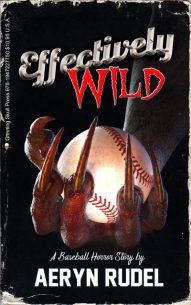
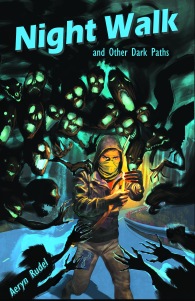
Night Walk & Other Dark Paths
Acts of War: Flashpoint

Acts of War: Aftershock

Acts of War: Stormbreak

 Aeryn Rudel's Rejectomancy