
Ten Years of Rejectomancy – ALL the Numbers

So, this is truly the final post in my Ten Years of Rejectomancy series. As promised, I’m gonna give you ALL the numbers for each year and then a total of subs, rejections, and acceptances for the entire decade (plus the years before and this year). It’s been a blast to look back on the highs and lows of ten-plus years in the submission trenches, and I hope the journey has been inspiring, validating, and make a tad reassuring to those of you new to the submission grind. It’s tough, brutal at times, but if you keep at it, the acceptances do start piling up.
Okay, here’s the numbers for fourteen years of submissions. 🙂
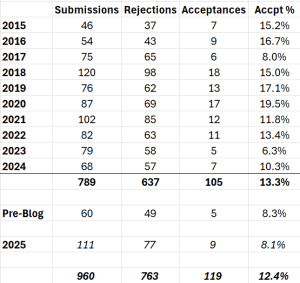
So, in the ten official blog years, I managed 789 submissions and 105 acceptances. Not too bad, and good enough for 13.3% acceptance rate. I was over 15%, but 2023 and 2024 brought my career average down, and it looks like 2025 isn’t going to help much in that department either. Still, averaging ten acceptances per year is pretty solid, I think. You can see the pre-blog years and 2025 year-to-date (which may improve or worsen as I hear back on pending submissions), as well as an overall total for the 14 years I’ve been submitting short stories. I’m closing in on 1,000 submissions and 800 rejections, which are big milestones I should be celebrating in the first half of 2026.
I’d very much like to get back to double digit acceptances per year and push that acceptance percentage up to around 15% again. Things have gotten markedly tougher out there for a number of reasons. An inundation of AI subs at certain markets has increased wait times on submissions for one, and, sadly, there are just fewer speculative markets to submit to these days. I’m not complaining, mind you. You have to roll with the punches in this biz, but it is a noticeable downturn over the last couple of years. I guess it could simply be that I’m writing more garbage than I used to, but the number of final-round rejections I’ve been getting has actually increased, so as much as I’d like to believe I’m just getting worse in the ol’ writing department, that’s probably not true. 🙂
And there you have it, the entirety of my submission career and all ten years of the blog laid out in plain numbers. How’s your 2025 shaping up submissions-wise? I’d love to hear about it in the comments.
Finally, if you’ve missed any of my Ten Years of Rejectomancy posts and want to catch up, here are the links to all the others in the series.
- Ten Years of Rejectomancy: The Pre-Blog Years
- Ten Years of Rejectomancy: Year One – To Pro or Not to Pro
- Ten Years of Rejectomancy: Year Two- Maybe I’m Good at This?
- Ten Years of Rejectomancy: Year Three – Maybe I’m NOT Good at This?
- Ten Years of Rejectomancy: Year Four – Back On Track!
- Ten Years of Rejectomancy: Year Five – Consistency is Key
- Ten Years of Rejectomancy: Year Six – Best Year EVAR!
- Ten Years of Rejectomancy: Year Seven – The Whiplash Effect
- Ten Years of Rejectomancy: Year Eight – Solid and Serviceable
- Ten Years of Rejectomancy: Year Nine – A Question of Querying
- Ten Years of Rejectomancy: Year Ten – A Decade of Denial
8 Comments on “Ten Years of Rejectomancy – ALL the Numbers”
Leave a comment
Effectively Wild – A Baseball Horror Story

Night Walk & Other Dark Paths
Acts of War: Flashpoint

Acts of War: Aftershock

Acts of War: Stormbreak

 Aeryn Rudel's Rejectomancy
Thanks for sharing your submission journey with us. I only have about two years I could track (since I started using Duotrope.) But I’m curious how my numbers lay out 🙂
That’s the great thing about tracking your subs through Duotrope or The Submission Grinder. You can always run a quick report and get an idea of where you’ve been and where you’re going. 🙂
Are there stylistic, genre, length, theme, or other metrics, qualitative or quantitative, that you could establish to, for your own edification as well as ours, educate on what sells and what doesn’t?
Not that you’d take my advice, but, AI can, at its current “pretty good” analysis capability, help in extracting data from written material. You have to be careful in saturating context. But, done in batches, you might be able to distill, say, Claude’s analysis, down to 10-15 topics which could then be fed back in a spreadsheet to have the AI extract knowledge from your vast data set.
My own submissions? I’ll never try again. I enjoy writing short stories. But I’ll just keep publishing them for free consumption.
The problem is that selling a story is so subjective that it almost defies any real analysis. I can make educated guesses when it comes to my own work based on my experience with certain publishers, but that info doesn’t always translate to other writers. Case in point. I’ve sold five stories to Factor Four Magazine, a pro flash fiction market. I have friends, excellent writers, who, for whatever reason, cannot crack that market, but CAN crack Flash Fiction Online, one that I struggle with. On paper, all three of us write fairly similar spec-fic, but editorial taste is a thing, and it’s pretty damn hard to quantify sometimes.
I don’t use AI in any of my writing endeavors, even for analysis. It’s just a slippery slope I don’t want to start down. Not to mention that nearly all publishers have strict anti-AI policies that I don’t want to brush up against at all.
So, I use Anthropic’s Claude to critique my writing. Take the gloves off, Claude, knuckle me bloody.
He’s most obliging.
I’m certain you’re missing an op here.
What do you do with all your rejected tales? Do you eventually publish them publicly somewhere?
I have a group of human writers that critique my work on a regular basis, so I’m all set there.
As for what I do with rejected stories, I think it’s important to understand that those rejection numbers I gave can be slightly misleading. The 763 rejections I cited comprise 164 distinct stories. Of those 164, I have sold 86, but it’s exceedingly rare that any story I sell doesn’t wrack up a few rejections first, and sometimes they can wrack up double digits. In fact, a full 60% of my rejections come from stories I’ve actually sold.
Of that 164 distinct stories, there’s another 23 that are still in submission rotation that I think WILL sell eventually. That leaves 55 stories that are truly trunk stories. Most of those are from my early days of submissions between 2012 and 2016 when I wasn’t quite as good at telling when and if a story was ready to submit.
I have published trunk stories on the blog before, mostly as a way to showcase what can go wrong with a story. I might do more of that in the future.
Hmm, there’s probably a good blog post in this info. lol
You’d be surprised what Claude can discover, or expose.
Trunk, as in, squirrelled away in a trunk?
Sorry, I have ethical concerns with using AI in my work at all, and then there’s the issue that 95% of publishers prohibit the use of AI, so I wouldn’t be able to publish anything I created.
Trunking a story just means that you’ve decided that it’s either not good enough to publish or that it would take too much work to get to a point where it could be published. I guess there might have been a time where authors put printed manuscripts in an actual trunk, but now it just means it collects dust on my hard drive. lol