
What Are They Saying: Analyzing My Editorial Feedback
When you’ve collected as many rejections as I have, you read A LOT of editor and first-reader feedback. I’m never one to put much stock in isolated feedback from a single source, but when you do this long enough, you start to see some patterns. Certain phrases repeated about your work. These, often as not, highlight your strengths as a writer and some of your weaknesses too.
Just for fun, let’s see what editors and first readers say about my work. I’ll only include feedback and comments from rejections because, well, when a story is accepted, I like to think I’ve focused on my strengths and held my weaknesses at bay. Not to mention, any feedback I get on an accepted story is universally good (I mean, they are buying the thing, right?) I should also note that most of the comments below come from shortlist or final-round rejections, which, in my experience, is when an editor is most likely to provide feedback.
The Good Stuff
So, what positives are mentioned about my work in a rejection? Well, different editors tend to like different things (shocking, right?) but a couple comments pop up with some regularlity.
Clear & Concise
I see these two mentioned a lot in regard to both my prose and my characters (sometimes the plot as well). Here are some examples:
- Writing was clear and concise, and the author has a distinct voice . . .
- I appreciated the clear character motivations . . .
- While we loved the clear prose . . .
My prose is not fancy or lyrical. It’s to the point, generally uncluttered, and easy to follow. These editor comments would seem to back that up. I’ve also seen comments like this in positive reviews. Now, it must be said, an editor looking for a story with beautiful language is likely not gonna dig my work, and that’s fine. I’ll actually look for some mention of “poetic” or “lyrical” prose in a publisher guidelines, and if I find them, then it’s a pretty safe assumption my work won’t be a great fit.
Good Action
When my stories include action, it’s often called out as a positive, as you can see below.
- . . . the author seems to have a fondness for battle segments, as these were where the author’s talents clearly shined.
- I appreciated the clear character motivations and the dinosaur hunting action.
- Readers generally liked the action and the ideas here.
- The paper ninja was cool and the action was exciting . . .
Yeah, no surprise here. I can write an action scene. I cut my writer teeth on media tie-in set in a war-torn steampunk world filled with steam-powered robots, mechanikal weaponry, and people engaged in near constant combat. In addition, I’ve spent a fair amount of time doing things like the SCA and HEMA, so I know my way around a melee weapon and generally how the flow of a fight should look and feel.
Stuff That Needs Work
Okay, now the not-so-fun stuff. When editors and readers choose to offer constructive criticism on my work, there are a couple of things I see on a fairly regular basis. Most editors are good about pairing the good with the needs work, and you’ll see some of the positives repeated below along with the things the editor or reader believed needed work.
Trouble Connecting to Characters
When my stories have issues and those issues are called out, I see this one a fair bit. The reader might have trouble connecting emotionally with the protagonist. Here are what those comments looks like.
- However, I found a lack of personal connection to the characters . . .
- While clearly a physically tough guy, the protag doesn’t present as a well-rounded character with a possibility of change. For example, he doesn’t seem to have any regrets about the atrocious acts he’s committed or even the sense that he’s open to another kind of life.
- It’s a solid piece, with some good characters and good tension. Unfortunately, by the end, I’m afraid it just didn’t “grab” me the way it might have. I’ve been sitting here thinking why not, and it occurs to me that I never really connected with Wyatt. Maybe if it had been first-person instead of third-person.
- While we loved the clear prose and the interesting scenario that you presented, I would have liked to see this story delve a lot deeper into McGrath’s personal faith, as well as the personal faith of the pilgrims (rather than simply their outward expressions of it) so that we can fully understand and appreciate the conclusion McGrath comes to in the final lines.
As you can see, I don’t always stick the landing with my protagonists. Some of this comes down to editorial taste, of course, but I think all four of these comments highlight real issue in each story. I listen to feedback that resonates with me, and I took the advice of the editors on the second and third comments, revised the stories accordingly, and sold both soon after.
Wrong(ish) Genre
Oh, wow, do I run into this one a lot. It’s not really an issue with my writing per se. It has more to do with my submission targeting and the kinds of stories I tend to write.
- This is a bit more dark urban fantasy than horror. The tension is solidly developed, but we’re missing the concurrent dread.
- We really enjoyed this one, Aeryn, but ultimately we decided that it reads more like a supernatural thriller than dark sci-fi, and therefore doesn’t quite fit what we’re looking for at this time.
- I like the story, but I think it seems like a better fit for our sister publication, which specializes in fantasy.
Yeah, so a lot of my work is what the second editor called a supernatural thriller, which feature elements of sci-fi, horror, and even fantasy. So they can be a tough sell to a market that specializes in one genre–not horror enough for the horror markets and not sci-fi enough for the sci-fi markets. I sold all three of these pieces to markets that publish broadly speculative stories. (I wish there were more of those.)
Of course, these are not the only things said about my work (good or bad), but they’re the most common. As I said earlier, some of this comes down to editorial taste, and I’ve sold stories that were rejected for unrelatable characters to an editor that thought the characters were very relatable. Still, when you see certain feedback pop up regularly, it’s time to reevaluate how you’re going about constructing your stories. I know I can write compelling characters that a reader can connect with, but I can also get caught up in other elements of the story, such as the action, the premise, and the plot and give my protagonists short shrift. It’s one of my writerly blind spots. I need to work on that, and I am. Conversely, I’m gonna keep writing my clear, straightforward prose and solid action scenes. 🙂
What feedback do you see on a regular basis about your own work? If you care to share, tell me about it in the comments.
Weeks of Writing: 1/31/22 to 2/13/22

Let’s do some weekly writerly catch-up.
Words to Write By
This week’s quote comes from E.B White.
“It is no sign of weakness or defeat that your manuscript ends up in need of major surgery. This is common in all writing and among the best of writers.”
–E.B. White
I am struggling mightily with a novel revision at the moment (more on that below), and this quote kind of sums up how I’m feeling. You see, it’s hard not to view it as a sign of weakness and defeat because the novel needs A LOT of revision. It needs more revision than any book I’ve written. It’s also quite easily the best book I’ve written. That’s a real motherfucker of a combo. The book is on the operating table, ready for that major surgery E.B. White mentioned, but I feel less like a surgeon and more like a butcher. cleaving meat and bone instead of making precise cuts. I know I’m not alone in my predicament. I don’t think there’s an author alive who hasn’t stood back from a manuscript at one point and said, “Okay, now what?” Ultimately, I have to make a decision, and I will.
Short Story Submissions
Pretty slow going in submission land for the past couple of weeks.
- Submissions Sent: 2
- Rejections: 2
- Acceptances: 0
- Publications: 0
- Shortlist/Hold: 0
- Withdrawn: 0
- Pending: 13
- 2022 Total Subs: 12
I’ve sent only two submissions in the last couple of weeks. I’ve got some new stories in the works–one that’s nearly finished–that’ll bump up my submission numbers in the second half of the month, though. Only two rejections in February so far, both form letters. One took six days, the other four months. This is my first submission (and rejection) with both markets, so it’s hard to say if these response times are typical. Other than the two rejections, not much happening on the submission front. I definitely expect to hear back on a few this week, especially a couple to pro markets whose response times are predictable and fast approaching.
A dozen subs for the year is a little off my pace. I need nine a month, more or less, to reach one hundred for the year. So, I’ll need to send out another six submission before February draws to a close.
Novel
Progress on the revision of Hell to Play has stalled, mostly because I’ve hit a rough patch, and I’m not sure how to proceed. It’s not writer’s block, per se, it’s more I know what I need to do, but I’m not sure the best way to do it. Analysis paralysis is probably closer to what I’m dealing with. I’ve never failed to revise a novel, but let me tell you, this one has turned into a real bear. I’m at that point where I’m wondering it it’s not better to move on, write a new book, and come back to this one when I’m in a better frame of mind. I feel like I’m just spinning my wheels at this point, and that’s an awful feeling. What I might be struggling with is the fact that I’m approaching this is a revision, when what I’m really dealing with is a rewrite. That’s new for me.
I have not been idle on the novel front entirely, though. I’m still shopping my other novel, Late Risers, which I did manage to revise successfully, with a number of indie publishers. Hoping to hear back soon from one of them.
The Rejectonomicon
I want to again draw your attention to my new Q&A column, THE REJECTONOMICON, over at Dark Matter Magazine and invite you to submit questions about submissions, rejections, and writing in general.
The first article went up a few weeks ago, and we’ll be doing these on a bi-monthly basis. Check out that first article by clicking the link in the banner below.
So, how do you submit questions to me? Easy. Here are the submission guidelines.
- Email your question to questions@rejectomancy.com.
- Put REJECTONOMICON in the subject line of the email.
- Write your question in the body of the email. Try to keep it relatively brief. Around a paragraph.
- Please let me know if you’d like your first name published along with your question or if you’d like to remain anonymous.
- Please restrict your questions to the subjects of writing, submissions, and rejections. Those are pretty broad categories, though, and I’d be happy to field questions about my past career as a TTRPG game designer/editor and media tie-in writer.
- I might make very slight edits to your questions but only to fix obvious typos and whatnot.
- If I choose your question for an installment of THE REJECTONOMICON, I’ll respond via email and let you know.
Got it? Then send me those questions! 🙂
Goals
Goals this week are finish up short stories, send submissions, and figure out what the fuck I’m gonna do about my novel.
Those were my weeks. How were yours?
Aeryn’s Archives: Dragon #427 (My D&D Swansong)
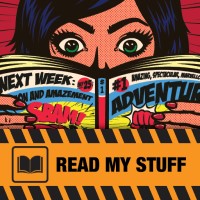
Looking back over my published credits, there’s one that sticks out, a bittersweet entry in my 15-plus years of professional writing. It’s the final article I published with Wizards of the Coast for Dungeons & Dragons, and it happened in September of 2013, in Dragon #427.

My article in this issue (which is also the cover image) is titled “The Lost World.” It’s described in the table of contents thusly: We brush away the dust of ages and reveal primordial beasts that lived before the rise of dinosaurs, or after their extinction. I’m a huge dinosaur and prehistoric animal nerd, and this article indulged my love of ancient critters and, hopefully, gave Dungeon Masters some interesting new monsters to work with. The article includes 4e stats for creatures like gorgonopsids (called urdrakes), sea scorpions, and various prehistoric mammals (called urbeasts). It was a fun article to write and seemed a fitting swansong for my final contribution to 4e Dungeons & Dragons.
So, why was this my last article? Well, if you look at the date of this issue of Dragon, you’ll see it’s September of 2013. In under a year’s time, a new version of D&D would be released. The new edition, 5e, would make the game more popular than ever and change the way the game was designed in many ways. Both Dragon and Dungeon magazines went by the wayside, and since the bulk of my contributions were in those publications, so did my work for WotC. In addition, my position at Privateer Press as publications manager was leaving me less and less time for extracurricular activities, and, what time I did have, I wanted to spend on writing fiction. I’m in no way bitter or upset with how things turned out. Writing for Wizards was a bucket list accomplishment, and I have nothing but fond memories of the five years or so I was writing official D&D content. I worked with fantastic editors, got sneak peeks at awesome upcoming games and content (Dark Sun!), and I learned a lot about writing and game design.
Anyway, if you’d like to check out this issue of Dragon, just click the cover image above. This issue and a bunch more are still for sale out at DriveThruRPG.
The Rejectonomicon – I Need Your Questions
Hey, folks, short update today. I just want to highlight my new Q&A column, THE REJECTONOMICON, over at Dark Matter Magazine and invite you to submit questions about submissions, rejections, and writing in general.
The first article is up already, and we’ll be doing these on a bi-monthly basis. You can check out that first article by clicking the link below.
The Rejectonomicon Volume I
So, how do you submit questions to me? Easy. Here are the submission guidelines.
- Email your question to questions@rejectomancy.com.
- Put REJECTONOMICON in the subject line of the email.
- Write your question in the body of the email. Try to keep it relatively brief. Around a paragraph.
- Please let me know if you’d like your first name published along with your question or if you’d like to remain anonymous.
- Please restrict your questions to the subjects of writing, submissions, and rejections. Those are pretty broad categories, though, and I’d be happy to field questions about my past career as a TTRPG game designer/editor and media tie-in writer.
- I might make very slight edits to your questions but only to fix obvious typos and whatnot.
- If I choose your question for an installment of THE REJECTONOMICON, I’ll respond via email and let you know.
Got it? Then send me those questions! 🙂
Submission Statement: January 2022

The first month of the 2022 is in the books, and it was a good one.
January 2022 Report Card
- Submissions Sent: 10
- Rejections: 8
- Acceptances: 2
- Publications: 8
- Further Consideration/Shortlist: 2
January was an all-around good month, and a great way to kick off the year. I sent ten submissions, which gives me a head start on my goal of 100 submission per year. I received eight rejections, which is about average against the number of submissions I sent. I had two story acceptances, and that’s fantastic for a number of reasons. One, it gets me on the board early and relieves some pressure, the kind of pressure I felt last year when my first acceptance didn’t come until April. Two, one of the stories accepted had been rejected FIFTEEN times previously, so it was extra sweet to finally find it a home. Finally, one of the stories accepted was a shortlist/hold, and since I haven’t been converting those much lately, it really feels like a win.
Rejections
Eight rejections in November.
- Standard Form Rejections: 6
- Upper-Tier Form Rejections: 2
- Personal Rejections: 0
All form rejections last month. Most were pretty quick, but one of them took long enough I thought I might have a good shot at publication. Alas, it was not to be. All of January’s rejected stories were sent back out again, some multiple times. It’s one of the ways I keep my submission numbers up. Rejections feed new submissions, which feeds new rejections, which feeds new submissions, and so on, and so on. 🙂
Publications
I actually had a lot of work published in January, the bulk of which were media tie-in stories for Privateer Press’s WARCASTER game setting. The last publication is for my new column over at Dark Matter Magazine. More info on that below.
Warcaster Stories
Each of those short tales (about 1,500 words) is set in the Thousand Worlds, the sci-fi campaign setting for Warcaster: Neo-Mechanika. Each story focuses on a wildcard, a mercenary or freelancer in the Thousand Worlds. These characters range from honorable bounty hunters and inscrutable mechanikal beings to sword-wielding nobles and ancient artificial intelligences. You can read the stories for free by clicking the links below.
- “In Humanity’s Defense”
- “Dead Past Counting”
- “Without Jurisdiction”
- “Inner Workings”
- “Not One of Us”
- “Death Becomes Him”
- “Friend and Foe”
The Rejectonomicon
I have a new question and answer column over at Dark Matter Magazine called THE REJECTONOMICON. The first article went up yesterday, and I offered my opinions on questions ranging from short story contracts to editorial feedback. You can check out the first article right here. As much I would dearly love for you to read last month’s article, I also need your help. Well, more specifically, I need your questions. So, if you have a question about submissions, rejections, or writing in general, send it to me and I might publish question and answer in an upcoming installment of the THE REJECTONOMICON. How do you send me questions? Here’s how.
Send your question as an email to questions@rejectomancy.com. Please put REJECTONOMICON in the subject line. In the body of the email, write your question and include at least your first name. Let me know if you’d like your name published with your question or if you’d rather remain anonymous. Please restrict your questions to the subjects of submissions, rejections, and writing. I’m not much good for anything else. 🙂
And that was January. How was your month?
The Way I Write Part 5: Novels & Stuff

I’ve explored my writing as it’s developed these past twenty years through a series of posts titled The Way I Write. I largely used the Flesch-Kincaid readability scores to get an idea of how my work has progressed over the years. Basically, I went from super-wordy and dense to spare and streamlined. Once I started making that transition, I got published. This is not to say you can’t get published with a wordy, dense style, just that I couldn’t. 🙂
Anyway, I focused primarily on short fiction in those posts, but I’ve also written novels and a novellas, both published and in the works/ I thought it might be interesting to look at my long-form fiction, check the readability scores, and see what they can tell us. Quick note: the Flesch-Kincaid readability scores presented here are for the entire novel or novella, not just the excerpt.
Before we get into to this post, here are the others in this series.
- The Way I Write Part 1: The Early Years
- The Way I Write Part 2: Evolution
- The Way I Write Part 3: Refinement
- The Way I Write Part 4: Something Resembling a Style
Acts of War: Flashpoint (2016)
This is the fist novel I published with Privateer Press. It’s set in the steampunk fantasy world of The Iron Kingdoms. In terms of genre, it’s fantasy (steampunk) but includes action/adventure and even sci-fi elements. The entire Acts of War trilogy follows the main character, Lord General Coleman Stryker (with a few other POVs here and there), through a massive continent-spanning war. The novel spends a lot of time in the thick of huge battles between massive armies, and that really sets the tone and pace of the books. Here’s a short excerpt.
Stryker closed his eyes and concentrated, strengthening his connection to the three warjacks he commanded. He’d controlled as many as seven at once, but more than four or five tended to stretch even a veteran warcaster’s abilities. It was like trying to solve complex mathematical equations in your head while simultaneously trying not to get shot, stabbed, or blown to pieces.
Digging into his arcane reserves, Stryker cast one of his more potent spells. Bright runes enveloped his warjacks, filling the great machines with furious energy that would ultimately conserve Stryker’s own power.
Being a media tie-in novel set in a universe with a whole lot of unique terms, I don’t expect everyone will follow what’s going on here, but that’s okay. I’m mostly concerned with the how it’s written and how it differs from the other novel excerpts in this post. To that point, here are the Flesch-Kincaid readability scores.
- Passive Sentences: 5.5%
- Flesch Reading Ease: 75.5
- Flesch-Kincaid Grade Level: 5.5
The readability scores here are definitely lower than the other pieces I’ll discuss in this post. A lot of that has to do with genre. I find that fantasy and sci-fi tends to be a little denser than other genres. A lot of that has to do with the high number of technical terms you find in these works. For example, in Flashpoint, you are bound to run into words like necromechanikal on a pretty regular basis, and since Flesch-Kincaid takes into account word length as part of its metrics, you get lower reading ease scores and higher grade level scores.
Late Risers (2018)
This novel is currently out on submission, but I finished the first draft in late 2018. It’s a supernatural thriller set in modern-day Seattle and a good example of how I write these days, though it is maybe a tad more serious than my usual fare. Here’s an excerpt.
Koldun Nikolay Kuznetzov picked up after one ring. “Andrei, it is good to hear from you. I trust your visit to the city went well.” Even through the phone, the koldun’s deep, measured voice sent tentacles of fear writhing through Andrei’s guts.
“It did,” Andrei said. “Regrettably, Maxim, Ivan, and Gavrie have decided to stay behind.”
A pause, then, “Unfortunate. Maxim will be missed.” Andrei sensed genuine regret, and Nikolay sounded almost human for once. “What should I tell our benefactor?”
Andrei shuddered. He’d only met the man Nikolay referred to once, and the experience haunted him. “Tell him he was right.”
This little snippet is pretty indicative of a lot of my writing. Dialogue heavy, stripped down, even simple. There’s plenty of action in this novel too, but it’s similar to the excerpt in tone and sentence construction. Since the book is a paranormal thriller, I’m aiming to convey a sense of urgency and movement with the prose. Whether or not I was successful with that is yet to be determined, but let’s see what the Flesch-Kincaid readability scores look like.
- Passive Sentences: 1.9%
- Flesch Reading Ease: 81.3
- Flesch-Kincaid Grade Level: 4.4
As you can see, the language in this novel is simpler and more straightforward than Flashpoint. Based on my research, the grade level score is at the low end for commercial fiction, somewhere between Hemingway and Cormac McCarthy. (I am, of course, not comparing myself to these two authors in any real sense.) Is that too low? I guess it depends on the reader and the publisher. I’ve certainly sold short fiction with similar scores, but, we’ll see.
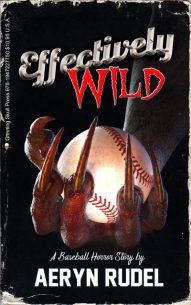
Effectively Wild (2021)
Effectively Wild is a standalone novella I wrote last year. Like Late Risers, it too is a paranormal or supernatural thriller. It combines two of my greatest loves: baseball and monsters. Let’s take a look at an excerpt.
After ten years as a catcher, Martin knew pitches made different sounds depending on their velocity. A ninety-mile-per-hour fastball hummed. A ninety-five-mile-per-hour fastball buzzed, and a pitch approaching triple digits hissed. The first warm-up toss from Dinescu came in like an angry snake and popped Martin’s glove like a shotgun blast. He flinched as he caught it, trembling from adrenaline, surprise, and plain old fear. He looked up at the scoreboard. The pitch speed read ninety-nine.
Although this excerpt doesn’t showcase it, the novella is similar in style to Late Risers. It’s dialogue-heavy and moves along at a pretty good clip. What this excerpt does show, or at least hint at, is that the novel includes a fair amount of baseball terminology. Will that effect the readability scores? Let’s see.
- Passive Sentences: 2.7%
- Flesch Reading Ease: 79.1
- Flesch-Kincaid Grade Level: 5.1
So the reading ease dropped and grade level went up. The jargon-heavy passages are definitely having an effect, and I’d guess that’s common with any piece of fiction that centers on a profession or subject that comes with a bevy of specific terminology. For example, John Grisham (lawyer) and Michael Crichton (science-heavy) have readability score in the mid sevens to the low eights. Still, well within the acceptable levels for modern commercial fiction, but toward the higher end. Of course, these authors’ readability scores are not solely determined by what they write about. Some of it’s certainly their own particular style and voice.
The numbers here line up with my short fiction, and for better or worse, show that this is my style. I started out writing prose that would make Lovecraft wince, and now I write prose that is often called “clear” and “easy to read.” I think that last one is compliment, but I’m never sure. 🙂 Regardless of whether folks love it or hate it, this is probably my final form as a writer. Sure, I’m always looking to improve, and I’ll keep refining my prose, but I’d guess my readability numbers are not going to change much from what you see here.
Thoughts on the Flesch-Kincaid readability scores? Tell me about it in the comments.
(Oh, and if you’re looking for the chart I references that shows the readability scores of various famous authors, you can find that right here.)
A Week of Writing: 1/17/22 to 1/23/22
Another week come and gone. How’d I do?
Words to Write By
This week’s quote comes from French novelist Gustave Flaubert
“I am irritated by my own writing. I am like a violinist whose ear is true, but whose fingers refuse to reproduce precisely the sound he hears within.”
– Gustave Flaubert
Jesus, I feel this one in my SOUL. Every time I sit down to write, no matter how clear the idea is in my mind, what ends up on the page is like a halfway decent photocopy of what’s in my brain. This is why I struggle with revision sometimes–the manuscript and the pictures in my head don’t match up. What’s important to understand, though, is that, generally, only you know that your story or novel or poem or whatever is an imperfect facsimile of the original idea. Sometimes, that halfway descent photocopy story is still pretty damn good, and if no one knows they’re reading something that doesn’t exactly fit your vision AND they still enjoy it, then maybe it doesn’t matter. That’s not to say you shouldn’t strive to create exactly what you see in your head, but maybe, just maybe, we shouldn’t beat ourselves up too much if it comes out a little different than we intended.
Short Story Submissions
A fairly eventful week in submission land.
- Submissions Sent: 2
- Rejections: 2
- Acceptances: 0
- Publications: 0
- Shortlist/Hold: 1
- Withdrawn: 0
- Pending: 12
- 2022 Total Subs: 8
I sent two submissions last week, giving me eight for the month and the year. That’s about the pace I want to be at. Around two subs a week gets me to 100 for the year. The two rejections were both of the form variety, though one of them took almost six months to get to me. I also got a shortlist notice on a story, and I’ll share that letter with you below. I still have twelve submissions pending (not counting novel subs), and a number of them are getting a little long in the tooth. I expect I’ll hear back on at least one the subs that’s been pending over 100 days in the next few weeks.
I often showcase rejections in my weekly updates, but hold/shortlist letters can be interesting literary artifacts as well, and they come in a wide variety. Here’s the one I received last week.
[Story Title] has been accepted for further consideration. We will be letting you know before the end of [month] whether or not it has been accepted for publication.
Most hold notices are short and to the point, and this one is no exception. This is a form letter that gives the the author the necessary information. It tells me the story is being held for further consideration and when I’m likely to hear back. That’s all I need to know. Very occasionally an editor will throw in a personal note about the story, but it’s not common in my experience. My success rate in turning holds into acceptances is historically about fifty percent, though it was much, much worse last year. Hopefully, 2022 will get me back on track.
Novel
I’m working steadily on the revision of Hell to Play. Last week I finished revising act one, and it’s in pretty good shape. The next big task was to write new material, namely the first POV chapter of the novel’s antagonist. I achieved that goal, and added a new 3,000-word chapter to the manuscript. I’ll be using the villain’s POV chapters as interludes between acts, and I think it’s going to accomplish a couple of things. One, it will make the villain’s motivations clearer, something that was a little murky in the first draft. Two, it will draw an interesting and important contrast between the villain and one of the protagonists. They’re both demons, but one is on a redemption arc and the other is, well, not. I think it’ll be helpful to have both perspectives: a demon that is questioning its place in the universe and one that’s reveling in it. Anyway, I had fun writing the new chapter. This week, it’s back to the grind in act two, which is going to need the most work of any section in the novel.
Goals
Goals this week are to keep revising the novel, send more submissions, and to spruce up a short story and get it ready for submission.
That was my week. How was yours?
A Week of Writing: 1/10/22 to 1/16/22
There goes another week where I was supposed to be writing and submitting stories. Let’s see how I did.
Words to Write By
This week’s quote comes from science fiction novelist Joe Haldeman
I think any writer keeps going back to some basic theme. Sometimes it’s autobiographical. I guess it usually is.
–Joe Haldeman
Saw this quote a few days ago, and I’ve been thinking about it a lot. There are definitely themes I return to in my writing, and at first blush, they don’t appear to be autobiographical. However, when I think about them in detail, that’s not completely true. I keep returning to subjects that frighten me in one way or another. Writing about these fears, even when I’m not fully aware of them, might be a way to tame them, even exorcise them. If I can put my fears into a story, I’m controlling them in some sense. This is not to say that my work never features overt autobiographical themes, and I’ve certainly written a few of those lately. The difference with these stories is the intent. I set out to be autobiographical. The other stories seem to happen without that same level of intent. It’s like my subconscious bubbles up and on to the page, and it’s only when I’m finished and rereading the story that I realize I’ve delved into something fairly personal.
Short Story Submissions
A slow week for submissions.
- Submissions Sent: 1
- Rejections: 1
- Acceptances: 0
- Publications: 0
- Shortlist: 0
- Withdrawn: 0
- Pending: 14
- 2022 Total Subs: 6
Just one submission last week. That said, it was for my novella Effectively Wild, which, as it would so happen, was also the lone rejection. Unlike short stories and flash fiction, where there are often dozens of possible markets, novellas are a different story. There are few magazines that take stories of that length, and once you exhaust those options, you have to start researching small book publishers, which is what I’ve been doing. Unfortunately, there aren’t a lot of publishers currently open to novella submissions or markets where my paranormal sports story would be a good fit. I did find one publisher that could be a match based on the novellas they’ve previously published, so I sent Effectively Wild there. Now it’s just wait and see.
The one submission last week gives me six for January, and I need nine to stay on pace for 100 submissions for the year. That shouldn’t be a problem. I’ve been working on a couple of flash pieces that’ll go out this week or next.
Novel
I made good progress on the revision of Hell to Play last week, and I revised about 75 pages, right through chapter six. The first act is in pretty good shape, so the bulk of my revisions was cutting out extraneous words, sentences, and paragraphs to sharpen the writing and improve the pacing. I also needed to make some minor character adjustments, though the bulk of those will happen in act two. I should finish act one this week, and then things get more difficult. Acts two and three will require full-on rewrites in some areas and the addition of new material in others. Challenging, but I have a clear idea of what I need to do. I just have to buckle down and execute.
Goals
Same goal as last week: keep revising the novel and send out more submissions.
That was my week. How was yours?
A Week of Writing: 1/1/22 to 1/9/22
The first week (and a bit more) of the new year has come and gone, so it’s time to start documenting my writing endeavors for 2022. Here we go.
Words to Write By
This week’s quote comes from playwright and novelist Larry L. King
“Write. Rewrite. When not writing or rewriting, read. I know of no shortcuts.”
—Larry L. King
This quote pretty much sums up my goals for 2022. I have a novel to revise, and I’ve jumped back into the the thick of it. My goal is to write and rewrite it until it becomes something I feel confident sending to agents and publishers. That might take a month or three, but I want to do it right. My reading fell off in a major way in 2021, and that’s something I need to address in 2022. I want to read more. I want to discover new writers with new and different perspectives. In short, I want to immerse myself in fiction because I know I’m a better writer when I’m plowing through novel after novel. So, yeah, write, rewrite, read are my guiding literary principles for this new year.
Short Story Submissions
I’ve been pretty active in submission land in the new year.
- Submissions Sent: 5
- Rejections: 3
- Acceptances: 1
- Publications: 0
- Shortlist: 1
- Withdrawn: 0
- Pending: 14
- 2022 Total Subs: 5
The last ten days or so have been pretty busy in terms of submissions. I sent five new subs, collected three rejections, landed an acceptance, and had another story shortlisted. Not bad. The acceptance definitely takes a bit of pressure off. I always want to get on the board as soon as possible in a new year, and this is a HUGE improvement over last year. My first acceptance in 2021 didn’t come until April.
My goal is, once again, to send 100 submissions for the year, which breaks down to around nine subs a month. I’ve got a good start on that.
Novel
My big goal for the first quarter of 2022 is to finish the revisions on my novel Hell to Play. I’ve adopted a new approach I think will keep me on track and help me get this thing done. I’ve revised half a dozen novels in the past, and though there are always challenges, this particular novel is proving far more difficult than the others. I’m out of excuses, though, and it’s time to just get it done so I can a) start shopping this book and b) start writing a new novel. Like I said, my goal is to finish this in the first quarter, which is more than enough time. Wish me luck. 🙂
Goals
The goal for the week is to work on revisions of Hell to Play as much as possible. As always, I also want to send out more submissions.
That was my week. How was yours?
Submit or Surrender? A Tale of Three Publishers
A popular topic in writerly circles is if and when a writer should give up on a market after multiple rejections. The idea being that if an editor rejects you a certain number of times, it’s likely they are not interested in your work because of style, taste, etc., and you should stop submitting to that publisher. Of course, opinions vary on how many rejections indicate you should wave the white flag, and some writers believe you should NEVER give up on a publisher, no matter how many rejections you receive. I tend to fall into the latter camp, but with a few caveats. I think I can best explain my thoughts on this issue with an examination of my submission records for three publishers.
As always, I will not be disclosing the names of the publishers or the titles of the stories I’ve sent them. This post is not about “calling out” editors for sending rejections; it’s about what we might learn from those rejection to improve our chances of getting accepted. Okay, let’s dive in.
Publisher #1 – Surrender
- Submissions: 23
- Rejections: 23
- Form Rejections: 23
- Submitted Stories Sold Elsewhere: 13
The first publisher is one I have given up on. The reason is simple: I have made zero progress after nearly two dozen submissions. All 23 of my submissions have resulted in basic form letters. Now, could it be that I’m just sending them bad stories? I mean, maybe, but I have gone on to sell over a dozen of the stories they rejected, some to pro markets. That tells me it might be that my style, voice, and even the things I tend to write about are just not a good fit for this editor/market. Now, I don’t have a single molecule of animosity toward this market, but I have come to the conclusion my work is probably not what they’re looking for. Honestly, I had my doubts around submission 15 or so, but I stubbornly pressed on. Again–and I can’t stress this enough–I have zero negative feelings toward this publisher. They’re an excellent market. The truth is simply that not every every writer is a good fit for every market.
Publisher #2 – Submit
- Submissions: 32
- Rejections: 32
- Form Rejections: 27
- Personal Rejections: 5
- Final Round Rejections: 4
- Submitted Stories Sold Elsewhere: 22
Now this might look worse than the first publisher, but I don’t believe it is. Yes, I have sent this publisher a ton of submissions and received a ton of rejections, but it’s the type of rejections I’ve received that keep me submitting. Instead of an avalanche of boilerplate form rejections, this publisher has sent me rejections that indicate I might be on the right track. Four times, I’ve made it to their final round of deliberations, which means the story was close to publication (how close is difficult to determine). In other words, I think they liked these stories, even if they ultimately didn’t make the final cut. That tells me my work might have a place with this publisher if I send them the right piece. So I keep trying, and as you can see my the number of stories I’ve sent that I’ve sold elsewhere, I try to send them my absolute best.
Publisher #3 – Success
- Submissions: 21
- Rejections: 20
- Acceptances: 1
- Form Rejections: 15
- Personal Rejections: 5
- Shortlist Rejections: 3
- Submitted Stories Sold Elsewhere: 16
The last publisher is one I have actually sold a story to. That said, it took me eleven tries before I did. In those eleven tries, I received encouraging rejections, and I eventually sent the right piece. Now, I’ve gone on to submit here ten more times, and in those ten attempts, there have been four personal rejections and two shortlists. So, even thought I haven’t sold them another story, I like to think my chances of another acceptance are pretty good. I included this publisher because I think they demonstrate that not giving up on a publisher when you’re receiving “good” rejections, even a bunch of them, can be the right decision. Keep in mind, though, just because you sell a piece to a publisher, especially one with a low acceptance rate, you still might struggle to sell them another (though, as in this case, you might continue to receive encouragement to keep submitting). Again, you see that a large number of the stories rejected by this publisher were accepted elsewhere. Please don’t misunderstand my reasons for including this number. It’s not that the publisher was wrong for rejecting those stories; it’s that the stories where just a better fit for another editor/publisher.
So, to sum up, giving up on a publisher after a ton of submissions is a perfectly reasonable thing to do, as is continuing to submit to that publisher. You just have to look a deeper at the numbers and ask yourself some potentially difficult questions. Also, as you can see by my numbers, a story that is wrong for one publisher may very well be exactly what another publisher is looking for. So, keep writing, keep submitting, and keep trying.
Thoughts on this issue? Have you given up on a publisher or stuck with one despite a ton of rejections? I’d love to hear about it in the comments.
Effectively Wild – A Baseball Horror Story
Night Walk & Other Dark Paths
Acts of War: Flashpoint

Acts of War: Aftershock

Acts of War: Stormbreak

 Aeryn Rudel's Rejectomancy