
Effectively Wild – A Horror/Baseball Novella

Way back in August of last year, I was joking with my wife about writing a baseball monster story featuring a certain type of monster. I offered the title Effectively Wild as a haha-isn’t-that-funny and got the appropriate eyeroll. Well, friends, that slightly silly idea began to take shape in the ol’ brain meats, and it wasn’t long before I had outlined a novella. Now, I love baseball, and I love monsters, so once I got started on this thing, I enjoyed the hell out of it. It wasn’t even the first time I’d done the monster baseball thing. Back in 2016, I published a story with Pseudopod called “Night Games”, which you can check out here.
Anyway, I finished a first draft of Effectively Wild, ran it through two excellent critique partners who pronounced it good, and then started submitting it. I knew it was gonna be a tough sell. For one, it’s more supernatural thriller than straight up horror, so that was strike one. Two, it features baseball, and, well, some folks are really not into sports, so strike two. Finally, there aren’t many short fiction markets that publish novella-length work. Strike three. I did try one short fiction market and received the simple form rejection I knew was coming. That led me to believe that independent book publishers interested in novellas would be a much better bet. So I went that route, and after two more rejections, I sent the novella to Grinning Skull Press. To my very pleasant surprise, I received an acceptance about six months later.
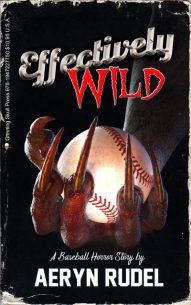
This will be the longest piece of fiction I’ve published outside of media tie-in (where I’ve published multiple novels), so this is an exciting development for me. Working with the staff at Grinning Skull has been a real delight, and a few days ago, the previewed the cover of Effectively Wild, which you can see below along with a short synopsis of the story (that’s spoiler free). I couldn’t be happier with the old-school 80s vibe of this thing. Check it out.
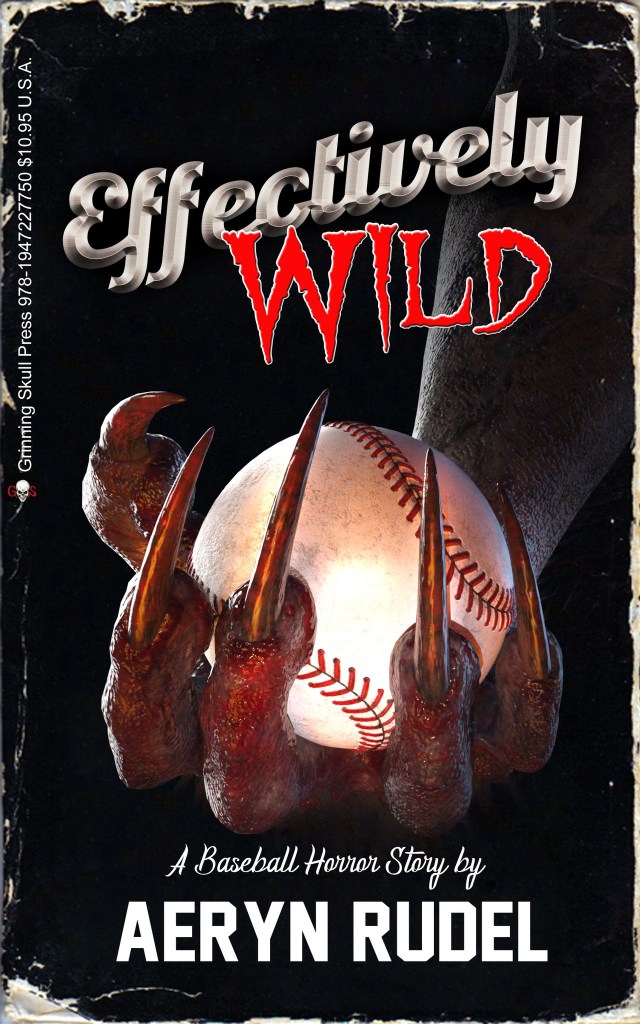
Martin Wagner, an aging catcher in the San Francisco Giants farm system, is offered a new assignment—take a promising young pitcher under his wing and show him the ropes. Martin’s manager is cagey about the new player, giving only his name, Andrei Dinescu, and his country of origin, Moldova. Despite the mysterious circumstances, Martin accepts the assignment, hoping to earn a return to the big leagues.
After his first bullpen session with the strange new pitcher, Martin is shocked by Andrei’s lack of physical ability and his unfamiliarity with the game of baseball. However, with each passing week, Andrei’s strength and skill grow exponentially, and his miraculous leaps in both ability and velocity begin to frighten Martin. This fear is compounded by the organization’s obvious attempts to keep Andrei separated from the rest of the team.
At the height of his prowess, Andrei is put into the rotation for his first start with Martin behind the plate. Before the game, the manager offers a devil’s bargain, and the source of Andrei Dinescu’s bizarre abilities becomes horrifically clear. Martin is faced with a desperate choice: walk away from baseball and everything he has known or deal with the monster on the mound and earn his way back to the majors.
This is just the cover reveal. The exact release date has yet to be determined, but it will be sometime in the Fall. Preorders are the next step, and I’ll post links to those as soon as I’m able.
Hopefully, there will be more monster/baseball mashups. I’ve got ideas for a bunch of them all loosely connected to Effectively Wild. I’ve even been tinkering with one tentatively titled Deep Count. 🙂
Further Considering Acceptance Rates

I recently received a further consideration/hold letter from an excellent pro market. This is my third story to make it through a first reader and be recommended to one of the editors for further review. Now, it can be hard to quantify exactly what it means when you get over that first hurdle. There a lot of questions you might ask. How many total submissions does the publication receive? How many stories make through the first round? And, finally, of those stories, how many end up accepted? Usually, all you can do is guess at those answers, but the editors at Apex Magazine recently gave us some hard numbers and shed some light on the situation.
I’ll link the Twitter thread here, but here’s the basic math.
According to the Apex editors, they received roughly 5,000 submissions through mid-May of this year, about 1,000 subs per month. Of those 5,000, around 100 were recommended to the editors (made it past the first reader). That’s around 2% of the total submissions received. Of those stories that made it through the first round, six stories were accepted for publication. That’s 6% of stories recommended to the editor and 0.12% of total submissions. I encourage you to read the Twitter thread, as it contains a more granular breakdown, but these are broad strokes.
I think you could expect similar numbers from other big genre markets like The Magazine of Science Fiction & Fantasy, Clarkesworld, Asimov’s Science Fiction, and others. These numbers do NOT mean you shouldn’t submit to these markets, but it’s good to understand the odds you’re up against, and, more importantly, what those odds mean. Let’s dive into that.
- A rejection from a market like this does not mean you’ve written a bad story. Even more so than smaller markets, It usually means you’ve simply written a story that isn’t right for the publication. Out of the 4,994 stories Apex rejected, I’d be willing to bet quite a few of them were pretty good and went on to be published elsewhere. So, don’t let a rejection from a big pro market get you down.
- If you do get a hold/further consideration letter from a market like this, you’ve reached rarified air. Publication is never a guarantee, but you’re certainly a big step closer. Even if the story is ultimately rejected, it’s a safe bet you’ve got a good one on your hands, and it just wasn’t quite the right fit for this market. Chances are good it will be for another. Case in point, the other two stories of mine Apex held for further consideration and ultimately rejected were sold elsewhere in fairly short order and to semi-pro or pro markets. Note, this does not mean Apex was wrong and the other publishers were right. It just means my stories were a better fit for those other markets.
- The number here demonstrates the crusty old adage that good stories get rejected too, and, as always, publication is about putting the right story in front of the right editor at the right time. Yes, the chance of acceptance is slim, but the chance of acceptance for the right story is always 100%. Keep writing, keep submitting, and eventually, you will beat the odds.
This kind of information is exceedingly helpful. So from this writer and I’m sure dozens of others, I would like to offer a sincere thank you to the editors of Apex Magazine for giving us a peek behind the curtain. It is very much appreciated.
Thoughts on these numbers and other pro markets? Tell me about it in the comments.
Swings & Misses IV: Revenge of the Rejection Streak
Submitting short stories to genre and lit magazines is a process that can be, uh, well, let’s just say discouraging. Why? Because rejections are inevitable, multiple rejections for the same story are expected, and even two or three rejections in the same day are not out of the ordinary. Most writers have a thick enough skin to withstand the fusillade of NOs, but what about when the rejections pile up and there’s not an acceptance in sight? Well, friends, I’m here to tell you that the dreaded rejection streak is also not that uncommon. I have endured three that crossed the twenty-rejection threshold. In fact, one just ended a few days ago. As I have done before with rejection streaks, I’m going to break down the latest one and see how it compares to the others. Then we’ll talk about why these streaks happen and what you can do about it.
First, data! Stat for my three rejection streaks in the table below.
| 2017-2018 | 2020-2021 | 2022 | |
| Rejections | 27 | 21 | 22 |
| Duration | 12/9/17 to 2/18/18 | 12/27/20 to 4/1/21 | 4/12/22 to 6/4/22 |
| Duration (Days) | 74 | 96 | 54 |
| Unique Stories | 13 | 13 | 13 |
| -Flash Fiction | 8 | 9 | 7 |
| -Short Stories | 5 | 4 | 3 |
| -Novellas | 0 | 0 | 1 |
| -Other | 0 | 0 | 2 |
| Markets | 17 | 14 | 15 |
| -Pro | 12 | 10 | 9 |
| -Semi-Pro | 5 | 4 | 5 |
| -Token | 1 | 0 | 1 |
The key difference in the three rejections streaks is duration. The other numbers are eerily similar. I mean, look at the unique stories line. That isn’t a mistake. Those with triskaidekaphobia would be understandably horrified. The rest of the data–number of markets, types of markets, and lengths of stories–are all pretty much the same. So what’s happening here? I’m a modestly successful short story writer with lots of publications. Why am I running afoul of these long streaks not-for-us’s? Now that I have a lot of data, some of my answers to that questions have changed, while some are evergreen and immutable. Let’s discuss.
- Bad Luck: Let me start with this a sports analogy. (Sorry.) In baseball, when a player goes on an extended hitless streak at the plate, his coaches will often turn to the analytics to figure out why. Sometimes, they can see that his exit velocity off the bat is consistently high, i.e., he’s hitting the ball hard, but by sheer luck he’s hitting the ball right at the defense and his hitless streak continues. My rejection streaks are similar. Hard hit baseballs translate to close-but-no-cigar rejections, and each of these streaks tends to feature more than usual. In other words, I’m making good contact, but the hits just aren’t dropping in. There is absolutely nothing you can do about that. You just have to keep stepping up to the plate and telling yourself this time it’s going over the fence.
- Tough Markets: I tend to submit primarily to pro and semi-pro markets. Often the acceptance rates at these markets are vanishingly small, so even a good story is likely to get rejected and require multiple submissions before it finds a home. Nearly all the short stories I’ve sold to pro markets were rejected upwards of ten times. You get a couple of those out there at the same time, and hello streak-ville.
- Long-Form: Unlike previous rejection streaks, this current one included a novella. Long-form fiction can be tougher to sell because there are fewer markets, and many of those markets are short story publishers that might occasionally publish a novella. In other words, the odds are stacked against you even more with pieces over 10,000 words or so. A fair number of rejections in this streak were for the novella I’ve been shopping around, but I’m happy to report there’s some good news on that front. 🙂
- Stuck in a Rut: We all have our go-to tropes and themes and narrative styles, and even if they are generally successful, you can find yourself churning out the same story over and over again. If you submit to a lot of the same publishers, they might get tired of reading ANOTHER tale about two people talking in a bar and one of them is a zombie/vampire/demon. I mean, who would write such a thing? 🙂 Anyway, I definitely needed to break out of a certain mold and get a little more creative with my work. It’s not that I’m not still writing about demons and vampires and weird psychic phenomenon. I’m just trying to stretch a little in terms of character and narrative structure. Too soon to tell if I’ll be successful, but I feel pretty good about the latest crop of stories.
So what’s the takeaway here? Essentially, the more you submit work, the more rejections you get, and occasionally, through bad luck and a few other factors, those rejections pile up. You honestly can’t avoid it, in my opinion. The thing to remember though, is that streaks, by their very nature, must end. You just have to be patient, try to take an objective look at your work, and see if there’s anything you can adjust. Often times, there isn’t, and it’s really about getting the right story in front of the right editor at the right time. So, hang in there, keep writing, keep submitting, and keep going.
Submission Statement: May 2022

May is in the books, and here’s how I did.
May 2022 Report Card
- Submissions Sent: 5
- Rejections: 7
- No Response: 1
- Acceptances: 0
- Publications: 1
- Further Consideration/Shortlist: 0
Well, as you can see, I was not particularly productive in May on the shot story front. I spent more time working on my current novel and doing freelance work. That might be because the seven rejections in May give me twenty-two in a row. I’ve hit these streaks in the past, and this one, though long, is still not my longest. I need twenty-seven to turn that trick. So, what do you do when you have two discouraging months in a row? One, you keep writing and you keep submitting. Two, you look for patterns in your stories and submissions that might illustrate the need for change in one or both. You have to be careful with that second one, though. When you hit a rough patch, the urge to change something can be strong, but it’s important to remember that what you’re doing has resulted in success in the past. Anyway, I have some new stories to submit in June, and I feel pretty good about them, so that’s where I’ll put my short story focus. All streaks, good and bad, have to end some time, right?
One anomaly this month is the single no response. It’s an interesting one because the market in question says in their guidelines that if you don’t hear back from them in 90 days, then assume they are not going to publish your story. I hit the 90-day mark and marked the story as no response, but, in truth, this is a no-response rejection. I’ll likely change it at some point, you know, after my next acceptance. 🙂
Rejections
Seven rejections in May.
- Standard Form Rejections: 4
- Upper-Tier Form Rejections: 0
- Personal Rejections: 3
It sounds funny to say it, but the quality of rejections in May was much better than it was in April. Three personal rejections tell me the submitted stories are likely to find homes at some point. As I said above, the no response is probably just a rejection, so it’s eight for May rather than seven.
Publications
I did have one publication in May. The third volume of THE REJECTONOMICON, my Q&A column over at Dark Matter Magazine, went up last month. You can check it out below. As always, I need your questions, so check out the guidelines, and send them to me. 🙂
Here’s how to send writing and rejection questions to me.
- Email your question to questions@rejectomancy.com.
- Put REJECTONOMICON in the subject line of the email.
- Write your question in the body of the email. Try to keep it brief.
- Please let me know if you’d like your first name published along with your question or if you’d like to remain anonymous.
- Please restrict your questions to the subjects of writing, submissions, and rejections. Those are pretty broad categories, though, and I’d be happy to field questions about my past career as a Tabletop RPG game designer/editor and media tie-in writer.
Got it? Then send me those questions!
That was my May. How was yours?
First Draft Finish Line: What’s Your Speed?
How long should it take you to write the first draft of a novel? There’s no right answer, really, but as both a writer of novels and a former editor of authors who write novels, I’ve identified three categories that most writers fall into (more or less). This is all ballpark math, but it might be helpful to folks thinking about tackling that first novel.
Before I get into the details, let’s talk ground rules. I’ll be using daily word count (DWC) goals to measure writing speed in conjunction with a five-day “work” week. So, 1,000 words per day would be 5,000 words per week. I’m using 90,000 words as the target number for a completed first draft. That’s fairly average in the genres I write, but shorter or longer novels are not uncommon in other genres. Now, I know not everyone is comfortable with word count goals, so if you’d rather use time or pages written, just figure 1,000 words is roughly two hours of work and about five double-spaced pages.
Speed One – Easy Does It
- DWC: 1,000
- Weekly Word Count: 5,000
- First Draft Completed: 18 weeks
Notice I didn’t call this speed slow. That’s for a couple of reasons. One, I think words like slow, deliberate, and so on have negative connotations that aren’t useful when discussing something as challenging as writing a novel. Two, 1,000 words a day is plenty fast most of the time, and it’ll get you a first draft in six months, which is entirely reasonable.
Writing at this speed has a lot of advantages. Let’s discuss some.
Not Overwhelming: I think 1,000 words per day is manageable for most folks. If you can write flash fiction, then writing 1,000 words per day on a novel probably won’t be too arduous.
Good For Complicated Novels: If you’re writing a book that needs you to do a lot of research, this is a comfortable pace. In fact, this what I’m doing right now, as my current work-in-progress requires me to do a fair amount of research while I write. It also has a lot of characters, so I find myself referring to my outline and character spreadsheets a lot. I can do all this, and still hit 1,000 words without feeling overwhelmed.
Good for Multitasking: If you write blog posts, articles, short stories, and other stuff on a daily basis, another 1,000 words on a novel is still manageable. Especially, if you do your 1,000 words on the week days, and then write shorts or whatever on the weekends.
Speed Two – The King Method
- DWC: 2,000
- Weekly Word Count: 10,000
- First Draft Completed: 9 weeks
I call this the King method because this is the pace Stephen King writes. He does 2,000 words every day, but for we mere mortals, 2,000 words a day, five days a week is plenty.
So why write at this speed? Here are few reasons.
Fast but still Manageable. This is my usual pace for aa first draft, and I’ve found that it’s possible to knock out this many words in two to four hours depending on how I’m feeling, how much research I need to do, and so on. I generally don’t feel overwhelmed at this speed, and I always feel like I’m making good progress.
Solid Output for Deadlines: I’ve written a number of novels on deadlines, and, generally, if you can complete first drats in around nine weeks, most publishers are gonna be happy with that. Of course, there’s the usual revision and editing that needs to take place, but you’re getting a good jump on it.
Still Pretty Good for Multitasking: This pace still allows you to write other things, but I will say it drains the creative battery a bit more than 1,000 words.
Speed Three – The Deadline Looms
- DWC: 3,000
- Weekly Word Count: 15,000
- First Draft Completed: 6 weeks
For most folks this is really moving, and I’ve done it once (finishing a first draft in 43 days). Unlike the other two speeds, there are some real drawbacks here as well as advantages.
Fast but All-Consuming: Knocking out a first draft in month and a half is really moving, and when I did it, I found I didn’t have much time for anything else. It requires a lot of commitment. But is it necessary? Probably not. I know plenty of authors who write fulltime, who don’t write this fast. In my opinion, it’s great for when you really need to churn out the words for a deadline, but I generally find it unsustainable.
Fresh in Your Mind: The advantage of this pace is that everything stays fresh in your mind. The plot, the characters, themes, all that stuff because you’re so immersed in the book. For me, 3,000 words is roughly one chapter, so when I did this, there was a real feeling of completion and progress, because I’d finished an entire beat in my outline. In other words, you’re less likely to forget details about the plot of characters at this pace because, well, it wasn’t that long ago that you write about them.
I chose these three speeds because they’re paces I’ve actually written, and I can relate firsthand knowledge. I’ll reiterate, however, that there is no right speed to write a novel (unless you have a deadline, and then you should, you know, hit that deadline). I started at 1,000 words, but, hell, if all you have time for is 500 words per day or 250 or whatever, then do that. Those words add up, and if you keep plugging, you’ll have a first draft before you know it. What I’m saying is that, most of the time, the right speed is one you can maintain and one that results in a finished first draft.
What’s your speed? I’d love to hear about it in the comments.
Weeks of Writing: 4/25/22 to 5/15/22

Well, I am more than a little behind here, so let’s catch up. Three weeks of writerly doings all at once.
Words to Write By
Today’s quote is from author James Lee Burke
“Every rejection is an incremental payment on your dues that in some way will be translated back into your work.”
— James Lee Burke
Well, since I’m on a rejection streak (19 and counting), I figure a quote about rejections is appropriate. I think you have to look at rejections as accomplishments to some degree. Yeah, they’re not exactly a good time, but they show you’re working, that you’ve got the guts to send your work out there to be judged, and that, hopefully, you are willing to learn and improve. That last bit is what I think James Lee Burke is getting at. Every rejection is an opportunity to grow as a writer, even if it’s a tiny, incremental amount. I learn something with every no and not for us. Sometimes, it’s what’s wrong with a story or my work in general, and sometimes it’s don’t send this market that kind of story or even don’t send this market anything. Each rejection teaches me something, even when I’m not really in the mood to learn. 🙂
Short Story Submissions
Although April was a strong submission month, I have not been very active in May.
- Submissions Sent: 3
- Rejections: 3
- Acceptances: 0
- Publications: 2
- Shortlist/Hold: 0
- Withdrawn: 0
- Pending: 11
- 2022 Total Subs: 38
Only three submissions in the last three weeks and three rejections to boot. That’s not great, nor is my current streak of nineteen straight rejections. I have a number of stories that need to go out, so I expect to send three or four this week. Hopefully some of those will come back with a much-needed acceptance. The rejections have been particularly disappointing of late because I thought the stories where good matches for the markets, but I missed the mark. It can be hard to keep going after so many rejections in a row, but you have to keep writing, keep submitting, and know that acceptances will come. I did have two stories published recently and the reaction to those was very good.
The Novel – Hell’s Aquarium
I may have been a little lax with my short story submissions, but I keep on trucking with this novel. I added over 12,000 words to the manuscript and broke the 50,000-word mark, which I think is about halfway. I’m writing this novel slower than usual, at about 1,000 words a day, because there’s a lot of research that needs to go into it. I’m stopping a lot to look things up, check my notes, and check my outlines. I’ve come to terms with that, and, hey, I’m still looking at a complete first draft sometime in early August. That’s totally fine. I think this novel is the best idea, concept, and characters I’ve yet created, so if I need to take it slower so I don’t fuck it up (much), then that’s what I’m gonna do.
Publications
Two publications in the last three weeks, both of which you can read for free on line. The first is a piece of crime flash called “Left is Right” published at Shotgun Honey. The other is a dark sci-fi take called “Fertilizer” in Radon Journal’s inaugural issue. Click the images below to read the stories.


Goals
Keep working on Hell’s Aquarium and send more submissions.
Those were my weeks. How were yours?
Submission Statement: April 2022
Not gonna lie, April was a tough month. Read all the gory details below. 🙂
April 2022 Report Card
- Submissions Sent: 9
- Rejections: 10
- Acceptances: 0
- Publications: 0
- Further Consideration/Shortlist: 0
Any month where the number of rejections eclipses the number of submissions is probably gonna be a bad month. Add to that exactly zero acceptances or publications, and, well, I’ll just stand by my opening statement. If I search for a silver lining, I guess it’s that I sent 9 submissions, giving me 36 for the year and a pace of 108 for 2022. So there’s that. Still, it was a tough and disappointing month. I really thought a couple of those rejections had a good shot at being acceptances, but it was not to be.
Rejections
Ten rejections in April.
- Standard Form Rejections: 10
- Upper-Tier Form Rejections: 0
- Personal Rejections: 0
Yep, ten form rejection. If I squint, I might be able to call a couple of the rejections upper-tier, but that would be disingenuous because I’m not certain the publishers in question actually send upper-tier rejections (many publishers don’t). The ten rejections in April bump my current rejections streak to fifteen. Not my longest by a long shot, but, you know, fifteen is enough. I also had a couple of multi-rejection days in April that made the rejections sting a bit more.
Okay, I’ve complained about my pile of rejections enough. The truth is, as always, rejections are just a reality of writing and submitting. If you do both long enough, you’re all but guaranteed to run into these little (or large) streaks of no’s and not for us’s. That said, if you’re a long-time short story submitter as I am, you know these streaks come to an end, and an acceptance is right around the corner. You just have to be patient, keep writing, and keep submitting. So that’s what I’ll do. 🙂
That was April. How was your month?
Good, but Not Good Enough

Something I’ve been thinking about a lot lately is talent. Specifically, writing talent (obvs). A lot of this comes down to my specific version of impostor syndrome, which says, “Yeah, you’re good, but you’re not good enough.” Impostor syndrome is a real asshole, huh? Still this belief that I have talent, just not enough of it persists. So when I find myself pondering this awful conundrum, there are two quotes by Stephen King I like to think about. To me, they handily sum up the “good” and the “good enough”.
Quote 1: “If you wrote something for which someone sent you a check, if you cashed the check and it didn’t bounce, and if you then paid the light bill with the money, I consider you talented.” – Stephen King
King’s formula for talent is pretty simple. If someone is willing to pay you for something you wrote, you probably have talent. I’ll add on to this and say, if multiple someones are willing to pay you to write things, you probably have enough talent to piece together something resembling a career in writing. This covers the good part. People who get paid to write, even a little, are probably good at it. (Of course, money is not the only measure of talent, but it’s an easy one to identify.) Still, having talent is not what I worry about. The second quote covers that.
Quote Two: “Talent is cheaper than table salt. What separates the talented individual from the successful one is a lot of hard work.” – Stephen King
There it is. The good enough part. When I say good enough, what I mean is good enough to land that dream agent, publish my novels, be recognized as a writer of note. You know, the big dreams, and, dare I say it, the improbable ones. I think what King is saying here is that talent is the baseline, the starting point for most of us. It’s not what makes us successful (whatever your definition of success might be). No, what we need to do is focus on that second part. The hard work part. Why? Because it’s the only part of the process we control. You can’t control whether an agent or publisher is gonna like your story or book or whatever. You can’t control if readers are going to love your work, hate it, or simply ignore it. What you can control is putting words on the page, making those word the best you can possibly make them, and then putting those words in front of as many agents, and editors, and readers as possible as many times as it takes. If you do that, and you have that little bit of talent, I like your chances.
Okay, let’s get to work. 🙂
Weeks of Writing: 4/11/22 to 4/24/22
Two more weeks of writing. Let’s dive in.
Words to Write By
Today’s quote is from author Allegra Goodman.
“Know your literary tradition, savor it, steal from it, but when you sit down to write, forget about worshiping greatness and fetishizing masterpieces.”
—Allegra Goodman
Great quote, and one I’ve somehow missed all these years. I think a lot of us start out trying to sound like our favorite authors. I know I did. Those are the literary traditions I think Allegra Goodman is talking about. You read your favorite works and authors, and think, well, this is how a successful author should sound. Then, what happens is a subtle shift, you start to draw inspiration from those authors, those literary traditions, and weave them into your own voice. Sure, I take a little Stephen King here, and but of Elmore Leonard there, and maybe a touch of Robin Hobb over there, but again, how and what they write is inspirational, and I’ve long since stopped trying to sound exactly like them. (God, I hope). So, I no longer worship. I no longer fetishize. I do, however savor and maybe borrow just a little, and I think that’s okay as long as I sound like me and not like them. 🙂
Short Story Submissions
I was pretty active over the last couple of weeks.
- Submissions Sent: 6
- Rejections: 7
- Acceptances: 0
- Publications: 0
- Shortlist/Hold: 0
- Withdrawn: 0
- Pending: 12
- 2022 Total Subs: 36
Six submissions over the last couple of weeks, which gives me 36 for the year. That’s exactly on pace for my goal of 100. I just sent another this morning, so I’ll end up with nine for April at a minimum. Not bad. That said, April has seen A LOT of rejections. I’m on a streak of 15 in a row, and last week I has two multi-rejections days. These little slumps happen from time to time, but, I’ll admit, I thought at least one of the rejections I received in the past week was going to be an acceptance. That’ll teach me to get my hopes up. 🙂 Anyway, the only thing you can do in these situations is keep writing and keep submitting. Those acceptances are around the corner.
The Novel – Hell’s Aquarium
About four years ago, I had a great idea for a novel. I started writing it, got about 35,000 words in, and then got spooked about all the research I needed to do. I moved on to write two other novels in the next four years, and while I enjoyed writing those books, I have yearned to return to Hell’s Aquarium. Last week, I did that, and I produced over 5,000 new words in the manuscript. I detailed how I’m going about reclaiming a novel I haven’t worked on in four years in this post. Anyway, I’m taking baby steps back into this book, writing at about half the speed I usually do on a first draft (1,000 words per day as opposed to 2,000). I’m sure I’ll pick up the pace eventually, but this is enough for now, and I feel pretty good about where the book is going.
The Rejectonomicon
The second volume of THE REJECTONOMICON, my Q&A column over at Dark Matter Magazine, went up last month. You can read it by clicking the banner below. The third volume is coming in May, and I’ve already got some great questions, but as usual, I want MORE!
Here’s how to send writing and rejection questions to me.
- Email your question to questions@rejectomancy.com.
- Put REJECTONOMICON in the subject line of the email.
- Write your question in the body of the email. Try to keep it brief.
- Please let me know if you’d like your first name published along with your question or if you’d like to remain anonymous.
- Please restrict your questions to the subjects of writing, submissions, and rejections. Those are pretty broad categories, though, and I’d be happy to field questions about my past career as a Tabletop RPG game designer/editor and media tie-in writer.
Got it? Then send me those questions!
Goals
Keep working on Hell’s Aquarium, send more submissions, and finish up a short story or two.
Those were my weeks. How were yours?
Three Steps for Novel Reclamation
So, recently, I returned to a novel I abandoned about four years ago. It’s tentatively titled Hell’s Aquarium, and I wrote 35,000 words, essentially the first act, got spooked by the research I needed to do, and moved on to other projects. I’ve since written two other novels, but I’ve longed to return to Hell’s Aquarium. Well, now I have finally summoned the courage to do what needs to be done, and I’ve started writing the book again. It really think it’s the best idea I have for a novel, and I’m excited to see where it goes. Anyway, in this post I thought I’d talk about the steps I’ve taken to return to a novel I’ve barely looked at for four years. I figure I’m not the only one with a half-written manuscript crying out to be completed by its wayward creator. 🙂
Step One – Thank God for Prep: As a dedicated plotter, I wrote a complete and thorough outline for Hell’s Aquarium, which is proving invaluable. Even more helpful is something I’ve only ever done with this particular novel. It has a large cast of characters, so I way back when I was planning out this book, I made a spreadsheet listing every one of them. The info includes character names, descriptions, motivations, and their professions (important in this novel). I have returned again and again to that spreadsheet, and it has been a real life-saver. Now, I know not everyone prepares for a novel in the same way, but I would encourage folks to make some kind of notes on the book you’re writing just in case you end up in a situation like this.
Step Two – Read What You Have: The very first thing I did when I decided to return to Hell’s Aquarium was to carefully read what I’d already written. I approached my first read-through less like a writer and more like a reader (as much as that’s possible), really trying to absorb the tone of the book and the voice of the main character. My second read-through was one-hundred percent writer-oriented, and I made more notes about individual characters and plot points that would help me down the line. These read-throughs really helped me get reacquainted with the book, and were vitally important.
Step Three – Baby Steps: I began writing the book again this week. Normally I write 2,000 words a day minimum when I’m writing a first draft. For this first week, and likely the second, I’m cutting that down to a 1,000. It feels more manageable, and because of the research I need to do, I don’t get overwhelmed. I plan to get back to my 2,000 words a day benchmark soon, but for now, easy does it is the way to go. I’d recommend this approach to anyone getting back to a novel they’ve not worked on for some time, but, of course, every write is different, and diving into the deep end, might be more beneficial to some. Just not me. 🙂
So those are my three basic steps for reclaiming a novel you’ve set aside for some time. As I mentioned above, every writer is different, and what I have here may not work for everyone. It’s worked well for me, though, and I believe I’m on my way to finishing this book, which is pretty damn exciting because I think this one has real potential.
If you have tips on novel reclamation projects, I’d love to hear about them in the comments.
Effectively Wild – A Baseball Horror Story
Night Walk & Other Dark Paths
Acts of War: Flashpoint

Acts of War: Aftershock

Acts of War: Stormbreak

 Aeryn Rudel's Rejectomancy